


Article by
Peterson Huang DMD, MS, FACP, FRCDC
Dr. Peterson Huang is a dual board-certified prosthodontist serving Falls Church and Northern Virginia. He has been recognized as a Top Prosthodontist by Northern Virginia Magazine and Arlington Magazine and is affiliated with the Inova Fairfax Hospital Tumor Board. Dr. Huang focuses on dental implants, full mouth reconstruction, and complex restorative dentistry for patients who need advanced, comprehensive care.
If a crown keeps chipping, a tooth keeps cracking, or your jaw muscles feel tired after chewing, the way your upper and lower teeth meet may be one factor worth examining. An occlusal analysis is a systematic evaluation of how the teeth contact each other at rest and during function. It helps a clinician identify uneven contacts, wear patterns, and areas of heavy load, so that treatment decisions can account for them.
This guide explains what an occlusal analysis involves, how articulating paper compares with digital recording methods, why it matters for implants and large restorations, and when evaluation by a prosthodontist may be useful. It is written by Nova Premier Dental, a private prosthodontic specialty dental office in Falls Church serving Northern Virginia.
Key Takeaways
- An occlusal analysis evaluates tooth contacts, the timing and distribution of bite forces, and the relationship of the teeth to the jaw joints and muscles.
- Articulating paper shows where teeth touch but not how hard or in what sequence; digital sensors can add timing and relative force information, and the two are often used together.
- Implants lack a periodontal ligament, so bite contacts on implant restorations are adjusted carefully. Occlusal overload is one of several factors associated with implant complications.
- Bite findings are diagnostic considerations and associations. Worn teeth, jaw pain, or headaches do not automatically have a bite cause.
- General dentists perform many occlusal evaluations and adjustments appropriately. Prosthodontic evaluation can be helpful for complex or repeated restorative problems.
What Is Occlusal Analysis and Why Does Your Bite Matter?
An occlusal analysis is the structured evaluation of how the upper and lower teeth contact one another. It considers three related elements:
- Force: how much load each tooth or restoration carries.
- Timing: which teeth touch first and whether contact is shared at the same moment.
- Alignment: how tooth position and jaw position relate during closing, chewing, and side-to-side movements.
The examination also takes in the jaw joints, the chewing muscles, and the condition of the teeth and existing restorations. More background on the topic is available in this overview of dental occlusion.
Many people feel no symptoms even when a tooth or restoration is carrying more load than average. Heavy or poorly distributed forces are associated with wear, fractured restorations, and tooth mobility, but they are only one contributing factor. Gum disease, material choice, tooth structure, and habits such as clenching also play a role, and the clinical picture varies from person to person.
Peterson Huang, DMD, MS, FACP, FRCDC, is a dentist and dual board-certified prosthodontist (certified in the United States and Canada). Prosthodontists complete additional specialty training in restoring and replacing teeth, which includes occlusion. Dr. Huang's training and background are available on his biography page.
The Symptoms of Malocclusion
Malocclusion simply means the teeth or jaws do not fit together in an ideal relationship. Many people have some degree of malocclusion without problems. Findings that may prompt an occlusal evaluation include:
- Cracked or chipped enamel, or repeated fractures of crowns and veneers.
- Tooth sensitivity or flattened, worn biting surfaces.
- Gum recession localized to one or two teeth.
- Difficulty chewing, clicking in the jaw joints, or muscle fatigue in the face or temples.
Dentists also distinguish between types of tooth surface loss. Attrition is wear from tooth-to-tooth contact, abrasion is wear from external objects or abrasive materials, and erosion is chemical dissolution of enamel by acid. An abfraction is a wedge-shaped notch near the gumline that has been proposed to result from bending forces on the tooth; its causes are still debated, and brushing habits and acid may contribute as well.
These signs have several possible explanations. Jaw pain and headaches, for example, have many potential sources, and a bite discrepancy is not assumed to be the cause. Likewise, worn teeth do not necessarily mean a loss of vertical dimension. For related reading, see our article on TMJ pain and bite changes and our page on TMJ and jaw joint disorders.
Occlusion and Long-Term Oral Health
When biting forces are shared across several teeth, individual teeth and restorations are less likely to be overloaded. This matters for crowns and fixed bridges, which can fracture or loosen when a "high spot" concentrates load. How long any restoration lasts depends on many factors, including materials, tooth structure, oral hygiene, gum health, and habits such as grinding, so no specific lifespan can be promised. Occlusal planning is one part of the broader process described in our guide to complex dental rehabilitation planning.
Digital vs. Traditional Occlusal Analysis: A Comparison
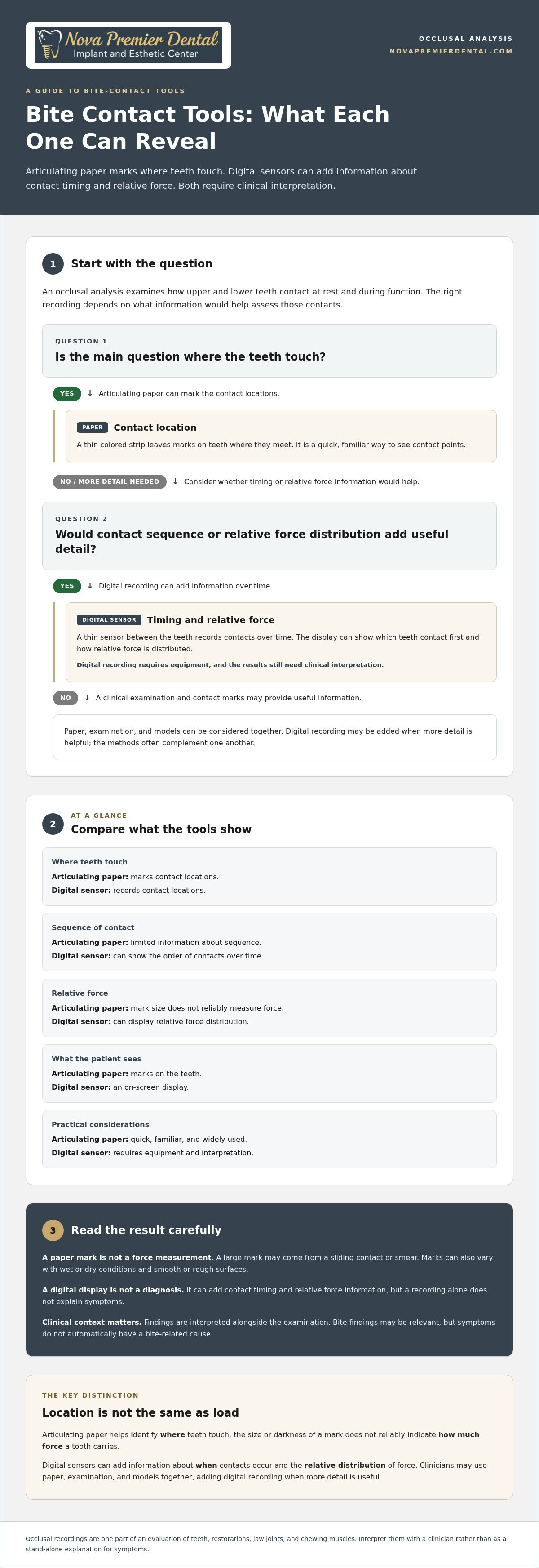
Articulating paper is the traditional tool. It is a thin colored strip that marks the teeth where they touch. Digital systems use a thin sensor placed between the teeth to record contact over time. Each has strengths and limits, as summarized below.
| Feature | Articulating paper | Digital sensor recording |
|---|---|---|
| Shows where teeth touch | Yes | Yes |
| Shows sequence of contact | Limited | Yes, recorded over time |
| Shows relative force | Not reliably; mark size does not equal force | Displays relative force distribution |
| Visual for patient education | Marks on teeth | On-screen display |
| Practical use | Quick, familiar, widely used | Requires equipment and interpretation |
In practice the methods complement each other. Skilled clinicians use paper, clinical examination, and models together, and add digital recording when more detail is helpful. Digital data still require clinical interpretation, because a recording does not by itself explain symptoms.
Nova Premier Dental has not provided a specific digital occlusal device for this article, so we do not name one here. If you are curious which tools are used during your visit, ask at your consultation.
The Limitations of Articulating Paper
The size and darkness of a mark can be misleading. A large mark may reflect a sliding contact or a smear rather than a heavy load, and the same biting force can leave different marks on dry versus wet or on smooth versus rough surfaces. Paper also records a contact, not the order in which contacts occurred, and it cannot quantify the load a tooth carries during chewing. Paper remains useful, particularly in experienced hands, but its findings should be interpreted as location information rather than force measurement.
Benefits of Digital Bite Analysis
Where digital recording is used, it can add objective information to a patient's description of how the bite feels. It can show which teeth contact first, how force is distributed across the arch, and whether the pattern changes after an adjustment. Seeing the display can also help patients understand the findings. Some clinicians find it helpful when finishing new restorations, though the effect on the number of adjustment visits will vary by case.
When Is Occlusal Analysis Important? Implants and Reconstruction
Occlusal evaluation is part of planning whenever teeth are restored or replaced in a way that changes how the bite fits together. It is especially relevant for dental implants, full-mouth rehabilitation, and cosmetic restorations in patients who clench or grind.
The Critical Role in Dental Implant Success
Natural teeth are suspended in bone by the periodontal ligament, which allows slight movement and provides sensory feedback. Dental implants are anchored directly to bone (osseointegration) and do not have this ligament, so they cannot cushion or sense load in the same way. Because of this, implant crowns are commonly adjusted to light contact in some positions, and the load is shared across the arch.
Excess occlusal load is discussed in the literature as one of several factors that may contribute to prosthetic complications such as loose screws, fractured porcelain, and in some cases bone changes around implants. Other factors include implant position, hygiene, gum health, smoking, and prosthesis design. It is helpful to separate two outcomes: survival of the implant fixture in bone, and the longevity of the crown, bridge, or denture attached to it, which may need repair or replacement over time. For more on this topic, see why an implant crown may come loose, common causes of implant restoration failure, and our dental implants page.
For multi-unit restorations such as full-arch fixed prostheses, planning includes how contacts are distributed across the whole prosthesis. Implants should be reviewed periodically, and the bite is typically checked at routine maintenance visits, since teeth shift and restorations wear. The right interval depends on the individual.
Full Mouth Rehabilitation and TMJ
When many teeth are restored at once, the clinician designs the new bite contacts, tooth positions, and restorative space as part of one plan. This may involve assessing vertical dimension and the relationship of the jaws. Our overview of oral reconstruction and the article what full mouth reconstruction involves describe this process.
Jaw joint findings are evaluated alongside tooth contacts, but the relationship between occlusion and temporomandibular disorders is complex and not a simple cause and effect. Many TMJ conditions are managed with conservative measures first. Custom night guards are sometimes used to protect teeth in people who clench or grind and may reduce muscle symptoms for some, though responses vary; see our guide to custom night guards.
Porcelain veneers and crowns can chip when subjected to heavy parafunctional forces (clenching or grinding), so a bite assessment and often a protective appliance are part of planning those restorations.
When a Prosthodontist's Evaluation May Be Helpful
General dentists provide important preventive and restorative care and appropriately perform many bite evaluations, crowns, bridges, and implant restorations. Prosthodontics is a recognized dental specialty with additional training in restoring and replacing teeth and in managing complex restorative cases, including occlusion and jaw relationships. Specialist evaluation may be worth considering when:
- Restorations repeatedly fracture, loosen, or wear without a clear reason.
- Many teeth need restoration at once, or the bite height may have changed because of severe wear.
- Implants are planned for multiple teeth or a full arch.
- Jaw symptoms accompany significant tooth wear and a second opinion would help clarify options.
Specialist care does not guarantee a better outcome than care from another qualified dentist, and not every patient needs it. A second opinion can simply provide another diagnostic perspective. You can read more about prosthodontic care in Northern Virginia, or about unstable occlusion and vertical dimension loss.
What to Expect at an Occlusal Evaluation
The following steps outline a typical evaluation. The exact components depend on your symptoms and history.
- History: symptoms, prior dental work, grinding or clenching habits, and any jaw or headache complaints.
- Clinical examination: assessment of tooth wear, cracks, mobility, gum condition, and palpation of the jaw muscles and joints.
- Bite recording: contacts are checked with articulating paper and, when indicated, recorded with other methods such as impressions, scans, or models.
- Review of findings: Dr. Huang explains what was found, which findings are likely relevant to your concerns, and what remains uncertain.
- Options: these may range from monitoring, to minor adjustment or replacement of a restoration, to a night guard, to more extensive restorative treatment.
Whether insurance covers occlusal evaluation depends on your plan; our dental insurance and benefits page has more information. Nova Premier Dental offers in-house payment plans for qualifying patients, allowing treatment costs to be paid over several months.
If you have questions about a complex restorative or prosthodontic concern, Nova Premier Dental in Falls Church provides prosthodontic specialty care for patients throughout Northern Virginia. You can contact the office to arrange a consultation.
Frequently Asked Questions
Is an occlusal analysis painful?
No. It is non-invasive and does not involve needles. You may be asked to bite on thin paper or a sensor, and the jaw muscles are gently pressed to check for tenderness. If those areas are already sore, palpation may feel uncomfortable.
How long does an occlusal analysis take?
The time varies with the complexity of the case and the methods used. A basic bite check can be part of a routine exam, while a more detailed evaluation takes longer. The office can tell you what to expect when scheduling.
Will my dental insurance cover an occlusal analysis?
Coverage differs between plans, and some include bite evaluation within a comprehensive exam. Check with your insurer and the office before the visit.
Can a bad bite cause chronic headaches or ear pain?
Headaches and ear pain have many possible sources, including muscle tension, jaw joint disorders, and conditions unrelated to the teeth. Some people with clenching or jaw muscle pain report headache, and bite evaluation can be part of sorting out contributors, but a bite discrepancy should not be assumed to be the cause. Persistent headaches or ear pain should be evaluated by a physician as well.
What is the difference between an occlusal analysis and a regular dental exam?
A routine exam screens for decay, gum disease, and oral cancer, and usually includes a basic check of how the teeth fit. An occlusal analysis looks more closely at contact patterns, wear, tooth movement, and muscle and joint findings, often to plan or troubleshoot restorative treatment.
How often should my bite be re-evaluated after getting implants?
There is no single interval for everyone. Bite contacts on implant restorations are usually reviewed at routine maintenance visits, and sooner if you notice a loose crown, chipping, or a change in how your teeth fit.
Can an occlusal analysis help with teeth grinding (bruxism)?
It can document wear patterns and identify contacts that may affect restorations, and it informs the design of a night guard. Bite adjustment is not a proven way to stop grinding, which is influenced by factors such as stress and sleep. See our article on bruxism treatment.
What happens if I choose not to treat a malocclusion?
Many malocclusions cause no problems and need no treatment. When wear, fractures, or discomfort are present, they may progress over time, but progression varies and is not inevitable. Monitoring with periodic exams is a reasonable option in some cases.
Disclaimer
The information provided on this website and blog is intended for general educational and informational purposes only and should not be considered dental or medical advice, diagnosis, or treatment. Reading content on this website does not establish a doctor-patient relationship with Nova Premier Dental or Dr. Peterson Huang. Dental conditions and treatment needs vary from patient to patient. Individuals should consult directly with a qualified dental professional for personalized evaluation, diagnosis, and treatment recommendations. Do not delay seeking professional dental care based on information found on this website. While we strive to provide accurate and up-to-date information, no guarantee is made regarding the completeness, accuracy, or applicability of the content. Treatment outcomes may vary depending on individual circumstances. If you are experiencing a dental emergency or urgent oral health concern, please contact a licensed dental professional immediately or call 911 in the event of a medical emergency.


