


Article by
Peterson Huang DMD, MS, FACP, FRCDC
Dr. Peterson Huang is a dual board-certified prosthodontist serving Falls Church and Northern Virginia. He has been recognized as a Top Prosthodontist by Northern Virginia Magazine and Arlington Magazine and is affiliated with the Inova Fairfax Hospital Tumor Board. Dr. Huang focuses on dental implants, full mouth reconstruction, and complex restorative dentistry for patients who need advanced, comprehensive care.
Treatment sequencing is the planned order in which the steps of a full mouth reconstruction are carried out. The planning and diagnostic work done before any restorative procedure shapes the rest of care, and patients often ask why several separate stages are needed. This article explains the clinical reasoning behind each stage. Nova Premier Dental is a private prosthodontic specialty practice in Falls Church serving Northern Virginia.
Treatment sequencing means completing disease control and healing before final restorations are made, so that each step rests on a stable base. A prosthodontist in Northern Virginia is a dentist who has completed additional specialty training in restoring and replacing teeth. Peterson Huang, DMD, MS, FACP, FRCDC, is dual board certified in prosthodontics in the United States and Canada. This guide describes how a reconstruction is typically phased, the limits of any timeline, and how payment is handled. Nova Premier Dental offers in-house payment plans for qualifying patients, allowing treatment costs to be paid over several months.
Key Takeaways
- Treatment sequencing is the planned order of care, so that each procedure is coordinated with the overall treatment plan.
- Disease control and healing of the foundation (gums, bone and remaining teeth) are generally addressed before functional and cosmetic restorations.
- Reconstruction is commonly described in three phases: disease control and stabilization, functional reconstruction, and final restoration with maintenance.
- Rushing healing or skipping steps may increase the risk of complications such as restoration fracture, implant problems or discomfort. Risk varies by patient.
- Nova Premier Dental offers in-house payment plans for qualifying patients, allowing treatment costs to be paid over several months.
What is Treatment Sequencing in Advanced Restorative Dentistry?
Treatment sequencing is the order in which restorative steps are performed so that disease control, healing and bite planning come before final restorations. It differs from treating individual teeth one at a time as problems arise. When a patient needs a comprehensive reconstruction of an entire dental arch, the procedures are planned together. Sequencing coordinates each crown, implant or veneer with the overall plan.
Treating teeth individually is often appropriate and is the usual approach for limited problems. When many teeth are involved, a broader evaluation of gums, bone, bite and jaw joints helps predict how a change in one area may affect another. Planning the whole mouth together can reduce the need for revisions, although it cannot eliminate them.
Prosthodontists complete additional specialty training focused on restoring and replacing teeth and managing complex restorative problems. A prosthodontist in Northern Virginia may lead the plan for complex cases, accounting for biology, mechanics and appearance, and may coordinate with general dentists and other specialists such as periodontists and oral surgeons.
The Biological Rationale for Phased Care
Bone remodeling and soft tissue healing take time and cannot be safely hurried. If treatment sequencing is rushed, final restorations may be placed on tissue that is not yet stable. This may contribute to problems such as implant failure or gum recession. Controlling infection and gum disease is generally the first step in a restorative timeline, because a healthy foundation supports better outcomes.
Mechanical Harmony and Bite Alignment
Appearance matters, but so does function. Before permanent crowns or bridges are made, the clinician evaluates the bite (occlusion), the jaw joint and the chewing muscles. If symptoms of TMJ and jaw joint disorders are present, they are usually evaluated early, since unmanaged forces may contribute to restoration wear or fracture. The evidence linking bite changes to jaw symptoms is limited and varies by patient. Diagnostic wax-ups and temporary restorations are often used to test the proposed bite before final restorations are made. Patients who grind or clench (bruxism, or parafunction) may need a protective appliance, and restorations of any type may eventually need repair or replacement.
How Prosthodontists Plan a Treatment Timeline
Planning a sequence for rebuilding and/or replacing all of the teeth usually begins with a detailed exam, radiographs, digital imaging and 3D scans. This stage maps the condition of the teeth, the bone, the nerve pathways and the jaw relationship, not only visible damage. Dr. Peterson Huang completed specialty training in prosthodontics and holds board certification through the American Board of Prosthodontics and the Royal College of Dentists of Canada. The findings help anticipate possible complications and adjust the treatment sequencing, though not every complication can be predicted.
Each patient arrives with a different clinical history, so plans are individualized. During case presentation at the Falls Church office, the clinician explains the reason for each phase, the alternatives, and the limitations of the proposed treatment, so that patients can decide with full information.
Diagnostic Integration and Technology
Cone-beam CT (CBCT) is a 3D X-ray used to assess bone volume and anatomy before bone grafting or placement of dental implants. Digital smile design is a planning tool that previews a proposed result, though the final result may differ. Patients take part in setting priorities, and the timeline is adjusted to clinical needs and personal circumstances.
When Specialist Evaluation Is Indicated
Specialist evaluation may be appropriate for cases involving many missing or worn teeth, previous restoration failures, jaw joint symptoms, or the need to coordinate several providers. In these cases the prosthodontist may help coordinate the sequence among the clinicians involved. If a proposed plan from any provider seems unclear, a second opinion is a reasonable step. To discuss your situation, you can schedule a consultation at our practice.
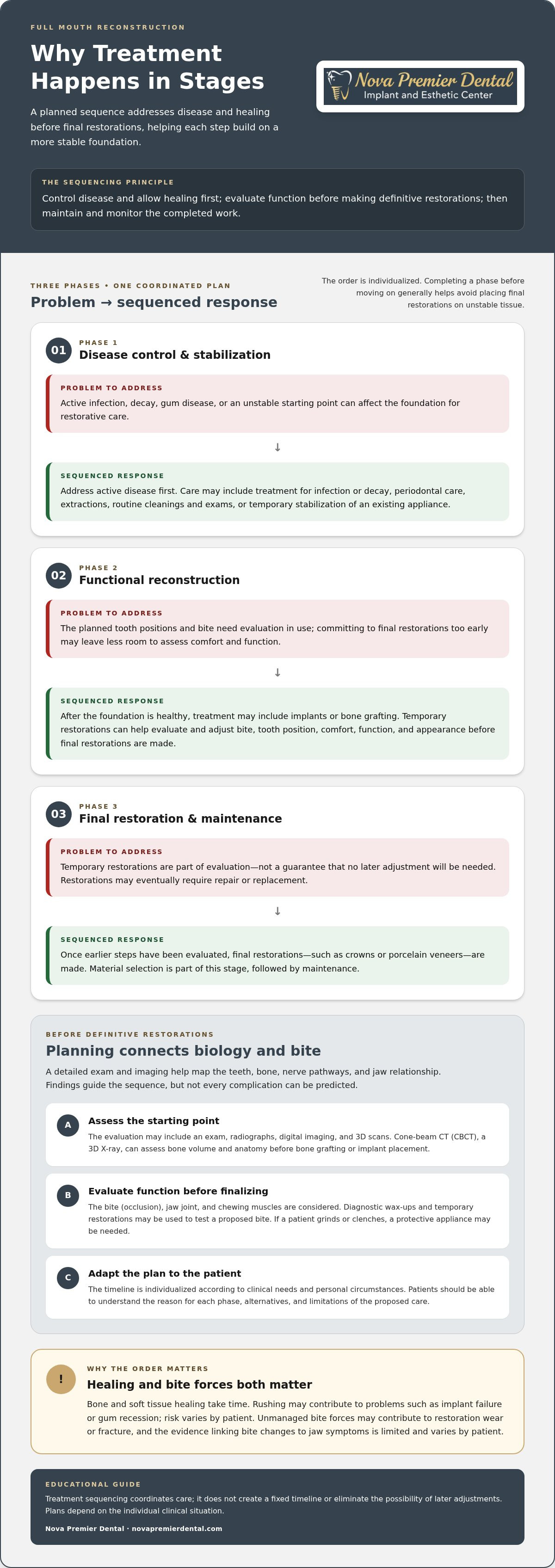
The Three Phases of a Dental Treatment Sequence
A full mouth reconstruction is usually divided into three phases: disease control and stabilization, functional reconstruction, and final restoration with maintenance. Approaches to sequencing the treatment plan vary, but completing each phase before the next generally reduces the risk of placing final restorations on unstable tissue.
Phase 1: Disease Control and Stabilization
The first phase addresses active disease, such as infection, decay and periodontal (gum) disease. It may involve extractions and routine cleanings and exams to reduce bacterial load. Patients with existing appliances may need emergency denture repair or temporary stabilization while preparation continues.
Phase 2: Functional Reconstruction
Once the foundation is healthy, the functional phase begins. It may include placing dental implants or bone grafting to replace lost volume. Provisional (temporary) restorations are often worn so the bite and tooth position can be evaluated and adjusted before final restorations are made. This helps identify problems with comfort, function and appearance, but it does not guarantee that no later adjustment will be needed.
Phase 3: Final Restoration and Maintenance
In the final phase, materials are chosen for the final crowns or porcelain veneers based on strength, wear and appearance. The bite (occlusion) is checked and adjusted. A maintenance schedule follows, including professional cleanings, bite checks and, when needed, a night guard. Implants and the restorations on them are different: an implant may remain in function for many years, while crowns, bridges and attachments may need repair or replacement over time. Longevity varies with oral hygiene, bite forces and overall health.
Why Order Matters: The Risks of Rushing Complex Care
Skipping or shortening steps may increase the risk of complications. If healing is incomplete when restorations are placed, problems such as broken porcelain, loose implant components or discomfort may occur and may require retreatment.
Bite forces matter as well as biology. If permanent teeth are placed before jaw symptoms are evaluated, excess force may contribute to restoration fracture, and jaw or muscle symptoms may need TMJ therapy. The causes of jaw pain are often multifactorial, so a dental restoration is not assumed to be the cause. Implants need time to integrate with bone (osseointegration) before they bear chewing forces, and the length of time varies by patient and site. Loading an implant too early may increase the risk of failure.
Cost Considerations of Rushed or Incomplete Planning
Retreatment can add cost and time, though the amount varies widely by case. Completing diagnosis and stabilization first may reduce the chance of revisions. Nova Premier Dental offers in-house payment plans for qualifying patients, allowing treatment costs to be paid over several months.
To discuss a comprehensive evaluation with Dr. Peterson Huang, contact our Falls Church office.
What to Expect at Nova Premier Dental
Choosing a full mouth reconstruction is a significant decision affecting health and daily function. Nova Premier Dental is a private prosthodontic specialty practice in Falls Church serving Northern Virginia. Understanding the treatment sequencing for your case, including its risks and alternatives, helps you take part in decisions about your care.
Each phase is explained so patients know the expected length and nature of treatment. Care is led by a prosthodontist, a dentist with additional specialty training in complex restorative problems, who may coordinate with your general dentist and other specialists.
In-House Payment Plans for Phased Care
Because treatment is phased, costs are spread across the stages of care. Nova Premier Dental offers in-house payment plans for qualifying patients, allowing treatment costs to be paid over several months.
Payment plans may make it easier to begin foundational work without delay. Eligibility and terms are discussed during the consultation.
The First Consultation
Care begins with a prosthodontic consultation. Dr. Peterson Huang will conduct an evaluation, which may include imaging, to begin collecting diagnostic information. The visit is an opportunity to discuss your goals and questions, and to review before and after cases. Individual results vary.
Whether you have a single complex problem or need a full-arch restoration, the consultation helps define options and limitations. You can learn more about the practice on our homepage or read about Dr. Huang's training and credentials.
Summary: Why Sequencing Matters in Full Mouth Reconstruction
Sequencing a full mouth reconstruction means treating disease and allowing healing before final restorations are made. This approach may lower the risk of complications from rushed procedures, but it cannot eliminate them, and restorations may need maintenance or replacement over time.
Nova Premier Dental provides complex oral reconstruction at its Falls Church office. Peterson Huang, DMD, MS, FACP, FRCDC, is dual board certified in prosthodontics in the United States and Canada. Nova Premier Dental offers in-house payment plans for qualifying patients, allowing treatment costs to be paid over several months.
Schedule a consultation with Dr. Huang to discuss your treatment options.
Frequently Asked Questions
How long does a typical treatment sequence for a full mouth reconstruction take?
The duration varies with case complexity and healing. Reconstruction commonly takes several months and in some cases more than a year, depending on factors such as bone grafting or implant integration. Dr. Huang monitors progress at our Falls Church office so each phase is evaluated before the next begins. Timelines are estimates and may change.
Can I skip the bone grafting phase if I want my implants sooner?
Bone grafting is only done when it is clinically indicated, and skipping it when needed may increase the risk of implant complications. Implants need adequate bone volume to remain stable under chewing forces. Your clinician evaluates bone with imaging and discusses alternatives, such as shorter implants or different designs, along with their limitations.
Will I be without teeth during the different phases of my treatment?
Provisional restorations are generally used so that you have teeth during treatment. These temporary teeth function as placeholders while implants heal or final crowns are made, and they help maintain appearance and basic function. Temporary teeth may be less comfortable or less strong than final restorations, and some patients have limits on what they can eat.
Why do I need a specialist like a prosthodontist to sequence my dental work?
Prosthodontists complete additional specialty training focused on restoring and replacing teeth and managing complex restorative problems. Dr. Peterson Huang completed specialty training in prosthodontics and holds board certification through the American Board of Prosthodontics and the Royal College of Dentists of Canada. Many general dentists also provide excellent restorative care, and complex cases are often managed jointly between general dentists and specialists.
Is it possible to change the sequence once the treatment has already started?
The sequence can be changed when clinical findings require it, though major changes are discussed with you first. Timing may be adjusted based on healing, and the general progression from disease control to final restoration is usually maintained. Changing the order mid-treatment may affect the outcome of the reconstruction, so thorough planning is done at the start.
How does treatment sequencing affect the total cost of my dental implants?
Sequencing spreads the cost of dental implants across the stages of care rather than requiring a single payment. Total cost depends on the number of implants, grafting, restorations and other factors, and is reviewed during the consultation. Retreatment can add cost, so careful planning may help avoid some repeat procedures.
What happens if a biological phase (like bone healing) takes longer than expected?
If a phase such as bone healing takes longer than expected, the timeline for that stage is extended. Restorative work generally begins once the foundation is clinically stable. Incomplete healing is one factor that may contribute to implant complications, which is why each phase is evaluated before moving on.
Are there in-house payment options to help with the cost of sequenced care?
Nova Premier Dental offers in-house payment plans for qualifying patients, allowing treatment costs to be paid over several months.
Disclaimer
The information provided on this website and blog is intended for general educational and informational purposes only and should not be considered dental or medical advice, diagnosis, or treatment. Reading content on this website does not establish a doctor-patient relationship with Nova Premier Dental or Dr. Peterson Huang. Dental conditions and treatment needs vary from patient to patient. Individuals should consult directly with a qualified dental professional for personalized evaluation, diagnosis, and treatment recommendations. Do not delay seeking professional dental care based on information found on this website. While we strive to provide accurate and up-to-date information, no guarantee is made regarding the completeness, accuracy, or applicability of the content. Treatment outcomes may vary depending on individual circumstances. If you are experiencing a dental emergency or urgent oral health concern, please contact a licensed dental professional immediately or call 911 in the event of a medical emergency.


