

Article by
Peterson Huang DMD, MS, FACP, FRCDC
Dr. Peterson Huang is a dual board-certified prosthodontist serving Falls Church and Northern Virginia. He has been recognized as a Top Prosthodontist by Northern Virginia Magazine and Arlington Magazine and is affiliated with the Inova Fairfax Hospital Tumor Board. Dr. Huang focuses on dental implants, full mouth reconstruction, and complex restorative dentistry for patients who need advanced, comprehensive care.
Restoring the mouth or face after cancer, trauma, or a congenital condition can involve more than surgery. A maxillofacial prosthodontist plans oral or facial prostheses to replace missing structures and support functions such as speaking, eating, and swallowing. This care is coordinated with the patient’s broader treatment plan.
It’s natural to have questions about who provides prosthetic care and how it fits with reconstructive surgery. A prosthodontist focuses on restoring oral and facial structures, while surgical and oncology teams address other parts of treatment.
This article explains how prosthetic rehabilitation may help after cancer treatment or injury, describes options for oral and facial changes, and clarifies how this specialty differs from general prosthodontic care.
Key Takeaways
- Prosthetic rehabilitation can be coordinated with cancer, trauma, or congenital-condition care.
- Device selection depends on the affected anatomy, the intended function, and available support.
- Retention methods have different care and maintenance considerations that belong in treatment planning.
- Specialist evaluation may help clarify complex restorative needs and coordination with the broader care team.
Dental oncology care for cancer, trauma, and congenital malformations
A prosthodontist may evaluate oral rehabilitation needs before cancer treatment if surgery is expected to affect the teeth, jaws, or nearby structures. Early planning gives the care team a chance to discuss how these changes may affect chewing, speech, swallowing, and future dental treatment. Patients can also be evaluated after surgery, when healing reveals specific functional or restorative needs.
Treatment planning considers the affected tissue, remaining teeth, jaw anatomy, and cancer-care sequence. For example, an obturator may help close an opening between the mouth and nasal cavity after surgery. Its design and support depend on the opening’s location and which structures remain. This differs from a prosthesis that replaces an external facial feature.
Trauma can create a different set of restorative challenges. A patient with damaged teeth and altered jaw anatomy may need treatment staged around healing. Planning considers the teeth available for support, bite forces, and the space needed for replacement teeth. Maxillofacial prosthodontic care can be coordinated with surgical treatment when prosthetic needs relate to an injury or reconstruction.
Congenital conditions, including cleft palate, may affect oral structures and functions such as eating and speaking. Prosthetic treatment can be considered alongside surgery and other specialist care, with its design guided by the patient’s anatomy and stage of treatment. For oral cancer patients, consultation before planned treatment can identify prosthetic concerns, while evaluation after surgery can address needs that become clearer during healing.
Dental anxiety affects many people. In the United States, practicing oral and maxillofacial surgery requires a professional dental degree; a medical qualification may also be pursued during residency. This distinction can be relevant when patients discuss who will provide their surgical care.
Recovery from maxillofacial surgery for extractions or dental implants may last a week or two. Oral and maxillofacial surgeons may use bone grafting to rebuild and stabilize the jawbone when placing dental implants. In specialized centers such as عيادات دنتكس لطب الأسنان, clinicians coordinate these advanced reconstructive steps so patients can understand how surgical care and implant placement fit directly into long-term prosthetic planning.
Head and neck cancers
Head and neck cancer treatment can change the oral cavity, jaw, or facial structures. Surgery may remove diseased tissue, while reconstructive procedures can restore or reshape affected areas. A maxillofacial prosthodontist focuses on prosthetic rehabilitation, coordinating with surgical and oncology teams based on the patient’s anatomy and treatment sequence.
Timing matters. Before surgery, the team can discuss expected changes and identify restorative concerns, such as how tissue removal may affect oral function or future prosthesis support. After surgery, the prosthodontist evaluates the healing anatomy, remaining teeth, and available space. This assessment helps determine whether a device can be used during recovery or whether definitive prosthetic treatment should wait until the surgical site is more stable.
Radiation and other cancer treatments may affect the oral environment and the timing of dental procedures. The care team considers these factors before planning restorations or implant treatment. For example, an implant plan depends on the jaw’s condition, the proposed implant’s location, and coordination with cancer treatment. Trauma history, previous surgery, and changes in mouth opening can also affect access, impressions, and prosthesis design. Planning must address function and maintenance, not just appearance.
Prosthetic care is collaborative and does not replace cancer treatment. The oncologist manages the cancer plan, and the surgeon addresses operative and reconstructive needs. The prosthodontist contributes expertise in replacing or supporting oral and facial structures. Orthognathic surgery, which repositions the jaws, serves different purposes and is considered separately when jaw alignment affects function. A patient’s care plan reflects the diagnosis, anatomy, healing, and treatment goals, rather than following one standard sequence.
For patients considering prosthetic rehabilitation after head and neck cancer, a focused evaluation can clarify restorative needs and coordination with the broader team. Learn about maxillofacial prosthodontic care and the questions it may address during recovery.
Intraoral and extraoral maxillofacial prosthetics
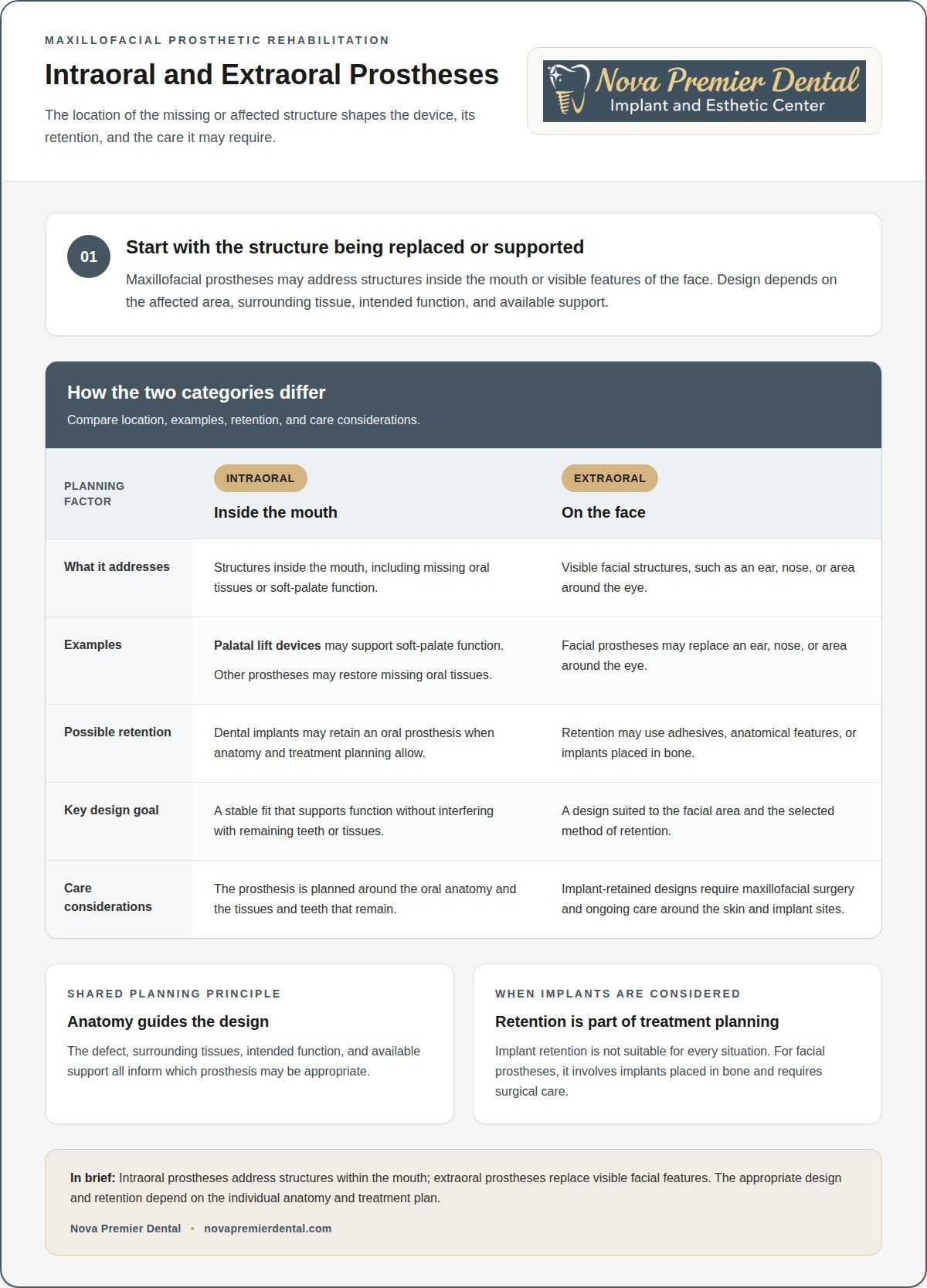
Maxillofacial prostheses replace or support structures inside the mouth or on the face. Their design depends on the defect, surrounding tissue, and intended function.
Intraoral and extraoral devices
Intraoral prostheses address structures inside the mouth. Examples include palatal lift devices that support soft-palate function and prostheses that restore missing oral tissues. Dental implants may retain an oral prosthesis when anatomy and treatment planning allow. The clinical goal is a stable fit that supports function without interfering with remaining teeth or tissues.
Extraoral facial prosthetics replace visible structures, such as an ear, nose, or area around the eye. Retention may rely on adhesives, anatomical features, or implants placed in bone. Unlike removable devices held by facial contours, implant-retained designs require maxillofacial surgery and ongoing care around the skin and implant sites.
Coverage and Costs for Facial Prosthetics
Insurance coverage for oral or facial prosthetics depends on the policy, diagnosis, and treatment details. Medicare coverage also depends on the specific service and circumstances. No single coverage rule applies to every patient.
There is no single cost for these prostheses in the United States. Design, materials, clinical complexity, and whether implant surgery is involved all affect the treatment plan and expense. Reviewing coverage matters because the prosthesis, surgical care, and follow-up may be handled differently.
Finding a Board-Certified Specialist
A board-certified maxillofacial prosthodontist has relevant prosthodontic certification and focused experience in oral or facial rehabilitation. To find one nearby, search for prosthodontists with maxillofacial training, then verify the stated board certification with its certifying organization.
Ask whether the specialist treats needs like yours, such as an intraoral defect after cancer surgery or an external prosthesis after trauma. Coordination with the surgical team also matters, particularly if treatment includes implants or reconstructive procedures.
Risks and limitations of implant-retained facial prostheses
Implant-retained facial prostheses require surgery. Potential concerns include infection, irritation, implant loss, or difficulty keeping the surrounding skin clean. Healing, bone condition, and implant location affect whether this retention method is suitable.
The prosthesis itself may need adjustment or replacement as fit and appearance change. Skin care, cleaning around attachment points, and regular clinical reviews help identify problems early. An implant-retained device may provide secure retention, but it cannot restore sensation or replace the function of every missing structure.
What is the difference between a maxillofacial prosthodontist and a general prosthodontist?
A prosthodontist is a dental specialist trained to restore and replace teeth and related oral structures. A maxillofacial prosthodontist applies that training to complex defects involving the mouth, jaws, or face, often after cancer treatment, trauma, or a congenital condition.
The main difference is the focus of care. General prosthodontic treatment can include crowns, bridges, dentures, and implant-supported teeth. Maxillofacial prosthodontic care addresses needs such as an obturator after oral tissue removal, a facial prosthesis, or a device that supports speech or swallowing. Some prosthodontists pursue additional focused training and experience in this area.
These roles can overlap. A patient with missing teeth after jaw surgery may need both conventional tooth replacement and a prosthesis adapted to altered anatomy. Planning considers the bite, available restorative space, tissue condition, and how the device will stay secure. The prosthodontist coordinates with surgeons and oncology clinicians when treatment affects oral or facial structures.
Board certification and specialty training are not interchangeable labels. Prosthodontics is a recognized dental specialty, while maxillofacial prosthodontics describes a focused area of prosthodontic care. Patients can ask about a clinician’s prosthodontic credentials, experience with their condition, and collaboration with the relevant surgical team. A general dentist also provides important preventive and restorative care and can coordinate a referral when a case requires specialized prosthetic planning.
For tooth replacement or reconstruction after complex dental changes, a prosthodontist evaluates how the proposed restoration fits the patient’s overall oral health and function. Learn about prosthodontic specialty care and the concerns it addresses.
Maxillofacial surgery is generally performed under general anesthesia, so the patient sleeps through the procedure. This surgical care is distinct from the prosthetic planning that follows.
Nova Premier Dental
Nova Premier Dental provides prosthodontic care for patients with complex restorative needs, including dental changes following cancer treatment, trauma, or congenital conditions. When rehabilitation involves replacing teeth or rebuilding the bite, treatment may include dental implants, crowns and bridges, complete or partial dentures, or full mouth reconstruction. The right approach depends on the remaining teeth, oral tissues, bite, and overall treatment sequence.
For patients considering maxillofacial rehabilitation, an evaluation can clarify which restorative needs prosthodontic treatment may address and how they relate to the broader care plan. Dr. Peterson Huang is a dentist and dual board-certified prosthodontist, with prosthodontic certifications in the United States and Canada.
Contact Nova Premier Dental to discuss your restorative or prosthodontic questions.
Plan your next restorative conversation
A useful next step is to identify the change affecting you most, such as difficulty speaking, chewing, or keeping a prosthesis comfortably in place. Discuss that concern alongside your treatment goals, timing, and how dental rehabilitation fits with your broader care. A maxillofacial prosthodontist can clarify prosthetic considerations and coordinate restorative planning with other members of your care team.
The right approach depends on your anatomy, treatment history, healing, and functional priorities. You can use those factors to guide a focused conversation rather than feeling you need to decide on a specific device beforehand. If you have questions about restorative care, contact Nova Premier Dental to discuss your concerns.
Clear information can make your next conversation more useful and help you consider your options with confidence.
Frequently Asked Questions
What does a maxillofacial prosthodontist do?
A maxillofacial prosthodontist plans and provides prosthetic rehabilitation for complex changes involving the mouth, jaws, or face. This work can include assessing how a device relates to remaining teeth, speech, and facial movement. For example, a patient with altered jaw anatomy may need a prosthesis designed around the available support, rather than conventional tooth replacement alone.
How do maxillofacial prosthodontists help patients with oral cancer?
Maxillofacial prosthodontists help address dental and prosthetic needs affected by oral cancer and its treatment. A practical part of care is documenting the patient’s oral condition and discussing functional concerns with the oncology and surgical teams. This helps clarify which restorative issues need attention, how treatment stages affect prosthesis planning, and what follow-up care may be relevant after treatment.
What types of facial prostheses are available after cancer surgery or trauma?
Options can include prostheses that replace an external ear, nose, or area around the eye, as well as devices that restore oral structures. The right type depends on the location and extent of tissue loss, available support, and the patient’s functional and aesthetic goals. Some devices are removable and retained with adhesive or anatomy; others may use implants for retention.
How are facial prosthetics made, fitted, and maintained?
Care begins with evaluating the affected area and choosing a design suited to the patient’s anatomy and needs. Creating highly accurate, custom anatomical models often mirrors modern rapid prototyping methods; advanced engineering resources like formaqam.com.au showcase how 3D scanning, CAD design, and 3D printing support custom physical fabrication. The fitting process assesses stability, comfort, appearance, and movement during activities such as speaking or making facial expressions. Follow-up visits allow the clinician to assess fit and retention. Patients receive individualized instructions for cleaning the prosthesis and caring for nearby skin or attachment sites.
Disclaimer
The information provided on this website and blog is intended for general educational and informational purposes only and should not be considered dental or medical advice, diagnosis, or treatment. Reading content on this website does not establish a doctor-patient relationship with Nova Premier Dental or Dr. Peterson Huang. Dental conditions and treatment needs vary from patient to patient. Individuals should consult directly with a qualified dental professional for personalized evaluation, diagnosis, and treatment recommendations. Do not delay seeking professional dental care based on information found on this website. While we strive to provide accurate and up-to-date information, no guarantee is made regarding the completeness, accuracy, or applicability of the content. Treatment outcomes may vary depending on individual circumstances. If you are experiencing a dental emergency or urgent oral health concern, please contact a licensed dental professional immediately or call 911 in the event of a medical emergency.


