


Article by
Peterson Huang DMD, MS, FACP, FRCDC
Dr. Peterson Huang is a dual board-certified prosthodontist serving Falls Church and Northern Virginia. He has been recognized as a Top Prosthodontist by Northern Virginia Magazine and Arlington Magazine and is affiliated with the Inova Fairfax Hospital Tumor Board. Dr. Huang focuses on dental implants, full mouth reconstruction, and complex restorative dentistry for patients who need advanced, comprehensive care.
Neither a screw-retained crown nor a cement-retained crown is best for every implant. These implant crown types differ in tissue considerations, restorative space, retrievability, and potential complications. The right choice depends on implant position, bite, and restoration design.
Both approaches can work well when planned around the implant and the patient’s needs. This article compares practical tradeoffs, including tissue risks, available space, maintenance access, and possible complications, to explain the reasoning behind a treatment recommendation.
Key Takeaways
- Compare crown retention by considering implant position, bite forces, tissue health, and available restorative space rather than choosing by appearance alone.
- Understand why careful cement placement and cleanup matter when a crown is cement-retained.
- Weigh the ease of retrieving a restoration for maintenance or repair against possible screw and component complications.
- Learn how the prosthetic screw secures a crown and why the access-channel location influences the final design.
Screw Retained Implant Crown vs Cement-Retained: Which is Best?
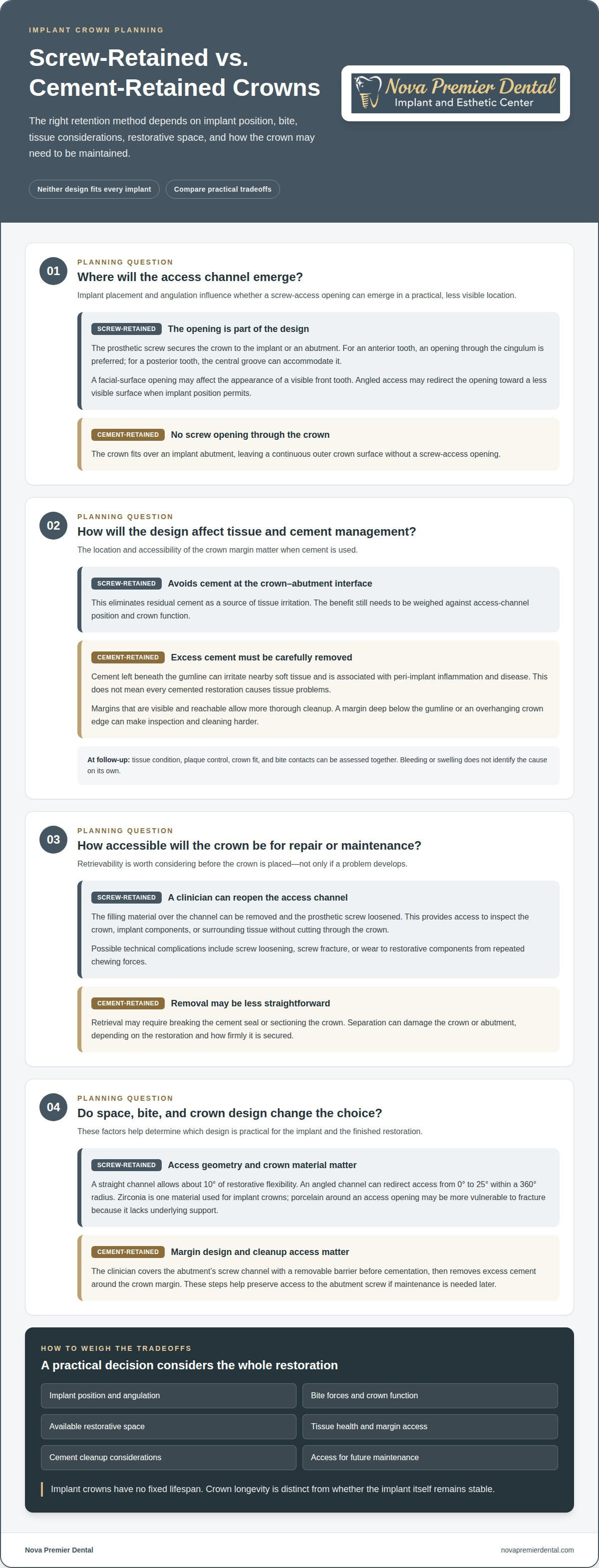
Neither retention method suits every implant. Key considerations include access-channel position, cement management, restorative space, and the appearance of the finished crown. Implant placement and angulation determine which designs are practical.
| Option | Access | Cement | Appearance |
|---|---|---|---|
| Screw-retained | Opening exits through a planned surface | No cement at the crown-abutment margin | Opening must be restored |
| Cement-retained | No crown screw opening | Excess must be removed | Continuous outer surface |
Screw-Retained Crown Access
A prosthetic screw secures this crown to the implant or an abutment. Implant placement affects where its access hole emerges. In an anterior tooth, an opening through the cingulum is preferred; in a posterior tooth, the central groove can accommodate it. A straight channel allows about 10 degrees of restorative flexibility. An angled channel can redirect access from 0° to 25° within a 360° radius.
Cement-Retained Crown Cement Clearance
This design fits over an implant abutment without an opening through the crown. Before cementation, the clinician covers the abutment’s screw channel with a removable barrier. After seating the crown, the clinician removes excess cement around the margin. These steps help preserve access to the abutment screw if maintenance is needed later.
Access Holes and Esthetics
An access hole emerging through the facial surface may affect the appearance of a visible front tooth. Angled access can redirect it toward a less visible surface when implant position permits. In a molar, an opening through the central groove can fit the biting surface. Zirconia is one material used for implant crowns; porcelain around an access opening may be more vulnerable to fracture because it lacks underlying support. Crown form and bite planning are part of implant crown design.
Choose the design by weighing implant angulation, access location, restorative space, cement cleanup, and esthetic priorities.
Residual cement and peri-implant tissue risks
With a cement-retained restoration, cement secures the crown to an implant abutment. Cement left beneath the gumline can irritate nearby soft tissue and is associated with peri-implant inflammation and disease. This does not mean every cemented restoration causes tissue problems, but it makes margin design and thorough cleanup important.
After seating the crown, the clinician removes excess cement and examines accessible margins. A margin that is easier to see and reach allows more thorough cleanup than one deep below the gumline. The restoration’s contour matters too: an overhanging edge can make the margin harder to inspect and clean during follow-up.
At follow-up visits, assessment includes the tissue around the implant, plaque control, crown fit, and bite contacts. Bleeding or swelling may prompt an examination of the crown margins for retained cement, as well as an evaluation of other possible causes. Symptoms alone do not identify the source, so the crown and surrounding tissue need to be assessed together.
Screw retention avoids cement at the crown-abutment interface, eliminating this particular source of residue. That benefit must be weighed against design considerations such as access-channel position and crown function. Cement retention may still be appropriate when margins are accessible and excess cement can be managed carefully.
With either design, ongoing maintenance includes monitoring the tissue and keeping the restoration clean. Persistent tenderness, bleeding, or swelling around an implant should be assessed by a dental professional. An examination can determine whether retained cement, plaque, a restorative issue, or another factor needs attention.
Retrievability and prosthetic complications
Implant crowns have no fixed lifespan. Material, bite forces, oral hygiene, and maintenance all play a role. Crown longevity is separate from whether the implant itself remains stable.
Screw-retained crowns are accessed through a sealed opening, while cement-retained crowns are secured to an abutment with cement. This difference affects how each restoration can be removed for repair.
Retrieval for Maintenance and Repairs
To retrieve a screw-retained crown, a clinician removes the filling material over its access channel and loosens the prosthetic screw. This allows the clinician to inspect the crown, implant components, or surrounding tissue before replacing the restoration. The design provides access for maintenance or repair without cutting through the crown.
A cement-retained crown may be harder to remove after cementation. Separation can damage the crown or abutment, depending on the restoration and how firmly it is secured. Position and margin design affect access, so retrieval should be considered before placement, not only after a complication arises.
Crown Placement and Repair
For screw retention, the crown is positioned over the implant or abutment, secured with a prosthetic screw, and the access opening is sealed. If repair or inspection becomes necessary, the clinician reopens that channel and removes the crown. Implant angulation influences where the opening emerges and how accessible it remains.
With cement retention, the crown is seated on an abutment with cement, and excess is removed from its margins. Retrieval may require breaking the cement seal or sectioning the crown, making repair less straightforward. The implant’s position and the restoration’s design affect which method provides practical access later.
Both methods have potential technical complications. Screw-retained restorations may experience screw loosening, screw fracture, or wear to restorative components from repeated chewing forces. Cement-retained restorations may be difficult to retrieve if the crown needs repair. Regular clinical assessment can identify changes in fit, bite contacts, or tissue condition before they complicate maintenance.
How does a screw-retained implant crown work?
A screw-retained implant crown connects to a dental implant with a prosthetic screw. The implant is a titanium post placed surgically in the jawbone; an abutment or titanium base may connect it to the crown. The crown is designed to fit that connection, with a channel through the restoration providing access to the screw.
Once the implant is ready to support a restoration, the clinician evaluates its position, angulation, and relationship to the opposing teeth. These details guide the crown’s shape and the access channel’s direction. For example, an opening through a back tooth’s biting surface can be covered after the screw is secured.
When delivering the crown, the clinician seats it on the implant or on a screw-retained abutment or titanium-base assembly. A prosthetic screw passes through the crown’s channel and engages the implant connection or abutment. The clinician secures the assembly, then seals the access hole with restorative material.
The seal closes the channel at the crown’s surface, but it is designed to be removable. If the crown needs inspection or repair, a clinician can remove the sealing material and access the screw. With cement retention, by contrast, cement holds the crown on an abutment instead of a screw fastening it through an access channel.
The access opening affects how the crown is made. Depending on the restoration’s material and design, the area around the opening may have less underlying support, so its thickness and the surrounding design matter. The clinician also considers how the crown contacts opposing teeth, since the opening and its repair material must fit within the functional surface.
A screw-retained restoration therefore brings together three planned elements: the implant connection, crown design, and access-channel position. It provides direct access to the screw for retrieval, while appearance and function depend on implant placement and restorative design. These factors explain why retention is part of the overall implant restoration plan, not an isolated preference.
Nova Premier Dental: Dental Implants
Nova Premier Dental evaluates implant position, bite relationships, tissue health, and restorative space when planning implant-supported crowns. These factors help determine whether screw or cement retention is suitable and how the crown can be maintained. For complex restorative needs, Dr. Peterson Huang, a dentist and dual board-certified prosthodontist in the United States and Canada, brings prosthodontic training to treatment planning. Evaluation may also consider how an implant crown fits with adjacent teeth or a broader reconstruction. If you have questions about implant placement or the design of an implant-supported crown, a specialist assessment can clarify the relevant options and tradeoffs. Contact Nova Premier Dental to discuss your dental implant concerns.
Plan for a Restoration That Fits Your Needs
Choosing among implant crown types, including a screw-retained crown and a cement-retained crown, is one part of planning tooth replacement. Next, consider how the restoration fits into your broader dental care, including its relationship to neighboring teeth, your bite, and other restorative needs. A crown may replace a single tooth or coordinate with a larger treatment plan.
Before deciding, consider what matters in daily care and what future maintenance may involve. A focused clinical discussion can relate those priorities to your oral health, implant position, and restorative goals. It can also clarify whether a single implant crown or a broader restorative approach is appropriate.
If you’re ready to discuss your options, contact Nova Premier Dental. A thoughtful next step can help you move forward with a plan that reflects your needs.
Frequently Asked Questions
What Are some Differences and Commonalities?
Both approaches secure a custom crown to an implant-supported foundation, but use different retention methods. The choice also depends on the restoration’s shape, the implant’s position, and the crown’s relationship to neighboring teeth. For example, a single front tooth has different visibility considerations from a back molar. In either case, the material and bite contacts need to suit the restoration.
What If I Still Want the Benefits of Cement?
Cement retention may be considered when a screw-access opening would interfere with the crown’s visible surface or preferred shape. It can provide a continuous outer surface, which may suit some designs. The tradeoff is that cement margins must allow access and cleanup. A treatment discussion can clarify whether these advantages fit the implant position and tissue conditions.
What types of crowns can be used on dental implants?
Implant crowns may be made from zirconia, porcelain fused to metal, or glass-ceramic materials. Each differs in strength, translucency, and design requirements. A highly visible front tooth may call for attention to natural-looking light transmission, while a molar must tolerate substantial chewing forces. The implant connection and retention method also affect which material designs are suitable.
How does a cement-retained implant crown work?
A cement-retained crown fits over an abutment attached to the implant. The clinician applies dental cement inside the crown, seats it on the abutment, and removes excess cement around the margins. The crown’s contour and margin position affect access for cleanup and future assessment. Unlike a screw-retained design, the crown itself has no screw opening for direct retrieval.
What are the advantages and disadvantages of screw-retained versus cement-retained implant crowns?
Screw retention offers direct access for removal, while cement retention avoids an opening through the crown’s outer surface. A posterior crown with a centrally located access channel may suit screw retention; an unfavorably positioned channel may affect appearance. Cement retention requires careful margin design and cement removal. Neither method is automatically preferable: implant position and restoration design determine the tradeoffs.
What are the risks of excess cement around an implant crown?
Excess cement near an implant crown can irritate surrounding tissue and is associated with peri-implant inflammation and disease. The concern is greater when cement collects below the gumline, where it can be harder to detect and remove. Persistent bleeding or swelling calls for dental assessment, but symptoms alone cannot establish the cause. An examination can assess the tissue and crown margins.
Disclaimer
The information provided on this website and blog is intended for general educational and informational purposes only and should not be considered dental or medical advice, diagnosis, or treatment. Reading content on this website does not establish a doctor-patient relationship with Nova Premier Dental or Dr. Peterson Huang. Dental conditions and treatment needs vary from patient to patient. Individuals should consult directly with a qualified dental professional for personalized evaluation, diagnosis, and treatment recommendations. Do not delay seeking professional dental care based on information found on this website. While we strive to provide accurate and up-to-date information, no guarantee is made regarding the completeness, accuracy, or applicability of the content. Treatment outcomes may vary depending on individual circumstances. If you are experiencing a dental emergency or urgent oral health concern, please contact a licensed dental professional immediately or call 911 in the event of a medical emergency.


