


Article by
Peterson Huang DMD, MS, FACP, FRCDC
Dr. Peterson Huang is a dual board-certified prosthodontist serving Falls Church and Northern Virginia. He has been recognized as a Top Prosthodontist by Northern Virginia Magazine and Arlington Magazine and is affiliated with the Inova Fairfax Hospital Tumor Board. Dr. Huang focuses on dental implants, full mouth reconstruction, and complex restorative dentistry for patients who need advanced, comprehensive care.
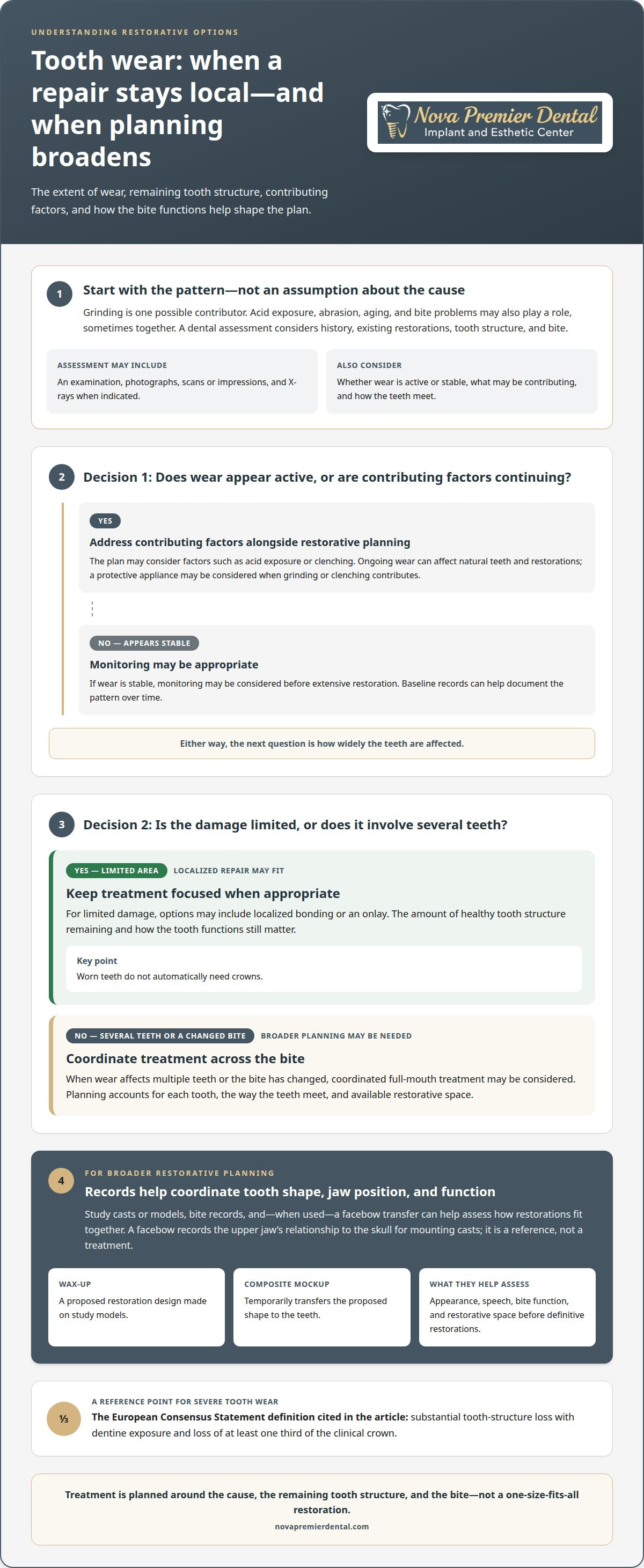
Severely worn teeth can often be rebuilt, but that doesn’t mean every tooth needs a crown. Depending on the damage, care may involve localized bonding or an onlay, or coordinated treatment across several teeth when the bite has changed. The plan considers how much healthy structure remains, how the teeth function together, and what may be contributing to the wear.
Grinding is one possible cause, but acid exposure and other factors can also wear teeth. An evaluation considers the pattern of damage, bite, existing restorations, and dental history. This article explains how wear is assessed, when targeted repairs may be suitable, and what broader restorative treatment can involve.
Key Takeaways
- Grinding is only one possible cause of tooth wear; acids, brushing habits, and bite problems may also contribute.
- A thorough assessment considers your dental history, existing restorations, bite, and records such as photographs, radiographs, or models.
- Study casts, bite records, and a facebow transfer can help plan how restorations fit together and relate to jaw position.
- Localized restorations may suit limited damage, while wear affecting multiple teeth may call for coordinated full-mouth treatment.
Are worn teeth always caused by grinding?
No. Tooth wear can result from grinding, acid erosion, abrasion, aging, or bite problems, and several causes may contribute at once. Restoring worn teeth may involve sensitivity, chips, or bite adjustments. Recovery depends on the number of teeth treated, the procedures involved, and whether temporary restorations are used.
Common Causes of Tooth Wear
Tooth wear is the gradual loss of enamel or dentine through chemical exposure or physical contact. Its pattern can help identify contributing factors. Grinding and clenching repeatedly load the teeth, flattening biting surfaces or causing small cracks. Acid erosion may follow frequent exposure to acidic foods or drinks, or reflux. Abrasion can result from aggressive brushing or using teeth to open packages. Wear may also accumulate with age, while an uneven bite can concentrate forces on certain teeth.
Identifying and Managing Wear Causes
A comprehensive evaluation combines your dental history, an examination, and baseline records to distinguish active wear from changes that have stabilized. The assessment may include diet, reflux symptoms, sleep habits, medications, previous dental treatment, and when the changes began. Photographs, scans or impressions, and X-rays when indicated document tooth condition and provide a basis for comparison. Management addresses contributing factors, such as acid exposure or clenching, alongside decisions about restorative care.
Signs that warrant evaluation include sensitivity, chipped edges, repeated filling or crown breakage, jaw fatigue, headaches, or a bite that feels different. A visible pattern alone doesn’t prove grinding is the only cause. The clinician also considers current occlusion, missing teeth, older restorations, and the stability of the bite. For broader damage, full-mouth rehabilitation planning may require records that show how teeth meet and how much structure remains.
Lost enamel does not biologically regenerate, so documenting the wear pattern helps guide monitoring and treatment. If wear is stable, monitoring may be appropriate before extensive restoration. If contributing factors continue, addressing them matters: ongoing acid exposure or grinding can affect both natural teeth and restorations. A protective appliance may be considered when clenching or grinding contributes to wear.
What is the best treatment for severe tooth wear?
The right treatment depends on the remaining tooth structure, bite stability, and whether the wear is active. An evaluation identifies likely causes and helps determine whether localized restorations or coordinated reconstruction can restore function.
There’s no single cost for treatment in the United States. The price depends on the teeth involved, procedures, materials, and staging, and is given after a quote request.
Dental insurance coverage varies by plan and proposed treatment. Before treatment begins, review your benefits for restorative care, exclusions, and any approval requirements.
Assessment and Diagnostic Records
A dental assessment combines an examination and diagnostic records to determine the extent and pattern of wear. Photographs, scans or models, radiographs when indicated, and a bite assessment help evaluate tooth structure, gums, restorations, and occlusion. The European Consensus Statement defines severe tooth wear as substantial tooth-structure loss with dentine exposure and loss of at least one third of the clinical crown. These findings guide treatment planning.
The evaluation also considers jaw position, muscles and joints, supporting bone, and whether decay, infection, gum disease, or erosion needs attention first. Bruxism, tooth prognosis, and available restorative space affect whether crowns or more conservative restorations are appropriate. If wear affects multiple teeth, coordinated full-mouth rehabilitation may involve staged care and assessment of vertical dimension, the relationship between the upper and lower jaws.
Wax-Ups and Composite Mockups
A diagnostic wax-up is a proposed restoration design made on study models; a composite mockup temporarily transfers that shape to the teeth. Together, they help assess appearance, speech, and bite function before definitive restorations. They can also show whether the planned changes create enough restorative space without unnecessary removal of tooth structure. The findings can guide revisions to the treatment plan.
For severe wear, look for a dentist experienced in complex restorative planning or a prosthodontist with advanced training in restoring teeth and the bite. Practices such as Damansara Dental Studio illustrate how clinics approach comprehensive rehabilitation by balancing clinical function with aesthetic design. General dentists also provide important restorative care and may appropriately treat many cases. A prosthodontic evaluation can be useful when wear affects multiple teeth, changes vertical dimension, or makes restoration sequencing more complex.
What Does Full Mouth Rehabilitation Mean?
Full-mouth rehabilitation coordinates treatment across multiple teeth to address oral health, chewing function, bite stability, and appearance. Planning for severe wear considers jaw position, restorative space, and the needs of each tooth.
Bite and Jaw Assessment
A clinical bite and jaw assessment examines how the teeth contact and how the jaw moves, helping guide functional treatment planning. The clinician evaluates the muscles and joints, tooth contacts when you close, and movement during chewing. This can identify interferences and show whether worn surfaces have changed the vertical dimension. It also helps distinguish a localized contact issue from a broader bite pattern that may require coordinated restoration.
Study Casts and Bite Records
Study casts are physical or digital replicas, bite records capture how the upper and lower teeth meet, and a facebow transfer records the upper jaw’s relationship to the skull for mounting casts on an articulator. Together, these records let the clinician examine tooth contacts outside the mouth and plan restorative contours. A facebow is a reference, not a treatment. These records help coordinate tooth shape and function across the arches.
Bite Planning and Trial Restorations
Bite planning establishes the intended tooth contacts, restorative space, and vertical dimension before final restorations are made. A diagnostic wax-up previews proposed contours on casts, while temporary restorations let you assess speech, comfort, chewing, and appearance. Your feedback can guide refinements before definitive restorations are completed. Trial restorations may also help assess how the proposed bite works in daily activities and whether the aesthetic changes feel acceptable.
Bite Adjustment and Functional Adaptation
Bite adjustment refines restoration contacts so they work together when you close your mouth and move your jaw. The clinician checks contact patterns and movement for disruptive high spots or interferences. Temporary restorations can be adjusted while comfort and chewing are assessed. Final adjustments require care because excessive removal may compromise restorative material or tooth structure. Follow-up helps assess adaptation and identify changes that may need attention.
Localized restorations versus full-mouth reconstruction
The choice depends on how many teeth are affected, the wear pattern, the remaining tooth structure, and bite stability. An examination helps determine whether targeted repairs can restore function or whether the teeth need coordinated reconstruction.
Localized care may suit isolated damage when neighboring teeth remain stable and the bite functions well. Direct bonding can add material to selected worn edges with limited additional tooth reduction. For back teeth, onlays may rebuild chewing surfaces while preserving more natural structure than full crowns. Not every worn tooth needs a crown. The tooth’s prognosis and the amount of available enamel influence whether an adhesive restoration is practical.
Broader treatment may be appropriate when wear affects multiple areas, reduces restorative space, or changes how the upper and lower teeth meet. Rebuilding only one or two teeth in an unstable bite can leave them exposed to forces that contributed to damage elsewhere. A coordinated plan considers contact patterns, vertical dimension, tooth position, and whether restorations can be placed without compromising weakened teeth. Full-mouth reconstruction may combine different restorations rather than use the same approach throughout.
Contributing factors and other oral health problems matter before definitive reconstruction. Decay, gum disease, infection, or ongoing erosion may need attention first. The treatment sequence can prioritize at-risk teeth, then address other surfaces in stages. Provisional restorations may help assess chewing, comfort, and appearance before final materials are selected.
The practical distinction is scope, not simply severity: localized restoration targets specific teeth, while full-mouth treatment coordinates multiple teeth and their bite relationships. Stable wear with sound neighboring teeth may support a conservative approach; widespread damage or bite changes may call for comprehensive planning. Explore coordinated full-mouth rehabilitation when wear affects several teeth or alters how they function together.
Nova Premier Dental: Dental Implants
Nova Premier Dental provides restorative care in Falls Church for patients whose worn teeth occur alongside missing teeth or more extensive damage. Dental implants replace missing teeth, but they do not rebuild worn natural teeth; those may need other restorations based on their condition and bite. If tooth loss affects how the remaining teeth meet, treatment planning can consider implants alongside crowns and bridges or full-mouth reconstruction. Complete and partial dentures are also options for replacing missing teeth, each with different design and maintenance considerations.
A clinical evaluation helps determine which teeth can be restored, whether replacement is needed, and how the bite should function across the teeth. For complex cases, Dr. Peterson Huang is a dentist and dual board-certified prosthodontist, with prosthodontic certifications in the United States and Canada.
Contact Nova Premier Dental to discuss an evaluation for worn or missing teeth.
Choose a restorative plan that fits your priorities
Start with what matters most to you: comfortable chewing, a stable bite, appearance, or preserving as much natural tooth structure as possible. These goals can overlap, but they may influence which restorations are suitable and how treatment is sequenced. Ask how the proposed plan addresses your priorities, what alternatives are available, and what maintenance each option involves. A clear discussion turns concerns about worn teeth restoration into practical decisions, without assuming every tooth needs the same treatment.
Bring up changes you’ve noticed and any concerns about daily function or appearance. The discussion can clarify which decisions are immediate and which can be considered over time. Contact Nova Premier Dental to discuss your restorative concerns and possible next steps. A thoughtful plan can make complex choices feel more manageable.
Frequently Asked Questions
Can severely worn teeth really be rebuilt?
Yes, if the affected teeth remain suitable for restoration. The assessment considers whether cracks extend below the gumline, whether decay has weakened a tooth, and whether enough healthy structure remains to support a restoration. If a tooth cannot be predictably retained, replacement may be part of the broader discussion. The treatment plan considers each tooth’s prognosis rather than assuming all worn teeth can be rebuilt in the same way.
Does Every Worn Tooth Need a Crown?
No. A crown is one way to restore a tooth, not an automatic response to visible wear. Its suitability depends on how much tooth remains, where the damage is, and whether the restoration can be retained securely. The choice also considers how the restored tooth will contact neighboring teeth. A more conservative option may be appropriate when it can restore the needed shape and function.
Does worn enamel grow back?
No. Enamel that has been physically lost does not grow back. This differs from early mineral changes on an intact surface, which may respond to preventive care. An examination can clarify whether a pale or rough area reflects a mineral change, a surface defect, or actual loss of tooth contour. The distinction matters because prevention and restoring lost shape address different problems.
How Do You Protect the Result?
Daily care and consistent follow-up help maintain restored teeth. Brush gently with fluoride toothpaste, clean between your teeth, and limit frequent acidic drinks or snacks. At maintenance visits, the dentist can inspect restoration edges, check for decay, and assess whether the bite has changed. Contact Nova Premier Dental if a restoration feels loose or a new sharp edge interferes with eating.
How Is Treatment Planned?
Treatment planning matches the sequence of care to the condition of each tooth. For example, a tooth with active decay may need treatment before its final restoration, while a stable tooth can be planned for a later phase. The plan also weighs how restorations will work together, what natural structure can be preserved, and whether care should be coordinated with another dental or medical professional.
How Is a New Bite Planned?
A planned bite should feel even during ordinary closure, without one restored tooth consistently striking first. After restorations are placed, the clinician checks contact points and asks about chewing comfort. If one tooth seems to hit early or chewing causes discomfort, that feedback helps guide reassessment. The goal is coordinated contact, not making every tooth touch with equal force.
Disclaimer
The information provided on this website and blog is intended for general educational and informational purposes only and should not be considered dental or medical advice, diagnosis, or treatment. Reading content on this website does not establish a doctor-patient relationship with Nova Premier Dental or Dr. Peterson Huang. Dental conditions and treatment needs vary from patient to patient. Individuals should consult directly with a qualified dental professional for personalized evaluation, diagnosis, and treatment recommendations. Do not delay seeking professional dental care based on information found on this website. While we strive to provide accurate and up-to-date information, no guarantee is made regarding the completeness, accuracy, or applicability of the content. Treatment outcomes may vary depending on individual circumstances. If you are experiencing a dental emergency or urgent oral health concern, please contact a licensed dental professional immediately or call 911 in the event of a medical emergency.


