


Article by
Peterson Huang DMD, MS, FACP, FRCDC
Dr. Peterson Huang is a dual board-certified prosthodontist serving Falls Church and Northern Virginia. He has been recognized as a Top Prosthodontist by Northern Virginia Magazine and Arlington Magazine and is affiliated with the Inova Fairfax Hospital Tumor Board. Dr. Huang focuses on dental implants, full mouth reconstruction, and complex restorative dentistry for patients who need advanced, comprehensive care.
When teeth wear down gradually over decades or are lost without being replaced, the physical relationship between the upper and lower jaws changes. Many individuals begin to notice that their teeth appear noticeably shorter, their lips look thinner, or their lower face seems to be compressing. In dentistry, this condition is known as a loss of dental vertical dimension—specifically, the vertical dimension of occlusion (VDO). It is not merely an aesthetic concern, but a structural and functional change in the foundation of the oral masticatory system.
Addressing a collapsed bite requires a thorough understanding of neuromuscular physiology, jaw mechanics, and restorative materials. At Nova Premier Dental in Falls Church, Virginia, care is focused on diagnosing the underlying causes of bite collapse and systematically rebuilding stable dental function.
Understanding the Loss of Dental Vertical Dimension (VDO)
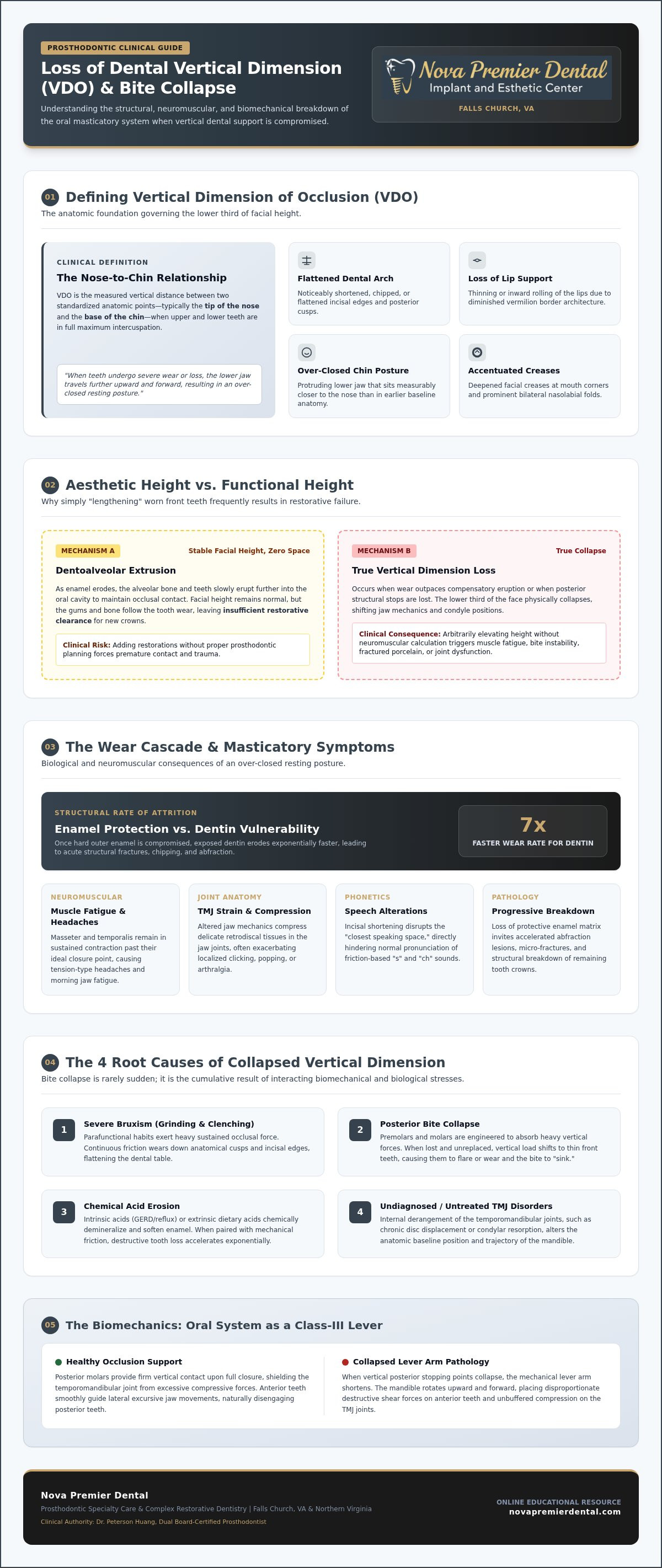
Vertical dimension of occlusion (VDO) refers to the measured distance between two selected anatomic points—typically one on the tip of the nose and one on the chin—when the upper and lower teeth are fully intercuspated (meeting together). This measurement defines the height of the lower third of the face during biting.
The lower facial height relies directly on the structural support provided by the teeth and their supporting alveolar bone. When teeth undergo severe attrition, erosion, or loss, that vertical stopping point shifts. The lower jaw (mandible) must travel further upward and forward to make contact with the upper arch, leading to an over-closed resting posture.
Common clinical signs of a reduced vertical dimension include:
- Severely shortened, flattened, or chipped front and back teeth.
- Thinning or inward rolling of the lips (loss of vermilion border support).
- An apparently protruding lower jaw or chin that sits closer to the nose than in earlier photographs.
- Deepened creases at the corners of the mouth and prominent nasolabial folds.
Because rebuilding vertical height alters how the temporomandibular joints (TMJs) and chewing muscles function, evaluation by a prosthodontist in Northern Virginia is often recommended for comprehensive diagnostic planning.
The Difference Between Aesthetic and Functional Height
It is common to think of worn teeth primarily as a cosmetic issue. However, tooth display is fundamentally governed by the underlying skeletal and muscular relationships of the jaw. When enamel erodes, the body attempts to compensate through a process called dentoalveolar extrusion—where the alveolar bone and the teeth slowly erupt further into the mouth to maintain contact. In many cases of severe tooth wear, the vertical dimension of the face may remain partially stable while the gum tissue and bone follow the worn teeth downward or upward, leaving little to no "restorative space" to place new crowns.
In other scenarios, wear outpaces compensatory eruption, or the loss of posterior teeth causes a true loss of vertical dimension. Here, the lower third of the face physically collapses. Restoring this height is not simply a matter of lengthening the front teeth for a more youthful appearance; if functional height is not correctly calculated, placing taller restorations will cause muscle fatigue, bite instability, fractured porcelain, or joint dysfunction.
Symptoms You Shouldn't Ignore
A reduced vertical dimension places chronic strain on the masticatory system. Patients experiencing bite collapse frequently report symptoms that extend beyond their teeth:
- Jaw Muscle Fatigue and Headaches: Because the mandible travels past its ideal physiologic closure point, the masseter and temporalis muscles remain in a state of sustained contraction, often contributing to morning jaw soreness and tension-type headaches.
- Temporomandibular Joint (TMJ) Strain: Altered bite mechanics can compress the retrodiscal tissues in the jaw joints, potentially exacerbating clicking, popping, or localized pain.
- Speech Changes: Changes in the position and length of the anterior teeth can interfere with phonetics, particularly the production of "s" and "ch" sounds, which depend on a precise clearance known as the closest speaking space.
- Progressive Dental Breakdown: As protective enamel is worn away, softer underlying dentin is exposed. Dentin wears up to seven times faster than enamel, accelerating the rate of chipping, abfraction lesions, and structural fractures.
The Root Causes and Health Impacts of a Collapsed Bite
A loss of dental vertical dimension rarely occurs overnight. It is typically the culmination of multiple interacting mechanical, biological, and lifestyle factors over years or decades.
- Severe Bruxism (Chronic Grinding and Clenching): Parafunctional habits exert tremendous force on the occlusal surfaces of teeth. Over time, friction grinds away cusps and incisal edges, flattening the dental anatomy.
- Posterior Bite Collapse: The back teeth (premolars and molars) are designed to absorb vertical chewing forces and protect the front teeth. When molars are extracted and not replaced, heavy biting forces transfer directly onto the thinner anterior teeth. The front teeth flare outward or wear down rapidly, causing the posterior bite to "sink."
- Chemical Acid Erosion: Intrinsic acids (such as from chronic gastroesophageal reflux disease, or GERD) and extrinsic dietary acids (frequent consumption of acidic beverages) soften the enamel matrix. When acid erosion is paired with mechanical friction from bruxism, tooth loss accelerates exponentially.
- Undiagnosed or Untreated TMJ Disorders: Structural changes within the jaw joints, such as disc displacement or condylar resorption, can shift the baseline position of the mandible and change vertical relationships.
Biomechanical Consequences of VDO Loss
The human masticatory system operates as a class-III lever. When vertical support is lost, the lever arm changes, placing disproportionate mechanical stress on the anterior teeth and the jaw joints. In a healthy occlusion, the posterior teeth contact firmly during closure to shield the jaw joint, while the anterior teeth guide the jaw during sideways movements to disengage the back teeth (canine guidance or anterior guidance).
When vertical dimension is lost, this protective guidance disappears. All teeth may collide simultaneously during chewing and swallowing. Attempting to repair individual broken teeth with isolated fillings in an over-closed bite often results in repeated restoration failure; there is simply insufficient physical clearance (restorative space) to place restorative materials with adequate thickness and strength. Resolving this issue requires a comprehensive approach to the entire dental arch rather than localized repairs.
The Aesthetic "Aging" Effect
The teeth and alveolar ridges serve as an internal scaffold for the perioral soft tissues. When the vertical dimension diminishes, the soft tissues drape differently across the lower face:
- The distance between the nose and chin shortens, leading to a compressed facial profile.
- The corners of the mouth turn downward, creating an appearance of fatigue or sternness even when the facial muscles are relaxed.
- Saliva can pool at the downward-sloping corners of the lips, creating a moist environment prone to fungal or bacterial irritation known as angular cheilitis.
- Lips appear thinner and less defined because they lack underlying incisal support.
While patients frequently seek cosmetic treatments such as dermal fillers to address these deep facial folds, soft-tissue injectables cannot resolve a structural deficit caused by a collapsed bite. Establishing correct functional dental height provides the proper internal support needed before secondary cosmetic therapies are evaluated.
How a Prosthodontist Diagnoses and Measures VDO Loss
Determining whether a patient has experienced true VDO loss—and deciding how much vertical height can safely be regained—is one of the most demanding tasks in restorative dentistry. Prosthodontists complete three additional years of ADA-accredited post-doctoral training dedicated specifically to the kinematics of occlusion, jaw relationships, and full-mouth rehabilitation.
The diagnostic workup involves several systematic evaluations:
- Assessment of Physiologic Rest Position (PRP): When the facial muscles are completely relaxed, a natural space exists between the upper and lower teeth. This is termed the "freeway space" (interocclusal rest space), typically measuring 2 to 4 millimeters. By measuring the distance between reference points at rest and comparing it to the distance when teeth are fully closed, a clinician can evaluate how much space is available.
- Phonetic Analysis: The clinician observes the patient speaking, specifically listening to sibilant ("s") sounds. The closest speaking space evaluates the relationship of the incisal edges during speech. Teeth should not collide while speaking; if they do, the vertical dimension may be over-opened.
- Evaluation of Facial Proportions: Evaluating the facial thirds (trichion to glabella, glabella to subnasale, and subnasale to menton) helps identify whether the lower third is disproportionately shortened compared to the upper facial structures.
- Recording Centric Relation (CR): Centric Relation is the clinically repeatable, physiologic position where the condyles of the mandible articulate in the anterior-superior position against the articular eminences of the temporal bones, independent of tooth contact. Determining Centric Relation provides an objective, stable starting point to rebuild the bite without perpetuating acquired jaw deviations.
- Diagnostic Wax-Up and Digital Bite Analysis: Precise impressions or optical digital scans are mounted on an articulator—an instrument that simulates jaw movements. A physical or virtual "diagnostic wax-up" is constructed to anatomically sculpt the planned restorations at the proposed vertical dimension, verifying that the new bite provides functional clearance and stable contacts.
The Importance of Board-Certified Expertise
Rehabilitating a collapsed occlusion involves high-stakes decision-making. If vertical dimension is increased beyond what the muscles and joints can accommodate, patients may experience muscle hyperactivity, pain, difficulty speaking, and porcelain fracture. Conversely, if vertical dimension is under-restored, there will not be enough room to place structurally durable materials.
At Nova Premier Dental, Dr. Peterson Huang approaches complex bite reconstruction through his background as a dual board-certified prosthodontist. Specialized training in oral reconstruction ensures that the mechanical forces of the bite, the biological health of the gums and bone, and the functional demands of the TMJs are addressed simultaneously.
Technology in Modern Bite Analysis
Digital dentistry has refined how restorative space is analyzed. High-resolution intraoral scanners capture tooth preparations, occlusal wear facets, and gingival margins with high accuracy. 3D digital articulators allow clinicians to evaluate dynamic excursions—the pathways teeth take when grinding side to side or sliding forward—minimizing interferences before any final materials are fabricated.
In addition, standardized clinical photography documents the lip-to-tooth relationship during full smiles, rest, and speech, ensuring that any mechanical alteration of the bite integrates harmoniously with the patient's natural facial dynamics.
Advanced Restorative Solutions for Reclaiming Your Smile
Restoring lost vertical dimension is rarely resolved with single-tooth treatments. Because the entire upper and lower arches must meet uniformly at the newly established height, care typically involves coordinated full-arch or full-mouth therapy.
Comprehensive Restorative Options
- Full-Coverage Dental Crowns: When remaining natural teeth have lost substantial coronal structure from wear or large fillings, crowns encase the tooth structure, restoring proper anatomic contour, vertical height, and protective enamel layers.
- Onlays and Ceramic Overlays: In modern biomimetic dentistry, conservative bonded ceramic onlays can be placed over worn posterior teeth. This preserves remaining sound tooth structure while rebuilding the vertical cusps required to support the bite.
- Dental Implants: Where posterior teeth have been missing for an extended period, implants replace the missing roots and provide rigid anchor points. Implants prevent reconstructed front teeth from absorbing excessive vertical loads, halting recurrent bite collapse.
- Porcelain Veneers: Once posterior vertical stability is established, anterior veneers can be combined with posterior restorations to re-establish proper incisal guidance, length, and aesthetics.
Treatment Comparison for Restoring Vertical Dimension
| Restorative Modality | Primary Indication | Clinical Advantages | Key Considerations |
|---|---|---|---|
| Full-Mouth Reconstruction (Crowns & Onlays) | Widespread tooth wear with intact natural roots. | Restores ideal tooth anatomy, protects remaining tooth structure, stabilizes bite. | Requires comprehensive planning across both arches; meticulous bite adjustment. |
| Implant-Supported Fixed Bridges | Loss of multiple posterior teeth causing bite collapse. | Stops anterior overloading; provides rigid vertical stops independent of natural teeth. | Requires sufficient bone density; healing interval needed for osseointegration. |
| Full-Arch Fixed Implant Prostheses (e.g., All-on-4) | Severe, non-restorable tooth breakdown or complete edentulism. | Replaces entire dental arch on 4 to 6 implants; fully restores facial lower-third height. | Surgical procedure; requires ongoing hygienic maintenance around implant abutments. |
| Removable Partial or Complete Dentures | Extensive tooth loss where fixed options are not clinically feasible. | Non-invasive restorative option; re-establishes facial support and lip fullness. | Relies on soft tissues and bone for support; requires periodic relining as bone resorbs. |
The Trial Phase: Provisionals
One of the most critical principles in prosthodontic vertical dimension restoration is the reversible evaluation phase. A patient should never transition directly from a collapsed bite to final ceramic restorations without an adaptation period.
To ensure patient comfort and clinical success, the planned vertical height is first tested using high-density provisional (temporary) restorations or a diagnostic occlusal appliance. This trial phase typically lasts anywhere from a few weeks to several months. During this window, the clinician monitors:
- Muscle and Joint Comfort: Verifying that the patient experiences no TMJ pain, stiffness, or muscle soreness at the new vertical dimension.
- Speech Adaptability: Confirming that the tongue and lips adapt to the restorations and that phonetic clarity is maintained without whistling or lisping.
- Chewing Function: Ensuring the patient can chew comfortably without biting their cheeks or tongue.
Once the patient demonstrates clear adaptation and stability in the provisional phase, the parameters of the provisional restorations are duplicated in high-strength, long-term materials such as monolithic zirconia or layered lithium disilicate ceramics.
Comprehensive Oral Rehabilitation at Nova Premier Dental
Managing loss of vertical dimension requires a structured, coordinated treatment plan. At Nova Premier Dental in Falls Church, care is organized systematically to minimize uncertainty and deliver predictable long-term results.
Every rehabilitation begins with an extensive initial consultation. High-resolution diagnostic imaging, joint palpation, muscle examination, and occlusal registrations are performed to build an accurate anatomical baseline. From there, treatment sequencing is established. If preliminary care is needed—such as periodontal therapy, endodontic stabilization, or implant placement—each stage is scheduled logically so that provisional restorations maintain functional stability throughout the restorative process.
A Patient-Centric Approach to Complex Care
Undergoing full-mouth care is a significant clinical and personal investment. Patients throughout Northern Virginia, including McLean, Arlington, and Vienna, seek care at our practice because of the measured, patient-centered approach brought to complex restorative situations.
Rather than adopting a one-size-fits-all formula, treatment plans are tailored to individual clinical conditions, addressing functional concerns while maintaining respect for healthy remaining tooth structure. Case photographs and digital models help patients understand their oral biomechanics, clarify why past restorations may have failed, and see the clinical objectives of each restorative phase.
Managing the Cost of Your New Smile
Comprehensive reconstruction of the vertical dimension involves detailed laboratory artistry, high-grade materials, and advanced clinical planning. Because these procedures represent a substantial commitment, understanding financial arrangements prior to treatment is essential.
Nova Premier Dental offers in-house payment plans for qualifying patients, allowing treatment costs to be paid over several months while patients enjoy their new smile. During your treatment planning consultation, our administrative team will provide clear, written breakdowns of all procedural fees and review scheduling sequences to help you plan care in a manner that aligns with your timeline.
Frequently Asked Questions
What exactly is dental vertical dimension?
Dental vertical dimension, or vertical dimension of occlusion (VDO), is the distance between two arbitrary anatomical points (such as the tip of the nose and the chin) when the upper and lower teeth are closed together. It defines the height of the lower third of the face and is maintained by the height and position of your teeth.
Can loss of vertical dimension cause chronic headaches?
Yes. When teeth wear down or are lost, the lower jaw closes beyond its normal physiologic stopping point. This can force the muscles of mastication (the masseter and temporalis muscles) into sustained over-contraction during chewing, swallowing, and rest, which often triggers tension-type headaches and facial muscle fatigue.
How do I know if my face is "collapsing" due to my teeth?
Common signs include noticeable shortening of the teeth, thinning or inward rolling of the lips, deep folds at the corners of the mouth, and an appearance where the chin looks closer to the nose than it used to. If family members notice changes in your facial profile or your bite feels increasingly unstable, an evaluation can determine if vertical height has decreased.
Is VDO restoration considered a cosmetic or functional procedure?
While restoring vertical dimension improves facial proportions and smile aesthetics, it is primarily a functional, structural rehabilitation. Re-establishing proper height relieves muscle strain, establishes protective bite relationships, protects teeth from destructive wear patterns, and creates the physical clearance needed to place long-lasting dental restorations.
How long does it take to restore a lost vertical dimension?
Because the jaw joints and muscles must adapt to the new bite height, treatment is completed in phases. The active process usually spans several months. This includes a necessary provisional phase, during which you test drive your new bite height in durable provisional restorations before final restorations are fabricated and placed.
Will I need to have all my teeth crowned to fix my bite?
Not necessarily. While full-arch or full-mouth coordination is required to ensure that all teeth contact evenly at the new height, modern techniques allow for conservative restorations. Depending on remaining tooth structure, a combination of full crowns, bonded ceramic onlays, veneers, or implant-supported restorations may be used to preserve natural enamel wherever possible.
Why should I see a prosthodontist instead of a general dentist for this?
Prosthodontists undergo three additional years of intensive, university-based residency training accredited by the American Dental Association, focusing specifically on complex occlusion, full-mouth reconstruction, and dental prosthetics. When a bite has collapsed, rebuilding it requires an understanding of jaw mechanics to prevent premature restoration failure or TMJ complications.
What happens if I choose not to treat my lost vertical dimension?
Left unmanaged, loss of vertical dimension is typically progressive. Enamel wear accelerates as softer dentin is exposed, leading to recurring tooth fractures, nerve exposures, and localized pain. Furthermore, chronic bite instability can worsen TMJ dysfunction and make eventual restorative treatment more complex and extensive later on.
If you have questions about a collapsed bite, worn teeth, or complex restorative concerns, Nova Premier Dental in Falls Church provides prosthodontic specialty care for patients throughout Northern Virginia. Contact our office today to schedule a comprehensive evaluation with dual board-certified prosthodontist Dr. Peterson Huang.
Disclaimer
The information provided on this website and blog is intended for general educational and informational purposes only and should not be considered dental or medical advice, diagnosis, or treatment. Reading content on this website does not establish a doctor-patient relationship with Nova Premier Dental or Dr. Peterson Huang. Dental conditions and treatment needs vary from patient to patient. Individuals should consult directly with a qualified dental professional for personalized evaluation, diagnosis, and treatment recommendations. Do not delay seeking professional dental care based on information found on this website. While we strive to provide accurate and up-to-date information, no guarantee is made regarding the completeness, accuracy, or applicability of the content. Treatment outcomes may vary depending on individual circumstances. If you are experiencing a dental emergency or urgent oral health concern, please contact a licensed dental professional immediately or call 911 in the event of a medical emergency.


