


Article by
Peterson Huang DMD, MS, FACP, FRCDC
Dr. Peterson Huang is a dual board-certified prosthodontist serving Falls Church and Northern Virginia. He has been recognized as a Top Prosthodontist by Northern Virginia Magazine and Arlington Magazine and is affiliated with the Inova Fairfax Hospital Tumor Board. Dr. Huang focuses on dental implants, full mouth reconstruction, and complex restorative dentistry for patients who need advanced, comprehensive care.
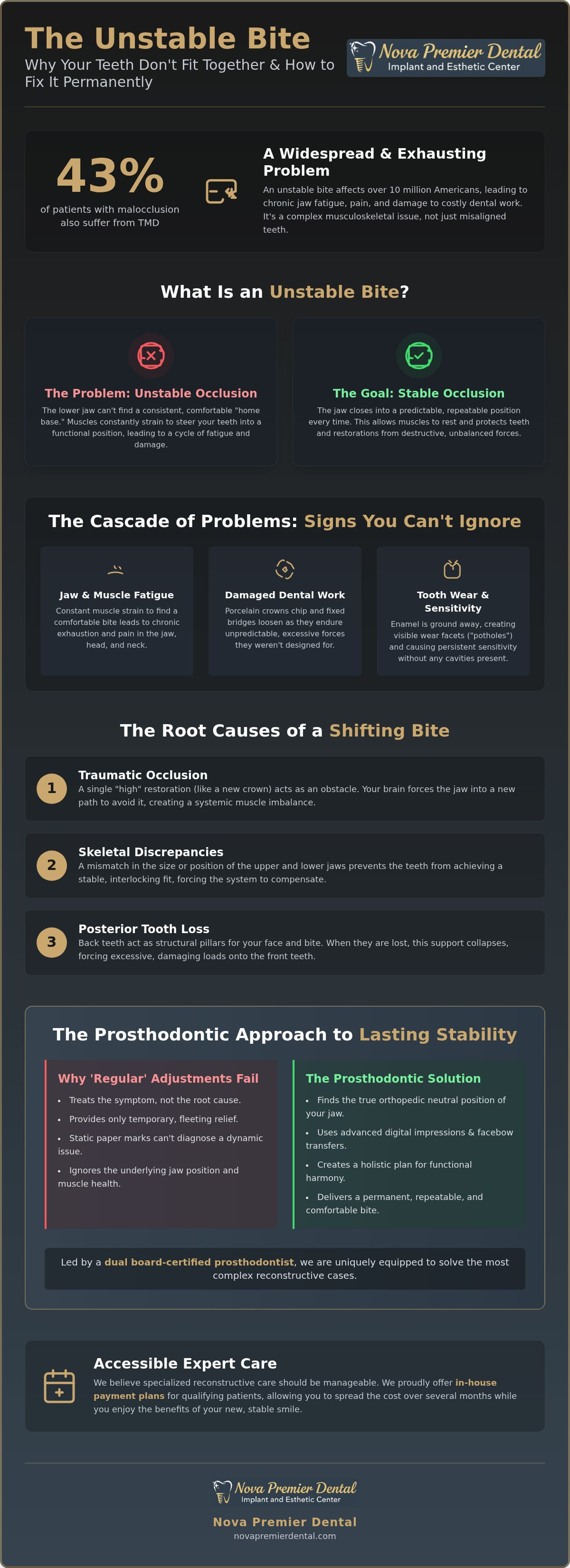
A 2025 meta-analysis indicates that 43% of patients with malocclusion also suffer from Temporomandibular Disorders (TMD), a condition that affects over 10 million Americans. If you feel like your teeth don't fit together the same way twice, you're likely dealing with unstable occlusion (bite). It is exhausting to live with chronic jaw fatigue or the constant worry that your next meal might break a costly dental restoration. At Nova Premier Dental, we understand that a shifting bite is more than a minor inconvenience. It is a complex musculoskeletal issue that requires a meticulous, specialized approach to resolve.
You deserve a repeatable, comfortable bite that protects your long term oral health. In this article, you'll discover why these inconsistencies occur and how advanced prosthodontic care can restore permanent functional stability. We will examine the diagnostic precision offered by a prosthodontist in Northern Virginia and how Dr. Peterson Huang utilizes his dual board-certification to solve the most difficult reconstructive cases. From understanding new 2026 diagnostic codes to exploring our in-house payment plans for qualifying patients, you'll find the path to a pain-free, stable smile.
Key Takeaways
- Learn how a shifting mandible prevents your teeth from finding a consistent home base, leading to chronic discomfort and muscle fatigue.
- Discover why specialized prosthodontic diagnostics are necessary to identify the root causes of an unstable occlusion (bite).
- Understand the complex relationship between your teeth, jaw joints, and muscles to stop the cycle of chipping crowns and failing restorations.
- See how a dual board-certified prosthodontist uses advanced technology like digital impressions and facebow transfers to restore functional harmony.
- Find out how in-house payment plans for qualifying patients allow you to manage the cost of complex reconstructive care over several months.
Understanding Unstable Occlusion: More Than Just a Bad Bite
In the study of occlusion in dentistry, we examine the precise way your upper and lower teeth contact one another. However, a "bad bite" is often misunderstood as merely having crooked teeth. While simple malocclusion refers to a static misalignment, unstable occlusion (bite) is a much more complex functional failure. It occurs when your lower jaw, or mandible, cannot find a consistent, comfortable home base during closure. Instead of a predictable landing, your jaw muscles must constantly work to steer your teeth into a position that avoids painful interferences. This lack of a repeatable musculoskeletal position places immense strain on the entire masticatory system.
A shifting bite is a significant red flag for underlying structural issues. It often indicates that the harmony between your jaw joints, muscles, and tooth surfaces has collapsed. Left unaddressed, this instability leads to a cycle of dental destruction. You might notice that your porcelain crowns chip or your fixed bridges loosen prematurely. This isn't necessarily a failure of the dental material, but a failure of the foundation. At Nova Premier Dental, we provide the specialized expertise needed to halt this progression, offering in-house payment plans for qualifying patients to ensure that complex restorative care remains accessible.
Common Symptoms of an Unstable Bite
Patients with an unstable occlusion (bite) often report symptoms that seem unrelated to dental alignment. Because the system is trying to compensate for the instability, you may experience:
- Frequent tooth sensitivity or soreness that occurs without the presence of cavities.
- Visible wear facets or "potholes" on the biting surfaces where enamel has been ground away.
- A distressing, persistent sensation that "my teeth don't fit together anymore."
Why 'Regular' Adjustments Often Fail to Hold
Many patients visit a general dentist for a "bite adjustment" only to find the relief is temporary. Traditional articulating paper only shows where teeth touch in a static moment; it doesn't account for the dynamic movement of the jaw. Your brain actually masks bite discrepancies by forcing your muscles to accommodate the misalignment. If the underlying jaw position is incorrect, shaving down a high spot on a tooth is merely treating a symptom rather than the cause. Dr. Peterson Huang, a dual board-certified prosthodontist in Northern Virginia, looks beyond the tooth surface to find the true orthopedic neutral position of your jaw, ensuring a result that actually lasts.
The Root Causes of Occlusal Instability: Why Your Bite Keeps Changing
An unstable occlusion (bite) rarely develops in isolation. It is usually the result of a progressive breakdown in the architectural support of your mouth. One common trigger is traumatic occlusion. This occurs when a single restoration, such as a "high" crown, prevents the rest of the teeth from meeting correctly. To avoid this interference, your brain subconsciously redirects your jaw muscles. This constant avoidance creates a systemic muscle imbalance that eventually shifts the entire mandibular position, making it feel as though your teeth no longer have a consistent place to land.
Skeletal discrepancies also play a significant role. If there is a mismatch between the size of the upper and lower jaws, or if issues like mandibular protrusion are present, the teeth cannot achieve a stable interlock. This lack of harmony forces the masticatory system to compensate, which often leads to the chronic muscle fatigue and joint pain discussed in the previous section. Identifying these root causes requires the meticulous diagnostic approach of a prosthodontist in Northern Virginia who specializes in the mechanics of the entire jaw.
Tooth Loss and Posterior Vertical Dimension
Your back teeth, or molars, serve as the structural pillars for your face. When these teeth are lost, the vertical distance between your upper and lower jaw begins to collapse. This loss of posterior support forces your front teeth to take on excessive loads they weren't designed to handle. This often leads to splaying, loosening, or fracturing of the anterior teeth. To stop this collapse, dental implants are essential. They provide the necessary biological and mechanical support to maintain a stable vertical dimension and protect your remaining natural teeth from further damage.
Erosion and Attrition: The Cycle of Wear
Occlusal stability is also compromised by the gradual loss of enamel. This happens through chemical erosion, often from diet or acid reflux, or mechanical attrition caused by chronic grinding. As the biting surfaces flatten, the teeth lose their ability to interlock properly. This loss of tooth height further destabilizes the jaw position. Restoring this lost structure with high-strength ceramics, such as porcelain veneers or full-coverage crowns, is often necessary to rebuild a functional bite. If you're concerned about the cost of comprehensive reconstruction, Nova Premier Dental offers in-house payment plans for qualifying patients to help manage the investment in your long-term health.
Beyond Teeth: The Role of Muscles, Nerves, and the TMJ
This strain isn't limited to the jaw. Because of a neurological phenomenon known as trigeminal-cervical convergence, the nerves that control your jaw muscles share pathways with those that serve your neck and shoulders. This is why an unstable occlusion (bite) frequently manifests as chronic neck pain, shoulder tension, or debilitating headaches. To better understand how to manage this type of systemic tension, check out Yuba Sutter Chiropractic & Wellness for insights into advanced care for the root causes of pain. When the instability is severe, it can lead to condylar displacement. This occurs when the jaw joint clicks or pops because the muscles are pulling the joint out of its proper orthopedic socket to accommodate the teeth.
Your body has an incredible capacity to protect itself through a process called muscle splinting. If your brain detects a tooth interference, it signals the muscles to tighten, effectively creating a biological "splint" to prevent further damage. This often leads to nighttime bruxism, as the system attempts to grind away the interference in your sleep. While many see custom night guards as simple protectors, we use them as vital diagnostic tools. By analyzing the wear patterns on a guard, Dr. Peterson Huang can pinpoint exactly where the instability originates and how the muscles are responding.
TMJ Disorders and Bite Stability
Achieving long term comfort requires more than just straight teeth; it requires a stable joint foundation. Chronic bite instability often leads to TMJ and jaw joint disorders, where inflammation within the joint capsule physically shifts the jaw's position. This creates a "moving target" for any dental work, making it impossible to find a comfortable bite. Our goal at Nova Premier Dental is to establish "Centric Relation," a repeatable and physiologically relaxed position for the jaw joints. For patients in Falls Church and McLean requiring these complex rehabilitative services, we offer in-house payment plans for qualifying patients to ensure care is manageable while you regain your functional health.
Diagnosing and Treating an Unstable Bite: The Prosthodontic Approach
Treating a complex case of unstable occlusion (bite) requires moving beyond the "tooth-by-tooth" philosophy of general dentistry. While a standard exam focuses on cavities and gum health, the prosthodontic approach views the mouth as an integrated mechanical system. A dual board-certified prosthodontist possesses the advanced training to synchronize the teeth with the jaw joints and musculature. This level of specialization is critical when previous dental work has failed or when chronic pain has become a daily reality.
The diagnostic phase is meticulous. We utilize digital impressions for extreme accuracy and facebow transfers to map how your upper jaw relates to your skull and jaw joints. This data allows us to perform a comprehensive joint analysis, identifying exactly where the system is failing. The ultimate objective of oral reconstruction is to equalize forces across all dental surfaces, ensuring that no single tooth or joint is subjected to destructive loads.
Step 1: Establishing a Stable Jaw Position
Before permanent restorations can be placed, we must find a repeatable "home base" for your jaw. We often utilize stabilization splints to "de-program" hyperactive muscles that have spent years compensating for a bad bite. This allows the mandible to find its physiologic rest position, free from the interference of misaligned teeth. Dr. Peterson Huang meticulously maps these complex movements to ensure the new bite foundation is biologically sound. If you are ready to end the cycle of discomfort, schedule a comprehensive evaluation to begin your diagnostic journey.
Step 2: Restorative Interventions
Once stability is established, we move to the restorative phase. This may begin with occlusal equilibration, which involves the precise reshaping of tooth surfaces to remove interferences. For more significant cases, we use high-strength crowns and fixed bridges to rebuild the lost vertical dimension and restore functional harmony. Whether you require minor adjustments or a full mouth rehabilitation due to severe attrition, our team provides a level of precision that general offices cannot replicate. To help patients manage the cost of these life-changing procedures, we offer in-house payment plans for qualifying patients, allowing you to pay over several months while already enjoying your restored smile.
Reclaiming Stability at Nova Premier Dental in Falls Church
For patients in Falls Church, McLean, and Arlington who feel their teeth never meet the same way twice, the search for relief can be frustrating. At Nova Premier Dental, we specialize in stabilizing these complex cases through highly personalized care plans. When you live with unstable occlusion (bite), the solution isn't a one-size-fits-all adjustment; it's a comprehensive architectural redesign of your oral health. Our practice is dedicated to restoring functional harmony, ensuring that every crown, bridge, or implant works in unison with your jaw's natural mechanics.
We understand that comprehensive restorative care is a significant investment in your long-term quality of life. To ensure that our specialized services remain accessible to those who need them most, we offer in-house payment plans for qualifying patients. These plans allow you to distribute the cost of your care over several months. This flexibility makes it possible to manage your financial health while you begin to experience the relief and confidence of a stable, pain-free smile.
Why Specialization Matters for Your Bite
Choosing a prosthodontist in Northern Virginia is the most critical decision you can make for a failing bite. While a general dentist handles a wide array of routine needs, a prosthodontist undergoes years of additional residency training focused specifically on the restoration of complex dental and facial structures. Dr. Peterson Huang is frequently sought out for second opinions and for managing "failed" dental cases where previous work hasn't held up to the forces of an unstable bite. Our commitment goes beyond aesthetics; we prioritize "functional beauty," where your smile looks exceptional because it's built on a foundation of orthopedic health. You can explore our prosthodontic services to see how this specialized training translates into lasting results for our patients.
Taking the First Step Toward Comfort
Your journey toward stability begins with a comprehensive occlusal analysis. During your initial consultation, we'll review your dental history, perform a physical examination of your jaw joints and muscles, and utilize advanced diagnostic mapping. This isn't just a check-up; it's the first step in reclaiming the peace of mind that comes with a predictable, stable bite. To prepare, simply bring any records of previous dental work and a list of your specific symptoms, such as jaw fatigue or chronic headaches. When you're ready for an expert evaluation, contact Nova Premier Dental to schedule your visit. We look forward to helping you achieve the functional stability you deserve.
Restoring Your Path to Functional Harmony
Achieving a repeatable, pain-free bite requires a level of diagnostic precision that looks far beyond the surface of the teeth. As we've explored, resolving unstable occlusion (bite) is an orthopedic challenge that demands the perfect synchronization of the jaw joints, masticatory muscles, and restorative surfaces. At Nova Premier Dental, our focus is on providing permanent solutions for the most complex rehabilitative cases. We don't just fix teeth; we rebuild the foundation of your oral health.
As a dual board-certified prosthodontist in Northern Virginia and a specialist in oral reconstruction, Dr. Peterson Huang is dedicated to providing meticulous, individualized care. To make this high-level treatment accessible, we offer in-house payment plans for qualifying patients, allowing you to manage the cost of care over several months. Schedule your specialized bite consultation with Dr. Huang today to take the first step toward lasting comfort. You don't have to live with the daily burden of jaw fatigue and dental instability. We're here to guide you toward a future of functional beauty and predictable health.
Frequently Asked Questions
What exactly does it mean to have an unstable bite?
An unstable bite occurs when your teeth do not meet in a consistent, repeatable position that is in harmony with your jaw joints and muscles. Instead of your mandible finding a natural home base, your muscles must constantly work to steer your teeth into a position that avoids interference. This lack of orthopedic stability often leads to chronic muscle fatigue and is a primary indicator of unstable occlusion (bite).
Can an unstable bite cause chronic headaches or ear pain?
Yes, an unstable bite is a frequent cause of chronic headaches and ear-related discomfort. Because the nerves controlling your jaw muscles are neurologically linked to those serving your head and neck, constant muscle strain can trigger tension headaches. Many patients in Falls Church also report ear pain or fullness because the temporomandibular joint is located directly adjacent to the ear canal and can become inflamed due to bite instability.
How do I know if I need a prosthodontist or a general dentist for my bite?
You should seek a prosthodontist in Northern Virginia if your bite issues involve complex reconstruction, failed previous dental work, or chronic TMJ symptoms. While general dentists focus on routine care, Dr. Peterson Huang is a dual board-certified specialist with years of advanced residency training specifically in the mechanics of the jaw. This expertise is essential for diagnosing the musculoskeletal causes of an unstable occlusion (bite).
Will I need braces to fix my unstable occlusion?
While orthodontics can align teeth, many cases of instability are best resolved through prosthodontic restorative care at Nova Premier Dental. We focus on rebuilding the biting surfaces using crowns, bridges, or porcelain veneers to establish a stable vertical dimension. If your instability is caused by worn-down teeth or missing posterior support, restorative reconstruction is often the most direct path to achieving a functional, repeatable bite position without the need for braces.
What happens if I leave an unstable bite untreated?
Leaving an unstable bite untreated typically leads to a progressive breakdown of the entire masticatory system. You may experience accelerated tooth wear, frequent fracturing of expensive dental restorations, and worsening jaw joint degeneration. Over time, chronic muscle compensation can lead to permanent changes in the jaw joint structure and persistent neuropathic pain. Addressing instability early protects your long term oral health and prevents the need for more extensive full mouth reconstruction later.
How long does the process of stabilizing a bite typically take?
The stabilization process varies based on complexity but generally follows a structured timeline. We often begin with a de-programming phase using a stabilization splint for several weeks to relax hyperactive muscles. Once a repeatable jaw position is established, the restorative phase can take a few months to complete. Our team provides clear milestones throughout your treatment, and we offer in-house payment plans for qualifying patients to make this comprehensive care manageable over time.
Are the results of occlusal equilibration permanent?
Occlusal equilibration provides permanent results when the underlying jaw position is correctly identified and stabilized first. This procedure involves the precise reshaping of tooth surfaces to eliminate interferences that trigger muscle strain. However, for the results to last, the teeth must be protected from future wear. Dr. Peterson Huang ensures that every adjustment is part of a holistic plan that considers joint health, muscle function, and the durability of your dental restorations.
Does insurance cover treatment for unstable occlusion?
Insurance coverage for bite stabilization depends entirely on your specific provider and the restorative nature of the procedures required. While some diagnostic phases or restorative components like crowns may be partially covered, complex occlusal therapy is often viewed as specialized care. We provide detailed documentation to help you maximize your benefits. For any remaining balance, our Falls Church practice offers in-house payment plans for qualifying patients to help distribute the cost comfortably over several months.
Disclaimer
The information provided on this website and blog is intended for general educational and informational purposes only and should not be considered dental or medical advice, diagnosis, or treatment. Reading content on this website does not establish a doctor-patient relationship with Nova Premier Dental or Dr. Peterson Huang. Dental conditions and treatment needs vary from patient to patient. Individuals should consult directly with a qualified dental professional for personalized evaluation, diagnosis, and treatment recommendations. Do not delay seeking professional dental care based on information found on this website. While we strive to provide accurate and up-to-date information, no guarantee is made regarding the completeness, accuracy, or applicability of the content. Treatment outcomes may vary depending on individual circumstances. If you are experiencing a dental emergency or urgent oral health concern, please contact a licensed dental professional immediately or call 911 in the event of a medical emergency.


