


Article by
Peterson Huang DMD, MS, FACP, FRCDC
Dr. Peterson Huang is a dual board-certified prosthodontist serving Falls Church and Northern Virginia. He has been recognized as a Top Prosthodontist by Northern Virginia Magazine and Arlington Magazine and is affiliated with the Inova Fairfax Hospital Tumor Board. Dr. Huang focuses on dental implants, full mouth reconstruction, and complex restorative dentistry for patients who need advanced, comprehensive care.
Restorative dentistry repairs or replaces damaged, worn, or missing teeth so that a person can chew, speak, and smile comfortably. If you are comparing options for restorative dentistry in Falls Church, VA, the most useful starting point is understanding which treatments exist, what each can and cannot do, and when a case is complex enough to benefit from a prosthodontist's evaluation. Many restorative procedures are routinely and appropriately performed by general dentists. This guide explains the options and the factors that influence the choice.
Nova Premier Dental is a private prosthodontic specialty dental office in Falls Church serving Northern Virginia. Peterson Huang, DMD, MS, FACP, FRCDC, is a dentist and dual board-certified prosthodontist, with prosthodontic certification in the United States and Canada.
Key Takeaways
- Restorative dentistry aims to restore function and appearance together; the right treatment depends on remaining tooth structure, gum and bone health, and the bite.
- Options range from fillings, inlays, and onlays to crowns, bridges, implants, dentures, and full-mouth rehabilitation.
- Implant fixtures and the crowns, bridges, or dentures they support have different lifespans, and outcomes vary from patient to patient.
- Prosthodontists complete formal advanced specialty training in restoring and replacing teeth, which can be helpful for complex cases, failed prior work, or extensive treatment planning.
- A thorough evaluation and treatment sequence matter as much as the final restoration.
What Is Restorative Dentistry?
Restorative dentistry is the branch of dentistry focused on repairing damaged teeth and replacing missing ones. It covers a spectrum, from conservative white fillings, inlays, and onlays to crowns, bridges, implant-supported restorations, dentures, and comprehensive rehabilitation. The general definition is broad, and the scope of any one patient's care depends on their clinical situation.
Every restoration has two goals: function (chewing and speaking) and appearance. A restoration that looks natural but is poorly matched to the bite may chip, loosen, or wear opposing teeth, so the two goals are planned together.
The Core Goals of Oral Rehabilitation
- Restore structural integrity: rebuild damaged teeth so forces are distributed in a way the remaining teeth and supporting tissues can tolerate.
- Support the remaining tissues: when a missing tooth is replaced with an implant, the implant may help preserve bone locally in appropriate candidates. It does not stop all bone change.
- Improve function: well-fitting restorations can improve chewing comfort and speech, although results vary and no replacement fully duplicates a natural tooth.
When to Seek Restorative Care
Many problems are not painful early on. Signs worth having evaluated include:
- Dark or open margins around an existing crown or filling
- Persistent temperature sensitivity
- Chipped, cracked, or heavily worn teeth
- A loose crown, bridge, or denture
- Difficulty chewing because of missing teeth
Treating decay or structural failure earlier often allows more conservative options that preserve natural tooth structure. Routine dental exams and cleanings help detect these problems and keep gum disease under control, which is important before any restorative work.
Restorative Options: From Single Crowns to Full-Mouth Rehabilitation
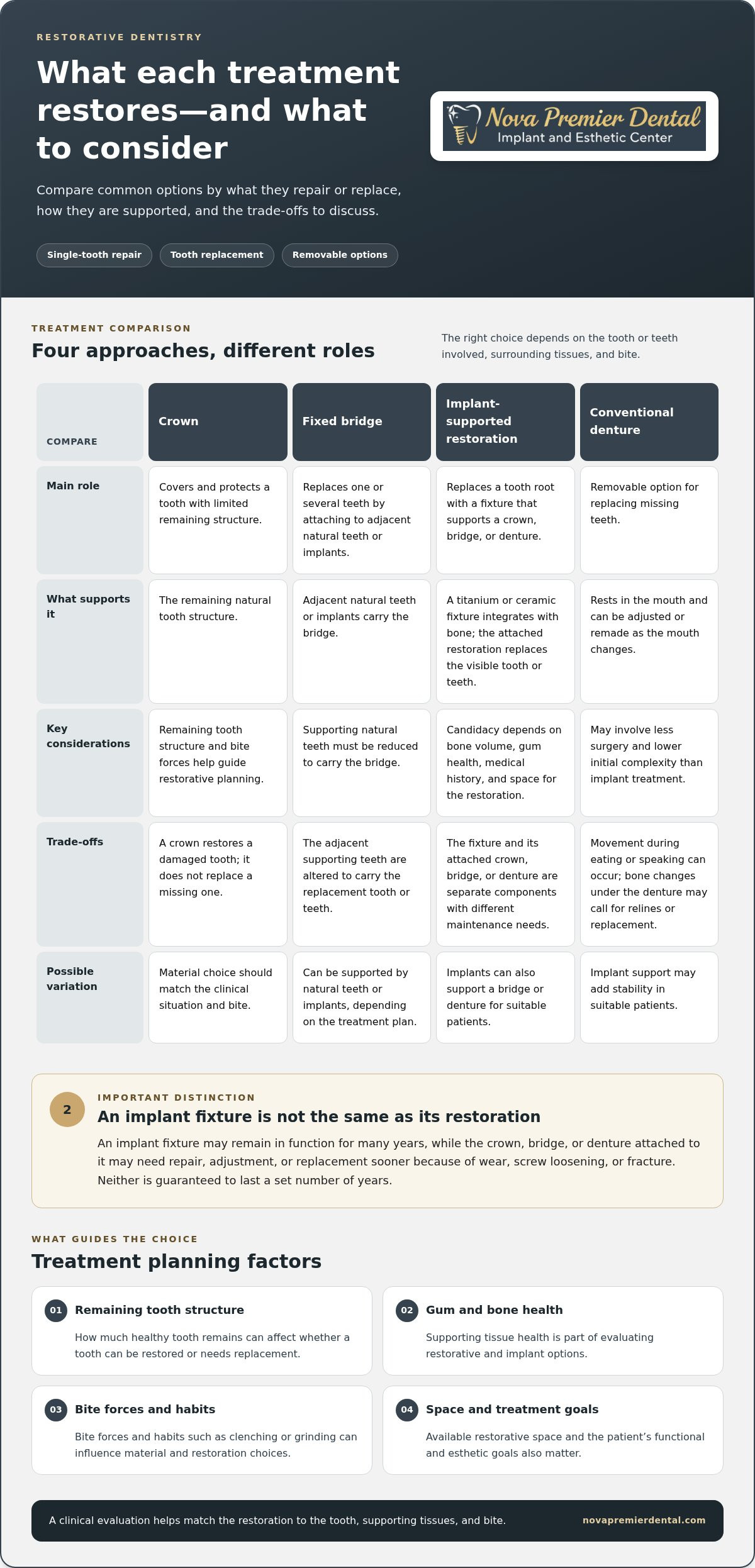
Treatment selection depends on how much tooth remains, the health of the gums and bone, the patient's bite forces, habits such as clenching or grinding, and esthetic goals. Common materials include zirconia, lithium disilicate, porcelain-fused-to-metal, gold alloys, and composite resin. Each has trade-offs: zirconia is strong and resists fracture but requires careful bite adjustment, while more translucent ceramics may look more natural but can be less suited to heavy grinders. Material choice should follow the clinical situation rather than a single preferred product.
Digital tools such as intraoral cameras let patients see the condition of their teeth, which supports informed decisions.
Crowns, Bridges, and Implants
Crowns cover and protect a tooth with limited remaining structure. Fixed bridges replace one or several teeth by attaching to adjacent natural teeth or implants; the supporting teeth must be reduced to carry the bridge, which is one trade-off to weigh.
Dental implants replace the tooth root with a titanium or ceramic fixture that integrates with bone and supports a crown, bridge, or denture. Candidacy depends on bone volume, gum health, medical history, and the space available for the restoration. Success depends on the implant's position, as discussed in why implant position matters. It helps to distinguish two things: the implant fixture often remains in function for many years, while the crown, bridge, or denture attached to it may need repair, adjustment, or replacement sooner because of wear, screw loosening, or fracture. Neither is guaranteed to last a set number of years.
Conventional dentures are a reasonable option for many patients. They are removable, usually involve less surgery and lower initial complexity, and can be adjusted or remade as the mouth changes. Trade-offs include potential movement while eating or speaking and ongoing bone changes under the denture, which may require relines or replacement. Dentures and partial dentures can also be supported by implants for added stability in suitable patients.
Full-Mouth Rehabilitation
Full-mouth rehabilitation is a planned, sequenced approach to restoring teeth in both jaws, often when many teeth are worn, broken, missing, or failing. It may combine crowns, onlays, veneers, implants, and removable or fixed prostheses. Oral reconstruction planning evaluates the gums, remaining tooth prognosis, bone, bite relationships, and esthetics before treatment is staged. For a step-by-step view, see what full mouth reconstruction involves.
Severe tooth wear does not automatically mean the bite has lost vertical dimension, and grinding does not automatically lead to bite collapse. These are determined through examination, history, and diagnostic records, not assumed from appearance.
Prosthodontist and General Dentist: Who Provides Restorative Care?
General dentists provide essential preventive and restorative care, and they appropriately perform many fillings, crowns, bridges, and other procedures. A prosthodontist is a dentist who has completed additional formal specialty training, typically three years, focused on restoring and replacing teeth and managing complex restorative situations. Specialist evaluation may be helpful when a case involves:
- Multiple missing or failing teeth in one or both arches
- Extensive wear, fractures, or a bite that needs to be reassessed
- Restorations that have repeatedly failed
- Limited restorative space or unusual implant positioning
- Maxillofacial or oral cancer rehabilitation
- Complex dentures or full-arch implant restorations
A second opinion is reasonable for any major treatment plan. For more on the distinction, see this comparison of prosthodontists and general dentists, or learn about prosthodontic care in Northern Virginia.
Occlusion and Jaw Joint Considerations
Occlusion describes how teeth contact when the jaws close and move. Planning a restoration includes checking those contacts so a new crown is not too high and forces are distributed reasonably. The relationship between bite and jaw joint disorders is complex and not fully explained by tooth contacts alone, so bite changes are not assumed to cause jaw pain or headaches. Patients with jaw symptoms are evaluated individually; see information on TMJ and jaw joint disorders.
Complex Cases and Failed Restorations
Prosthodontic training also applies to congenital differences, trauma, and oral cancer rehabilitation. When older work has failed, the first step is working out why: decay under a crown, a fractured tooth, a loose implant screw, inadequate space, or excessive bite forces. Replacing the restoration without addressing the cause can lead to repeat failure.
What the Evaluation and Treatment Process Involves
A restorative evaluation typically includes a medical and dental history, an exam of teeth, gums, and jaw joints, radiographs, and an assessment of the bite. Digital scans or impressions and photographs may be used to study the teeth and plan restorations. Active gum disease or decay is generally stabilized first, since restorations depend on a healthy foundation.
Treatment Planning
A plan outlines the options, the advantages and disadvantages of each, expected maintenance, and the sequence of visits. Complex cases are often phased, with provisional restorations used to test appearance and function before final ones are made. Your goals, health, schedule, and budget all shape the plan. Nova Premier Dental offers in-house payment plans for qualifying patients, allowing treatment costs to be paid over several months.
Recovery and Long-Term Maintenance
Recovery depends on the procedure; crowns usually require little downtime, while implant surgery follows specific post-surgical instructions. Longevity depends on the clinical work, the materials, the patient's bite forces, and home care. Maintenance usually includes daily cleaning around restorations and implants, regular professional visits, and a night guard when grinding is present. Restorations can chip, loosen, or wear, and repairs or replacements over time are common.
Frequently Asked Questions
What is the difference between restorative and cosmetic dentistry?
Restorative dentistry primarily repairs structure and function, while cosmetic dentistry primarily improves appearance. The two overlap, since restorations should also look natural.
How long do crowns and bridges last?
There is no fixed lifespan. Durability varies with the material, the remaining tooth structure, gum health, bite forces, and hygiene. Many last for years, but some need earlier repair or replacement.
Is restorative dentistry painful?
Local anesthesia is used for most procedures, so treatment is generally comfortable. Some soreness or sensitivity can follow, depending on the procedure.
How much does restorative dentistry cost?
Cost depends on the number of teeth, materials, and the complexity of treatment, so it is best discussed after an examination. A written treatment plan can outline the phases and fees.
What happens if I do not replace a missing tooth?
Consequences vary. Neighboring teeth may drift, opposing teeth may over-erupt, chewing may change, and the bone in the area may gradually shrink. Not every gap requires replacement, but it is worth discussing the options.
Can a prosthodontist fix old or failing dental work from another office?
Often, yes. The first step is identifying why the work failed and whether the tooth or implant can be retained, repaired, or replaced.
How do I know if I need a full-mouth reconstruction?
It may be considered when many teeth are missing, worn, fractured, or failing and treating them one at a time would not address the underlying problems. Only an examination can determine this.
Summary
The right restorative treatment depends on diagnosis, not preference for a particular procedure. Many needs are well served by a general dentist, while complex or repeatedly failing cases may benefit from a prosthodontic evaluation. If you have questions about a complex restorative concern, Nova Premier Dental in Falls Church provides prosthodontic specialty care for patients throughout Northern Virginia, and you can contact the office to arrange a consultation.
Disclaimer
The information provided on this website and blog is intended for general educational and informational purposes only and should not be considered dental or medical advice, diagnosis, or treatment. Reading content on this website does not establish a doctor-patient relationship with Nova Premier Dental or Dr. Peterson Huang. Dental conditions and treatment needs vary from patient to patient. Individuals should consult directly with a qualified dental professional for personalized evaluation, diagnosis, and treatment recommendations. Do not delay seeking professional dental care based on information found on this website. While we strive to provide accurate and up-to-date information, no guarantee is made regarding the completeness, accuracy, or applicability of the content. Treatment outcomes may vary depending on individual circumstances. If you are experiencing a dental emergency or urgent oral health concern, please contact a licensed dental professional immediately or call 911 in the event of a medical emergency.


