


Article by
Peterson Huang DMD, MS, FACP, FRCDC
Dr. Peterson Huang is a dual board-certified prosthodontist serving Falls Church and Northern Virginia. He has been recognized as a Top Prosthodontist by Northern Virginia Magazine and Arlington Magazine and is affiliated with the Inova Fairfax Hospital Tumor Board. Dr. Huang focuses on dental implants, full mouth reconstruction, and complex restorative dentistry for patients who need advanced, comprehensive care.
What if the best place for an implant isn’t simply where bone is easiest to reach? Available bone matters, but the implant also needs to support a crown that looks natural, functions comfortably, and can be maintained. That’s why implant placement for a crown, implant angulation, and restorative implant planning are considered together rather than as separate decisions.
This article explains a restorative-first approach: plan the intended crown, then assess where and at what angle an implant could support it. Bone anatomy, available space, bite forces, and access for cleaning can all influence the plan. An angled implant may affect the crown’s design without automatically ruling out treatment. You’ll also find questions to ask a restorative specialist so you can understand how the proposed position relates to appearance, strength, comfort, and maintenance.
Key Takeaways
- Restorative implant planning coordinates the intended crown with implant position, bite, and oral anatomy before treatment decisions are made.
- Implant angulation can influence crown contours, screw access, available restorative options, and how easily the area can be cleaned.
- Ask how your anatomy, restorative space, neighboring teeth, and bite shape the proposed implant placement for crown and restoration.
- Discuss alternatives and ongoing care needs, since implant-supported crowns require regular home cleaning and professional follow-up.
Why Implant Placement for a Crown Starts With the Final Restoration
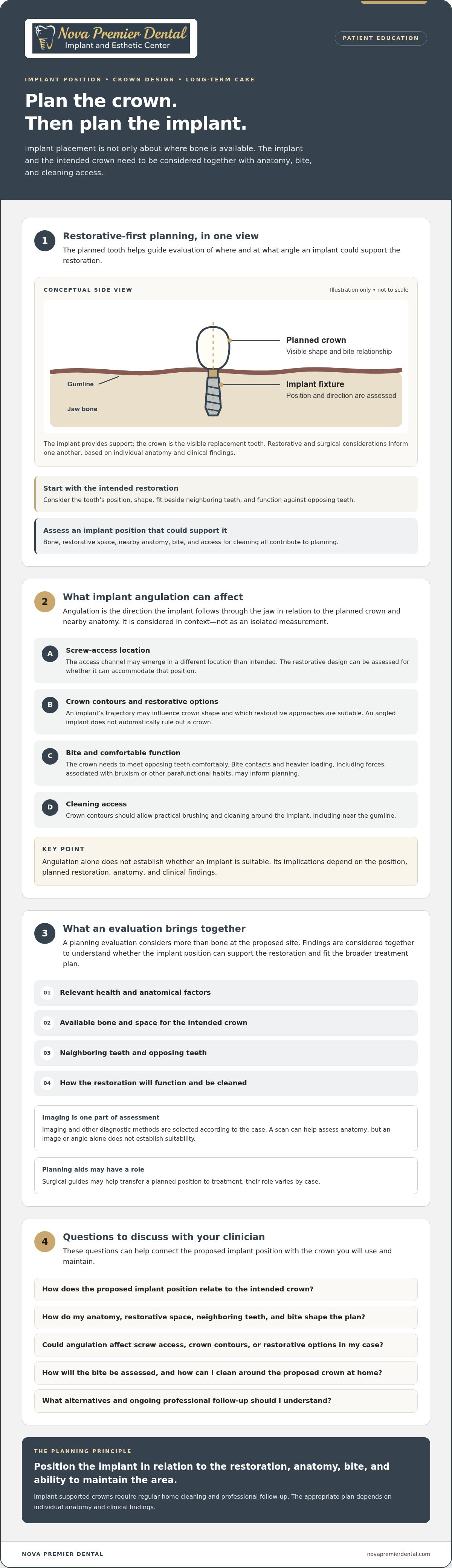
Bone availability is important, but it doesn’t identify the ideal implant position on its own. The planned crown also needs to fit the space, relate naturally to neighboring teeth, meet opposing teeth comfortably, and allow practical cleaning. Restorative implant planning brings these requirements together with the patient’s anatomy before treatment decisions are finalized.
What does restorative-first implant planning mean?
The clinician considers the intended tooth’s position, shape, and function, then evaluates where an implant could support that restoration. The crown isn’t designed in isolation, and surgery doesn’t necessarily follow a predetermined plan. Restorative and surgical considerations inform one another, with the final approach based on individual anatomy and clinical findings.
Implant placement determines where and how the implant sits in the jaw; crown design determines the visible tooth’s shape, fit, and relationship to the bite. The implant provides support, while the crown is the visible replacement tooth. A dental implant can support a prosthesis such as a crown. For treatment-specific information, see Nova Premier Dental’s dental implant services.
Why does the crown affect implant position?
The implant’s three-dimensional position influences how the crown emerges through the gum and where a restoration’s screw access may be located. If the implant’s trajectory doesn’t suit the planned tooth, the crown may require different contours or restorative options. An overbuilt or hard-to-reach area can make cleaning more difficult, while the visible shape affects how naturally the restored tooth fits beside its neighbors. Bone is part of the plan, but the crown, bite, and ability to maintain the area also guide implant placement for a crown.
How Implant Angulation Can Affect Crown Design, Bite, and Cleaning
Implant angulation describes the direction the implant follows through the jaw in relation to the planned crown and nearby anatomy. It’s assessed alongside the intended restoration, bite, and patient anatomy, not as an isolated measurement. Planning implant placement for a crown means considering how angulation may affect screw-access location, crown shape, and available restorative options.
Can an implant be angled and still support a crown?
Yes. An angled implant doesn’t automatically make a crown unsuitable, but the implications depend on its position and the restorative design. For example, the screw-access channel may emerge somewhere other than the intended location. The clinician can assess whether the design can accommodate that position or whether another restorative approach may be considered. The right option depends on the case. The process of placing a dental implant includes surgical and restorative stages that need to be considered together.
How do bite forces and cleansability shape the design?
A crown needs to meet opposing teeth in a way that supports comfortable function. If its shape or position concentrates force, the clinician may reconsider the design or bite contacts. Heavier loading, including forces associated with bruxism or other parafunctional habits, may also inform planning. No single factor determines the plan.
Crown contours matter after treatment, too. The restoration should allow practical brushing and cleaning around the implant, including near the gumline. Ask how to clean around the proposed crown at home and how its bite will be assessed. Discussing implant angulation and restorative planning can clarify how these factors apply to your treatment. Learn more about dental implant treatment and how it may relate to your situation.
What a Restorative Implant Planning Evaluation Should Consider
An evaluation considers more than the bone at the proposed site. The clinician assesses relevant health and anatomical factors, space for the intended crown, neighboring teeth, and how the restoration will meet opposing teeth. Together, these findings help determine whether the proposed implant position can support the restoration and fit the broader treatment plan.
Imaging and other diagnostic methods are selected according to the case. A scan can help a clinician assess anatomy, but an angle or image alone doesn’t establish whether an implant is suitable. For implant placement for a crown, the clinician considers angulation in the context of the planned restoration and the patient’s findings. Planning aids such as surgical guides may help transfer a planned position to treatment, though their role varies by case. Learn about prosthodontic specialty care in Northern Virginia when restorative decisions are complex.
Which questions can patients ask before treatment?
Ask the clinician to explain how the proposed position relates to the restoration and daily care:
- How does the implant position support the planned crown?
- Where will screw access emerge, if applicable, and how can I clean around the restoration?
- What alternatives or limitations could affect the restoration, treatment sequence, or maintenance?
When may a prosthodontic evaluation be useful?
Specialist input may be useful when implant treatment needs to be coordinated with several restorations, a complex bite, or other significant restorative needs. A prosthodontist’s training focuses on restoring and replacing teeth, which can inform planning in these situations. Not every implant requires specialist care; whether an evaluation may help depends on the individual case.
Choosing Next Steps for Implant Placement and Crown Planning
A useful treatment discussion connects the proposed restoration to the implant’s position and explains how the plan fits your bite and anatomy. Work through the decision in sequence: clarify what restoration is planned, ask why the implant is positioned as proposed, discuss alternatives and limitations, then understand the cleaning and follow-up the restoration will require. No single implant angle or plan suits every patient.
What should a clear treatment plan explain?
Ask what type of restoration is being considered and how its position relates to the implant. The plan should also address relevant limitations, the expected treatment sequence, and how you’ll clean around the finished restoration. Implant placement for a crown, implant angulation, and restorative implant planning involve individual clinical decisions, not a universal template.
A single-tooth crown plan differs from a bridge or full-arch restoration. For a single tooth, planning centers on its relationship to nearby and opposing teeth. A bridge or full-arch restoration involves coordinating multiple supporting implants, the shape and extent of the prosthesis, and access for cleaning. Ask how the specific design affects maintenance and what professional follow-up may be recommended for you.
Where can patients learn more or request an evaluation?
For broader treatment context, read Nova Premier Dental’s Falls Church dental implant specialist guide. An implant-supported crown needs ongoing home care and professional follow-up; the appropriate schedule depends on your restoration and oral health.
If your plan involves complex restorative needs, bite concerns, or coordination with other restorations, a prosthodontic evaluation may help clarify the options. Nova Premier Dental in Falls Church provides prosthodontic care for patients in Northern Virginia, including McLean, Great Falls, Arlington, Fairfax, Tysons, and Annandale. Explore Nova Premier Dental to learn more or discuss your restorative questions.
Make Your Implant Plan a Restorative Plan
The position of an implant should be considered in relation to the crown it will support, not just the bone available. Implant placement for a crown, implant angulation, and restorative implant planning work together: the proposed position can affect crown shape, bite relationships, access for cleaning, and available restorative options. A clear plan should explain the intended restoration, why its position fits your clinical needs, and what maintenance it will require.
Ask your clinician how the implant will support the planned crown, what alternatives or limitations matter in your case, and how to care for the restoration over time. Individual anatomy and treatment goals guide these decisions, so one approach isn’t right for everyone.
For complex restorative questions, Nova Premier Dental is a prosthodontic specialty practice in Falls Church, Virginia, led by Dr. Peterson Huang, a dual board-certified prosthodontist. Discuss your restorative questions with Nova Premier Dental. Understanding how the plan connects implant position with everyday function can help you move forward with greater clarity.
Frequently Asked Questions
How does implant placement affect the crown?
Implant placement establishes the foundation and direction available for the crown. For implant placement for a crown, that relationship may affect the crown’s contours, where restorative access emerges, how it fits beside neighboring teeth, and whether you can clean around it effectively. The clinician evaluates position alongside your anatomy and bite. A scan or the implant’s visible angle alone can’t determine whether the restoration is suitable.
Can a dental implant be placed at an angle for a crown?
An implant can be angled in some treatment plans, but whether that position can support an appropriate crown depends on your anatomy and restorative design. Implant angulation may influence the location of screw access, crown contours, and how the restoration relates to your bite. Ask your treating clinician what the proposed trajectory means for cleaning, function, and available alternatives in your particular case.
Why is the crown planned before implant surgery?
Considering the intended crown before surgery helps the clinical team assess where an implant could support the restoration, rather than choosing a position based only on available bone. Restorative implant planning also considers neighboring teeth, the bite, and access for cleaning. This doesn’t mean every patient follows the same sequence or workflow; the plan is adapted to clinical findings and individual treatment needs.
What factors affect the position of a dental implant?
Clinicians may consider bone and soft-tissue anatomy, neighboring teeth, restorative space, the intended crown, bite forces, and cleaning access. Existing restorations and habits such as grinding may also matter. These factors are evaluated together. If you’re reviewing an image or measurement, ask the clinician how it relates to the planned restoration rather than using it alone to judge your suitability for treatment.
Who plans the crown for a dental implant?
Planning roles vary by clinician and case, so ask who will coordinate implant placement with the final restoration. A prosthodontist has advanced training in restoring and replacing teeth, which may be useful for complex restorative needs. Nova Premier Dental is a prosthodontic specialty practice in Falls Church serving Northern Virginia. Learn about Dr. Huang’s training and background as a dual board-certified prosthodontist.
Disclaimer
The information provided on this website and blog is intended for general educational and informational purposes only and should not be considered dental or medical advice, diagnosis, or treatment. Reading content on this website does not establish a doctor-patient relationship with Nova Premier Dental or Dr. Peterson Huang. Dental conditions and treatment needs vary from patient to patient. Individuals should consult directly with a qualified dental professional for personalized evaluation, diagnosis, and treatment recommendations. Do not delay seeking professional dental care based on information found on this website. While we strive to provide accurate and up-to-date information, no guarantee is made regarding the completeness, accuracy, or applicability of the content. Treatment outcomes may vary depending on individual circumstances. If you are experiencing a dental emergency or urgent oral health concern, please contact a licensed dental professional immediately or call 911 in the event of a medical emergency.


