


Article by
Peterson Huang DMD, MS, FACP, FRCDC
Dr. Peterson Huang is a dual board-certified prosthodontist serving Falls Church and Northern Virginia. He has been recognized as a Top Prosthodontist by Northern Virginia Magazine and Arlington Magazine and is affiliated with the Inova Fairfax Hospital Tumor Board. Dr. Huang focuses on dental implants, full mouth reconstruction, and complex restorative dentistry for patients who need advanced, comprehensive care.
What if a prosthesis could help separate the mouth from the nasal cavity, yet need adjustment as tissues heal? An obturator prosthesis, often called a maxillary obturator when it closes a defect in the upper palate, may help restore that separation. It may be used after oral cancer surgery or another condition that leaves an opening in the palate. This type of oral cancer prosthesis is part of maxillofacial prosthodontics, the specialty focused on restoring oral and facial function after disease, injury, or congenital differences.
It’s understandable to wonder how an opening might affect speech, swallowing, eating, or appearance, and what wearing a prosthesis involves. This article explains what an obturator can and can’t do, how treatment may progress from an initial device to a longer-term prosthesis, and why adjustments may be important as the surgical site changes. You’ll also learn what a prosthodontist may assess and which questions to raise with your care team.
Key Takeaways
- Learn how an obturator prosthesis, including a maxillary obturator used as an oral cancer prosthesis, fits into maxillofacial prosthodontics and may help address an opening in the palate.
- Understand how the defect’s location, remaining anatomy, healing, and retention needs can shape prosthesis design.
- See why assessment, fitting, and follow-up may vary with surgery, healing, and individual needs.
- Know when a change in fit or concerns with speech, swallowing, or eating may be worth discussing with the care team or a prosthodontist.
What Is a Maxillary Obturator Prosthesis, and What Does It Do?
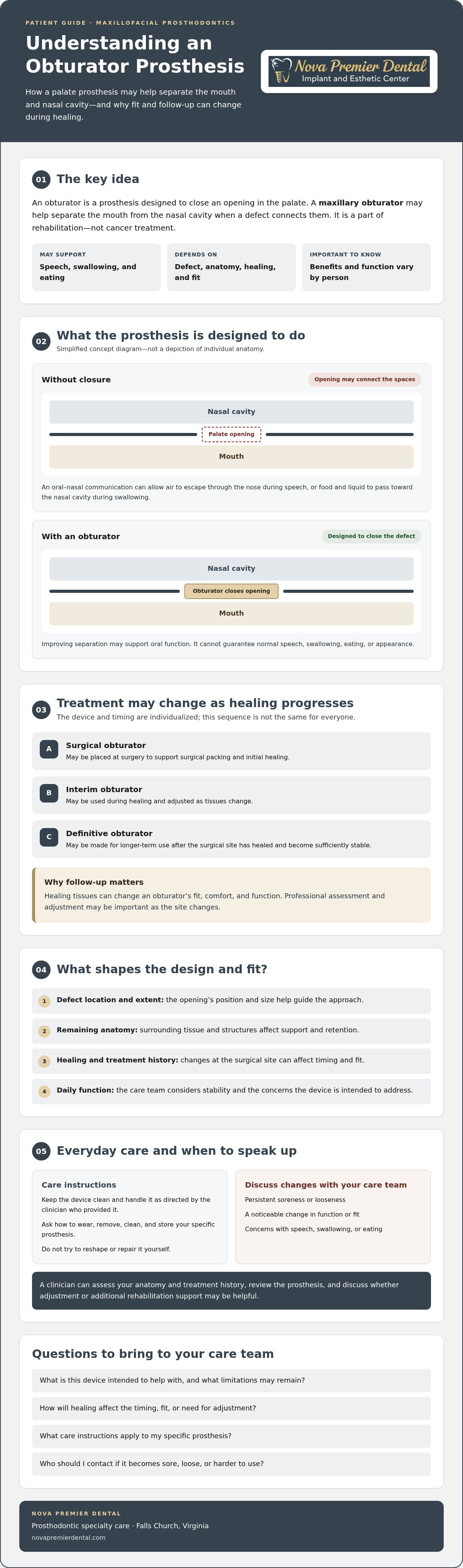
An obturator prosthesis is designed to close an opening in the palate, the roof of the mouth. A maxillary obturator may help separate the mouth from the nasal cavity when a defect connects them. This separation may support speech, swallowing, and eating, although the benefit varies from person to person. In maxillofacial prosthodontics, an obturator may be part of rehabilitation after oral cancer surgery or another condition. It is not cancer treatment.
An opening between the oral and nasal spaces is called an oral-nasal communication. Air may escape through the nose during speech, while food or liquid may pass toward the nasal cavity during swallowing. Surgery for oral cancer, including a maxillectomy that removes part of the upper jaw, is one possible cause. Trauma and congenital conditions may also create defects. The opening’s location and extent, along with the surrounding anatomy, help determine whether an obturator or another approach may be appropriate.
When might someone need a maxillary obturator?
A maxillary obturator may be considered when an opening affects oral function. Whether it is suitable depends on the defect, the patient’s needs, and the treating team’s assessment. Ask the care team what the device is intended to address, what limitations may remain, and how its fit will be reviewed. For background on related services at Nova Premier Dental, see oral cancer rehabilitation.
How Is an Obturator Designed, and What Can It Restore?
Design depends on the defect’s location and extent, the anatomy available to support the device, and the stage of healing. The prosthesis also needs to remain stable during daily activities. A clinician may assess how much tissue remains around the defect and how the device can be retained. A maxillary obturator may help separate the oral and nasal spaces, but its fit and potential benefits depend on the individual’s anatomy and treatment history.
Obturator care may involve different devices as healing progresses:
- Surgical obturator: May be placed at surgery to support surgical packing and initial healing.
- Interim obturator: May be used during healing and adjusted as tissues change.
- Definitive obturator: May be made for longer-term use after the surgical site has healed and become sufficiently stable.
An obturator may support speech or swallowing by improving separation between the oral and nasal spaces, but it can’t guarantee normal function or appearance. Results vary with the defect, remaining structures, healing, and prosthesis fit. An oral cancer prosthesis is part of rehabilitation, not cancer treatment, and the care plan may involve other clinicians.
What affects fit, comfort, and function?
The shape of the defect and surrounding tissues influence how the device fits and stays in place. As tissues heal or change, the prosthesis may need professional adjustment. Contact the treating clinician about persistent soreness, looseness, or difficulty using it. Speech or swallowing concerns are also worth discussing with the care team, which can assess whether additional rehabilitation support may be helpful.
For general information about the Falls Church practice, visit Nova Premier Dental. A clinician must evaluate your anatomy and treatment history to discuss the possible benefits and limitations of an obturator in your case.
What Are the Stages of Obturator Treatment and Ongoing Care?
Obturator treatment generally involves clinical assessment, planning, fitting or fabrication, and follow-up. The care team evaluates the defect, surrounding anatomy, healing, and functional concerns to decide what type of device may be appropriate and when. In some cases, treatment may progress through a surgical device, an interim device during healing, and a longer-term prosthesis. This sequence isn’t the same for everyone.
Follow-up matters because healing tissues can change an obturator’s fit, comfort, and function, making professional assessment and adjustment important. Keep the device clean and handle it as directed by the clinician who provided it. Cleaning methods and instructions for wearing, removing, and storing it can vary, so ask the treating team what applies to your specific prosthesis. Don’t try to reshape or repair it yourself. Report persistent soreness, looseness, or a noticeable change in function.
How does cancer treatment affect rehabilitation planning?
Surgery and other cancer treatments can affect the timing and coordination of rehabilitation. The surgical site needs time to heal, and the care team may consider tissue changes and treatment-related needs when planning an obturator prosthesis. A maxillary obturator may be one part of oral rehabilitation after cancer surgery, but it isn’t cancer treatment. Follow the instructions of your oncology and surgical teams, and ask how prosthetic care fits into your overall plan.
For information about Nova Premier Dental’s oral cancer rehabilitation services, see oral cancer rehabilitation. A prosthodontist with experience in maxillofacial prosthodontics may be involved in complex rehabilitation planning, but a clinician must determine whether a particular service or device is appropriate and available for an individual case.
To learn about the Falls Church practice, visit Nova Premier Dental.
When Should You Discuss Maxillofacial Prosthodontics in Northern Virginia?
A prosthodontic evaluation may be worth discussing if oral anatomy is complex, a prosthesis no longer fits as expected, or concerns with speech, swallowing, eating, or comfort persist. A prosthodontist can assess how the device relates to the defect and remaining structures. This input may be coordinated with surgeons and oncology clinicians as part of a broader care plan; it doesn’t mean every patient needs specialist care.
Nova Premier Dental is a prosthodontic practice in Falls Church serving the Northern Virginia community, including McLean, Great Falls, Arlington, Fairfax, Tysons, and Annandale. Dr. Peterson Huang, a dual board-certified prosthodontist, leads the practice. Learn more about prosthodontic care in Northern Virginia and ask whether an evaluation may be relevant to your situation.
Questions to bring to a prosthodontic evaluation
Consider bringing your treatment history and questions from your oncology or surgical team. You may also want to ask:
- What is the prosthesis intended to address, and what limitations may remain?
- How could healing affect its fit, and when should I ask about adjustments?
- How should I clean, handle, and store this specific device?
- Who will coordinate follow-up with my other clinicians?
These questions can help clarify the device’s role and how care will be coordinated. Whether a particular prosthesis or service is appropriate depends on an individual assessment.
Dr. Peterson Huang is a dual board-certified prosthodontist. You can learn about Dr. Huang’s background and explore Nova Premier Dental, a prosthodontic specialty practice in Falls Church. Contact the practice to ask whether its services may be relevant to your needs.
Take the Next Step With Clear Questions
An obturator prosthesis, such as a maxillary obturator, may help address an opening in the palate and support oral function. As an oral cancer prosthesis, it is part of rehabilitation, not cancer treatment. Its design, fit, and potential benefits depend on the defect, remaining anatomy, and healing, so speech, swallowing, and appearance can’t be predicted without an individual assessment. Follow-up matters as tissues change and adjustments may be needed.
Questions about the device’s goals, limitations, cleaning, and care coordination can help you take an active role in treatment discussions. A prosthodontist may contribute to a coordinated plan with the surgical and oncology teams. Dr. Peterson Huang is a dual board-certified prosthodontist, and Nova Premier Dental provides advanced prosthodontics and oral reconstruction in Falls Church. Ask the practice whether its services are appropriate for your specific obturator-related needs.
If you’d like to learn more about the practice in Falls Church, explore prosthodontic care at Nova Premier Dental. Contact the practice to discuss whether an evaluation may be appropriate for your needs.
Frequently Asked Questions
What is a maxillary obturator prosthesis?
A maxillary obturator is a removable prosthesis that may close an opening involving the upper jaw or palate. By separating oral and nasal spaces, it may support speech and swallowing. Its design and expected benefit depend on the defect’s location and extent, surrounding tissues, treatment history, and clinical findings. A clinician can explain whether this device is appropriate after an individual evaluation.
Is an obturator used after oral cancer surgery?
Yes, an obturator may be considered after surgery creates an opening between the mouth and nasal or sinus spaces. It is a rehabilitation device, not a cancer treatment, and doesn’t replace oncology care. Whether it’s suitable, and when fitting can occur, depends on the operation, healing, anatomy, and recommendations of the surgical and oncology teams.
Can an obturator restore normal speech and swallowing?
An obturator may improve separation between the mouth and nasal spaces, which can help address some speech or swallowing concerns. It can’t guarantee normal function. Outcomes depend on the defect’s size and location, tissue changes, how the prosthesis fits, and other health factors. Follow-up or additional rehabilitation may be recommended based on the patient’s needs and the care team’s assessment.
How is a maxillary obturator fitted?
Fitting generally starts with an assessment of the defect, oral tissues, treatment history, and functional needs. The clinician uses this information to determine a suitable design and evaluate its fit, comfort, and function. Follow-up may be needed. The sequence and timing can differ, especially when surgery or cancer treatment affects healing. The treating team can explain the plan for an individual case.
How do you clean and maintain an obturator?
Clean and store an obturator according to instructions for that specific device. Ask the treating clinician before using an unfamiliar cleaning product or attempting an adjustment. Follow-up visits allow the care team to assess fit and tissue changes. Contact the clinician if the prosthesis becomes painful, damaged, loose, or difficult to use. Patients in Falls Church or elsewhere in Northern Virginia can ask prospective providers about relevant services.
Disclaimer
The information provided on this website and blog is intended for general educational and informational purposes only and should not be considered dental or medical advice, diagnosis, or treatment. Reading content on this website does not establish a doctor-patient relationship with Nova Premier Dental or Dr. Peterson Huang. Dental conditions and treatment needs vary from patient to patient. Individuals should consult directly with a qualified dental professional for personalized evaluation, diagnosis, and treatment recommendations. Do not delay seeking professional dental care based on information found on this website. While we strive to provide accurate and up-to-date information, no guarantee is made regarding the completeness, accuracy, or applicability of the content. Treatment outcomes may vary depending on individual circumstances. If you are experiencing a dental emergency or urgent oral health concern, please contact a licensed dental professional immediately or call 911 in the event of a medical emergency.


