


Article by
Peterson Huang DMD, MS, FACP, FRCDC
Dr. Peterson Huang is a dual board-certified prosthodontist serving Falls Church and Northern Virginia. He has been recognized as a Top Prosthodontist by Northern Virginia Magazine and Arlington Magazine and is affiliated with the Inova Fairfax Hospital Tumor Board. Dr. Huang focuses on dental implants, full mouth reconstruction, and complex restorative dentistry for patients who need advanced, comprehensive care.
The most visibly damaged tooth isn’t always the one that needs to be removed. Whether a compromised tooth can be restored depends on more than its appearance or how much it hurts. Before deciding whether to save a tooth or replace it with an implant, it helps to understand what the examination shows and what each option would involve.
This article explains how clinicians assess tooth prognosis, compare preservation with extraction and replacement, and identify useful questions to ask. You’ll learn which findings can influence a recommendation and what to discuss before making a decision.
Key Takeaways
- For a compromised tooth, the tooth vs implant decision depends on its tooth prognosis and whether it can be restored predictably, not on damage alone. Clarify what supports a recommendation to extract or save the tooth.
- A sound evaluation considers symptoms, examination findings, imaging when indicated, and how much healthy tooth structure remains.
- Compare preserving a tooth, replacing it with an implant, and other suitable restorations by considering function, limitations, and ongoing maintenance.
- Bring focused questions about the diagnosis, alternatives, risks, and what could change the treatment plan to your restorative evaluation.
What makes a tooth compromised, and what does prognosis mean?
A compromised tooth has damage or disease that may affect whether it can be restored and how well it may function over time. “Prognosis” is a clinician’s individualized estimate based on the available findings, not a guarantee or a conclusion drawn from a single test. A crack, deep decay, a large or failing restoration, or changes in gum support can each affect that estimate. A tooth pulp overview explains how inflammation inside the tooth can contribute to symptoms, but pulp health is only one part of the assessment.
Damage alone does not determine whether preserving a tooth is reasonable. The tooth vs implant decision calls for a broader assessment than judging whether to extract or save a tooth based on appearance or pain alone.
Which findings can affect a tooth’s prognosis?
Clinicians consider how much sound tooth structure remains and whether it can support a restoration under everyday biting forces. They also assess the root, surrounding bone and gum support, mobility, and whether a crack is limited to the crown or extends deeper. Previous fillings or crowns matter because they affect how much tooth structure remains and its condition.
Symptoms provide useful information, but they don’t establish restorability by themselves. A tooth with little pain may still have extensive damage, while a painful tooth may have treatment options. An examination and imaging, when indicated, help clarify what symptoms alone cannot.
Why does the planned restoration matter?
For some damaged teeth, a crown can cover and protect the remaining structure. Whether a crown is suitable depends on the tooth’s condition and the design needed to restore its shape and function. Dental crowns and restorative planning involve considering not only the visible damage, but also how the finished restoration will fit into the bite.
Bite forces can affect the plan. For example, bruxism, or habitual clenching and grinding, may place added stress on a tooth and its restoration. The clinician considers these forces alongside the tooth’s remaining support when discussing prognosis and options.
How do clinicians assess whether a compromised tooth can be saved?
Assessment usually follows a sequence: the clinician reviews your dental history and symptoms, examines the tooth and surrounding tissues, considers imaging when indicated, then plans how the tooth could be restored. They may check for decay, visible or suspected cracks, previous treatment, mobility, gum support, and the amount of sound tooth structure that remains.
Imaging can reveal changes around a root or other findings that aren’t visible during an examination. It may not show every crack, however, and an image alone can’t predict how a tooth will perform over time. Diagnostic findings inform a prognosis; they don’t guarantee future performance.
What does a restorative evaluation consider?
The amount and location of remaining tooth structure affect which restoration may be feasible. A tooth with enough sound structure in a usable position may support a different design than one with damage extending below the gumline. Clinicians also consider periodontal support, how opposing teeth meet, and whether there’s enough restorative space for a functional restoration.
Clenching or grinding, known as bruxism, can add force to teeth and restorations, so it may influence planning. If root canal treatment is being considered, the restorative clinician may coordinate with an endodontic provider to assess the tooth and how it could be restored afterward. The American Association of Endodontists explains why preserving a natural tooth may be worth considering when it can be treated and restored.
When might specialist input help?
Prosthodontic input may be useful when restoration is complex, the tooth prognosis is uncertain, or proposed plans differ. A prosthodontist considers the planned restoration alongside bite, support, and function, which can help clarify options before an irreversible decision. Dr. Peterson Huang is a dual board-certified prosthodontist.
For an individualized discussion of restorative options, explore Nova Premier Dental.
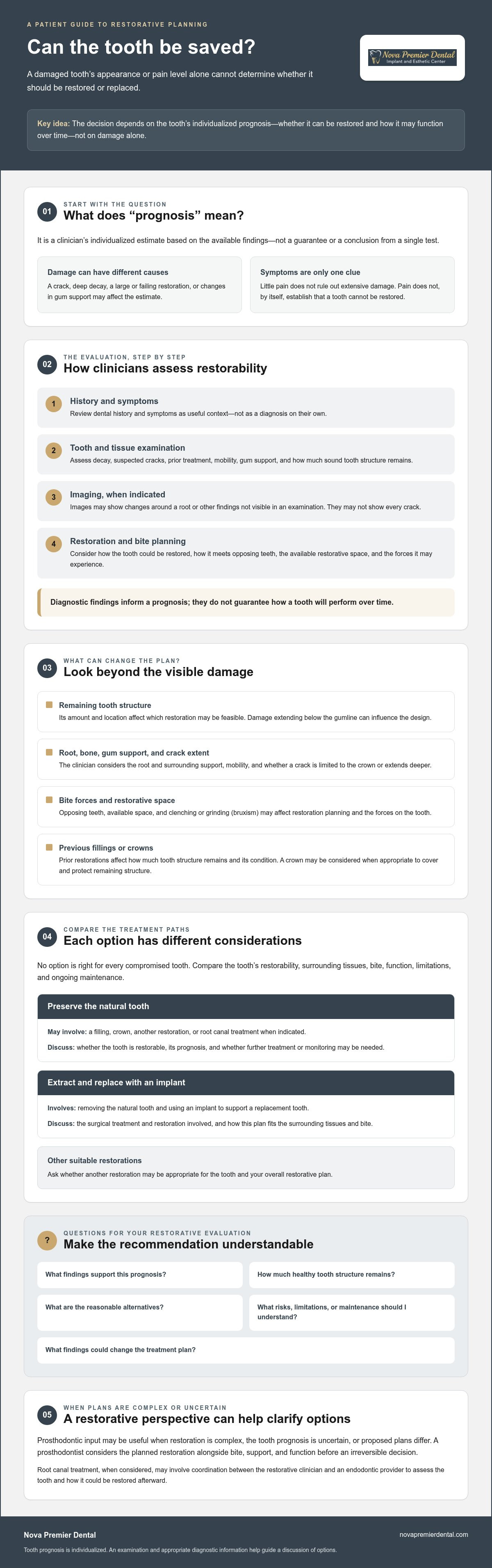
Saving a tooth versus extraction and an implant: how do the options compare?
No option is right for every compromised tooth. The decision depends on whether the tooth can be restored predictably, the condition of the surrounding tissues, and how each plan fits your bite and oral health.
| Option | Potential role | Key considerations |
|---|---|---|
| Preserve the tooth | A filling, crown, or other restoration may be considered; root canal treatment may be part of care when indicated. | Depends on restorability and tooth prognosis. Further treatment and ongoing monitoring may be needed. |
| Extract and replace with an implant | An implant supports a replacement tooth after the natural tooth is removed. | Requires surgical treatment and restorative planning. An implant replaces a missing tooth, but doesn’t reproduce a natural tooth or eliminate maintenance. |
| Other restoration | A tooth-supported bridge or another suitable option may replace a missing tooth in selected cases. | Suitability depends on neighboring teeth, the site, bite, restorative space, and patient needs. |
When might preserving the natural tooth be considered?
If an examination shows that the tooth can support a restoration, preserving it may be a reasonable option. Root canal treatment may be considered when the pulp is affected and the tooth remains restorable. It isn’t appropriate for every damaged tooth, and treatment can involve uncertainty, additional procedures, and continued maintenance. Research comparing root canal and implant outcomes should be interpreted in context, since individual findings and definitions of success vary.
What changes when a tooth is extracted?
Replacement planning starts with the intended result, not just the empty space. The clinician considers the site, neighboring teeth, bite, available restorative space, and your needs. An implant-supported restoration may be an option; a tooth-supported bridge may also be appropriate in some circumstances. Each has distinct treatment and maintenance considerations. Review dental implant treatment options as part of a personalized discussion.
For an individualized comparison of preservation and replacement, explore restorative care at Nova Premier Dental.
How can you make a confident decision about a tooth’s prognosis?
A recommendation should connect the clinical findings with your priorities and a restoration that can function in your bite. If the diagnosis or proposed plan isn’t clear, ask for the reasoning in plain language. For a compromised tooth, the tooth vs implant discussion should explain what supports a recommendation to extract or save the tooth, how uncertain the tooth prognosis remains, and what could change the plan. Before irreversible treatment, you can ask whether further evaluation or a second opinion is appropriate.
Questions to bring to a dental consultation
- What findings affect restorability? Ask about the extent of decay or cracking, remaining sound tooth structure, root condition, and gum and bone support.
- What would preservation involve? Ask which restorative steps may be needed, what uncertainties remain, and what could lead to a different recommendation.
- What are the alternatives? Ask whether extraction and replacement or another restoration could be suitable, and how their risks and maintenance differ.
- How does the planned restoration fit my bite? Ask how bite forces, clenching or grinding, neighboring teeth, and available space affect the design and expected function.
When is a prosthodontic consultation relevant?
A prosthodontic evaluation may be helpful when a tooth’s prognosis is uncertain, several teeth or restorations affect the bite, or replacement planning needs to account for neighboring teeth and restorative space. The purpose is to assess the proposed restoration as part of the overall plan, not to assume that every patient needs specialist care. Dr. Peterson Huang’s prosthodontic training may be relevant to complex restorative decisions.
If you’d like an individualized assessment of a restorative concern, you can learn more about Nova Premier Dental’s Falls Church practice.
Make your next decision with clarity
A damaged tooth’s appearance or pain level alone can’t determine whether it should be preserved. The tooth prognosis depends on clinical findings, the amount of sound structure remaining, and whether a restoration can function in your bite. Comparing a compromised tooth with an implant replacement also means weighing maintenance, treatment needs, and the limits of each option. Before deciding whether to extract or save a tooth, ask your clinician to explain the diagnosis, alternatives, uncertainties, and what could change the recommendation.
For complex restorative decisions, a prosthodontic evaluation may help clarify how the tooth or replacement would fit into your overall bite and treatment plan. Dr. Peterson Huang is a dual board-certified prosthodontist at Nova Premier Dental, a Falls Church practice serving Northern Virginia, including McLean, Great Falls, Arlington, Fairfax, Tysons, and Annandale.
Learn about individualized prosthodontic care at Nova Premier Dental. Contact the practice to discuss an evaluation of your restorative options.
Frequently Asked Questions
Is it better to save a compromised tooth or replace it with an implant?
Neither option is automatically better for every patient. The choice depends on whether the tooth can support a suitable restoration, the condition of its root and periodontal support, bite forces, and the alternatives available. A clinician can explain what preserving the tooth would involve, the uncertainties, and how extraction with replacement compares for your situation.
Can a dentist tell from an X-ray whether a tooth can be saved?
An X-ray provides useful information about roots and surrounding structures, but it can’t determine restorability on its own. Some cracks or structural problems may not be fully visible on imaging. The clinician also considers symptoms, examination findings, remaining tooth structure, gum support, and whether a suitable restoration can be designed to function in your bite.
What happens if I delay deciding about a compromised tooth?
The effect of waiting depends on the cause and severity of the problem. Some conditions may progress, while others may remain stable for a time, so an individual outcome can’t be predicted from a description alone. Ask your clinician what changes to watch for, what follow-up is appropriate, and whether waiting could affect the treatment options available later.
Is a dental implant the same as a natural tooth?
No. An implant is a replacement structure that supports a restoration; it doesn’t reproduce a natural tooth or its tissues. Implant planning considers the condition of the bone and gums, restorative space, bite forces, and the replacement’s design. Implants also require ongoing care and maintenance. Ask your clinician to compare these considerations with preserving your natural tooth.
When should I seek a prosthodontic opinion about a tooth prognosis?
A prosthodontic opinion may be useful if a tooth has extensive damage, previous restorations, uncertain restorability, or several possible replacement plans. Prosthodontists have advanced training in restorative and replacement treatment planning, though not everyone needs specialist care. Nova Premier Dental is a prosthodontic specialty practice in Falls Church serving patients throughout Northern Virginia. Dr. Peterson Huang is a dual board-certified prosthodontist.
Disclaimer
The information provided on this website and blog is intended for general educational and informational purposes only and should not be considered dental or medical advice, diagnosis, or treatment. Reading content on this website does not establish a doctor-patient relationship with Nova Premier Dental or Dr. Peterson Huang. Dental conditions and treatment needs vary from patient to patient. Individuals should consult directly with a qualified dental professional for personalized evaluation, diagnosis, and treatment recommendations. Do not delay seeking professional dental care based on information found on this website. While we strive to provide accurate and up-to-date information, no guarantee is made regarding the completeness, accuracy, or applicability of the content. Treatment outcomes may vary depending on individual circumstances. If you are experiencing a dental emergency or urgent oral health concern, please contact a licensed dental professional immediately or call 911 in the event of a medical emergency.


