


Article by
Peterson Huang DMD, MS, FACP, FRCDC
Dr. Peterson Huang is a dual board-certified prosthodontist serving Falls Church and Northern Virginia. He has been recognized as a Top Prosthodontist by Northern Virginia Magazine and Arlington Magazine and is affiliated with the Inova Fairfax Hospital Tumor Board. Dr. Huang focuses on dental implants, full mouth reconstruction, and complex restorative dentistry for patients who need advanced, comprehensive care.
What if the primary obstacle to restoring your smile isn't the health of the tooth itself, but the literal gap between your upper and lower jaws? It's often confusing when a dentist explains that you have limited restorative space, especially when you're eager to complete a treatment and move on. You might worry about why a standard crown space isn't immediately available or fear that any restoration placed in a tight spot will eventually chip or fail. We understand that these delays feel like setbacks, but precision at this stage is what prevents screw loosening and prosthetic fractures later.
This article explains how a prosthodontist in Northern Virginia evaluates restorative space to ensure your implant restoration remains durable under the heavy forces of your bite. We will discuss clinical solutions for inadequate vertical clearance, including bite opening and the use of high-strength materials. You will discover how the specialized diagnostic approach taken by Dr. Peterson Huang at Nova Premier Dental helps correct complex anatomical challenges. By understanding these biomechanical requirements, you can feel confident in a treatment plan designed for longevity rather than just a temporary fix.
Key Takeaways
- Understand why restorative space is the foundation of a successful crown or implant, providing the necessary physical height for durable prosthetic materials.
- Identify how common issues like bruxism or teeth drifting into old extraction sites can compromise your vertical clearance and lead to restoration failure.
- Learn how a prosthodontist manages limited restorative space through specialized implant restoration designs, such as screw-retained crowns that require less vertical height.
- Discover the role of diagnostic wax-ups and digital articulators in planning complex bite reconstructions to safely restore lost vertical dimension.
What Is Restorative Space in Crown and Implant Dentistry?
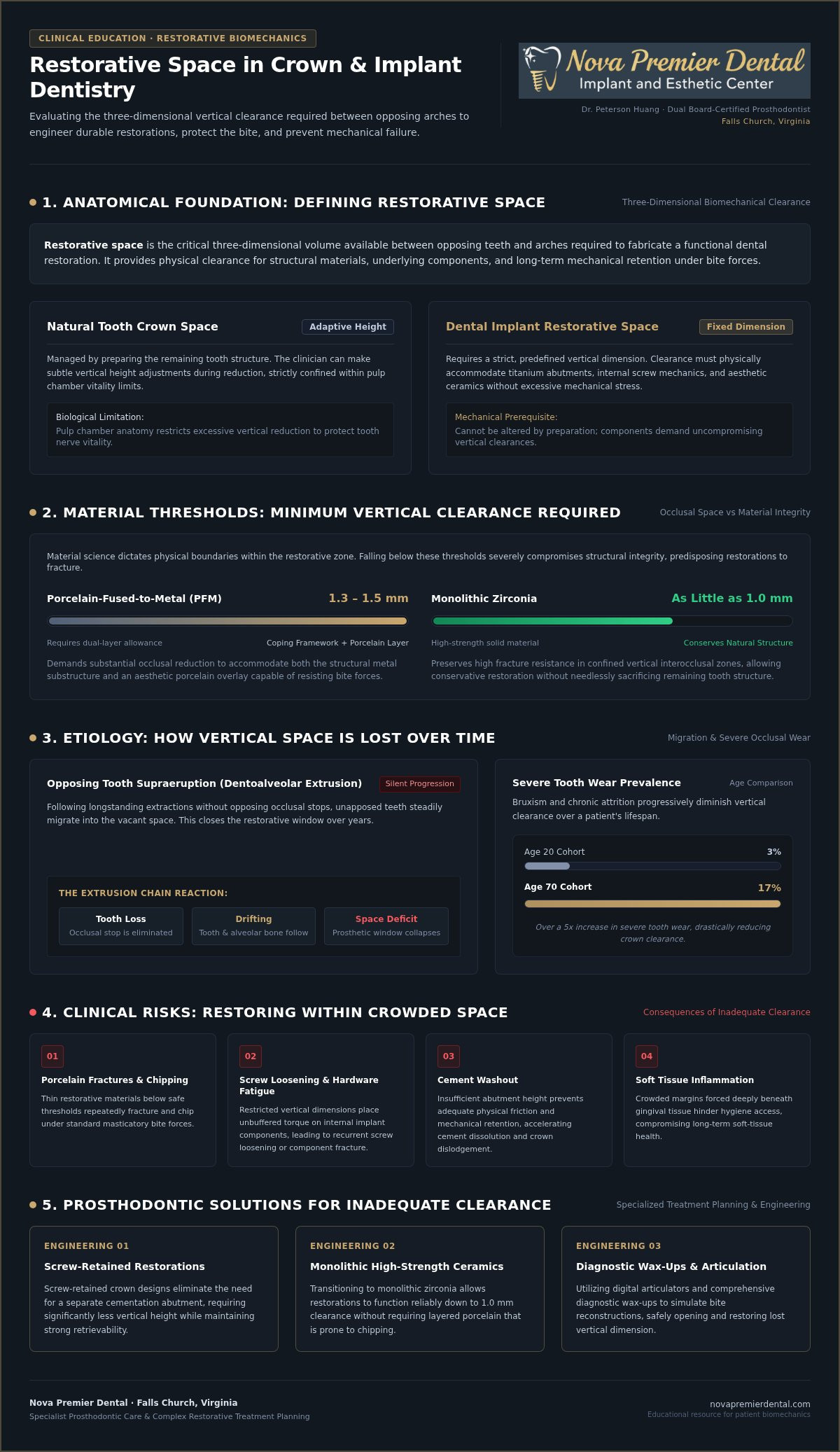
Restorative space is the three dimensional volume available between opposing teeth and arches to construct a functional dental restoration. It's not merely an empty gap; it represents the critical physical clearance required for dental materials, underlying structural components, and long term mechanical retention. When a patient presents with limited restorative space, the structural integrity of the prosthetic teeth is severely compromised. Inadequate space often forces material thicknesses below safe thresholds, which leads to porcelain fracturing, compromised aesthetics, and poor hygiene access that threatens the surrounding soft tissues.
Natural Tooth Crown Space vs. Dental Implant Restorative Space
Managing a natural Crown (dentistry) involves preparing the remaining tooth structure. The clinician can make subtle vertical height adjustments during tooth reduction, provided the adjustments remain safely outside the limits of pulp chamber vitality. Conversely, an implant restoration demands a strict, predefined vertical dimension. Implants require fixed clearance to accommodate titanium abutments, internal screw mechanics, and the overlying ceramic material without placing undue stress on the implant fixture itself.
Minimum Dimensions Required for Restorative Longevity
Material science dictates the exact dimensions needed within the crown space. Traditional porcelain fused to metal options require a total occlusal reduction of 1.3 to 1.5 mm to accommodate both the metal framework and the aesthetic porcelain layer. Modern monolithic zirconia restorations can function with reduced clearance, sometimes requiring as little as 1.0 mm of occlusal space. This high strength material preserves fracture resistance in tight spaces, allowing a board certified prosthodontist to protect the bite without unnecessarily sacrificing remaining tooth structure or jeopardizing the longevity of the restoration.
Causes and Clinical Risks of Limited Restorative Space
Understanding why limited restorative space occurs is the first step in avoiding prosthetic failure. Often, this condition develops silently over several years. One primary cause is the supraeruption of an opposing tooth following a longstanding extraction. Without a functional partner to provide occlusal stops, the unapposed tooth drifts into the empty gap. This migration doesn't just involve the tooth; the alveolar bone and soft tissue often follow, significantly narrowing the available window for a future implant restoration.
How Opposing Teeth Migrate into Empty Spaces
When teeth move occlusally, they steadily close the prosthetic window. This process, known as dentoalveolar extrusion, complicates the planning for a new crown or bridge. If left unaddressed, the lack of crown space makes it impossible to achieve a natural looking result without first correcting the position of the drifted tooth. Patients often don't realize their bite has shifted until they seek tooth replacement. Clinical studies show that severe tooth wear, another major factor, increases from 3% at age 20 to 17% by age 70, further reducing the vertical clearance needed for restorations.
Biomechanical Failures Caused by Crowded Interocclusal Space
Attempting to place a restoration in a crowded area invites significant biomechanical risks. Thin restorative materials are prone to recurrent ceramic chipping and porcelain fractures under normal chewing forces. In implant cases, insufficient abutment height often leads to cement washout, recurrent screw loosening, or even fracture of the internal implant components. Beyond mechanical issues, crowding can force restorative margins too deep into the gingival tissues, triggering chronic inflammation.
If you suspect your bite has changed, Dr. Peterson Huang can perform a comprehensive evaluation to assess your restorative space and prevent these complications. Meticulous planning at our Falls Church office ensures that your treatment addresses both the cause and the symptoms of bite collapse.
Prosthodontic Solutions for Inadequate Restorative Clearance
Managing limited restorative space demands a transition from standard dentistry to restorative engineering. When the vertical gap is insufficient, we don't simply thin the material, as this often leads to premature fracture. Instead, we use systematic methods to regain clearance, such as enameloplasty. This process involves the gentle recontouring of the opposing teeth to level the biting plane and create a more predictable environment for your new restoration.
Screw-Retained Restorations and Modern Material Engineering
The choice of implant restoration design is a critical factor in long term success. Screw-retained crowns are particularly advantageous in restricted areas because they bypass the need for a bulky abutment, requiring only 4 to 5 mm of vertical height. This is significantly less than the 7 to 8 mm needed for cement-retained designs. By utilizing monolithic zirconia, which retains its integrity even at 1.0 mm of thickness, we can provide durable dental crowns that withstand significant occlusal pressure without chipping.
Pre-Restorative Therapies: Surgery, Orthodontics, and Enameloplasty
Sometimes, the issue lies with the foundation rather than the teeth themselves. Clinical crown lengthening surgery allows us to reposition the gum and bone levels to expose more healthy tooth structure, creating the necessary crown space for a secure fit. If a tooth has drifted too far into an empty space, minor restorative orthodontic intrusion can move it back into its correct position. These specialized therapies ensure we don't have to compromise on the structural integrity of your smile. Meticulous planning at this stage is what differentiates a temporary fix from a lasting solution.
If you've been told you don't have enough room for a crown, schedule a specialty evaluation at Nova Premier Dental to discuss these clinical solutions for your restorative space concerns.
Comprehensive Treatment Planning and Specialist Evaluation
Resolving limited restorative space requires a meticulous diagnostic approach before any clinical work begins. We utilize diagnostic wax-ups and digital articulators to simulate proposed bite modifications, allowing us to visualize the final outcome in a three dimensional space. This predictive workflow ensures that the final implant restoration has the necessary clearance to function without compromising your comfort or jaw joint health. By identifying spatial constraints early, we can avoid the trial and error often associated with complex restorative cases.
When Limited Space Involves Full-Mouth Occlusal Changes
In cases of widespread dental wear or bite collapse, restoring a single tooth is rarely sufficient. These situations often necessitate a comprehensive increase in the vertical dimension of occlusion (VDO) to create adequate crown space throughout the entire arch. Through dedicated oral reconstruction protocols, we can systematically rebuild the bite, ensuring that every restoration is supported by a stable and functional foundation. This holistic approach prevents the localized failures that occur when restorations are forced into a collapsed bite.
The Role of Prosthodontic Specialty Care in Northern Virginia
Managing the intersection of biomechanics and aesthetics requires specialized knowledge. Prosthodontists complete three additional years of post-doctoral training focused on complex occlusal dynamics and full mouth rehabilitation. Dr. Peterson Huang's training and background as a dual board-certified specialist provide him with the expertise to manage even the most challenging anatomical limits. For patients requiring dental implants or complex crowns, consulting with a board-certified prosthodontist in Northern Virginia ensures a predictable result based on sound clinical reasoning. If you're facing a complex restorative challenge, our Falls Church practice is dedicated to providing the specialized care necessary for a functional, lasting smile.
Securing Your Restorative Success
Achieving a durable result begins with recognizing that restorative space is a functional requirement, not just a matter of aesthetics. Clearance matters. We've explored how identifying the causes of bite collapse and utilizing specialist techniques like screw-retained designs can overcome limited restorative space. By prioritizing a comprehensive diagnostic evaluation, you ensure that your crown space or implant restoration is built to withstand the daily forces of chewing. Dr. Peterson Huang's dual board-certified leadership ensures that every treatment plan is tailored to your unique anatomy and long term function. If you have questions about a complex restorative or prosthodontic concern, Nova Premier Dental in Falls Church provides prosthodontic specialty care for patients throughout Northern Virginia. We look forward to helping you regain a stable, comfortable, and functional smile that stands the test of time.
Frequently Asked Questions
What is the minimum space required for a dental implant crown?
The minimum vertical clearance for a dental implant crown depends on the retention method used. A screw-retained restoration typically requires at least 4 to 5 mm of space from the implant platform to the opposing teeth. Cement-retained designs generally demand more room, often needing 7 to 8 mm to accommodate the abutment and material. Our diagnostic process ensures these measurements are precise to prevent mechanical failure.
Can you place a crown if there is not enough vertical space?
Placing a crown without adequate vertical clearance is generally not recommended because it leads to thin, fragile materials that easily fracture. If the crown space is insufficient, a prosthodontist must first regain clearance through clinical interventions. These may include recontouring opposing teeth, surgical crown lengthening, or orthodontic intrusion. Neglecting these steps often results in recurrent chipping and the eventual failure of the restoration.
What causes teeth to lose vertical space over time?
Several factors contribute to the gradual loss of limited restorative space, most notably severe tooth wear and supra-eruption. Bruxism, or chronic teeth grinding, can wear down enamel until the bite collapses. Research shows severe wear affects approximately 17% of adults by age 70. Additionally, when a tooth is lost, the opposing tooth may drift into the empty gap, steadily closing the vital prosthetic window.
How does a screw-retained crown help when space is limited?
A screw-retained implant restoration is often the preferred solution in tight spaces because it eliminates the need for a separate cementation abutment. By integrating the crown directly with the implant fixture, we can achieve a functional result in as little as 4 mm of vertical height. This design also provides easier maintenance and retrievability, making it a reliable choice for patients with restricted interocclusal clearance.
Is crown lengthening always required for short clinical teeth?
Crown lengthening is a common surgical tool to increase retention, but it isn't always mandatory. In some cases, we can utilize high strength materials like monolithic zirconia that function well in thinner cross sections. Other alternatives include minor enameloplasty on opposing teeth or opening the overall bite to increase vertical dimension. The choice depends on the specific biomechanical needs of the tooth and the patient's goals.
Disclaimer
The information provided on this website and blog is intended for general educational and informational purposes only and should not be considered dental or medical advice, diagnosis, or treatment. Reading content on this website does not establish a doctor-patient relationship with Nova Premier Dental or Dr. Peterson Huang. Dental conditions and treatment needs vary from patient to patient. Individuals should consult directly with a qualified dental professional for personalized evaluation, diagnosis, and treatment recommendations. Do not delay seeking professional dental care based on information found on this website. While we strive to provide accurate and up-to-date information, no guarantee is made regarding the completeness, accuracy, or applicability of the content. Treatment outcomes may vary depending on individual circumstances. If you are experiencing a dental emergency or urgent oral health concern, please contact a licensed dental professional immediately or call 911 in the event of a medical emergency.


