


Article by
Peterson Huang DMD, MS, FACP, FRCDC
Dr. Peterson Huang is a dual board-certified prosthodontist serving Falls Church and Northern Virginia. He has been recognized as a Top Prosthodontist by Northern Virginia Magazine and Arlington Magazine and is affiliated with the Inova Fairfax Hospital Tumor Board. Dr. Huang focuses on dental implants, full mouth reconstruction, and complex restorative dentistry for patients who need advanced, comprehensive care.
Feeling unexpected movement while chewing rarely means your dental implant has failed in the jawbone. If you are currently experiencing a loose implant crown, implant screw loosening, or a loose implant restoration, it is completely natural to fear that the entire foundation has detached. That sudden instability can make eating uncomfortable and leave you wondering whether you are facing an urgent dental emergency. In most situations, the integrated titanium fixture beneath your gumline remains entirely secure; the issue is almost always a mechanical complication involving the prosthetic screw or abutment joint above it.
In this guide, you will learn why dental implant restorations become loose, practical steps to protect the delicate internal screw threads from permanent damage, and how targeted prosthodontic evaluation safely resolves recurrent stability problems. We will explore the critical differences between bone osseointegration loss and prosthetic component wear so you know exactly what to do next.
Key Takeaways
- A loose implant restoration almost always stems from internal prosthetic screw loosening or cement washout rather than true bone integration loss.
- Unchecked bite forces and nighttime bruxism exert continuous lateral stress, accelerating mechanical wear on retention components.
- Stop chewing immediately on the unstable side and avoid DIY glues or tightening to protect delicate internal screw threads from irreversible damage.
- Specialized prosthodontic evaluation uses periapical imaging and precision torque instruments to diagnose root causes and securely retorque or replace components.
Recognizing a Loose Implant Crown: Fixture Failure vs. Prosthetic Loosening
When an artificial tooth shifts, patients often assume the entire replacement has failed. Fortunately, true integration failure is far less common than mechanical detachment. Distinguishing between a compromised surgical fixture and a loose implant restoration requires understanding how these complex assemblies stay anchored.
The Three Components of an Implant-Supported Tooth
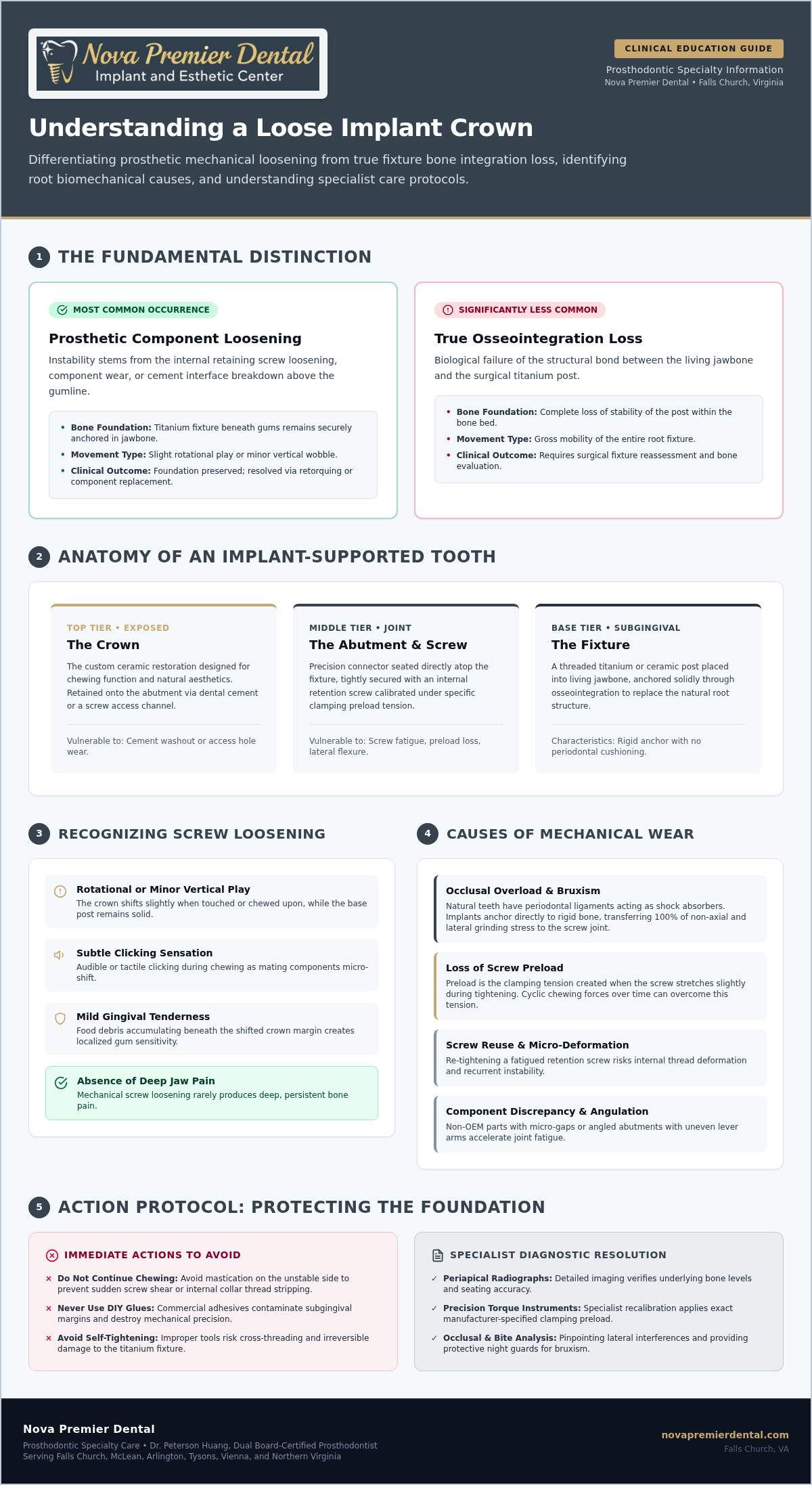
An implant-supported tooth relies on three discrete parts working in harmony. To understand what a dental implant is, consider its structural anatomy:
- The Fixture: A threaded titanium or ceramic post placed into living bone, anchoring via osseointegration.
- The Abutment: A precision connector seated directly atop the fixture, secured with an internal retention screw.
- The Crown: The visible ceramic restoration that restores normal chewing and aesthetics, retained via dental cement or a screw channel.
Signs That Point to Screw Loosening Rather Than Bone Loss
A loose implant crown usually displays slight rotational play or minor vertical movement while the base remains rock-solid. You might feel a subtle click while chewing or notice mild gum tenderness from food debris accumulating beneath the shifted margin. Notably, this mechanical instability rarely causes deep, persistent jaw pain.
True osseointegration failure, by contrast, involves gross mobility of the surgical post itself within the bone bed. At our Falls Church clinic, detailed in this overview of Nova Premier Dental, diagnostic periapical radiographs verify whether underlying bone levels remain intact. As dual board-certified prosthodontist Dr. Peterson Huang frequently observes during clinical assessments, addressing implant screw loosening promptly prevents continuous micro-movement from stripping delicate internal collar threads or causing sudden screw shear, preserving the foundation for simple retorquing.
Common Causes of Implant Screw Loosening and Restorative Wear
A prosthetic connection experiences tremendous functional demand with every bite. When an implant screw loosening event occurs, the breakdown usually stems from mechanical fatigue rather than random failure. Identifying these triggers prevents repetitive looseness and protects the internal assembly.
Occlusal Overload and Parafunctional Grinding Habits
Natural teeth sit suspended within periodontal ligaments that serve as shock absorbers, giving microscopic cushioning under heavy loads. Implants, however, anchor directly into rigid bone with zero flexibility. Consequently, occlusal forces transfer entirely to the prosthetic interface. Chronic grinding or clenching introduces non-axial, lateral forces that flex the restoration. Over time, this rocking action creates screw fatigue, often requiring diagnostic bite adjustments or custom night guards to neutralize excessive nighttime tension.
Screw Preload, Component Wear, and Manufacturing Discrepancies
Stability relies on screw preload, which is the tension generated when an internal screw stretches slightly to clamp the abutment to the fixture. If a retaining screw settles or experiences repeated flexure, that clamping tension dissipates:
- Loss of Preload: Cyclic mastication slowly overcomes the initial clamping torque, resulting in a loose implant restoration.
- Screw Reuse: Re-tightening an already fatigued screw risks microscopic thread deformation and recurrent detachment.
- Component Mismatch: Non-OEM or third-party abutments frequently lack exact manufacturing tolerances, leaving micro-gaps that invite joint instability.
- Suboptimal Angulation: Angled abutments create uneven lever arms that accelerate mechanical wear.
Following established prosthodontic guidelines ensures that each mechanical connection receives systematic evaluation. If your crown repeatedly wobbles, a comprehensive bite evaluation at our Falls Church dental practice can pinpoint whether bite forces or worn hardware are causing the instability.
What to Do Immediately When Your Implant Crown Moves
Discovering unexpected movement in a dental restoration requires swift, deliberate action. How you handle a loose implant crown in the initial hours directly affects whether the fix remains simple or escalates into complex mechanical repair.
Immediate Precautions to Protect the Implant Fixture
Protecting the internal joint integrity is your primary priority. If you detect movement, adopt these protective habits right away:
- Cease Chewing: Transfer all chewing to the opposite side of your mouth. Chewing on an unstable crown acts like a crowbar against the internal retention screw.
- Adopt a Soft Diet: Avoid sticky, crunchy, or dense foods that exert heavy lateral tension.
- Avoid Manual Testing: Resist the urge to wiggle the restoration with your tongue or fingers; continuous rocking promotes screw fatigue and thread deformation.
- Rinse Gently: Maintain cleanliness around the shifted margin using warm salt water rinses rather than aggressive brushing or flossing.
Why At-Home Repairs and Commercial Adhesives Cause Severe Damage
Never attempt to resolve implant screw loosening with commercial superglues, hardware tools, or over-the-counter dental cements. Household adhesives introduce toxic chemicals that trigger severe peri-implant soft-tissue inflammation and bone loss. Attempting to force or tighten components yourself easily leads to cross-threading, stripping the internal bore of the surgical fixture. When a weakened screw shears flush inside the implant collar, retrieving that fractured fragment demands microscopic retrieval techniques that risk permanent post damage.
If the restoration detaches completely, place it in a clean, rigid container and bring it to your clinical visit. Leaving an implant platform exposed allows adjacent gum tissue to collapse over the collar within days, complicating reattachment. If your restoration shifts or rocks, promptly contact our Falls Church specialty team to secure an evaluation before internal mechanical damage develops.
Prosthodontic Evaluation and Repair: How Specialists Restore Stability
Resolving chronic mobility requires more than simply tightening hardware until it feels snug. When addressing a loose implant crown, specialists systematically evaluate mechanical components, internal screw threads, and dynamic chewing patterns to ensure enduring stability.
Diagnostic Steps: Radiographs, Thread Inspection, and Torque Control
Diagnostic evaluation begins with targeted periapical imaging. Radiographs confirm complete seating of the abutment base against the implant collar while verifying that crestal bone levels remain undisturbed around the platform. Once verified, the clinician accesses the retention chamber:
- Screw Inspection: The retaining screw is removed and examined under magnification for thread distortion, micro-fractures, or stripping. Fatigued fasteners are discarded rather than reused.
- Internal Thread Cleansing: The female threads inside the implant body are cleared of biological debris or residual cement to guarantee passive seating.
- Calibrated Torque Delivery: Using mechanical torque drivers, the clinician secures a brand-new retaining screw to the exact Newton-centimeter (Ncm) rating specified by the manufacturer, establishing optimal preload without overstressing titanium joints.
Occlusal Adjustments and Long-Term Prosthetic Redesign
Mechanical complications frequently stem from minor occlusal interferences. A prosthodontist evaluates your complete arc of closure using articulating film to identify heavy contact points during lateral excursions. Equilibrating these premature contacts shields the crown from lateral shearing forces that otherwise cause recurring implant screw loosening.
In cases involving legacy cement-retained restorations that continually detach, converting to a retrievable screw-retained crown offers an effective solution. This design provides immediate access for future servicing without damaging the ceramic exterior. For patients throughout the region, pursuing specialized prosthodontic care in Northern Virginia provides access to detailed occlusal analysis and component maintenance tailored to challenging restorative situations.
Protecting Your Restorative Investment and Long-Term Stability
Experiencing a loose implant restoration can feel alarming, but prompt clinical care keeps a routine mechanical issue from escalating into irreversible fixture damage. By avoiding pressure on the unstable crown, skipping hazardous home adhesives, and seeking professional diagnostics, you safeguard the underlying bone foundation. Resolving repeated implant screw loosening requires identifying subtle bite discrepancies and securing components using calibrated torque instrumentation rather than guesswork.
If you are experiencing movement, localized irritation, or chewing difficulties around your dental work, contact Nova Premier Dental in Falls Church for a comprehensive assessment. Led by dual board-certified prosthodontist Dr. Peterson Huang, our team specializes in complex restorative revisions, occlusal rehabilitation, and long-term implant maintenance across Northern Virginia. With precise evaluation and individualized adjustments, you can restore full chewing function and enjoy complete confidence in your smile.
Frequently Asked Questions
Can a loose implant crown damage the underlying dental implant?
Yes, continued chewing on an unstable restoration transfers heavy bending forces directly to the internal assembly. This recurring mechanical stress can deform the retaining screw threads, cause the screw to shear off inside the collar, or gouge the internal mating connection. Resolving a loose implant crown early prevents minor component fatigue from developing into permanent fixture damage.
Is a loose implant crown considered a dental emergency?
While an unstable prosthetic is rarely life-threatening, it does require timely professional attention. Without prompt intervention, adjacent gum tissue can quickly collapse over the exposed implant shoulder, or the loose restoration might detach completely and become an aspiration hazard. Seeking care within a few business days prevents the need for minor soft-tissue surgery during reattachment.
How does a prosthodontist fix a loose screw-retained crown?
A prosthodontist carefully removes the composite access filling on the chewing surface to inspect the internal retention screw under magnification. The clinician flushes away accumulated oral debris, verifies component fit with periapical radiographs, and inserts a brand-new factory-calibrated screw. Using a calibrated torque wrench, the fastener is secured to exact manufacturer specifications before resealing the access channel.
Why do dental implant crowns come loose years after placement?
Implants lack natural periodontal ligaments, meaning they absorb millions of chewing cycles without natural shock absorption. Over several years, subtle shifts in adjacent natural teeth, unconscious night grinding, or gradual preload loss can trigger implant screw loosening. Periodic prosthodontic examinations ensure dynamic bite forces remain balanced as your natural dentition ages.
Can I still eat while my implant crown is loose?
You should immediately avoid chewing on the affected side of your mouth until a clinician evaluates the restoration. Eating foods that require grinding or heavy biting forces can bend the internal retention screw or crack the ceramic margin. Stick entirely to a soft diet and avoid manipulating the crown with your tongue or fingers.
Disclaimer
The information provided on this website and blog is intended for general educational and informational purposes only and should not be considered dental or medical advice, diagnosis, or treatment. Reading content on this website does not establish a doctor-patient relationship with Nova Premier Dental or Dr. Peterson Huang. Dental conditions and treatment needs vary from patient to patient. Individuals should consult directly with a qualified dental professional for personalized evaluation, diagnosis, and treatment recommendations. Do not delay seeking professional dental care based on information found on this website. While we strive to provide accurate and up-to-date information, no guarantee is made regarding the completeness, accuracy, or applicability of the content. Treatment outcomes may vary depending on individual circumstances. If you are experiencing a dental emergency or urgent oral health concern, please contact a licensed dental professional immediately or call 911 in the event of a medical emergency.


