


Article by
Peterson Huang DMD, MS, FACP, FRCDC
Dr. Peterson Huang is a dual board-certified prosthodontist serving Falls Church and Northern Virginia. He has been recognized as a Top Prosthodontist by Northern Virginia Magazine and Arlington Magazine and is affiliated with the Inova Fairfax Hospital Tumor Board. Dr. Huang focuses on dental implants, full mouth reconstruction, and complex restorative dentistry for patients who need advanced, comprehensive care.
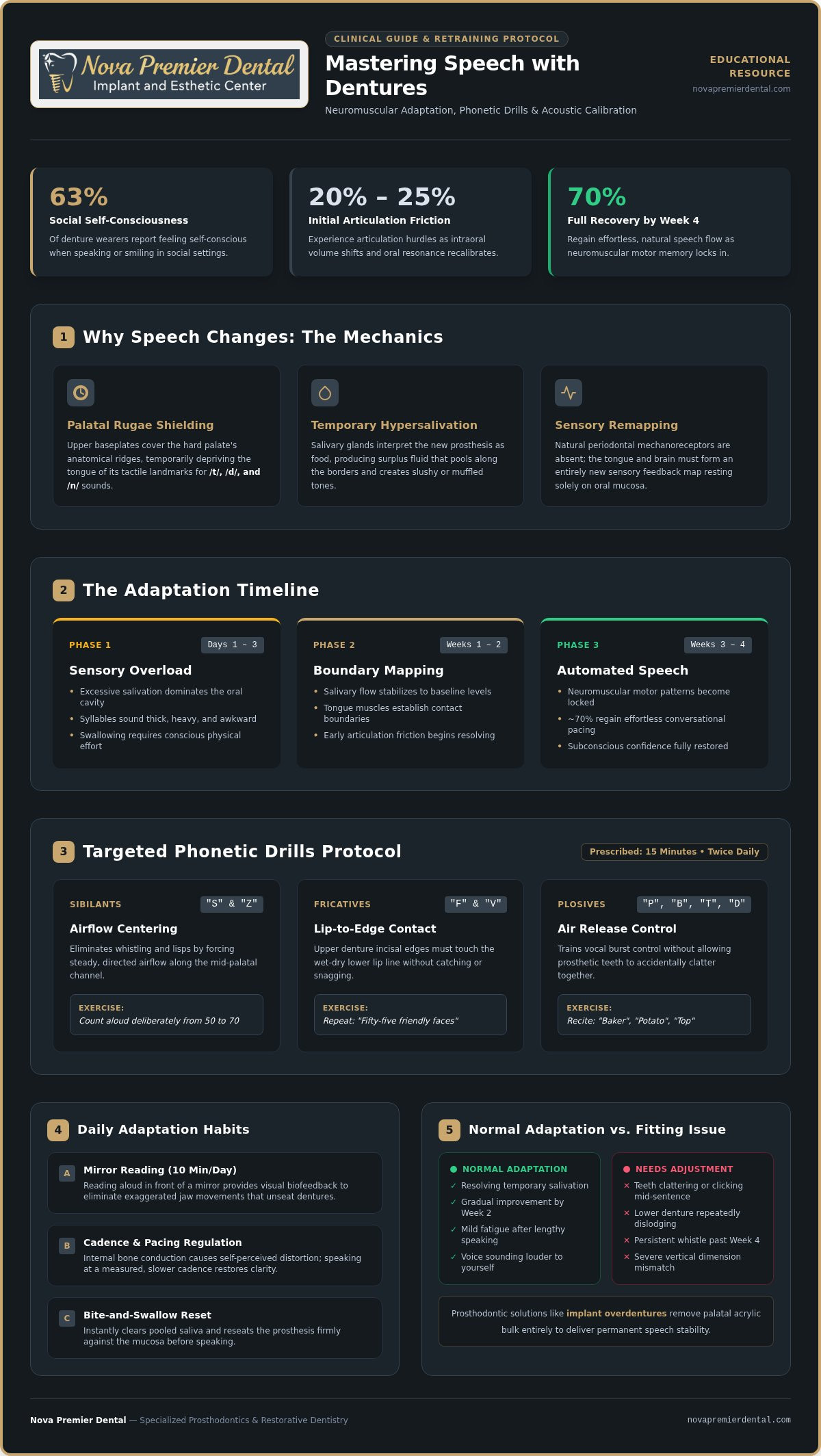
According to national patient surveys, roughly 63% of denture wearers experience persistent self-consciousness about speaking or smiling in social settings. If you find yourself mumbling through meetings, battling excess salivation, or dreading an embarrassing click mid-sentence, learning how to talk with dentures can feel like learning an entirely new language. You aren't imagining the physical challenge; the acrylic base naturally reduces intraoral volume, forcing your tongue and facial muscles to recalibrate their boundaries.
It is completely understandable to worry that your teeth might slip or to feel exhausted after brief conversations. Fortunately, clear speech is well within reach. By applying targeted phonetic drills and understanding how your prosthesis interacts with your oral anatomy, you can eliminate whistling and master difficult consonants without hesitation. Below, we provide a specialist's step-by-step vocal retraining guide, outline normal adaptation milestones, and explain precisely when speech distortion signals the need for a clinical adjustment or implant stabilization.
Key Takeaways
- Understand how acrylic baseplates alter oral acoustics and why your neuromuscular pathways need deliberate practice to adapt.
- Discover practical phonetic drills for how to talk with dentures without whistling, lisping, or muffling tricky consonant sounds.
- Adopt simple daily habits, including the bite-and-swallow reset and vocal pacing, to control excess saliva and prevent jaw fatigue.
- Recognize whether persistent clicking, slippage, or speech distortion stems from standard adjustment or a mechanical fitting issue.
- Learn how advanced prosthodontic solutions like implant-supported overdentures eliminate palatal coverage to deliver permanent speech stability.
Why Speech Changes with New Dentures and What to Expect
Speech is a delicate aerodynamic process. When you speak, your vocal cords generate sound waves, but your tongue, lips, hard palate, and natural teeth shape those waves into distinct syllables. Placing a removable prosthesis instantly reconfigures this acoustic chamber. Clinical studies indicate that 20% to 25% of new denture wearers encounter articulation difficulties during the initial adjustment period. Learning how to talk with dentures requires an understanding of how these mechanical changes alter oral resonance.
Your salivary glands initially interpret the prosthesis as food, triggering temporary hypersalivation. This excess fluid pools along the borders, creating a muffled or slushy sound during conversation. Simultaneously, the brain must recalibrate its motor control. Natural teeth contain periodontal ligament mechanoreceptors that provide feedback on biting force and position. Because dentures rest directly on the mucosa, your tongue must establish an entirely new sensory map to pronounce familiar sounds.
The Neuromuscular Adaptation Timeline
Speech rehabilitation follows a well-documented physiological progression as oral tissues adapt:
- Days 1 to 3: Sensory overload and elevated salivation dominate. Syllables feel thick, and swallowing feels awkward.
- Weeks 1 to 2: Saliva production normalizes. Tongue muscles begin mapping the new oral boundaries, resolving early articulation friction.
- Weeks 3 to 4: Approximately 70% of wearers regain fluid, effortless speech as neuromuscular patterns lock in.
How Acrylic Palates and Baseplates Alter Sound Formation
The biomechanics of a prosthesis directly dictate how air travels through your mouth. An upper denture covers the anatomical rugae of the hard palate. These tissue ridges serve as primary tactile markers when the tongue produces linguopalatal sounds such as /t/, /d/, and /n/. When smooth acrylic shields these landmarks, the tongue loses its natural traction, leading to temporary slurring. Understanding how dentures affect articulation reveals why acrylic thickness matters so profoundly.
Lower dentures introduce a different obstacle by reducing space in the sublingual floor, which can cause the tongue to dislodge the appliance during rapid speech. Additionally, if the prosthetic teeth alter your vertical dimension of occlusion, air escape channels change, producing lisps or whistles. Seeking specialized dentures and partial dentures crafted with minimized palatal bulk ensures your tongue retains maximal space, drastically reducing the time it takes to master how to talk with dentures comfortably.
Practical Speech Exercises to Master Talking with Dentures
Mastering conversational clarity requires targeted muscle retraining rather than passive waiting. Just as an athlete builds muscle memory through structured repetitions, your oral musculature needs deliberate exercise to navigate prosthetic teeth. Committing to a daily vocal regimen helps you learn how to talk with dentures smoothly, restoring enunciation and preventing social hesitation.
Targeted Drills for Sibilants, Fricatives, and Plosives
Certain consonant groupings present predictable challenges due to the specific air channels they require. Dedicating fifteen minutes twice daily to isolated phonetic repetitions trains your tongue to find its new points of contact:
- Sibilants ("S" and "Z"): Count aloud from 50 to 70. This sequence forces continuous airflow along the center of the palate, eliminating whistling and correcting lisps.
- Fricatives ("F" and "V"): Recite phrases like "fifty-five friendly faces." Ensure the incisal edges of your upper denture gently touch the wet-dry border of your lower lip without snagging.
- Plosives ("P", "B", "T", "D"): Repeat explosive words such as "baker," "potato," and "top." Focus on releasing air without allowing prosthetic teeth to clatter together.
Reading Aloud and Cadence Regulation Strategies
Spend ten minutes each morning reading a newspaper or book aloud in front of a mirror. Visual feedback lets you monitor lip movements and identify exaggerated jaw shifts that might unseat your appliance. When adjusting to speech with dentures, internal bone conduction often makes your voice sound unusually loud or muffled to your own ears. Speaking at a deliberately measured cadence counteracts this distortion.
Record your voice using a smartphone voice memo app. Listening to the playback provides an objective evaluation of your progress, revealing that subtle lisps are often undetectable to listeners even when they feel obvious to you.
Eliminating Denture Clicks and Mid-Sentence Slips
Unwanted clicking occurs when teeth impact during rapid speech, while mid-sentence slips happen when the peripheral seal is broken. To stop these interruptions immediately, master the bite-and-swallow reset. Before starting a long sentence, lightly close your jaw and swallow. This action clears pooled saliva and draws the denture base firmly against your ridge via natural muscular suction.
Avoid excessively wide vertical jaw movements during laughter or animated speech. Stabilize lower dentures by resting the lateral edges of your tongue against the lingual acrylic borders. If unwanted clicks continue despite disciplined practice, the team at Nova Premier Dental can evaluate whether minor occlusal adjustments are necessary to optimize your speech clearance.
Daily Habits That Accelerate Natural Speech Adaptation
Consistent, full-time wear during waking hours is the fastest path to fluid pronunciation. Removing your prosthesis whenever speech feels awkward resets the learning curve, forcing your tongue and buccinator muscles to start from scratch each time. Daily perseverance trains these oral tissues to coordinate naturally around the replacement teeth. Mastering how to talk with dentures requires steady acoustic reinforcement, transforming conscious articulation into an automatic reflex.
Conversational fatigue is common during the first few weeks because supporting new intraoral appliances requires sustained muscle contraction. Gentle facial stretches, such as alternating between wide smiles and relaxed lips, relieve tension in the cheeks and lips. Massaging the masseter muscles along the jawline after extended discussions prevents the cramping that often causes slurred speech late in the day.
Hydration and Saliva Regulation for Clear Diction
Saliva serves as the natural fluid seal beneath your appliance. Both excessive saliva and oral dryness disrupt speech mechanics. While early hypersalivation subsides within a few weeks, xerostomia (dry mouth) creates ongoing speech challenges. When moisture levels drop, the thin fluid film between the acrylic base and mucosal tissue breaks down, destabilizing suction and causing speech to slur.
Keep room-temperature water nearby and take small sips during conversations. Regular sips re-establish the peripheral suction ring and prevent the tongue from sticking to the acrylic palate. Limiting caffeinated beverages and dehydrating liquids helps protect the mucosal tissues, keeping them cushioned against the prosthesis.
Judicious Use of Temporary Denture Adhesives
Strategic adhesive application provides helpful security while your neuromuscular control develops. Prosthodontic clinical standards recommend applying no more than three or four pea-sized dollops of a zinc-free formulation across each arch. Excessive adhesive that oozes past the borders distorts the contours of your palatal vault and disrupts consonant articulation.
Adhesive should serve strictly as an interim confidence aid rather than a permanent structural fix. To explore specialized care routines, consult our comprehensive guide on dentures in Falls Church, VA. Research from the Cleveland Clinic's guide to dentures confirms that ongoing slippage during conversation indicates an underlying fit issue rather than user error. If your prosthesis wobbles despite proper adhesive use, learning how to talk with dentures effectively requires clinical re-evaluation rather than thicker layers of paste.
When Speech Difficulties Signal an Ill-Fitting Denture vs. Normal Adaptation
Neuromuscular adaptation typically resolves minor articulation issues within 14 to 28 days of daily speech practice. When speech distortion, clattering teeth, or involuntary whistling continue past 30 days, the root cause is rarely patient technique. Instead, persistent vocal difficulties usually signal a mechanical or dimensional error in the prosthesis itself. Mastering how to talk with dentures requires recognizing when physical practice has reached its limit and clinical adjustment must take over.
A properly fitted denture preserves what clinicians call the "closest speaking space." If your teeth click together during casual conversation, the vertical dimension of occlusion is likely overextended, leaving zero freeway space for the jaw to move naturally. Conversely, continuous whistling often points to an improperly positioned anterior arch or excessively thick palatal acrylic, which forces escaping air through an unnatural constriction.
Diagnostic Symptoms Requiring Professional Evaluation
Certain functional failures require immediate clinical assessment rather than continued home vocal exercises:
- Chronic mucosal ulcerations: Persistent sore spots beneath the baseplate indicate uneven pressure points that destabilize the appliance whenever you articulate plosives.
- Persistent lisping past four weeks: If "s" sounds remain slushy, the anterior teeth may be set too far lingually, depriving the tongue tip of adequate operational room.
- Perimeter unseating during phonation: Dentures that lift or drop when you pronounce vowels reveal overextended borders or severe jawbone resorption along the alveolar ridge.
- Acrylic fractures: Microcracks or loose teeth destroy peripheral suction and call for immediate emergency denture repair to restore speech mechanics.
The Prosthodontic Adjustment: Relines, Rebasing, and Repositioning
Prosthodontists undergo three additional years of CODA-accredited residency training to diagnose and resolve complex functional issues. Correcting speech complications involves specific laboratory and chairside modifications. A hard laboratory reline refits the tissue-bearing surface to accommodate ongoing bone resorption, restoring the peripheral seal that prevents mid-word movement.
Precise occlusal equilibration gently reshapes prosthetic tooth contours, eliminating premature contact points so teeth do not clack together. Furthermore, a specialist can selectively reduce palatal acrylic thickness using calibrated calipers, preserving structural durability while opening the airway for crisp sibilants. If your prosthesis continues slipping mid-sentence, learn how a specialized prosthodontist in Northern Virginia can evaluate your bite architecture and restore effortless conversation.
Advanced Solutions for Lasting Speech Stability and Confidence
Phonetic training and precision relines significantly improve vocal control, yet traditional removable prosthetics still rely entirely on gum tissue and peripheral suction for retention. For patients seeking a definitive resolution to shifting appliances, modern restorative prosthodontics offers therapies that bypass the physical restrictions of conventional acrylic. Understanding how to talk with dentures without continuous anxiety often means upgrading the underlying mechanical support of your smile.
How Dental Implants Restore Natural Speech Biomechanics
Conventional maxillary dentures rely on a broad acrylic plate that covers the roof of the mouth, dulling tactile sensation and dampening acoustic resonance. By integrating titanium dental implants into the jawbone, clinicians can design horseshoe-shaped prosthetics that leave the hard palate entirely exposed. Freeing the palatal rugae allows your tongue to strike natural anatomical landmarks, restoring immediate clarity to sibilants and lingual consonants.
Implant-retained overdentures and fixed restorations provide rigid structural anchorage. Because the prosthesis locks onto locator attachments or a precision-milled titanium bar, it cannot dislodge during hearty laughter, spirited debate, or rapid conversation. Choosing permanent dentures eliminates the need for messy adhesives, giving you total peace of mind that your teeth will remain stationary regardless of vocal inflection.
Specialized Care with Dr. Peterson Huang in Northern Virginia
Achieving optimal phonetic balance requires an advanced understanding of stomatognathic physiology. Dual board-certified prosthodontist Dr. Peterson Huang brings specialized clinical training to complex bite reconstructions and tooth replacement therapies. At Nova Premier Dental in Falls Church, every restoration is planned using acoustic assessments and digital diagnostics, ensuring your teeth complement your facial geometry and natural speech patterns.
Consulting our specialized prosthodontist Northern Virginia center elevates your long-term restorative outcomes beyond the limits of standard removable prosthetics. To make comprehensive care manageable, the practice provides flexible in-house payment plans for qualifying patients. These arrangements divide treatment costs over several months, allowing you to comfortably master how to talk with dentures while enjoying the security of a permanent, natural-sounding smile right away.
Reclaim Clear Diction and Speak with Complete Confidence
Mastering how to talk with dentures requires patience, consistent phonetic retraining, and proper oral hydration. While targeted daily drills help your oral tissues adapt, clear speech shouldn't remain an exhausting daily struggle. If clicking, slipping, or whistling persists beyond your initial adjustment period, your prosthesis likely requires clinical refinement or mechanical stabilization.
At Nova Premier Dental, dual board-certified prosthodontist Dr. Peterson Huang combines advanced reconstructive training with high-resolution digital diagnostics to resolve complex bite discrepancies. Whether your restoration requires a delicate occlusal adjustment, an acrylic reline, or permanent implant anchorage, individualized care can restore effortless conversation. To help you manage treatment comfortably, our practice provides flexible in-house payment plans distributed over several months, ensuring you can access elite care without delay.
Schedule a consultation with Dr. Peterson Huang today to eliminate speaking anxiety, protect your oral health, and communicate with lasting ease.
Frequently Asked Questions
How long does it take to talk normally with new dentures?
Most patients speak normally within two to four weeks of consistent daily vocal practice. Clinical data indicates that approximately 70% of new wearers adapt their neuromuscular patterns within 28 days. If you still struggle with enunciation past 30 days, your prosthesis may have an incorrect vertical dimension or palatal thickness that requires evaluation by a specialist.
Why do my dentures click together when I try to speak?
Dentures click when teeth contact prematurely due to an overextended vertical dimension of occlusion, which leaves insufficient freeway space for natural jaw movement. Clicking can also occur when lower dentures lose retention and lift off the ridge. Slowing your speaking rate helps initially, but persistent clattering typically requires a prosthodontic occlusal adjustment to balance the bite.
Can I eliminate the whistling sound when pronouncing the letter S?
Yes, you can eliminate whistling by practicing targeted drills and consulting your prosthodontist to inspect acrylic thickness. An involuntary whistle occurs when the air channel between your tongue and palate constricts too tightly. While phonetic exercises help your tongue reposition, a specialist in Northern Virginia can thin excess palatal acrylic or adjust anterior tooth placement to restore crisp sibilants.
What causes excessive saliva when speaking with new dentures?
Excessive salivation occurs because your autonomic nervous system initially misinterprets the new acrylic base as food, triggering the salivary glands to overproduce fluid. This normal physiological reaction usually resolves within two to three weeks. Practicing the bite-and-swallow reset clears pooled saliva before speaking and helps you master how to talk with dentures without muffled syllables.
Is it normal for my jaw muscles to ache after speaking with dentures?
Mild muscular fatigue is normal during the first two weeks as your buccinator and masseter muscles learn to stabilize the prosthesis. However, severe or persistent jaw ache signals that your dentures may hold your bite open too wide. If jaw soreness lingers, scheduling a clinical evaluation ensures your teeth aren't straining the temporomandibular joints during conversation.
How much denture adhesive should I use to keep my teeth secure while talking?
Apply only three to four small, pea-sized dollops of zinc-free adhesive across each arch. Using excessive adhesive oozes out along borders, altering palatal acoustics and hindering your speech. Adhesive serves as an interim confidence booster while you practice how to talk with dentures, but it should never be used as a permanent fix for an ill-fitting, loose appliance.
Can implant-supported dentures improve my speech more than traditional dentures?
Yes, implant-supported dentures significantly improve speech clarity by securing the prosthesis directly to your jawbone and eliminating palatal acrylic coverage. Without an acrylic roof dampening resonance, your tongue interacts with natural palatal tissues to form clean consonants. Patients in Fairfax and surrounding areas often choose implant restorations at Nova Premier Dental to eliminate speaking slips permanently.
Disclaimer
The information provided on this website and blog is intended for general educational and informational purposes only and should not be considered dental or medical advice, diagnosis, or treatment. Reading content on this website does not establish a doctor-patient relationship with Nova Premier Dental or Dr. Peterson Huang. Dental conditions and treatment needs vary from patient to patient. Individuals should consult directly with a qualified dental professional for personalized evaluation, diagnosis, and treatment recommendations. Do not delay seeking professional dental care based on information found on this website. While we strive to provide accurate and up-to-date information, no guarantee is made regarding the completeness, accuracy, or applicability of the content. Treatment outcomes may vary depending on individual circumstances. If you are experiencing a dental emergency or urgent oral health concern, please contact a licensed dental professional immediately or call 911 in the event of a medical emergency.


