


Article by
Peterson Huang DMD, MS, FACP, FRCDC
Dr. Peterson Huang is a dual board-certified prosthodontist serving Falls Church and Northern Virginia. He has been recognized as a Top Prosthodontist by Northern Virginia Magazine and Arlington Magazine and is affiliated with the Inova Fairfax Hospital Tumor Board. Dr. Huang focuses on dental implants, full mouth reconstruction, and complex restorative dentistry for patients who need advanced, comprehensive care.
Dentures replace missing teeth with a removable prosthesis, and the right design depends on how many teeth remain, the condition of the supporting bone and gum tissue, how you bite and chew, and your preferences for maintenance. If you are comparing dentures in Falls Church, VA, this guide explains the main types, how conventional and implant-supported options differ, what an evaluation involves, and what to consider before choosing a provider.
Nova Premier Dental is a private prosthodontic specialty dental office in Falls Church serving Northern Virginia. Prosthodontists complete additional specialty training in restoring and replacing teeth, including more complex cases. Many denture patients are also treated appropriately by general dentists, so the goal here is to help you understand your options, not to suggest that every patient needs a specialist.
Key Takeaways
- Complete dentures replace all teeth in an arch; partial dentures replace some teeth and use remaining teeth for support.
- Conventional dentures rest on gum tissue and bone. Implant-supported dentures add implants for stability, but they require surgery, adequate bone, and ongoing maintenance.
- Fit, bite, and aesthetics are evaluated through examination, imaging, impressions, and a try-in stage before the final denture is made.
- Dentures usually need periodic adjustment, relines, or replacement as the mouth changes. Outcomes vary by patient.
- Specialist evaluation may be helpful for complex situations such as significant bone loss, a worn or collapsed bite, or repeated problems with past dentures.
What Are Modern Dentures and What Do They Do?
A denture is a removable prosthesis made to replace missing teeth and the surrounding gum tissue. Beyond chewing and speaking, a well-fitted denture also supports the lips and cheeks. After teeth are lost, the jawbone gradually changes shape, a process called bone resorption, and this can alter how a denture fits and how the lower face looks. Resorption varies widely from person to person, and a denture is one way to restore lip and cheek support, though it cannot stop the underlying bone changes.
Modern dentures differ from older ones mainly in materials, in how they are designed, and in the options for added implant support. For a general reference on denture types, see the American Dental Association's MouthHealthy page on dentures. Nova Premier Dental provides complete and partial dentures as part of its prosthodontic services.
The Anatomy of a Denture
Most dentures have two parts: a base that rests on the gums and artificial teeth set into it. Bases are commonly made of acrylic resin, sometimes with a metal framework in partial dentures. Teeth may be acrylic resin or porcelain. Acrylic teeth are lighter and somewhat more forgiving to the opposing teeth, while porcelain teeth can look natural and resist wear but may chip or fracture and can wear natural opposing teeth. The base is tinted to resemble natural gum tissue.
Dentures can be made from traditional impressions or from digital scans, and some are milled. Which method is used matters less than the quality of the fit, the bite registration, and the try-in process.
Why Prosthodontic Training Can Be Relevant
Prosthodontics is the dental specialty focused on restoring and replacing teeth. Training includes jaw relationships, occlusion (how the teeth meet), muscle function, and planning for complex cases. Peterson Huang, DMD, MS, FACP, FRCDC, is a dentist and dual board-certified prosthodontist, with certification in the United States and Canada; you can read about Dr. Huang's training and background. For a comparison of provider types, see the prosthodontist vs. general dentist guide. Specialist evaluation is most useful when bone loss is advanced, the bite has changed, or previous dentures have not worked well.
Partial vs. Complete Dentures: How to Choose
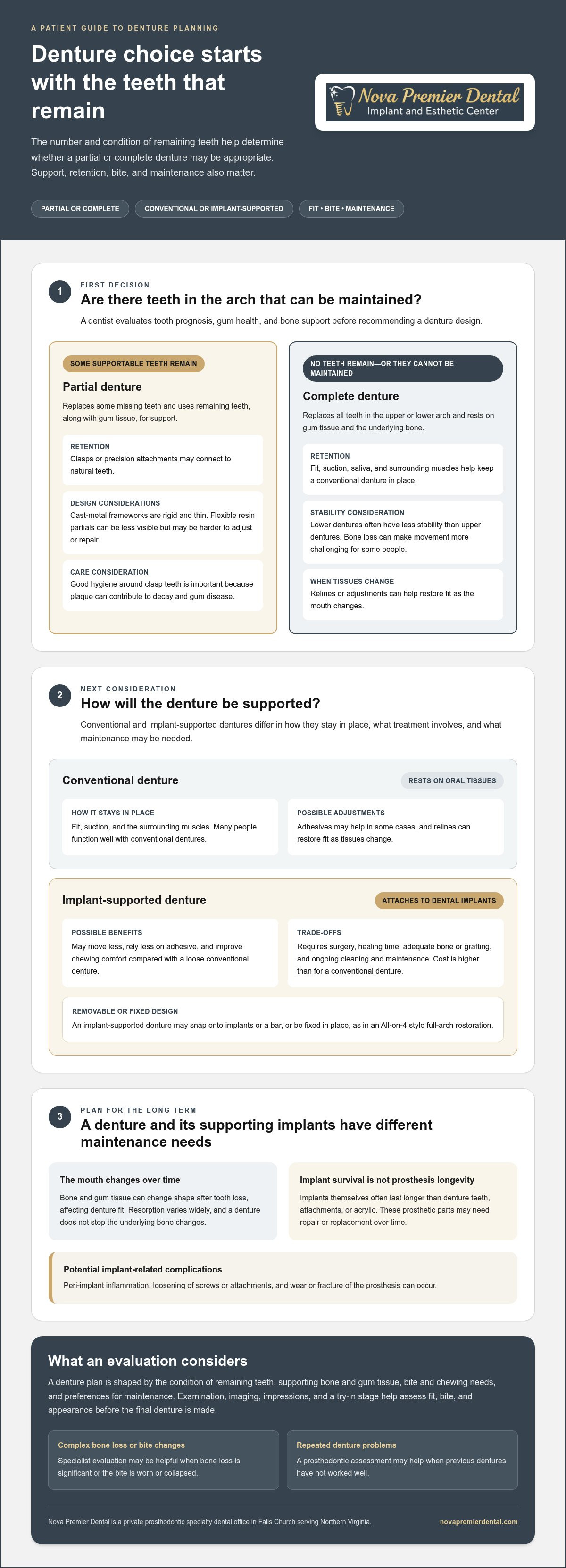
The main question is whether you have remaining teeth worth keeping. If healthy, supportable teeth remain, a partial denture may be appropriate. If all teeth in an arch are missing, or the remaining teeth cannot be maintained, a complete denture is used. Your dentist will assess tooth prognosis, gum health, and bone support before recommending either. More detail is available in Partial vs. Full Dentures: A Specialized Guide.
| Factor | Complete denture | Partial denture |
|---|---|---|
| Best suited for | No remaining teeth in the arch, or teeth that cannot be saved | Some healthy teeth remain |
| Support | Gum tissue and underlying bone | Remaining teeth plus gum tissue |
| Retention | Suction, saliva, and fit of the base | Clasps or precision attachments on natural teeth |
| Considerations | Lower dentures often have less stability than upper dentures | Clasp teeth need good hygiene and may carry added load |
Complete Dentures
Complete dentures are made for patients missing all teeth in the upper or lower arch. A conventional denture is made after extractions have healed, and healing time varies by patient. An immediate denture is placed on the day of extractions so you are not without teeth during healing. Because the gums and bone change as they heal, immediate dentures usually need relines or adjustments, and some patients later have a new denture made. Each approach has trade-offs: conventional dentures involve a period without teeth, while immediate dentures involve more follow-up.
Partial Dentures
Partial dentures use remaining teeth for support through clasps or precision attachments. Cast-metal frameworks are rigid and thin, while flexible resin partials can be less visible but may be harder to adjust or repair. A partial denture may also help keep adjacent and opposing teeth from drifting into gaps, although good oral hygiene is essential because plaque around clasp teeth can contribute to decay and gum disease. Depending on the situation, a fixed bridge or implants may be alternatives to discuss.
Conventional vs. Implant-Supported Dentures
Conventional dentures stay in place through a combination of fit, suction, and the surrounding muscles. Many people function well with them. Others, particularly with a lower denture and significant bone loss, find that the denture moves during chewing or speaking. Adhesives can help in some cases, and relines can restore fit as tissues change.
Implant-supported dentures attach to dental implants placed in the jaw. The denture may be removable (snapping onto implants or a bar) or fixed in place, as in an All-on-4 style full-arch restoration. Implants can improve stability and may help preserve bone locally around the implants, but they do not stop bone changes elsewhere in the jaw. Implant survival and prosthesis longevity are different: the implants themselves often last longer than the denture teeth, attachments, or acrylic, which may need repair or replacement over time.
Benefits and Limits of Implant-Supported Dentures
Potential benefits include less movement, less reliance on adhesive, and often improved chewing comfort compared with a loose conventional denture. Limits include surgery, healing time, higher cost, the need for adequate bone or grafting, and ongoing cleaning and maintenance. Complications can include peri-implant inflammation, loosening of screws or attachments, and wear or fracture of the prosthesis. Some patients are not candidates because of health conditions, medications, or bone volume. Our permanent dentures page describes fixed full-arch options, and the term "permanent" refers to being non-removable by the patient, not to lasting forever.
Which Option Fits Your Situation?
Consider your daily comfort, diet, willingness to undergo surgery, medical history, ability to clean the prosthesis, and budget. Evaluation typically includes a clinical exam, a review of health history, and 3D imaging such as cone-beam CT to assess bone. If bone is limited, options may include bone grafting, shorter or angled implant strategies, or a well-made conventional or implant-retained overdenture. Our guide on implant candidacy covers this in more depth.
What to Expect During a Denture Evaluation
A thorough evaluation usually includes a review of your medical and dental history, an exam of the teeth, gums, and soft tissues, an assessment of your existing dentures if you have them, imaging, and an analysis of how your jaws relate to each other. For complex cases, a bite analysis looks at how your teeth meet, how much space is available for the prosthesis, and whether the vertical dimension (the height of the bite) needs to be considered. Worn teeth do not automatically mean the vertical dimension has been lost, and these findings are diagnostic considerations rather than proof of any single cause.
Treatment generally proceeds in stages: impressions or scans, recording the bite, a try-in with a wax or trial version to check tooth position, appearance, and speech, then delivery and follow-up adjustments. The try-in lets you and your dentist evaluate tooth shape, size, and shade before the final denture is completed. Some soreness during the first weeks is common, and adjustments are a normal part of the process.
Digital Tools in Denture Design
Intraoral scanners can replace some traditional impressions, and CAD/CAM design and milling can be used to fabricate certain dentures. These tools can make records easier to reproduce, but their value depends on clinical judgment and a good bite registration. For patients with extensive tooth wear, bite changes, or jaw conditions, oral reconstruction planning may involve sequencing several treatments before the final prosthesis.
Customizing Tooth Shape and Shade
Tooth shape, size, and shade are selected to suit your face, lip position, smile line, and age. Photographs or your old photos can help guide this. If a denture breaks, the practice offers emergency denture repair for patients. Avoid repairing a denture with household glues, which can damage the material and make a professional repair harder.
What Affects the Cost of Dentures?
Cost depends on the type of denture, whether it is complete or partial, materials, laboratory work, the number of visits, and the complexity of the case. Implant-supported options add surgical and component costs, and extractions, grafting, or other preparatory treatment may be separate. Lower-cost dentures can be appropriate for some patients, though they may involve fewer customization steps, and the need for relines or replacement varies with each mouth. Ask for a written treatment plan that lists each stage and what is included, and ask what follow-up adjustments are covered.
Nova Premier Dental offers in-house payment plans for qualifying patients, allowing treatment costs to be paid over several months. Insurance information is available on the dental insurance and benefits page.
When to Seek an Evaluation
Consider an evaluation if you are losing teeth, your current denture is loose or painful, you have repeated sore spots, you struggle to eat or speak, or you are weighing implants. If you have questions about a complex restorative or prosthodontic concern, Nova Premier Dental in Falls Church provides prosthodontic specialty care for patients throughout Northern Virginia, and you can contact the office to ask questions.
Frequently Asked Questions
How long do dentures typically last?
There is no single lifespan. Denture teeth and bases wear, and the gums and bone change over time, so dentures often need relines, adjustments, or replacement. Habits such as grinding, cleaning routine, and the materials used all affect longevity. See our guide on when to replace dentures.
Will dentures look natural?
Tooth shape, shade, gum color, and position can be selected to suit your face and smile, and a try-in lets you review the appearance before completion. Results vary, and how natural a denture looks depends on the design and how well it fits.
What is the difference between a prosthodontist and a general dentist for dentures?
General dentists provide important preventive and restorative care and can appropriately make many dentures. Prosthodontists complete additional specialty training in restoring and replacing teeth, which can be useful for complex cases such as significant bone loss, bite changes, or previous denture problems.
How do I care for my dentures?
Remove and rinse the denture after eating, brush it daily with a soft brush and a non-abrasive denture cleanser, and clean your gums and any remaining teeth. Remove the denture overnight and keep it in water or a denture-soaking solution. Avoid hot water, which can warp the material. See caring for new dentures for the first weeks.
Can I eat normally with new dentures?
Most people start with soft foods in small pieces and gradually progress as they adapt. Chewing on both sides helps keep the denture stable. Chewing efficiency is usually lower than with natural teeth, and implant support may improve stability for some patients.
What should I do if my dentures are loose or cause sore spots?
Contact your dentist for an adjustment rather than modifying the denture yourself. Persistent sores, looseness, or pain can signal a fit or bite problem that is usually correctable.
Is getting dentures painful?
Impressions and fittings are generally not painful. Extractions, if needed, are done with local anesthesia and may cause soreness afterward. Mild soreness as you adapt to a new denture is common, but severe or persistent pain should be evaluated.
Are payment options available?
Nova Premier Dental offers in-house payment plans for qualifying patients, allowing treatment costs to be paid over several months.
Disclaimer
The information provided on this website and blog is intended for general educational and informational purposes only and should not be considered dental or medical advice, diagnosis, or treatment. Reading content on this website does not establish a doctor-patient relationship with Nova Premier Dental or Dr. Peterson Huang. Dental conditions and treatment needs vary from patient to patient. Individuals should consult directly with a qualified dental professional for personalized evaluation, diagnosis, and treatment recommendations. Do not delay seeking professional dental care based on information found on this website. While we strive to provide accurate and up-to-date information, no guarantee is made regarding the completeness, accuracy, or applicability of the content. Treatment outcomes may vary depending on individual circumstances. If you are experiencing a dental emergency or urgent oral health concern, please contact a licensed dental professional immediately or call 911 in the event of a medical emergency.


