


Article by
Peterson Huang DMD, MS, FACP, FRCDC
Dr. Peterson Huang is a dual board-certified prosthodontist serving Falls Church and Northern Virginia. He has been recognized as a Top Prosthodontist by Northern Virginia Magazine and Arlington Magazine and is affiliated with the Inova Fairfax Hospital Tumor Board. Dr. Huang focuses on dental implants, full mouth reconstruction, and complex restorative dentistry for patients who need advanced, comprehensive care.
Complete and partial dentures provide essential support for chewing, speech, and facial aesthetics following tooth loss. However, many patients assume that once a prosthetic is fabricated, it serves as a permanent, unchanging fixture. In clinical practice, removable prostheses operate within a constantly evolving biological environment. While the prosthetic acrylic and composite teeth are durable, the underlying oral anatomy undergoes continuous, natural transformation.
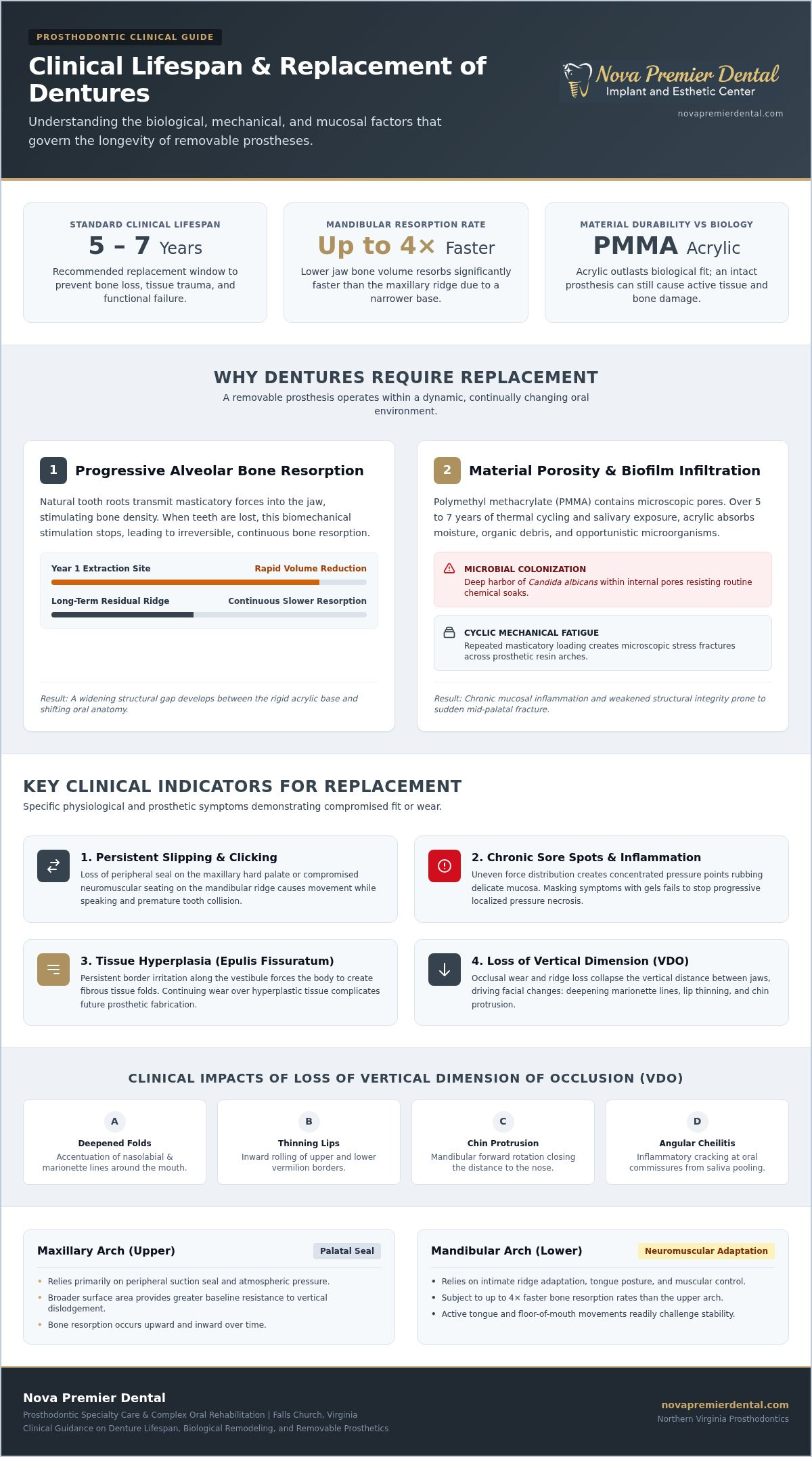
Understanding when to replace dentures is fundamental to protecting oral health, preventing soft tissue pathology, and maintaining proper masticatory function. Most complete and partial prosthetics have an average clinical lifespan of five to seven years. Beyond this window, biological resorption of the jawbone, mechanical wear of artificial teeth, and material degradation of the acrylic base can lead to significant oral health complications.
The Clinical Lifespan of Modern Dentures
In restorative dentistry and prosthodontics, a clear distinction exists between the physical durability of a prosthesis and its functional clinical longevity. A set of Dentures made from high-impact polymethyl methacrylate (PMMA) resin can physically stay in one piece for a decade or more without snapping. However, that does not mean it continues to function safely or effectively inside the mouth.
The standard recommendation from organizations like the American Dental Association is to have complete dentures evaluated regularly and typically replaced every five to seven years. This timeframe is dictated less by the breakdown of the plastic than by the biological remodeling of the patient's jaw.
The Biological Factor: Progressive Bone Resorption
Natural teeth transmit functional masticatory forces through their roots into the alveolar bone of the maxilla (upper jaw) and mandible (lower jaw). These mechanical forces stimulate continuous bone remodeling and density maintenance. When natural teeth are lost, this biomechanical stimulation ceases.
Without root stimulation, the alveolar ridge undergoes continuous, irreversible bone resorption. In the first year following tooth extraction, bone volume diminishes rapidly, followed by a slower but lifelong rate of residual ridge reduction. Studies indicate that the mandibular ridge resorbs up to four times faster than the maxillary ridge due to a narrower base of support and distinct vascular dynamics.
Because the denture base is rigid and the living bone underneath is constantly shrinking, a gap inevitably develops between the prosthetic base and the underlying oral tissues. Even if the denture itself looks intact, it no longer matches the contours of the mouth, causing uneven force distribution during chewing.
Material Fatigue and Hygiene Challenges
The materials used in modern dentures are subjected to substantial cyclic mechanical stress. A typical person bites and chews hundreds of times each day, exerting substantial compressive forces across the prosthetic arches. Over several years, this continuous loading creates microscopic fatigue fractures within the acrylic resin.
Simultaneously, the oral environment exposes dental acrylic to fluctuating thermal cycles, salivary enzymes, and microbial biofilms. PMMA acrylic contains microscopic porosities. Over five to seven years, these microscopic pores absorb oral fluids, pigments, and opportunistic microorganisms, notably Candida albicans. Once deep fungal and bacterial colonies establish themselves within the internal porosities of aged acrylic, surface brushing and chemical soaking solutions lose their effectiveness, increasing the risk of chronic mucosal inflammation.
8 Signs You Need to Replace Your Dentures
Recognizing the symptoms of a worn or ill-fitting prosthesis helps avoid chronic tissue trauma and nutritional deficiencies. The following eight clinical indicators signal that it is time to have your prosthesis assessed by a board-certified prosthodontist in Northern Virginia for replacement or comprehensive modification.
1. Persistent Slipping, Movement, or Clicking
A well-fitted maxillary denture relies on peripheral seal and atmospheric pressure to maintain retention against the hard palate, while a mandibular denture relies on neuromuscular control and intimate adaptation to the residual ridge. When residual bone resorbs, this intimate adaptation is lost. If your prosthesis frequently dislodges while talking, slips during meals, or produces an audible "clicking" sound as teeth contact prematurely, the underlying support architecture has shifted.
2. Chronic Sore Spots and Mucosal Inflammation
An unstable base creates focal pressure points where the hard acrylic rubs directly against delicate, non-keratinized oral mucosa. While occasional minor irritation can occur with a new prosthetic, chronic recurring sore spots in a denture you have worn for years indicate that occlusal forces are no longer evenly distributed. Masking these sore spots with over-the-counter anesthetic gels without correcting the prosthetic fit allows localized pressure necrosis to persist.
3. Tissue Hyperplasia (Epulis Fissuratum)
When an ill-fitting denture flange continually rubs along the vestibule (the fold where the cheek meets the gum line), the body attempts to protect itself by producing excess fibrous connective tissue. This condition, known as epulis fissuratum, appears as folds or rolls of excess tissue adjacent to the denture border. Epulis fissuratum requires professional clinical evaluation; continuing to wear a loose denture over hyperplastic tissue exacerbates the condition and can complicate the fabrication of future prosthetics.
4. Loss of Vertical Dimension and "Sunken" Facial Profile
Natural teeth establish what prosthodontists define as the Vertical Dimension of Occlusion (VDO)—the precise distance between the upper and lower jaws when the teeth are fully interdigitated. As artificial teeth wear flat and the alveolar ridges resorb, the vertical height of the lower third of the face progressively collapses.
This loss of structural support causes distinct facial changes:
- Deepening of the nasolabial folds (smile lines) and marionette lines around the mouth.
- Thinning and inward rolling of the upper and lower lips.
- Protrusion of the chin closer to the nose, creating a classic collapsed facial appearance.
- Increased susceptibility to angular cheilitis—painful, cracked inflammatory lesions at the corners of the mouth caused by chronic saliva pooling in deepened facial folds.
5. Severe Wear on Artificial Teeth
The artificial teeth on complete and partial dentures are typically fabricated from advanced acrylic resins or composite polymers. While designed to spare opposing natural teeth from aggressive wear, they wear down over time under masticatory friction. If the occlusal surfaces of your denture teeth appear flat, smooth, or completely devoid of their natural cusps and anatomy, chewing efficiency drops substantially. Patients often compensate by chewing harder or swallowing poorly masticated food, which can cause secondary digestive discomfort.
6. The Need for Increasing Amounts of Denture Adhesive
Denture adhesives can provide supplementary security in specific anatomical situations, but they are not intended to compensate for a fundamentally unstable base. If you find yourself applying adhesive multiple times per day, or applying thick layers to create a temporary cushion, you are using the paste to fill anatomical voids caused by progressive bone loss. Excessive reliance on adhesive is a clear indicator that the prosthesis requires clinical reassessment.
7. Persistent Odor, Discoloration, and Chronic Stomatitis
Aged acrylic that has absorbed oral bacteria and fungal hyphae produces persistent odors ("denture breath") that cannot be eradicated with standard effervescent cleansers. The accumulation of microbial colonies directly against the palatal tissue frequently causes denture-related stomatitis, characterized by bright red, inflamed, velvety tissue beneath the denture base. Resolving chronic stomatitis typically requires antifungal treatment combined with replacing the contaminated prosthetic material.
8. Hairline Fractures and Prior Patchwork Repairs
Inspect the pink acrylic base of your denture under a bright light. If you notice thin, web-like micro-cracks—especially near the midline of the upper palate or around the clasps of a partial denture—the material is experiencing structural fatigue. Fractures that have been previously repaired multiple times alter the balance and flexibility of the acrylic, rendering the entire appliance prone to sudden, catastrophic breakage during normal chewing.
Repair, Reline, or Replace? A Decision Framework
Experiencing fit issues or minor damage does not always necessitate an immediate, complete replacement. During a comprehensive evaluation at our Falls Church practice, Dr. Peterson Huang assesses three core components: the structural integrity of the prosthetic teeth, the condition of the base material, and the patient's existing vertical dimension of occlusion.
| Intervention | Clinical Indication | What the Process Entails | Limitations |
|---|---|---|---|
| Hard or Soft Reline | Mild to moderate ridge resorption where artificial teeth show minimal wear and bite alignment remains correct. | Adding a new layer of laboratory-processed acrylic (hard reline) or medical-grade polymer cushion (soft reline) directly to the tissue-contacting surface of the existing base. | Does not correct worn teeth, lost facial vertical dimension, or misaligned bites. Repeated relines can make the base excessively thick and heavy. |
| Denture Rebase | The artificial teeth remain in good condition with stable occlusion, but the pink acrylic base is porous, discolored, or heavily cracked. | Removing nearly all old pink acrylic and replacing it with an entirely new base while retaining the existing artificial teeth in their original arrangement. | Requires that the original bite, spacing, and vertical dimensions remain anatomically accurate. |
| Full Replacement | Significant loss of vertical dimension, flattened teeth, severe base contamination, recurrent structural failure, or advanced bone changes. | Comprehensive prosthodontic redesign: capturing new primary and secondary impressions, establishing correct jaw relationships, and fabricating a new prosthetic. | Requires a multi-appointment sequence to systematically verify speech, lip support, aesthetics, and balanced occlusion. |
Patients dealing with loose prosthetics should explore our detailed guide on fixing loose dentures to understand how different stabilization methods compare before deciding on treatment.
The Hidden Risks of DIY Denture Repairs
When a denture snaps in half, loses an artificial tooth, or chips along its border, patients are often tempted to turn to over-the-counter repair kits or household adhesives like cyanoacrylate (superglue). Prosthodontic specialists strongly advise against home repairs for several critical reasons:
- Chemical Toxicity: Commercial superglues contain industrial solvents, harsh cyanoacrylates, and plasticizers that are cytotoxic to oral soft tissues and dissolve under continuous salivary exposure.
- Irreversible Occlusal Misalignment: Even an alignment error of less than half a millimeter during home gluing can alter the way upper and lower teeth contact. This minor shift concentrates excessive force on single teeth, accelerates localized jawbone loss, and triggers acute temporomandibular joint (TMJ) discomfort.
- Impeding Professional Repair: Standard dental laboratory resins cannot bond to surfaces contaminated with household glues. When patients attempt DIY repairs, technicians often must grind away valuable prosthetic material to remove the glue residue, transforming what would have been a straightforward laboratory repair into a complicated reconstruction.
If you experience sudden structural damage, utilize our emergency denture repair services to ensure your appliance is stabilized with biocompatible, laboratory-cured resins under precise occlusal control.
Comprehensive Oral Health Screenings for Denture Wearers
A common misconception among denture wearers is that having no remaining natural teeth eliminates the need for routine dental evaluations. In reality, regular clinical examinations are vital for several non-dental health considerations:
- Soft Tissue Pathology and Oral Cancer Screenings: The tongue, floor of the mouth, soft palate, and alveolar mucosa require systematic visual and manual screening for leukoplakia, erythroplakia, ulcerations, or early mucosal neoplasms. Early detection remains the most decisive factor in successful oral cancer treatment.
- Assessing Ridge Resorption Rates: Monitoring bone loss patterns helps determine whether modifications are necessary before excessive resorption leads to nerve exposure. In severe mandibular atrophy, the mental nerve can emerge near the crest of the ridge, causing sharp, electric-like nerve pain whenever a denture presses down.
- Hygiene and Disinfection Oversight: Annual examinations ensure that localized fungal infections such as sub-prosthetic candidiasis are identified and treated early, before they cause extensive tissue hyperplasia.
Beyond Traditional Dentures: The Prosthodontic Advantage
While modern complete and partial dentures are carefully fabricated to mimic natural tissue, traditional removable prosthetics cannot address the underlying biological reality of progressive bone resorption. Because they sit passively on top of the gums, they rely entirely on the remaining ridge for stability.
As a dual board-certified prosthodontist, Dr. Peterson Huang evaluates denture wearers with a comprehensive perspective on long-term reconstructive stability. Prosthodontists complete three additional years of rigorous hospital- and university-based advanced surgical and restorative training beyond dental school, focusing specifically on the biomechanics of mastication, complex jaw relations, and full-mouth rehabilitation.
Implant-Retained and Implant-Supported Solutions
For patients experiencing recurrent looseness, severe ridge resorption, or chronic difficulty chewing with conventional removable prostheses, modern implant prosthodontics offers reliable functional alternatives:
- Implant-Retained Overdentures: Utilizing two to four strategically placed dental implants with snap-on attachments (such as locators), an overdenture snaps securely into position. The implants provide exceptional retention, eliminating unexpected slipping, clicking, and the need for adhesive pastes, while remaining removable for daily hygiene.
- Fixed Full-Arch Restorations (Permanent Dentures): Often referred to as All-on-4 or hybrid prostheses, these restorations are permanently secured to four, five, or six implants. Because the prosthetic is rigidly anchored to bone, it does not rely on the gums for support, does not shift during eating, and eliminates palatal coverage on the upper jaw, significantly restoring natural taste sensation and speech clarity. Read more about these therapies in our comprehensive overview of permanent dentures.
- Bone Preservation: Most importantly, dental implants function like natural tooth roots. By transferring mechanical loads directly into the surrounding bone tissue, implants help slow or prevent the long-term disuse atrophy of the jawbone that inevitably accompanies traditional removable prosthetics.
When considering advanced restorative care or upgrading aged prosthetics, cost management is an important consideration. Nova Premier Dental offers in-house payment plans for qualifying patients, allowing treatment costs to be paid over several months while patients enjoy their new smile.
Frequently Asked Questions
How many years do dentures typically last before needing replacement?
Complete and partial dentures generally have an optimal clinical lifespan of five to seven years. While the acrylic materials may remain intact beyond that window, progressive alveolar bone resorption and the wear of artificial teeth alter fit, vertical facial height, and bite balance, necessitating laboratory relining, rebasing, or full replacement.
Is it normal for dentures to feel loose after two or three years?
Yes. The alveolar bone of the jaw undergoes continuous, natural remodeling following tooth loss. Within two to three years, sufficient bone resorption often occurs to create spaces beneath the rigid denture base. In many cases, a professional hard reline can restore stability without requiring a completely new prosthesis, provided the teeth and bite remain in good condition.
What happens if I wear ill-fitting dentures for too long?
Continuing to wear loose or worn dentures can lead to chronic soft tissue complications, including painful sore spots, recurrent fungal infections (denture stomatitis), and benign fibrous tissue growths known as epulis fissuratum. Additionally, an unstable bite accelerates uneven jawbone resorption and can cause facial collapse, angular cheilitis, and chronic jaw joint (TMJ) discomfort.
What is the difference between a hard reline and a soft reline?
A hard reline replaces the inner tissue-side surface of the denture with new, long-lasting laboratory acrylic, offering optimal durability for patients with firm, healthy gum ridges. A soft reline incorporates a resilient, medical-grade silicone or polymer material that stays slightly pliable, providing a gentle shock-absorbing layer for patients with sharp bony ridges, chronic sensitivity, or thin, easily traumatized mucosa.
Can broken or cracked dentures always be repaired?
Many clean structural fractures—such as a split midline on an upper denture or a dislodged tooth—can be professionally repaired using high-strength, laboratory-cured acrylic. However, if the denture has cracked because the material is aged, brittle, and structurally compromised, or if the fracture is secondary to a severe mismatch with your jaw anatomy, repairing it will only be a temporary measure. In such instances, fabrication of a new prosthesis is the safer, more durable option.
Restoring Function and Long-Term Oral Health
A well-designed denture should provide dependable stability, support clear articulation, and restore your natural facial proportions without causing chronic irritation. Because your oral anatomy changes continuously throughout life, having your prosthetic systematically evaluated ensures that minor biological shifts are addressed before they develop into painful soft tissue problems or permanent bone loss.
If you have questions about the fit, wear, or stability of your current prosthesis, or if you wish to explore advanced reconstructive options, Nova Premier Dental provides comprehensive prosthodontic specialty care for patients throughout Falls Church, McLean, Arlington, and surrounding Northern Virginia communities.
Disclaimer
The information provided on this website and blog is intended for general educational and informational purposes only and should not be considered dental or medical advice, diagnosis, or treatment. Reading content on this website does not establish a doctor-patient relationship with Nova Premier Dental or Dr. Peterson Huang. Dental conditions and treatment needs vary from patient to patient. Individuals should consult directly with a qualified dental professional for personalized evaluation, diagnosis, and treatment recommendations. Do not delay seeking professional dental care based on information found on this website. While we strive to provide accurate and up-to-date information, no guarantee is made regarding the completeness, accuracy, or applicability of the content. Treatment outcomes may vary depending on individual circumstances. If you are experiencing a dental emergency or urgent oral health concern, please contact a licensed dental professional immediately or call 911 in the event of a medical emergency.


