


Article by
Peterson Huang DMD, MS, FACP, FRCDC
Dr. Peterson Huang is a dual board-certified prosthodontist serving Falls Church and Northern Virginia. He has been recognized as a Top Prosthodontist by Northern Virginia Magazine and Arlington Magazine and is affiliated with the Inova Fairfax Hospital Tumor Board. Dr. Huang focuses on dental implants, full mouth reconstruction, and complex restorative dentistry for patients who need advanced, comprehensive care.
What if the ultimate success of your restorative journey depends less on the prosthetic itself and more on the first 720 hours you spend with it? Transitioning to a new smile is a significant clinical milestone, but it often comes with valid anxieties about initial discomfort, speech clarity, or the safety of specific cleaning agents. At Nova Premier Dental, we understand that the initial adaptation phase is where patients feel the most vulnerability. Our caring for new dentures guide is designed to bridge the gap between clinical excellence and daily habit, ensuring your investment remains both functional and aesthetically pristine.
You deserve a transition that prioritizes comfort without sacrificing the sophisticated quality of your reconstruction. Under the expert guidance of Dr. Peterson Huang, a dual board-certified specialist, you'll learn to navigate the first 30 days with confidence. This article outlines a professional adjustment timeline and maintenance protocols curated by a prosthodontist in Northern Virginia. We'll cover everything from managing sore spots to preserving the life of your dentures. To ensure these elite services remain accessible, we offer in-house payment plans for qualifying patients, allowing you to focus on your recovery while managing costs comfortably over several months.
Key Takeaways
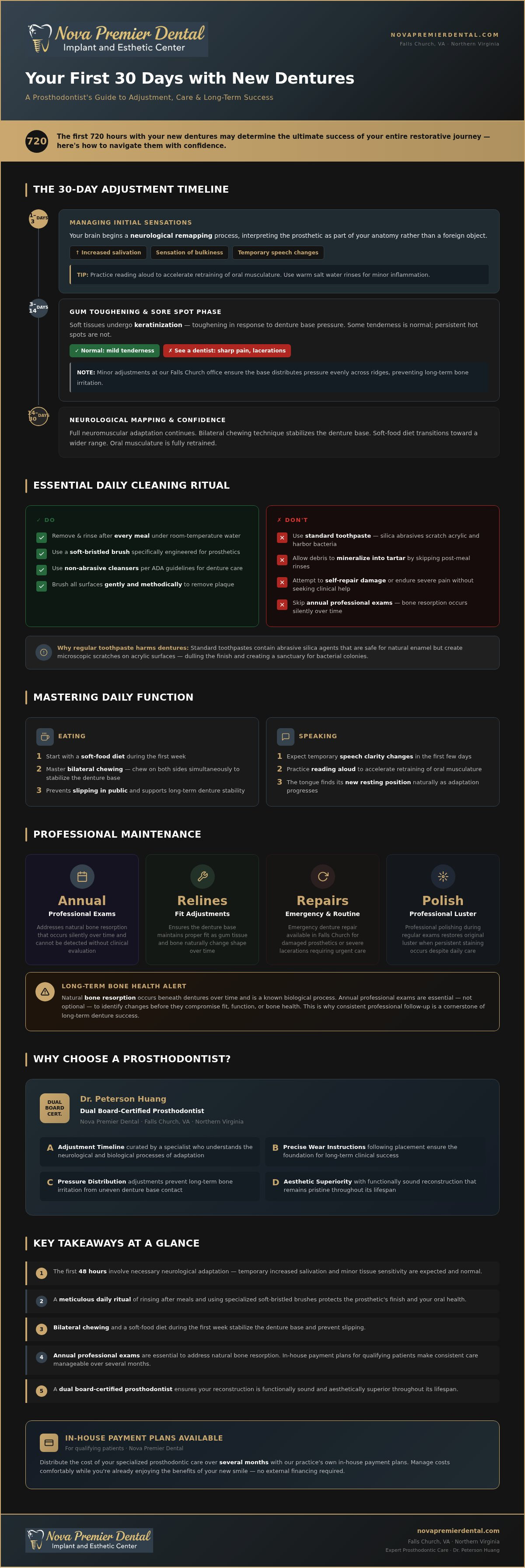
- Understand that the first 48 hours involve a necessary neurological adaptation, which often results in temporary increases in salivation and minor tissue sensitivity.
- This caring for new dentures guide emphasizes a meticulous daily ritual of rinsing after meals and using specialized soft-bristled brushes to protect the prosthetic's finish.
- Master the technique of bilateral chewing and prioritize a soft-food diet during your first week to stabilize the denture base and prevent slipping in public.
- Recognize that long-term success requires annual professional exams to address natural bone resorption, supported by manageable in-house payment plans for qualifying patients.
- Rely on the clinical expertise of a dual board-certified prosthodontist to ensure your reconstruction is both functionally sound and aesthetically superior throughout its lifespan.
Navigating the Adjustment Period: Your First 30 Days with Dentures
The transition to wearing dentures is as much a neurological process as it is a physical one. Your brain must learn to interpret the prosthetic as a functional part of your anatomy rather than a foreign object. During this initial phase, the sensory nerves in your gingival tissues send constant signals to the brain, which often results in increased salivation. This is a natural response; your body temporarily perceives the new material as food. This caring for new dentures guide provides the clinical framework you need to distinguish between expected adaptation and issues that require professional intervention.
The First 24-72 Hours: Managing Initial Sensations
Following the precise wear instructions provided by Dr. Peterson Huang immediately after your placement is vital for long-term success. You'll likely experience a sensation of bulkiness as your tongue struggles to find its new resting position. This often affects speech clarity for the first few days. We recommend practicing reading aloud to accelerate the retraining of your oral musculature. If you experience minor inflammation, warm salt water rinses can soothe sensitive tissues without compromising the integrity of the prosthetic. This period is about patience and allowing the neurological mapping of your mouth to reset.
Days 3 to 14: Identifying Sore Spots and Healing
As you move into the second week, your gums begin a biological process called keratinization. This is where the soft tissues toughen in response to the pressure of the denture base. While some tenderness is normal, persistent hot spots or sharp pain indicate a need for a clinical adjustment. You shouldn't attempt to endure pain that prevents daily function. If the prosthetic becomes damaged or causes severe lacerations, contact us for an emergency denture repair. Minor adjustments in our Falls Church office are a standard part of the restorative process. These appointments ensure the base distributes pressure evenly across your ridges, preventing long-term bone irritation.
To support your journey toward a functional smile, we offer in-house payment plans for qualifying patients. These plans allow you to distribute the cost of your specialized care over several months while you adapt to your new lifestyle. This ensures that the financial aspect of your treatment remains as comfortable as your new fit.
The Essential Daily Cleaning Routine for Longevity and Oral Health
Maintaining the structural and aesthetic integrity of a high-end prosthetic requires a disciplined clinical approach. This caring for new dentures guide emphasizes that mechanical cleaning is the foundation of long-term success. After every meal, you should remove your dentures and rinse them under room-temperature water to dislodge debris before it can mineralize into tartar. While it may be tempting to use standard toothpaste, these products often contain abrasive agents like silica that are safe for natural enamel but destructive to acrylic. These abrasives create microscopic scratches on the surface, which eventually dull the finish and provide a sanctuary for bacterial colonies.
Instead, utilize a soft-bristled brush specifically engineered for prosthetics. A gentle, methodical brushing of all surfaces ensures that food particles and plaque are removed without compromising the material. To maintain the highest standards of hygiene, we recommend following the American Dental Association guidelines on denture care, which advocate for the use of non-abrasive cleansers. If you find that persistent staining occurs despite your best efforts, our team at Nova Premier Dental can provide professional polishing during your regular exams to restore the original luster of your smile.
Preventing Biofilm and Fungal Infections
Oral hygiene extends beyond the prosthetic itself. Neglecting the underlying tissues can lead to denture stomatitis, a fungal infection characterized by localized inflammation and redness. To prevent this, you must clean your gums, tongue, and the roof of your mouth daily using a soft washcloth or a very soft toothbrush. This stimulates blood flow and removes the biofilm that naturally accumulates on the mucosa. Additionally, never use boiling or very hot water for cleaning. High temperatures can permanently warp the acrylic base, destroying the precise fit achieved by a prosthodontist in Northern Virginia.
Proper Storage and Handling
Fractures often occur during the cleaning process due to accidental drops. We advise handling your dentures over a sink filled with water or a folded towel to cushion any impact. When the dentures are not in your mouth, they must remain submerged in a specialist-approved soaking solution or plain water. Hydration is critical; if the acrylic dries out, it can lose its shape and become brittle, leading to a poor seal. For personalized maintenance protocols, you can consult with Dr. Peterson Huang, who provides tailored advice based on your specific prosthetic material. To help manage the long-term investment in your oral health, we offer in-house payment plans for qualifying patients, allowing you to prioritize professional maintenance while spreading the cost over several months.
Mastering Daily Function: Eating and Speaking with Confidence
Mastering the mechanics of a new prosthetic requires a disciplined approach to neuromuscular retraining. While the previous sections of this caring for new dentures guide focused on hygiene and biological adjustment, functional success depends on how you navigate the dining table and social interactions. During the first week, we strictly recommend a soft-food diet consisting of eggs, yogurt, and well-cooked vegetables. This minimizes the initial load on your healing tissues while allowing your brain to calibrate the new biting force required for daily use. It's a phase of patience where the goal is to prevent irritation while your oral musculature adapts.
The Mechanics of Chewing with Prosthetics
For individuals who may need assistance with specialized meal preparation or daily tasks during this initial recovery phase, you can check out Royal Care Companion for flexible, short-term home care services.
Traditional chewing patterns often involve a dominant side, but stabilized prosthetics require a technique known as bilateral chewing. By placing small portions of food on both sides of the mouth simultaneously, you distribute occlusal pressure evenly across the dental ridges. This prevents the denture from tipping or breaking its suction seal. It's also vital to avoid using your front teeth to bite into hard objects like apples or crusty bread. Instead, use your back teeth for all significant mechanical breakdown. This methodical approach ensures you can eventually return to your favorite Northern Virginia restaurants with total confidence in your prosthetic's stability.
Restoring Phonetic Clarity
Speech is a complex coordination of the tongue, teeth, and palate. Because a new denture slightly alters the thickness of the oral roof and the position of the teeth, certain phonetics like "S" and "F" sounds may initially result in a whistle or a click. Retraining your tongue is essential for clear communication. We suggest practicing these difficult sounds in front of a mirror to observe your lip placement and jaw movement. Reading aloud for fifteen minutes a day helps your tongue adapt to the new oral landscape. If you notice a clicking sound, it's often a sign that you're speaking too quickly; slowing your tempo allows the prosthetic to settle naturally between words. Practicing in private builds the psychological comfort needed for social engagements.
While some patients consider using adhesives to boost confidence, these should only be used if specifically recommended by Dr. Peterson Huang. A well-fitted denture, crafted by a prosthodontist in Northern Virginia, should rely primarily on suction and muscle control rather than chemical pastes. To ensure your restorative journey remains financially manageable, Nova Premier Dental provides in-house payment plans for qualifying patients. These plans allow you to focus on mastering your new smile while managing the investment over several months, ensuring that elite care is never out of reach.
Professional Maintenance: Relines, Repairs, and Bone Health
While daily maintenance is vital, the biological reality of tooth loss involves a process called resorption. Without the stimulation of natural tooth roots, the jawbone gradually loses volume and density over time. This shift changes the topography of your mouth. A prosthetic that fit perfectly on day one will eventually require professional adjustment to accommodate these skeletal changes. This caring for new dentures guide highlights that professional oversight is the only way to mitigate the effects of these shifts. We recommend scheduling annual exams at our Falls Church office to evaluate the health of your supporting tissues and the structural integrity of your prosthetic.
DIY repair kits found in local pharmacies often lead to irreversible damage. These materials can be abrasive or toxic; they frequently alter the vertical dimension of your bite, causing TMJ strain or chronic oral sores. If your prosthetic fractures or chips, professional intervention is mandatory to preserve the aesthetic and functional quality of the piece. Attempting a home repair can result in a misaligned fit that accelerates bone loss through uneven pressure distribution.
When Is a Reline Necessary?
A comprehensive caring for new dentures guide must address the years of maintenance that follow the initial placement. A reline becomes necessary when you notice frequent slipping, food trapped beneath the base, or unexplained localized sores. A "soft reline" uses a pliable material to provide immediate relief for sensitive gums. A "hard reline" replaces the entire fitting surface with a durable acrylic. This process ensures the denture remains in intimate contact with the mucosa, which helps distribute occlusal forces and protects the underlying bone from accelerated resorption.
Long-term Solutions: From Dentures to Implants
For patients seeking a more permanent solution to bone loss, dental implants offer a superior clinical alternative. By mimicking natural roots, implants provide the necessary stimulation to halt bone resorption. Options like All-on-4 or permanent dentures provide a level of stability that traditional prosthetics cannot match. If you're interested in upgrading your reconstruction, schedule a consultation to discuss how we can restore your functional bite. To help manage the investment in these advanced restorative procedures, we offer in-house payment plans for qualifying patients. These plans allow you to spread payments over several months while enjoying the health benefits of a more stable, bone-preserving smile.
Why Specialized Prosthodontic Care in Falls Church VA Makes the Difference
Choosing the right practitioner for your restorative journey is the most critical decision you'll make for your long-term oral health. While general dentistry practices often provide basic prosthetics, they typically lack the three years of advanced residency training required to manage complex reconstructive cases. This caring for new dentures guide has outlined the meticulous steps needed for success, but those steps are only effective when built upon a foundation of prosthodontic excellence. At Nova Premier Dental, we provide a level of diagnostic precision that ensures your initial fit is physiologically sound from the start. We don't just deliver a device; we manage the complex biological integration of your new smile.
The Elite Credentials of Dr. Peterson Huang
Restoring a smile is a sophisticated engineering task that requires a deep understanding of jaw dynamics and material science. Dr. Peterson Huang holds the rare distinction of being dual board-certified, a signature of elite status in the dental community. This level of certification means your care is guided by a practitioner who has met the most rigorous standards of both the American Board of Prosthodontics and the American Board of Periodontology. It isn't just about teeth; it's about the health of the surrounding bone and soft tissues.
This specialized expertise translates to superior functional beauty and a more predictable clinical outcome. It ensures that your 30-day adjustment period is supported by a prosthetic designed for your specific neuromuscular patterns, leading to greater long-term patient comfort. When you choose a prosthodontist in Northern Virginia with these credentials, you're investing in a specialist who understands the intricate relationship between aesthetics and oral function.
A Patient-Centric Experience at Nova Premier Dental
Our modern facility in Falls Church serves patients from McLean, Arlington, and the Tysons area, providing a welcoming environment for advanced dental care. We utilize cutting-edge diagnostic technology to create a personalized care plan tailored to your unique oral anatomy and aesthetic goals. This precision reduces the need for frequent emergency adjustments and provides the peace of mind that comes with elite-level leadership. You aren't just another patient; you're receiving a reconstruction designed specifically for your lifestyle.
Accessing specialized restorative care should be a seamless process. To support this, we offer in-house payment plans for qualifying patients. These plans allow you to manage the cost of your care over several months while you're already enjoying the benefits of your new, confident smile. If you're ready to experience the difference that specialized care makes, contact us today for a specialized consultation and take the first step toward a functional, beautiful restoration.
Securing Your Long-Term Restorative Success
Success with a new prosthetic is a partnership between daily discipline and professional precision. This caring for new dentures guide has provided the framework for navigating the first 30 days, from managing initial salivation to mastering the mechanics of bilateral chewing. By adhering to a rigorous cleaning schedule and attending annual exams at Nova Premier Dental, you protect both the aesthetic quality of your smile and the long-term health of your jawbone.
As a dual board-certified specialist, Dr. Peterson Huang is an expert in complex oral reconstruction. He ensures that every adjustment is tailored to your unique anatomy. To make this elite care accessible, we offer in-house payment plans for qualifying patients. This allows you to comfortably manage costs over several months while enjoying your new smile. This level of prosthodontist in Northern Virginia oversight provides the confidence you need for a life of functional beauty.
Schedule your specialized denture consultation with Dr. Huang today. Your transition to a radiant, functional smile is well within reach, and we're here to guide every step of the way.
Frequently Asked Questions
How long does it take for new dentures to feel natural?
It typically takes approximately 30 days for your brain to fully adapt to the new prosthetic. The first week requires the most patience as your tongue and facial muscles learn new resting positions. Patients in the Falls Church area often find that the initial "bulky" sensation diminishes significantly by the third week. Consistent wear and following the clinical advice of Dr. Peterson Huang are essential for accelerating this neurological transition.
Can I sleep with my dentures in?
You should remove your dentures every night to allow your gingival tissues to rest and recover. Constant pressure from a prosthetic can restrict blood flow and increase the risk of fungal infections like denture stomatitis. Storing your dentures in a specialist-approved soaking solution overnight also ensures they remain hydrated and maintain their precise shape. This practice is a foundational part of any professional caring for new dentures guide for long-term oral health.
What is the best way to clean my dentures daily?
The most effective daily routine involves rinsing your dentures after every meal and brushing them with a soft-bristled brush. Avoid standard toothpastes, as their abrasive nature can create micro-scratches that harbor bacteria and dull the finish. Instead, use a non-abrasive cleanser recommended by our prosthodontist in Northern Virginia. This methodical approach preserves the aesthetic quality and structural integrity of your restoration for years to come.
Why do my new dentures make it hard to speak clearly?
Speech challenges occur because the prosthetic slightly alters the space available for your tongue and the thickness of your palate. This often affects phonetic clarity, particularly with "S" and "F" sounds. We recommend practicing reading aloud or speaking slowly to retrain your oral musculature. Most patients in the Tysons and Arlington areas regain their full speaking confidence within the first month as their brain recalibrates to the new dental landscape.
What should I do if my dentures feel loose or cause sore spots?
If you experience persistent sore spots or a loose fit, you should contact our Falls Church office immediately for a professional adjustment. Don't attempt to endure the pain, as chronic irritation can lead to tissue damage or infection. Dr. Huang can perform precise modifications to the denture base to distribute pressure more evenly. Never use DIY repair kits, as they often cause permanent damage to the prosthetic and worsen oral sores.
How often should I see a prosthodontist for denture check-ups?
We recommend an annual examination with a dual board-certified prosthodontist to evaluate both the prosthetic and your underlying bone health. Your jawbone naturally changes shape through resorption, which can compromise the seal of your dentures over time. During these check-ups, we assess the need for professional relines and screen for oral cancer. This proactive maintenance is critical for patients throughout McLean and Great Falls who prioritize functional beauty and comfort.
Are there financing options for new dentures at Nova Premier Dental?
Nova Premier Dental offers in-house payment plans for qualifying patients to ensure elite restorative care remains accessible. These plans allow you to spread the cost of your treatment over several months, making it easier to manage your investment while you enjoy your new smile. We focus entirely on our own internal offerings rather than external financial services. This patient-centric approach helps you prioritize your oral health without the stress of immediate, full-sum payments.
Can my dentures be repaired the same day if they break?
Our practice provides emergency denture repair services to address fractures or damage as quickly as possible. While the complexity of the repair determines the exact timeline, we strive to restore your function promptly to minimize social discomfort. Serving the Fairfax and Annandale communities, our modern facility is equipped to handle urgent prosthetic issues with clinical precision. If your dentures break, avoid using household glues and seek specialized professional assistance immediately to prevent permanent damage.
Disclaimer
The information provided on this website and blog is intended for general educational and informational purposes only and should not be considered dental or medical advice, diagnosis, or treatment. Reading content on this website does not establish a doctor-patient relationship with Nova Premier Dental or Dr. Peterson Huang. Dental conditions and treatment needs vary from patient to patient. Individuals should consult directly with a qualified dental professional for personalized evaluation, diagnosis, and treatment recommendations. Do not delay seeking professional dental care based on information found on this website. While we strive to provide accurate and up-to-date information, no guarantee is made regarding the completeness, accuracy, or applicability of the content. Treatment outcomes may vary depending on individual circumstances. If you are experiencing a dental emergency or urgent oral health concern, please contact a licensed dental professional immediately or call 911 in the event of a medical emergency.


