

Article by
Peterson Huang DMD, MS, FACP, FRCDC
Dr. Peterson Huang is a dual board-certified prosthodontist serving Falls Church and Northern Virginia. He has been recognized as a Top Prosthodontist by Northern Virginia Magazine and Arlington Magazine and is affiliated with the Inova Fairfax Hospital Tumor Board. Dr. Huang focuses on dental implants, full mouth reconstruction, and complex restorative dentistry for patients who need advanced, comprehensive care.
Patients dealing with extensive dental breakdown, widespread tooth loss, or severe wear across their dental arches often face challenging clinical decisions. When multiple teeth are compromised simultaneously, addressing individual issues one tooth at a time without an overall strategy can lead to restorative disharmony, recurrent structural failures, and unexpected treatment complications. In advanced dental medicine, addressing these extensive restorative challenges successfully depends on thorough diagnostic evaluation and systematic complex rehabilitation planning.
At Nova Premier Dental, a private prosthodontic specialty office in Falls Church serving Northern Virginia, clinical treatment begins with an in-depth diagnostic process rather than immediate, irreversible procedures. Dr. Peterson Huang is a dentist and dual board-certified prosthodontist who completed specialty training in prosthodontics and holds board certification through the American Board of Prosthodontics in the United States and the Royal College of Dentists of Canada. Through careful assessment of skeletal relationships, joint dynamics, remaining tooth structure, and soft-tissue architecture, prosthodontic planning establishes a structured clinical sequence before restorations are fabricated. For individuals evaluating restorative options, this guide outlines the clinical components, diagnostic tools, material considerations, and procedural phases involved in comprehensive oral rehabilitation.
Key Takeaways
- Systematic Treatment Design: Comprehensive rehabilitation relies on an upfront diagnostic roadmap that coordinates periodontal health, joint stability, biomechanics, and aesthetic proportions before initiating restorative procedures.
- Specialty Focus: Prosthodontists complete three years of formal post-doctoral residency training dedicated to managing advanced restorative problems, severe wear, congenital dental anomalies, and full-arch reconstruction.
- Advanced Diagnostics: Cone-beam computed tomography (CBCT) and intraoral digital surface scans allow clinicians to assess alveolar bone volume, analyze dynamic occlusion (bite relationships), and evaluate restorative space virtually.
- Diagnostic Provisionalization: Phased provisional restorations function as functional prototypes, allowing patients and clinicians to verify phonetics, masticatory comfort, and the vertical dimension of occlusion before final prostheses are placed.
- Structured Financial Planning: Nova Premier Dental offers in-house payment plans for qualifying patients, allowing treatment costs to be paid over several months while patients enjoy their new smile.
What is Complex Dental Rehabilitation Planning?
Complex dental rehabilitation planning is the structured process of diagnosing, organizing, and sequencing restorative treatment for individuals presenting with widespread oral deterioration. Unlike single-tooth restorations, which focus on isolated lesions or defects, extensive rehabilitation treats the masticatory system as an integrated functional unit comprising the dentition, the periodontium (supporting gums and bone), the neuromuscular system, and the temporomandibular joints (TMJs).
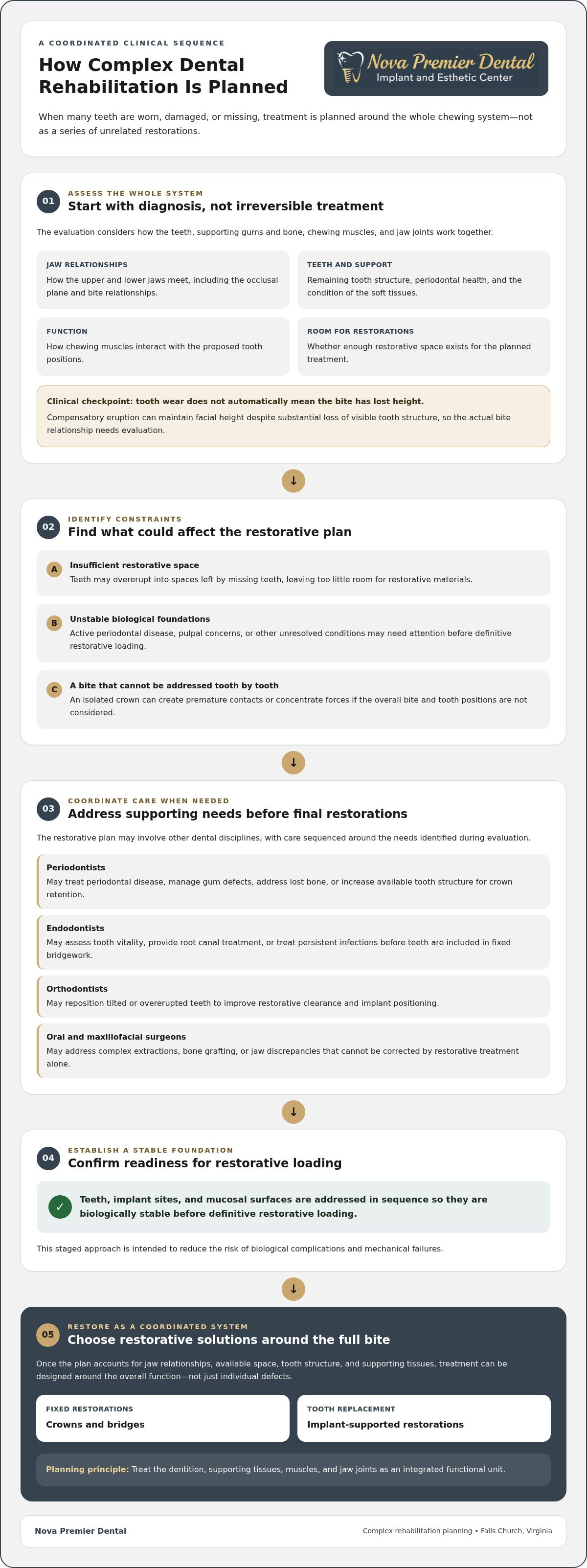
When teeth have broken down extensively, treating isolated teeth independently carries substantial risk. A single crown fabricated without evaluating the overall occlusal plane (the line along which teeth meet) can create premature occlusal contacts, concentrate destructive forces, or fail to resolve underlying functional deficiencies. Systematic planning evaluates how the upper and lower jaws intercuspate, whether sufficient restorative space exists, and how the patient's chewing muscles interact with the proposed tooth positions. This macro-level perspective guides both fixed solutions, such as crowns and bridges, and implant-supported restorations.
Patients who generally require this level of comprehensive evaluation include individuals with severe generalized tooth wear (caused by attrition from nocturnal teeth grinding or erosion from dietary acid or gastroesophageal reflux), acquired maxillofacial defects, multiple missing teeth with collapsed bite relationships, or generalized structural breakdown resulting from historical neglect or failed restorations. Through specialized full mouth rehabilitation protocols, prosthodontists evaluate biological, functional, and phonetic parameters to establish a durable, maintainable oral foundation.
The Interdisciplinary Nature of Oral Reconstruction
Extensive oral rehabilitation frequently requires multidisciplinary coordination. While a restorative specialist oversees the final design and placement of dental prosthetics, optimal clinical results often involve collaboration with other dental disciplines. In these cases, the prosthodontist often coordinates the sequence of clinical interventions:
- Periodontists: Address active periodontal disease, manage mucogingival defects, regenerate lost alveolar bone, or perform surgical crown lengthening to increase available tooth structure for crown retention.
- Oral and Maxillofacial Surgeons: Perform complex extractions, sinus augmentations, zygomatic or block bone grafting, and orthognathic jaw repositioning when underlying skeletal discrepancies exceed restorative correction alone.
- Endodontists: Assess pulpal vitality, perform root canal therapy on structurally vital abutments, and treat persistent periapical infections before teeth are integrated into fixed bridgework.
- Orthodontists: Upright tilted molars, intrude overerupted teeth, or adjust dental spacing to optimize restorative clearance and implant positioning.
This coordinated model ensures that every tooth, surgical implant site, and mucosal surface is biologically stable before definitive restorative loading occurs. Addressing these foundational elements sequentially reduces the risk of biological complications such as recurrent periodontitis, peri-implantitis, or secondary mechanical failures.
When is a Case Considered "Complex"?
In clinical dentistry, a case is designated as "complex" when routine single-unit restorative protocols are insufficient to re-establish function and stability. Several diagnostic criteria distinguish these presentations:
- Alteration of the Vertical Dimension of Occlusion (VDO): Prolonged wear or posterior tooth loss can alter the distance measured between the nose and the chin when the teeth are in maximum contact. However, severe wear does not automatically result in a lost vertical dimension; in many cases, continuous dentoalveolar compensatory eruption maintains the vertical facial height despite substantial loss of clinical crown height. Accurate diagnostic evaluation is necessary to distinguish true loss of VDO from compensatory remodeling.
- Lack of Restorative Space: When opposing teeth have overerupted into empty spaces left by missing teeth, insufficient interocclusal space remains for restorative materials without orthodontic intrusion, surgical reduction, or full-arch occlusal reorganization.
- Temporomandibular Joint and Muscular Symptoms: Instability in the dental arches or significant discrepancies between centric relation (the stable musculoskeletal position of the jaw joints) and maximum intercuspation can complicate bite registration, requiring careful stabilization before irreversible preparation.
- Maxillofacial Reconstruction: Patients who have experienced head-and-neck tumor resection, ablative surgery, radiation therapy, or facial trauma often require oral cancer rehabilitation with specialized intraoral prostheses to restore swallowing, speech, and mastication.
Executing systematic complex rehabilitation plannin enables the dental team to isolate each variable, simulate potential restorative trajectories, and avoid uncoordinated procedures that compromise the overall oral architecture.
The Role of a Board-Certified Prosthodontist in Complex Rehabilitation
Prosthodontics is one of the dental specialties officially recognized by the National Commission on Recognition of Dental Specialties and Certifying Boards (NCRDSCB). While general dentists provide fundamental preventative, diagnostic, and restorative treatments—such as periodic cleanings, composite fillings, root canal therapy, and straightforward crowns—prosthodontists complete three additional years of rigorous hospital- or university-based post-doctoral residency training. This advanced education focuses intensively on dental materials science, complex occlusal dynamics, fixed and removable prosthodontics, maxillofacial prosthetics, and the restoration of dental implants.
Dr. Peterson Huang, DMD, MS, FACP, FRCDC, completed his prosthodontic specialty training and earned a Master of Science degree before achieving board certification through both the American Board of Prosthodontics in the United States and the Royal College of Dentists of Canada. This dual certification requires passing rigorous written, clinical, and oral defense examinations covering complex diagnosis, biomechanics, full-arch reconstruction, and interdisciplinary rehabilitation. Board certification demonstrates verifiable adherence to established evidence-based standards in prosthodontic care.
Distinguishing Specialty Care from General Dentistry
General dentists serve as the foundation of primary dental healthcare. They deliver essential preventive therapies, diagnose caries and periodontal disease, perform routine restorative procedures, and monitor general oral health. Many general dentists successfully manage mild-to-moderate restorative treatments without requiring referral.
However, when a patient presents with generalized breakdown—such as terminal dentition in one or both arches, extensive loss of clinical crown height across all segments, or severe neuromuscular incoordination—the case moves beyond standard restorative dentistry. A prosthodontist in Northern Virginia possesses specialized training to systematically evaluate biomechanical load distribution, manage complex materials across large spans, and calculate the mechanical tolerances of natural tooth abutments versus rigid dental implants. Specialty referral does not suggest general dentistry is deficient; rather, it reflects a clinical consensus that multifactorial, high-risk reconstructions benefit from the focused training of a prosthodontic specialist.
Clinical Evaluation and Diagnostic Technologies in Complex Planning
Predictable full-arch and full-mouth rehabilitation relies on comprehensive data acquisition. Before clinical handpieces touch tooth enamel, the clinical team gathers an extensive diagnostic dataset to understand the patient's existing dental anatomy and neuromuscular function:
| Diagnostic Modality | Clinical Purpose | Diagnostic Insight Gained |
|---|---|---|
| Cone-Beam Computed Tomography (CBCT) | 3D volumetric radiographic imaging of maxillary and mandibular bone | Assesses bone volume/density, identifies nerve canals and maxillary sinus boundaries, and checks condylar morphology. |
| Intraoral Optical Surface Scanning | Digital surface capture of the dentition and soft-tissue contours | Eliminates conventional impression distortions, records accurate occlusal wear facets, and maps tooth positions. |
| Facebow Transfer & Semi-Adjustable Articulation | Mechanical or digital recording of the spatial relationship of the maxilla to the jaw joints | Replicates individual jaw hinge-axis movements to evaluate dynamic occlusal interference outside the mouth. |
| Diagnostic Wax-Up (Analog or CAD) | Pre-treatment three-dimensional physical or virtual simulation of proposed tooth contours | Determines required material thickness, verifies occlusal schemes, and guides crown preparation and provisionalization. |
Virtual Diagnostic Modeling and Provisional Prototyping
A core element of modern planning is the diagnostic wax-up, which can be designed physically using dental wax or digitally via computer-aided design (CAD) software. The wax-up bridges diagnostic imaging and clinical execution. By establishing the incisal edge position, tooth proportion, and cusp-to-fossa relationships prior to treatment, the team creates an exact functional template.
From this diagnostic model, high-strength provisional restorations (transitional temporaries) are generated. Patients wear these provisionals during an observation window that often spans from several weeks to several months. This provisionalization phase serves multiple diagnostic functions:
- Evaluation of Phonetics: Verifies that restored tooth lengths and lingual contours do not impede clear speech, particularly the production of "S," "F," and "V" sounds.
- Neuromuscular Adaptation: Confirms that modifications to the bite plane or changes to the vertical dimension are well-tolerated by the masticatory muscles and TMJs without initiating pain or dysfunction.
- Soft-Tissue Healing and Contouring: Supports gingival margins around prepared teeth and contours the emergence profile around newly uncovered implants.
- Aesthetic Verification: Provides the patient an opportunity to evaluate smile line position, tooth length, and symmetry in real-world environments before final ceramic fabrication. Documented clinical sequences can be reviewed in the practice's before-and-after gallery.
Material Selection and Biomechanical Considerations
Extensive reconstructive cases place demanding mechanical loads on restorative materials. Material selection is based on biological compatibility, opposing dentition, biting force patterns, and cosmetic demands. In modern prosthodontics, a single material rarely fits all regions of the mouth:
- Monolithic Zirconia: High-strength polycrystalline ceramic that offers exceptional flexural strength and fracture resistance. Often selected for posterior bridge frameworks or full-arch implant-supported prostheses in patients with severe parafunctional habits (bruxism/clenching). However, unpolished or poorly glazed zirconia can cause accelerated wear of opposing natural tooth enamel.
- Lithium Disilicate (Glass-Ceramic): Provides superior translucency and aesthetic lifelike characteristics along with strong adhesive bond strength to enamel. Commonly utilized for anterior single crowns, veneers, and partial-coverage onlays where high tensile and compressive loads can be shared effectively across natural tooth structures.
- Titanium and Noble Metal Alloys: Long established for internal custom implant abutments, framework substructures, and porcelain-fused-to-metal (PFM) restorations. Metallic substructures provide predictable micro-mechanical fit and fracture toughness across extended spans.
Balancing these materials requires analyzing the patient's individual chewing cycle, clenching tendencies, and remaining biological tooth structure to minimize risks of porcelain chipping, screw loosening, or abutment fracture.
Phasing and Sequencing: How a Comprehensive Plan is Executed
The clinical execution of extensive oral reconstruction follows a defined sequence. Attempting to place final crowns while active disease remains in the periodontium or bone leads to early biological failures. Treatment generally progresses through four structured stages:
- Phase I: Disease Control and Biological Stabilization. Active dental caries are excavated, hopeless teeth are removed, endodontic pathologies are resolved, and initial periodontal therapy (scaling and root planing) is performed. The mouth must achieve a disease-free baseline before restorative dimensions are established.
- Phase II: Surgical and Hard-Tissue Reconstruction. Bone grafts, sinus lifts, and dental implants are positioned according to a prosthetically driven plan. Implant placement is dictated by the planned final tooth location rather than existing bone morphology alone, frequently utilizing computerized 3D surgical guides.
- Phase III: Provisionalization and Occlusal Refinement. Provisional restorations are fabricated and adjusted in the mouth. Patients function with these restorations while implants undergo osseointegration (typically three to six months) and soft tissues mature. Any necessary bite adjustments or phonetic modifications are finalized during this period.
- Phase IV: Definitive Restoration Delivery. Once function, aesthetics, and tissue stability have been validated, the final prostheses (zirconia, porcelain, or metal-ceramic crowns, bridges, or fixed full-arch prosthetics) are fabricated, adjusted, and cemented or screw-retained.
Distinguishing Implant Survival from Prosthetic Longevity
In restorative literature, clinicians make a vital distinction between implant survival and prosthetic longevity. Dental implant osseointegration rates are exceptionally high; scientific literature consistently demonstrates that titanium fixtures integrate with healthy bone in over 90–95% of cases when placed under appropriate protocols. However, implant survival simply denotes that the fixture remains anchored in the jaw without persistent radiolucency or mobility.
Prosthetic longevity, by contrast, pertains to the lifespan of the crowns, bridges, screws, prosthetic teeth, and acrylic frameworks supported by those implants. Mechanical complications—such as screw loosening, screw fracture, porcelain chipping, acrylic wear, or loss of cementation—occur at higher frequencies over 5- to 10-year periods than biological implant loss. Complex planning focuses extensively on design mechanics, passive fit of frameworks, and occlusal force management to reduce mechanical strain on both the implants and the suprastructures.
Maintenance Protocols and Potential Complications
Completing a comprehensive oral reconstruction does not conclude a patient's clinical care; rather, it begins a required phase of lifelong preventive maintenance. Restored teeth remain vulnerable to secondary recurrent decay at restoration margins, while dental implants are susceptible to peri-implant mucositis and peri-implantitis (bacterial inflammation resulting in progressive supporting bone loss).
Long-term maintenance protocols must be tailored to the complexity of the case:
- Regular Hygiene Maintenance: Patients with extensive crown, bridge, or implant reconstructions typically require specialized professional maintenance every three to four months. Specialized hygiene instrumentation (such as titanium, carbon-fiber, or ultrasonic instruments with specialized tips) is necessary during dental exams and cleanings to avoid scratching polished titanium and ceramic surfaces.
- Occlusal Guard Therapy: Custom protective occlusal splints (night guards) are routinely indicated for patients who exhibit parafunctional habits such as bruxism to protect ceramic restorations from catastrophic nighttime impact forces.
- Periodic Radiographic Monitoring: Annual periapical and bitewing radiographs verify margin integrity, check retention screw seating, and assess marginal bone levels surrounding implants.
Prosthodontic Care at Nova Premier Dental in Falls Church
Located in Falls Church, Nova Premier Dental provides specialized prosthodontic services to patients throughout Northern Virginia, including McLean, Arlington, Fairfax, and surrounding communities. The practice focuses on managing challenging restorative dilemmas, second opinions for complex multi-tooth plans, and reconstructions requiring multi-disciplinary coordination. Under the care of Dr. Peterson Huang, clinical examinations focus on identifying root etiologies, clearly outlining restorative options, discussing limitations, and establishing evidence-supported treatments.
Financial Considerations and In-House Payment Options
Complex, full-arch dental reconstruction involves multiple clinical phases, advanced diagnostic imaging, surgical procedures, precision laboratory fabrication, and high-performance dental biomaterials. Because dental insurance policies are generally structured around routine maintenance and often have annual benefit maximums that cover only a fraction of extensive treatments, financing can become an important consideration for patients.
To assist patients in managing these treatment investments directly, Nova Premier Dental offers in-house payment plans for qualifying patients, allowing treatment costs to be paid over several months while patients enjoy their new smile. By keeping financial administration internal, treatment recommendations remain guided entirely by clinical requirements rather than institutional constraints.
Preparing for an Initial Prosthodontic Consultation
To maximize the clinical value of an initial evaluation, patients should arrive prepared with comprehensive background documentation:
- Historical Dental Records: Diagnostic radiographs (panoramic or full-mouth series) and cone-beam scans taken by other providers within the past 12 to 24 months should be forwarded to the office to avoid unnecessary duplicate radiation exposure.
- Comprehensive Medical History: A complete list of current medications, previous surgeries, and diagnosed conditions. Factors such as diabetes mellitus, osteoporosis treatments (including bisphosphonates or monoclonal antibodies), previous head-and-neck radiation, or cardiovascular therapies directly affect surgical healing, bone remodeling, and restorative candidacy.
- Documentation of Past Treatments: Information regarding past surgical interventions, specific implant systems used (implant cards or surgical logs), and orthodontic records helps the clinician determine compatibility with existing restorative hardware.
If you or a loved one is navigating multiple missing teeth, severe structural wear, or failing previous dental work and would like an in-depth diagnostic evaluation, you are welcome to contact our Falls Church office to arrange a consultation.
Frequently Asked Questions
What is the difference between full mouth reconstruction and complex rehabilitation?
The terms are often used interchangeably in restorative dentistry. However, "full mouth reconstruction" or "full mouth rehabilitation" typically refers to the collective group of surgical, periodontal, and restorative procedures utilized to rebuild both dental arches. "Complex rehabilitation planning" specifically denotes the foundational diagnostic process, risk assessment, sequencing, and biomechanical engineering that precedes and directs the execution of those clinical procedures.
How long does a complex dental rehabilitation plan take to complete?
Treatment durations vary depending on clinical complexity, bone healing rates, and the number of disciplines involved. While localized restorations may take a few months, cases involving bone grafting, multiple implant placements, or periodontally involved tissues routinely require six to eighteen months. This timeframe is essential to allow adequate osseointegration, periodontal remodeling, and an adequate trial period in transitional provisional restorations to verify functional adaptation.
Is complex dental rehabilitation painful?
Procedural discomfort during appointments is effectively managed with modern local anesthesia. Following surgical stages, such as extractions or implant placement, patients typically experience mild to moderate localized soreness and swelling for three to five days, which is usually well controlled with prescribed or over-the-counter pain medications. During the restorative stages—such as digital scanning, impression taking, or provisional placement—discomfort is minimal.
Will my insurance cover complex dental rehabilitation?
Standard dental insurance policies typically include annual maximum limits (often ranging between $1,000 and $2,000 annually), which were established decades ago and do not cover the scope of comprehensive full-arch reconstructions. While individual components like extractions, select diagnostic radiographs, or single crowns may receive partial coverage, substantial out-of-pocket costs are standard. Our administrative team assists patients by submitting pre-treatment estimates and providing detailed clinical documentation to maximize available dental benefits.
Can I get a second opinion on an extensive treatment plan in Northern Virginia?
Yes. Seeking a second opinion from a board-certified prosthodontist is a common and prudent step before embarking on irreversible or multi-phase restorative care. During a second opinion consultation, Dr. Huang examines existing records, assesses whether alternative restorative, conservative, or staged options exist, and evaluates whether the proposed bite relationships and prosthetic materials align with long-term biological goals.
How do I know if I need a prosthodontist instead of a general dentist?
A patient should consider evaluation by a prosthodontist when facing complex clinical scenarios. These include generalized severe tooth wear, total loss of teeth in an arch, severe bite collapse requiring alteration of the vertical dimension of occlusion, significant maxillofacial defects resulting from oral cancer, or history of repeatedly failing crowns and bridges. While general dentists capably handle many restorative needs, prosthodontists have completed three additional years of focused residency training specifically managing severe, multifactorial reconstructive dilemmas.
What can happen if complex dental breakdown is left unaddressed?
Dental issues rarely remain static. Unmanaged posterior tooth loss can lead to loss of posterior support, shifting excessive biting forces onto anterior teeth, which in turn can cause accelerated enamel chipping, splaying (flaring) of front teeth, and localized periodontal damage. Similarly, severe untreated wear can expose inner dentin, leading to rapid tooth erosion, pulpal necrosis, and loss of clinical tooth height, making eventual restorative treatment technically more difficult, surgically invasive, and costly.
Disclaimer
The information provided on this website and blog is intended for general educational and informational purposes only and should not be considered dental or medical advice, diagnosis, or treatment. Reading content on this website does not establish a doctor-patient relationship with Nova Premier Dental or Dr. Peterson Huang. Dental conditions and treatment needs vary from patient to patient. Individuals should consult directly with a qualified dental professional for personalized evaluation, diagnosis, and treatment recommendations. Do not delay seeking professional dental care based on information found on this website. While we strive to provide accurate and up-to-date information, no guarantee is made regarding the completeness, accuracy, or applicability of the content. Treatment outcomes may vary depending on individual circumstances. If you are experiencing a dental emergency or urgent oral health concern, please contact a licensed dental professional immediately or call 911 in the event of a medical emergency.


