


Article by
Peterson Huang DMD, MS, FACP, FRCDC
Dr. Peterson Huang is a dual board-certified prosthodontist serving Falls Church and Northern Virginia. He has been recognized as a Top Prosthodontist by Northern Virginia Magazine and Arlington Magazine and is affiliated with the Inova Fairfax Hospital Tumor Board. Dr. Huang focuses on dental implants, full mouth reconstruction, and complex restorative dentistry for patients who need advanced, comprehensive care.
Many adults who are missing teeth ask whether they are a candidate for dental implants, often after receiving different answers from different providers. Candidacy depends on a few identifiable factors: the volume and quality of your jawbone, the health of your gums, your general health and medications, and your habits, such as tobacco use. Some of these can be treated or managed before implant placement, so candidacy is often a matter of preparation and planning rather than a simple yes or no.
This article explains how those factors are evaluated, which conditions require extra care, and which preparatory procedures may make implant treatment possible. Evaluation can be done by a general dentist, a periodontist, an oral surgeon, or a prosthodontist. Nova Premier Dental is a private prosthodontic specialty dental office in Falls Church serving Northern Virginia, and the information below reflects how candidacy is typically assessed in prosthodontic planning.
Key Takeaways
- Core candidacy factors are adequate bone, healthy gums, stable general health, and the ability to maintain oral hygiene.
- Age alone is rarely a disqualifier for adults. Overall health and healing capacity matter more.
- Well-controlled conditions such as diabetes do not automatically rule out implants, but uncontrolled disease raises the risk of complications.
- Smoking, active gum disease, and some medications increase risk. Gum disease must be treated first.
- Bone grafting, sinus augmentation, and other preparatory procedures may create suitable conditions for implants in some patients.
- A 3D imaging scan (CBCT) and a full medical and dental history are the basis for a reliable answer.
Clinical Criteria for Dental Implant Candidacy
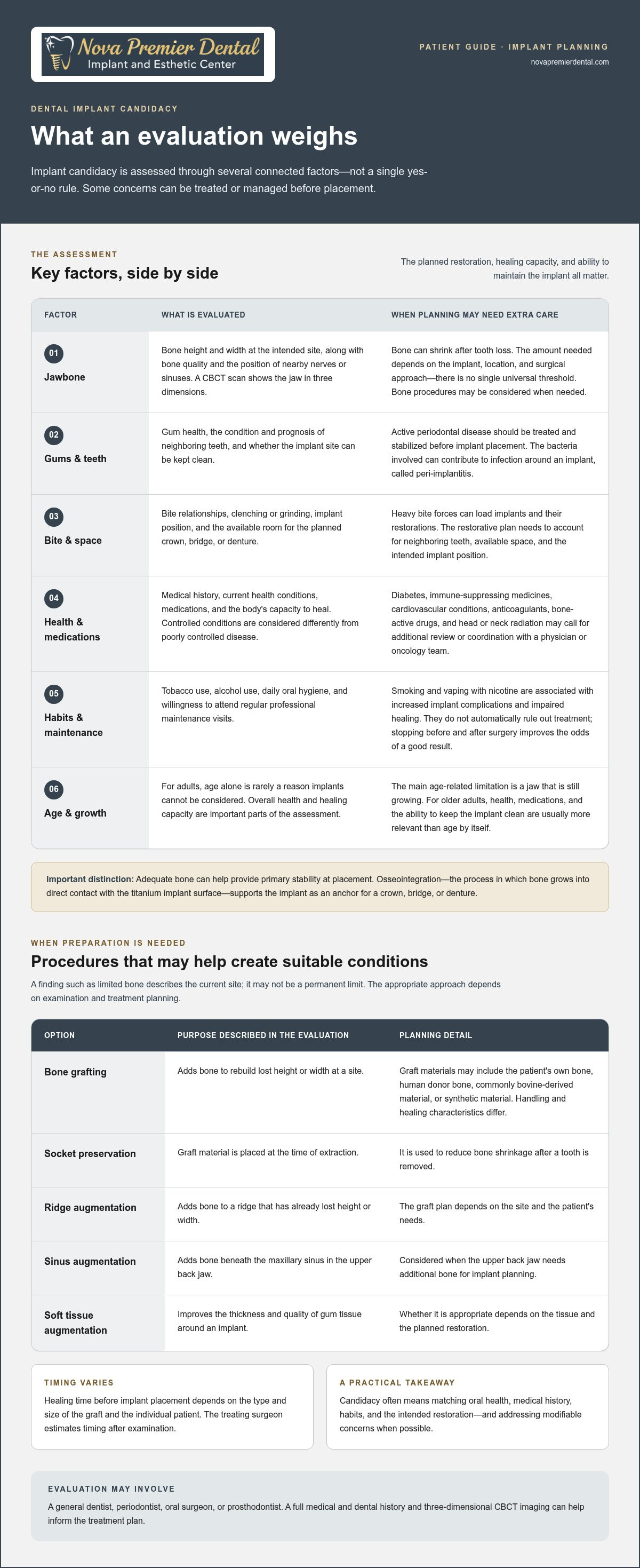
A good candidate generally has enough jawbone to hold an implant, healthy gum tissue, and general health that allows normal surgical healing. Implants rely on osseointegration, a process in which bone grows into direct contact with the titanium implant surface. This is what allows the implant to serve as an anchor for a crown, bridge, or denture. For background, see this overview of dental implants.
Age is rarely a disqualifying factor for adults. The main age-related limit applies to patients whose jaws are still growing. In older adults, the question is usually general health, medications, and the ability to keep the implant clean, not the number of years. Our page on implant considerations for seniors covers this in more detail.
Primary Oral Health Requirements
Active periodontal (gum) disease needs to be treated and stabilized before implants are placed, because the bacteria involved can contribute to infection around an implant (peri-implantitis). Beyond gum health, the evaluation looks at:
- Bone height and width at the planned implant site.
- The condition of neighboring teeth and whether they have a reasonable prognosis.
- Bite relationships and habits such as clenching or grinding, which can load implants and their restorations heavily.
- Available space for the final crown or prosthesis. See not enough space for a crown or implant.
The Significance of Bone Density
After a tooth is lost, the surrounding bone typically remodels and shrinks over time, so waiting can reduce available bone. Bone quantity and quality are assessed with a cone beam CT (CBCT) scan, which shows the jaw in three dimensions, including the position of nerves and sinuses. Adequate bone helps an implant achieve primary stability, meaning it is held firmly in place at placement, before bone has fully integrated. The exact amount needed depends on implant size, site, and surgical technique, so there is no single universal threshold. Implant position within the bone also affects the final restoration; see why implant position matters.
How General Health Affects Eligibility
Health conditions are weighed individually. The key distinction is between controlled and uncontrolled disease. A condition that is well managed under a physician's care is usually less of a concern than the same condition that is poorly controlled, because healing and infection resistance are affected by how well the body is regulated.
Conditions and medications that commonly prompt extra review include:
- Autoimmune disorders and immunosuppressive medications, which may affect healing.
- Cardiovascular disease and blood pressure, which may require medical clearance and planning for anticoagulant medications.
- Bisphosphonates and similar bone-active drugs, which are associated with a rare complication called medication-related osteonecrosis of the jaw. Risk differs by drug, dose, route, and duration.
- Head and neck radiation, which can reduce bone healing capacity and requires coordination with the oncology team. Our oral cancer rehabilitation page describes this area of prosthodontic care.
Managing Diabetes and Oral Surgery
Diabetes is not an automatic disqualifier. Poorly controlled blood sugar is associated with slower healing and a higher risk of infection, including peri-implantitis, so glycemic control is reviewed, often through the patient's recent HbA1c value and in consultation with their physician. Patients with well-controlled diabetes can be considered for implants, though they typically need closer monitoring and careful hygiene maintenance.
Habits That Influence Success Rates
Smoking is associated with a higher risk of implant complications and failure, likely because nicotine and other tobacco compounds reduce blood flow and impair healing. Vaping also delivers nicotine and should be discussed openly. Smoking does not necessarily rule out treatment, but cessation before and after surgery improves the odds of a good result. Heavy alcohol use can also interfere with healing. Finally, implants require daily cleaning and regular professional maintenance visits, and a willingness to do both is part of candidacy.
When Preparatory Procedures Make Implants Possible
If you have been told you do not have enough bone, that may describe your current situation rather than a permanent limit. Several procedures can add or reposition bone, and general dentists, periodontists, oral surgeons, and prosthodontists may all be involved in this kind of care depending on the case. Options include:
- Bone grafting to rebuild lost height or width.
- Sinus augmentation (sinus lift) to add bone beneath the maxillary sinus in the upper back jaw.
- Soft tissue augmentation to improve the thickness and quality of gum tissue around an implant.
Advanced Bone Grafting Techniques
- Socket preservation: graft material is placed at the time of extraction to reduce bone shrinkage afterward.
- Ridge augmentation: bone is added to a ridge that has already lost height or width.
- Graft materials: these may be autogenous (your own bone), allograft (human donor bone), xenograft (commonly bovine), or synthetic. Each has different handling and healing characteristics, and the choice depends on the site and surgeon.
Healing time before an implant can be placed varies with the type and size of the graft and the individual patient, and your surgeon will estimate it after examination. In some cases, grafting and implant placement can be done at the same visit.
Specialized Solutions for Severe Bone Loss
When conventional grafting is not practical, alternatives may include angled implants in an All-on-4 style full-arch design, which can make use of available bone, or zygomatic and pterygoid implants, which anchor in denser areas of the facial skeleton. These are technically demanding procedures with their own risks and are used selectively. Another option for some patients is an implant-retained or conventional denture; removable dentures are a reasonable choice for patients who prefer to avoid surgery, with trade-offs in stability and maintenance. For complex cases, see our oral reconstruction page.
What an Implant Candidacy Evaluation Involves
An evaluation generally follows these steps:
- Medical and dental history review, including medications, prior surgeries, radiation, and tobacco use.
- Clinical examination of gums, remaining teeth, bite, and soft tissue.
- Imaging, typically intraoral radiographs and a CBCT scan to measure bone and locate anatomical structures.
- Treatment planning that considers the final restoration first, then determines where implants should be placed and whether preparatory treatment is needed.
- Discussion of options, risks, and alternatives, including bridges and dentures.
Planning for the final restoration before surgery helps position implants where they can be restored properly; surgical guides may be used to carry out that plan.
When a Specialist Evaluation May Help
Many implant cases are appropriately treated by general dentists. A second opinion or prosthodontic evaluation may be useful if you have extensive tooth loss, significant bone loss, a history of implant or restoration problems, bite or wear concerns, or a complex medical history. Prosthodontists complete additional residency training focused on restoring and replacing teeth. Dr. Peterson Huang, DMD, MS, FACP, FRCDC, is a dentist and prosthodontist board-certified in both the United States and Canada; you can read about Dr. Huang's training and background. You can also read about prosthodontic care in Northern Virginia and how it compares with general dentistry.
Developing a Treatment Plan
The plan sequences care so that urgent problems, gum disease, and failing teeth are addressed first, followed by any grafting, implant placement, healing, and final restoration. If several providers are involved, such as a periodontist or oral surgeon, the plan is coordinated among them. Timelines and costs vary and are best estimated after your examination and imaging. Where cost is a concern, Nova Premier Dental offers in-house payment plans for qualifying patients, allowing treatment costs to be paid over several months.
Summary
Whether you are a candidate for dental implants depends on bone, gum health, general health, medications, habits, and your ability to maintain the implant. Many limiting factors can be treated or managed, but not every patient is a good candidate, and individual outcomes vary. Implant survival and the longevity of the crown or prosthesis on top of it are separate questions; restorations may need repair or replacement over time even when the implant itself remains stable. If you have questions about a complex restorative concern, Nova Premier Dental in Falls Church provides prosthodontic specialty care for patients throughout Northern Virginia, and you can contact the office to arrange an evaluation.
Frequently Asked Questions
Can I get dental implants if I have osteoporosis?
Often, yes. Osteoporosis itself is not generally considered a contraindication. The medications used to treat it, particularly bisphosphonates and similar drugs, need review because of the rare risk of osteonecrosis of the jaw. Your dentist and physician should coordinate before surgery.
Does smoking automatically disqualify me from getting dental implants?
No, but smoking is associated with a higher risk of complications and implant failure. Quitting before and during healing reduces that risk, and some providers will recommend delaying treatment until you do.
What is the success rate of dental implants for patients with diabetes?
Outcomes depend largely on how well the diabetes is controlled. Well-controlled patients can be treated, while poor control is associated with more infection and slower healing. Because individual risk varies, your provider will review your recent blood sugar values with your physician rather than quote a single figure.
Am I too old to be a candidate for dental implants?
Age alone rarely rules out implants for adults. Your general health, medications, bone, and ability to keep the area clean are more relevant.
What happens if I don't have enough bone for a dental implant?
Options may include bone grafting, sinus augmentation, shorter or angled implants, specialized implant designs, or non-implant alternatives such as a bridge or denture. The right choice depends on your imaging and goals.
Can I get implants if I currently have gum disease?
Not while the disease is active. Gum disease should be treated and stabilized first, and ongoing periodontal maintenance is important afterward because patients with a history of periodontitis have a higher risk of peri-implant disease.
How do I know if I need a bone graft before my implant surgery?
A clinical exam and a CBCT scan show the height and width of your bone and whether it can support an implant in the planned position. If it cannot, a graft may be recommended before or at the time of placement.
Why should I see a prosthodontist instead of a general dentist for my implants?
You do not always need to. General dentists routinely and appropriately place and restore implants. A prosthodontist, who has additional specialty residency training in restoring and replacing teeth, may be helpful for complex cases such as extensive tooth loss, severe bone loss, bite problems, or failed prior restorations.
Disclaimer
The information provided on this website and blog is intended for general educational and informational purposes only and should not be considered dental or medical advice, diagnosis, or treatment. Reading content on this website does not establish a doctor-patient relationship with Nova Premier Dental or Dr. Peterson Huang. Dental conditions and treatment needs vary from patient to patient. Individuals should consult directly with a qualified dental professional for personalized evaluation, diagnosis, and treatment recommendations. Do not delay seeking professional dental care based on information found on this website. While we strive to provide accurate and up-to-date information, no guarantee is made regarding the completeness, accuracy, or applicability of the content. Treatment outcomes may vary depending on individual circumstances. If you are experiencing a dental emergency or urgent oral health concern, please contact a licensed dental professional immediately or call 911 in the event of a medical emergency.


