


Article by
Peterson Huang DMD, MS, FACP, FRCDC
Dr. Peterson Huang is a dual board-certified prosthodontist serving Falls Church and Northern Virginia. He has been recognized as a Top Prosthodontist by Northern Virginia Magazine and Arlington Magazine and is affiliated with the Inova Fairfax Hospital Tumor Board. Dr. Huang focuses on dental implants, full mouth reconstruction, and complex restorative dentistry for patients who need advanced, comprehensive care.
A generic, over-the-counter night guard may seem like a quick remedy for nocturnal clenching, but ill-fitting retail appliances often fail to address the complex mechanics of your bite. Over time, an unbalanced appliance can unevenly distribute chewing forces, exacerbate muscular strain, and contribute to jaw discomfort. For individuals who have invested in restorative dental procedures such as crowns, bridges, or porcelain veneers, an uncalibrated mouthguard provides inadequate protection against nocturnal biting forces.
A professionally fabricated custom night guard for bruxism Falls Church patients receive at Nova Premier Dental is designed as a therapeutic oral appliance rather than a generic plastic barrier. Directed by Dr. Peterson Huang, DMD, MS, FACP, FRCDC—a dentist and dual board-certified prosthodontist certified by the American Board of Prosthodontics and the Royal College of Dentists of Canada—our practice focuses on preserving natural teeth and restorative dental work through balanced occlusal therapy. This guide outlines the biomechanical causes of sleep-related bruxism, how custom appliances function, and why specialized bite calibration is essential for long-term oral health.
Key Takeaways
- Clinical Signs of Bruxism: Morning tension headaches, masseter muscle fatigue, enamel flattening, and chipped restorations often indicate active nocturnal teeth grinding or clenching.
- The Prosthodontic Distinction: A prosthodontist completes three years of postdoctoral specialty training beyond dental school, focusing specifically on bite mechanics (occlusion) and complex tooth restoration.
- Custom versus Retail: Over-the-counter "boil-and-bite" guards are often soft and porous, which can stimulate chewing reflexes or shift tooth alignment, whereas custom appliances maintain neutral jaw positioning.
- Restoration Protection: Occlusal guards dissipate lateral forces away from dental implants and ceramic restorations, preventing mechanical complications like porcelain fracture or screw loosening.
- Flexible Financial Options: Nova Premier Dental offers in-house payment plans for qualifying patients, allowing treatment costs to be paid over several months while patients enjoy their new smile.
Understanding Bruxism and Its Impact on Northern Virginia Patients
Bruxism is the involuntary grinding, gnashing, or clenching of teeth. It can occur while awake (awake bruxism) or during sleep (sleep bruxism). Sleep bruxism is classified as a sleep-related movement disorder and often occurs without the patient's conscious awareness. In fast-paced professional areas such as Falls Church, Arlington, and McLean, elevated stress and irregular sleep schedules frequently correlate with increased muscle hyperactivity during rest.
During normal daytime chewing, teeth experience functional forces between 20 and 40 pounds of pressure per square inch. During nocturnal bruxism episodes, non-functional (parafunctional) forces can exceed several hundred pounds per square inch, applied over sustained periods without food to cushion the contact. Common signs and clinical symptoms include:
- Dull, aching tension headaches originating in the temples upon waking
- Pain, stiffness, or fatigue in the masticatory muscles (particularly the masseter and temporalis)
- Visible attrition, such as flattened biting edges, notched tooth margins (abfraction), or worn enamel
- Localized tooth sensitivity to temperature fluctuations without active dental decay
- Hypertrophy (enlargement) of the masseter muscles along the lower jaw angle
- Micro-cracks in natural enamel or recurrent chipping of existing fillings
The Silent Threat to Your Natural Teeth
Enamel is the hardest substance in the human body, but it is brittle when subjected to chronic shear stress. When opposing teeth slide repeatedly under intense force, enamel wears down, exposing the underlying dentin. Dentin is softer and significantly more susceptible to acid erosion and rapid wear. As dentin becomes exposed, patients frequently report heightened tooth sensitivity and a progressive change in tooth shape.
Beyond surface wear, chronic clenching introduces micro-fractures into the coronal tooth structure. Over months or years, these microscopic stress lines can propagate subgingivally toward the tooth root. Without early intervention using an occlusal guard to redistribute these forces, micro-fractures can result in a fractured cusp or complete vertical root fracture, often requiring extraction.
Bruxism and TMJ Disorders: A Dangerous Connection
The temporomandibular joints (TMJ) connect the lower jaw (mandible) to the temporal bones of the skull. These bilateral joints operate in coordination with a fibrocartilaginous articular disc that cushions bone-on-bone movement during opening, closing, and lateral chewing cycles. When severe clenching occurs, the condyles are forced against the articular discs and retrodiscal tissues under prolonged load.
This sustained mechanical stress can contribute to inflammation in the joint capsule, disc displacement, joint clicking, and episodic muscle spasms. While bruxism is not the sole cause of every temporomandibular disorder (TMD), it is a major contributing factor. Clinical management with an occlusal splint designed for TMJ jaw joint disorders provides a stable contact surface that allows overworked masticatory muscles to relax and reduces strain on the joints.
The Role of a Board-Certified Prosthodontist in Night Guard Therapy
A night guard should not be treated as a simple piece of plastic; it functions as a therapeutic orthotic appliance. General dentists provide essential preventive and restorative care for millions of patients, including routine night guards. However, when bite collapse, severe wear, TMJ complications, or extensive restorations are present, evaluation by a board-certified prosthodontist in Northern Virginia provides a deeper level of diagnostic insight.
Prosthodontists are dental specialists who complete three additional years of accredited post-doctoral residency dedicated to restoring and replacing teeth, managing complex occlusion, and treating severe dental wear. Dr. Peterson Huang is dual board-certified in prosthodontics in both the United States and Canada. This specialized background ensures that an occlusal appliance is designed with precise attention to how your upper and lower teeth interact statically and dynamically.
Precision Occlusal Analysis
Occlusion refers to the spatial relationship and contact pattern between the maxillary (upper) and mandibular (lower) teeth. When fabricating an appliance, a prosthodontist evaluates how the jaw articulates in centric relation—the stable, reproducible position of the condyles within the glenoid fossa, independent of tooth contact. For patients needing comprehensive care, a detailed occlusal analysis determines whether premature contacts or interferences exist.
If a night guard has high spots of even 50 to 100 microns, the brain registers that localized pressure during sleep, causing the jaw muscles to clench harder on that single point. A properly adjusted appliance provides simultaneous, bilateral contacts across the posterior teeth with gentle anterior guidance during excursions, discluding the back teeth to encourage muscle deprogramming.
Designing for Complex Restorations
Patients with extensive dental work require specialized guard planning. Ceramics such as lithium disilicate (porcelain veneers) and zirconia (dental crowns) exhibit high compressive strength but can fracture under tensile or shearing stresses. A prosthodontist fabricates guards with path-of-insertion clearance that protects delicate veneer margins from dislodgement forces.
Furthermore, dental implants behave differently than natural teeth. Natural teeth are suspended in the jawbone by the periodontal ligament (PDL), a fibrous tissue that acts as a natural shock absorber and provides neurosensory feedback. Implants are ankylosed directly to bone (osseointegration) and possess no periodontal ligament. Consequently, implants lack mechanical cushioning and tactile sensitivity, transmitting bite forces directly to the surrounding bone and abutment screws. A specialist-designed night guard buffers these loads, reducing the risk of screw loosening or ceramic chipping.
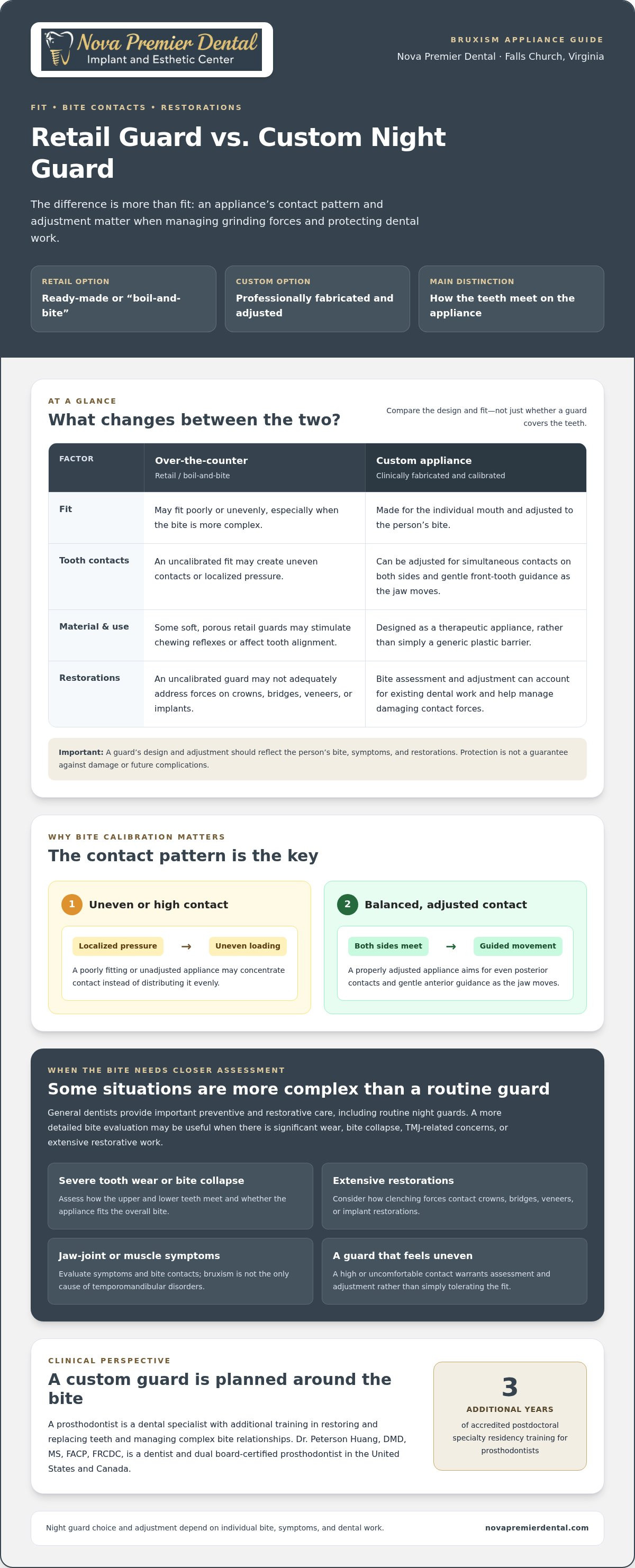
Custom Night Guards vs. Over-the-Counter Options
When seeking relief from jaw pain or tooth wear, patients often consider over-the-counter (OTC) products available at local pharmacies. While the low initial cost of a boil-and-bite guard is appealing, retail guards carry distinct biomechanical limitations and potential clinical risks when compared to professionally fabricated appliances.
| Feature | Custom Prosthodontic Night Guard | Over-the-Counter Boil-and-Bite Guard |
|---|---|---|
| Diagnostic Evaluation | Comprehensive clinical bite analysis, joint evaluation, and tooth wear screening | None; self-diagnosed and self-administered |
| Impression Method | High-resolution 3D digital intraoral scanning | Manual compression of boiled plastic in the mouth |
| Material Quality | Medical-grade, non-porous thermoplastics or dual-laminates | Porous, low-density retail ethylene-vinyl acetate (EVA) |
| Occlusal Balance | Calibrated to the micron to ensure bilateral, even contacts | Uneven contact surfaces that can introduce bite prematurities |
| Muscular Response | Deprograms masticatory muscles and reduces clenching activity | Soft, spongy texture can trigger the chewing reflex |
| Expected Longevity | Several years depending on severity of bruxism and maintenance | Often degrades, perforates, or deforms within a few months |
Clinical Risks of "Boil-and-Bite" Guards
The primary concern with retail night guards relates to their material properties and imprecise fit. Most OTC guards consist of pliable, rubbery plastics. When a patient clenches on a soft, resilient material during sleep, the periodontal receptors and muscle spindles frequently interpret the soft surface as a food bolus. This stimulates the central pattern generator for chewing, often increasing clenching and muscle activity rather than calming it.
Additionally, boil-and-bite guards rarely provide uniform posterior tooth support. If the appliance makes heavy contact on the back molars while leaving the front teeth unsupported, or vice versa, the jaw operates on an unbalanced pivot. Over time, uneven occlusal forces can lead to minor orthodontic tooth movement, bite changes (such as an anterior open bite), or aggravated TMJ capsulitis.
Comfort, Retention, and Patient Compliance
The therapeutic efficacy of any oral appliance relies entirely on patient compliance. Bulky, loose-fitting retail guards trigger gag reflexes, impede nighttime breathing, and frequently slip out of position during sleep. In contrast, an appliance engineered from precise anatomical models exhibits secure retention without excessive tightness.
By minimizing the appliance's bulk along the palate and lingual borders, a custom guard accommodates normal tongue posture and unobstructed airflow. A comfortable, low-profile fit allows patients to wear the appliance consistently throughout the night, protecting their dentition while fostering restful sleep.
The Clinical Process: Crafting Your Night Guard at Nova Premier Dental
At Nova Premier Dental, the fabrication of a custom night guard for bruxism follows a standardized clinical workflow designed to deliver accurate fit and balanced occlusion.
- Comprehensive Clinical Examination: Dr. Huang evaluates your temporomandibular joint mobility, palpates the masseter and pterygoid muscles for tenderness, and examines natural tooth surfaces and restorations for signs of attrition, abfraction, or mobility.
- Digital Intraoral Impressions: We utilize advanced 3D intraoral digital scanners rather than traditional, uncomfortable alginate trays. This scanning technology captures an accurate digital rendering of your dental arches, including marginal gingiva and existing prostheses.
- Interocclusal Bite Registration: An optical bite registration records the precise three-dimensional relationship of your maxilla and mandible in a physiologically stable position.
- Specialized Laboratory Fabrication: Digital models are transferred to a specialized dental laboratory where the appliance is milled or thermoformed using high-density, biocompatible materials based on the prosthodontist's prescription.
- Clinical Delivery and Micron-Level Equilibration: Once fabricated, the appliance is fitted intraorally. Dr. Huang uses fine articulating film to evaluate and adjust occlusal contacts, verifying that bite forces are shared evenly and that excursive guidance discludes posterior teeth without interference.
- Long-Term Follow-Up: The appliance is assessed during your routine dental exams and cleanings to check for wear facets, evaluate retention, and adjust the bite as normal dental changes occur over time.
Diagnostic Digital Workflows
The transition from traditional physical impressions to optical digital scanning has significantly improved appliance accuracy. Physical impression materials like alginate or polyvinyl siloxane (PVS) can undergo slight dimensional distortions during setting, disinfection, and stone pouring. Digital impressions capture tissue topography directly, eliminating distortion and ensuring tight passive retention.
This digital data integrates seamlessly into comprehensive dental records, allowing our team to monitor tooth wear progression over time by superimposing longitudinal scans. If a patient later requires complex restorative treatment or oral reconstruction, historical scan data provides a baseline of their original anatomy.
Materials Matter: Hard vs. Soft Guards
Different clinical situations warrant different material selections:
- Hard Acrylic (PMMA) Guards: Fabricated from rigid polymethyl methacrylate, hard guards represent the gold standard for severe bruxism. Their rigid surface allows the lower teeth to glide smoothly during parafunctional movements without catching, eliminating lateral torsional stress on teeth and joints.
- Dual-Laminate Guards: These appliances feature a soft, polyurethane inner layer for patient comfort against the enamel, bonded to a hard, durable outer shell that withstands heavy grinding. They are ideal for moderate bruxers who find fully rigid acrylic uncomfortable.
- Thermoplastic Materials: These medical-grade polymers become slightly pliable in warm water before insertion, adapting closely to the teeth for a comfortable, secure fit while maintaining structural rigidity at oral temperature.
Protecting Your Restorative Dental Treatments
A custom night guard functions as essential preventive care for patients who have undergone extensive cosmetic or restorative dentistry. While high-grade ceramics and dental titanium implants are resilient, they are not immune to the destructive physics of chronic parafunction. Preventing restoration failure saves significant time, discomfort, and financial expense over the lifespan of your smile.
Safeguarding Dental Implants and Prostheses
Dental implants boast exceptional long-term survival rates, but biological survival of an implant fixture in bone is distinct from the mechanical survival of the prosthetic components attached to it. Unlike natural teeth, osseointegrated implants do not have periodontal ligament fibers to cushion non-axial loads. When subjected to repetitive nocturnal grinding, implants absorb stress directly at the crestal bone interface and through the abutment screw.
Unmanaged bruxism can result in complications such as prosthetic screw loosening, screw fracture, or chipping of the overlying porcelain crown. A custom night guard absorbs and distributes these destructive shear forces across the entire arch, protecting both the prosthetic restoration and the supporting bone architecture.
Managing Treatment Costs
High-quality prosthodontic appliances represent an investment in preventive care, mitigating the need for costly emergency treatments, crown replacements, or root canal therapy. Dental insurance plans vary widely; some offer partial coverage for occlusal guards, while others categorize them under major or non-covered benefits. Our administrative team assists patients in reviewing policy details to maximize any available benefits.
To keep specialized prosthodontic therapy accessible, Nova Premier Dental offers in-house payment plans for qualifying patients, allowing treatment costs to be paid over several months while patients enjoy their new smile.
Prosthodontic Evaluation at Nova Premier Dental
If you wake with persistent jaw tightness, unexplained temple headaches, or notice your teeth becoming shorter or chipped, an occlusal evaluation can determine whether nocturnal bruxism is the underlying cause. Choosing an appliance designed by a dual board-certified prosthodontist ensures your guard is calibrated to your individual jaw mechanics and existing dental restorations.
If you have questions about custom night guards or complex restorative concerns, Nova Premier Dental in Falls Church provides prosthodontic specialty care for patients throughout Northern Virginia, including McLean, Arlington, and Tysons. Contact our Falls Church office today to schedule a consultation with Dr. Peterson Huang.
Frequently Asked Questions
How long does a custom night guard from a prosthodontist last?
A high-quality custom night guard typically lasts between three and five years, depending on the severity of the patient's grinding, the material selected, and home care practices. Patients with extreme clenching habits may wear down an appliance sooner, while mild grinders may use the same guard for longer. Bringing your guard to your routine dental appointments allows Dr. Huang to check the material for thinning, cracks, or bite changes.
Can a custom night guard help with my chronic morning headaches?
Yes. Many morning headaches originate from sustained contraction of the temporalis and masseter muscles during nocturnal clenching. A custom night guard creates a balanced biting surface that discludes posterior teeth during side-to-side movements, which clinically reduces the intensity of muscle contractions and alleviates morning tension headaches.
Will my dental insurance cover a custom night guard for bruxism?
Coverage depends entirely on your specific dental insurance policy. Some policies cover occlusal guards under preventive or basic services, reimbursing between 50% and 80%, while others exclude night guards altogether. Our administrative team will verify your benefits prior to treatment. For balances not covered by insurance, Nova Premier Dental offers in-house payment plans for qualifying patients, allowing treatment costs to be paid over several months.
Is it uncomfortable to sleep with a custom-fit night guard?
Most patients adjust to a custom-fit night guard within three to seven nights. Because the appliance is fabricated from a precise digital scan of your teeth, it has a snug, low-profile design that does not press excessively on gum tissues or dislodge during sleep. It is considerably less bulky and much easier to tolerate than thick, generic over-the-counter options.
What happens if I don’t wear a night guard for my teeth grinding?
Untreated nocturnal bruxism progressively wears down enamel, exposing the yellow, sensitive dentin beneath. Over time, this wear can shorten teeth, alter facial height, cause persistent jaw joint inflammation, and create micro-cracks that lead to tooth fractures. For patients with crowns, veneers, or implants, unmanaged grinding significantly increases the likelihood of ceramic chipping or mechanical failure.
How do I clean and maintain my custom night guard?
Rinse your appliance with cool or lukewarm water immediately after removing it each morning. Brush it gently using a soft-bristled toothbrush and a mild, non-abrasive liquid soap; avoid standard toothpastes, as their abrasive particles can scratch the plastic and harbor bacteria. Never use boiling water, as high temperatures will warp the thermoplastic material. Store the dry appliance in its ventilated protective case away from direct sunlight and pets.
Can a night guard fix my TMJ jaw pain permanently?
An occlusal guard is a highly effective management tool, but it is rarely a standalone "cure" for temporomandibular disorders. The appliance reduces joint loading, relieves muscle spasm, and protects the physical structures of the teeth. If TMJ pain stems from systemic arthritis, internal joint derangement, or skeletal malocclusion, Dr. Huang may incorporate the guard into a broader therapy regimen that includes physical therapy, dietary modifications, or bite rehabilitation.
Why shouldn’t I just buy a night guard at the drugstore?
Drugstore boil-and-bite mouthguards lack the precise occlusal alignment necessary to protect your jaw joints. Because they are typically made of soft, spongy material, they often trigger the jaw's natural chewing reflex, which can cause you to clench harder. Furthermore, an imprecise fit can apply uneven pressure to individual teeth, potentially shifting your bite and causing more harm than good.
Disclaimer
The information provided on this website and blog is intended for general educational and informational purposes only and should not be considered dental or medical advice, diagnosis, or treatment. Reading content on this website does not establish a doctor-patient relationship with Nova Premier Dental or Dr. Peterson Huang. Dental conditions and treatment needs vary from patient to patient. Individuals should consult directly with a qualified dental professional for personalized evaluation, diagnosis, and treatment recommendations. Do not delay seeking professional dental care based on information found on this website. While we strive to provide accurate and up-to-date information, no guarantee is made regarding the completeness, accuracy, or applicability of the content. Treatment outcomes may vary depending on individual circumstances. If you are experiencing a dental emergency or urgent oral health concern, please contact a licensed dental professional immediately or call 911 in the event of a medical emergency.


