


Article by
Peterson Huang DMD, MS, FACP, FRCDC
Dr. Peterson Huang is a dual board-certified prosthodontist serving Falls Church and Northern Virginia. He has been recognized as a Top Prosthodontist by Northern Virginia Magazine and Arlington Magazine and is affiliated with the Inova Fairfax Hospital Tumor Board. Dr. Huang focuses on dental implants, full mouth reconstruction, and complex restorative dentistry for patients who need advanced, comprehensive care.
Is clasp grip what keeps a removable partial denture secure? Not by itself. It’s understandable to focus on whether a cast metal partial denture feels tight or whether its clasps are visible, but dependable denture support and retention come from coordinated design, not simply a stronger grip. The framework must relate appropriately to the remaining teeth and gum tissues while helping the denture resist movement during chewing.
Support, retention, and stability describe different roles: support limits movement toward the gums, retention helps resist dislodgement, and stability helps control side-to-side or rotational movement. This article explains how rests, clasps, and the framework contribute to those functions, and how tooth health, tissue contours, bite forces, and fit affect comfort. It also explains what an individualized evaluation considers, why a denture that shifts or causes soreness should be assessed rather than adjusted at home, and how hygiene and follow-up help maintain fit over time.
Key Takeaways
- A removable partial denture replaces some, but not all, missing teeth. A cast metal partial denture uses a framework designed to work with remaining teeth and oral tissues.
- Support, retention, and stability serve different roles in helping the denture resist movement.
- Clasp visibility and perceived looseness vary. Discuss concerns during a clinical fit assessment rather than adjusting the denture yourself.
- The health of remaining teeth, bite forces, and available space inform individualized design and follow-up.
What Is a Cast-Metal Removable Partial Denture, and What Does It Replace?
A removable partial denture replaces selected missing teeth while some natural teeth remain. A cast-metal partial denture has a framework that connects artificial teeth with components designed to interact with remaining teeth and supporting oral tissues. Its suitability depends on the pattern of missing teeth, the health of the remaining teeth and tissues, and the overall treatment plan.
How does a cast-metal partial differ from a complete denture?
A partial denture replaces some missing teeth while natural teeth remain in the arch. A complete denture replaces all the teeth in an arch, so it relies on different supporting structures and does not use natural teeth for support or retention. The two types therefore involve different design considerations. For a partial denture, the location and condition of the remaining teeth help determine how its components interact with the mouth.
What does the metal framework contribute?
A cast-metal framework is the connected structural base that positions and links a partial denture’s components; it is distinct from the artificial teeth it supports. Its connectors, rests, and retainers are planned to work together. The American Dental Association’s overview of partial dentures describes common design features, including metal frameworks and clasps.
Planning accounts for more than replacing visible spaces. A clinician assesses the remaining teeth, their stability, the supporting tissues, and how the teeth meet during biting. The pattern of missing teeth also matters: a gap bounded by natural teeth is supported differently from a space that extends behind the last remaining tooth. These findings help determine whether a cast-metal framework is appropriate and how its components should interact with the mouth. Learn more about partial-denture care and treatment options at Nova Premier Dental.
How Support, Retention, and Stability Work Together
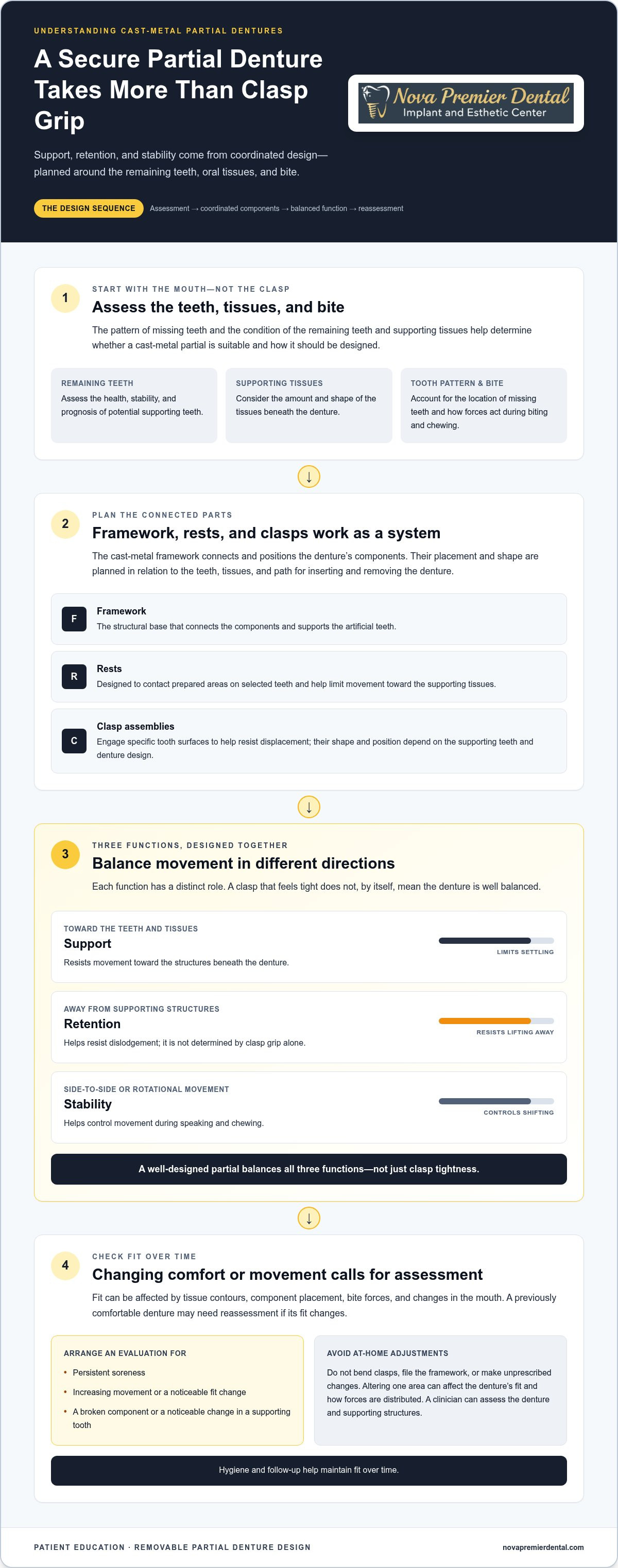
A well-designed removable partial denture balances three related functions. Support resists movement toward the teeth and oral tissues beneath the denture. Retention resists movement away from those structures. Stability helps limit sideways or rotational movement during speaking and chewing. For a cast metal partial denture, denture support and retention must work alongside stability. One function cannot make up for a design that does not adequately address another.
Retention isn’t determined by clasp grip alone. A removable partial denture depends on the coordinated fit of its framework, rests, clasps, and other components. In a cast metal partial denture, denture support and retention are planned in relation to the individual teeth and tissues, not simply by making a clasp tighter. The American College of Prosthodontists offers additional patient information about dentures and how partial dentures relate to remaining teeth.
How do rests and clasps contribute to support and retention?
Rests are designed to contact prepared areas on selected teeth and help limit movement toward the supporting tissues. Clasp assemblies engage specific tooth surfaces to help resist displacement. Their placement and shape depend on which teeth can serve as abutments and the planned path for inserting and removing the denture. A clasp that feels tight isn’t necessarily evidence of a well-balanced design; its role must be considered alongside the framework and other components.
Why do the remaining teeth and tissues matter?
The clinician assesses the condition and prognosis of potential abutment teeth, including their periodontal health, as well as the amount and shape of available supporting tissue. These findings affect which teeth can reasonably contribute to support and how the denture may share functional forces. Bite patterns and chewing forces also matter. The design must account for how forces act on both the denture and the structures supporting it, rather than relying on clasp tension to hold everything in place.
Nova Premier Dental provides prosthodontic care, including partial-denture treatment, at its Falls Church office for patients throughout Northern Virginia.
Will a Cast-Metal Partial Denture Feel Loose or Show Clasps?
Comfort, movement, and visible clasps are reasonable concerns, but how a partial denture feels and looks depends on the person’s mouth and the design. A cast-metal framework may include clasps that show when smiling, depending on the position of the supporting teeth and the components needed for function. Appearance and retention are both planning considerations, balanced with the clinical needs of the remaining teeth and tissues. The American Dental Association’s overview of partial dentures describes common designs, including those with metal frameworks and clasps.
What can influence comfort and stability?
Fit depends on how the denture’s components relate to the teeth and supporting tissues. Tissue contours, clasp and framework placement, and bite forces can all affect comfort and movement. Getting used to a new removable partial denture may also take adjustment. A sense of looseness can have several causes, including a change in fit or a component that needs clinical assessment. Changes in the mouth over time may alter how the denture fits, so a previously comfortable fit does not rule out the need for reassessment.
When should a partial denture be reassessed?
Arrange an evaluation for persistent soreness, increasing movement, a broken component, or a noticeable change in a supporting tooth. Don’t bend clasps, file the framework, or make unprescribed adjustments. Altering one area can affect how the rest of the denture fits and distributes forces. A clinician can examine the denture and supporting structures to determine whether an adjustment or other care is appropriate.
If a partial denture feels unstable or uncomfortable, a clinical assessment can help identify the cause rather than treating the symptoms with a home adjustment.
How Is a Partial Denture Designed, Evaluated, and Maintained?
Planning a removable partial denture begins with the mouth, not a standard framework. The clinician reviews oral health, examines the remaining teeth and supporting tissues, considers the bite, and plans a design. Once made, the denture’s fit and function are assessed. This sequence helps determine whether a cast metal partial denture is suitable and how its components can work with the structures available.
What does the clinician consider during treatment planning?
Assessment includes the condition and prognosis of potential supporting teeth, the health of the surrounding tissues, how the upper and lower teeth meet, and the space available for replacement teeth and denture components. Bite forces and the planned design can affect how forces are distributed. Alternatives depend on these findings and on the patient’s goals. Prosthodontic training may be useful when tooth replacement involves complex restorative considerations. Dr. Peterson Huang, DMD, MS, FACP, FRCDC, is a dentist and dual board-certified prosthodontist with prosthodontic certifications in the United States and Canada; read about Dr. Huang’s training and background.
What helps maintain a removable partial denture?
Daily care supports both the denture and the teeth it fits around. Follow the individualized instructions provided for cleaning and storage, and clean supporting teeth carefully as part of regular oral hygiene. Dental follow-up allows the clinician to assess the denture and the condition of the teeth and tissues; the appropriate interval depends on individual needs.
If the fit changes, discomfort persists, or a component is damaged, arrange an evaluation rather than attempting to adjust the appliance yourself. A well-planned design still needs ongoing attention: changes in oral health or the condition of supporting teeth may affect denture support and retention over time.
Choose a Design That Fits Your Oral Health
A well-designed removable partial denture is planned around the remaining teeth, supporting tissues, bite, and available space. A cast-metal framework may be appropriate for some patients, but fit, appearance, support, and retention depend on individual clinical findings. Persistent soreness, movement, or damage warrants assessment rather than home adjustment, and ongoing cleaning and dental follow-up help monitor the denture and supporting teeth.
Nova Premier Dental is a private prosthodontic specialty dental office in Falls Church serving Northern Virginia, including McLean, Great Falls, Arlington, Fairfax, Tysons, and Annandale. Learn more about prosthodontic care in Northern Virginia, or visit Nova Premier Dental to discuss partial-denture care.
Frequently Asked Questions
What is the difference between support, retention, and stability in a partial denture?
Support resists movement of the denture toward the supporting teeth and oral tissues. Retention resists movement away from those structures, such as lifting during use. Stability helps limit sideways or rotational movement. These functions work together, but they’re not interchangeable: a partial denture may resist lifting yet still rock if its design doesn’t adequately control movement during chewing.
Are cast-metal partial dentures more stable than acrylic partial dentures?
Not in every case. A cast-metal framework is rigid and can connect components that engage teeth and supporting tissues, but stability depends on fit, oral anatomy, remaining teeth, and design. Acrylic partial dentures have different construction and uses. The appropriate comparison is how each option may function given your clinical findings and needs, rather than assuming one material is always more stable.
Can a cast-metal partial denture damage the teeth that support it?
A partial denture is designed to work with its supporting teeth, but those teeth still need monitoring. Their health and stability are considered during planning, and careful cleaning around teeth and denture components is important. If a supporting tooth becomes painful, loose, or difficult to clean, arrange a dental assessment. The clinician can evaluate the tooth and the denture’s fit and design.
Why does my removable partial denture feel loose?
A removable partial denture can feel loose for several reasons, including a change in fit, a damaged or altered component, changes in the mouth, or movement during function. The cause can’t be determined by feel alone. Don’t bend clasps or file the framework yourself, since an adjustment may affect other parts of the fit. Have persistent looseness assessed clinically.
How should I clean and maintain a cast-metal partial denture?
Follow your dentist’s instructions for cleaning and storing the denture, and clean the teeth and gum areas around its components carefully. Regular dental follow-up helps assess the fit and supporting teeth; the timing depends on your needs. If the denture becomes uncomfortable, changes fit, or is damaged, seek an evaluation rather than trying to adjust it at home.
Disclaimer
The information provided on this website and blog is intended for general educational and informational purposes only and should not be considered dental or medical advice, diagnosis, or treatment. Reading content on this website does not establish a doctor-patient relationship with Nova Premier Dental or Dr. Peterson Huang. Dental conditions and treatment needs vary from patient to patient. Individuals should consult directly with a qualified dental professional for personalized evaluation, diagnosis, and treatment recommendations. Do not delay seeking professional dental care based on information found on this website. While we strive to provide accurate and up-to-date information, no guarantee is made regarding the completeness, accuracy, or applicability of the content. Treatment outcomes may vary depending on individual circumstances. If you are experiencing a dental emergency or urgent oral health concern, please contact a licensed dental professional immediately or call 911 in the event of a medical emergency.


