

Article by
Peterson Huang DMD, MS, FACP, FRCDC
Dr. Peterson Huang is a dual board-certified prosthodontist serving Falls Church and Northern Virginia. He has been recognized as a Top Prosthodontist by Northern Virginia Magazine and Arlington Magazine and is affiliated with the Inova Fairfax Hospital Tumor Board. Dr. Huang focuses on dental implants, full mouth reconstruction, and complex restorative dentistry for patients who need advanced, comprehensive care.
Full mouth reconstruction—often referred to interchangeably as full mouth rehabilitation or total oral restoration—is a comprehensive treatment process designed to rebuild, restore, or replace compromised teeth throughout both the upper and lower dental arches. When oral health has deteriorated significantly due to extensive decay, advanced wear, trauma, or tooth loss, individual fillings or localized restorations are frequently insufficient to re-establish stable function. In these situations, a systematic, full-arch approach is necessary to restore chewing efficiency, comfort, speech, and dental appearance.
For patients seeking full mouth reconstruction in Falls Church and the broader Northern Virginia area, understanding the diagnostic principles, clinical sequence, and treatment options is an important first step. This guide outlines the clinical fundamentals of comprehensive oral reconstruction, the difference between elective cosmetic procedures and functional rehabilitation, and how advanced prosthodontic training informs the management of complex dental needs.
Defining Full Mouth Reconstruction: Functional Rehabilitation and Structural Stability
At its core, full mouth reconstruction is the simultaneous or systematically staged restoration of all or most teeth in the maxilla (upper jaw) and mandible (lower jaw). Rather than addressing isolated dental problems as they arise, reconstruction approaches the mouth as an integrated biological and mechanical system. It involves an evaluation of tooth structure, periodontal (gum and bone) support, the temporomandibular joints (TMJ), masticatory musculature, and occlusion (the way teeth contact during chewing and rest).
Comprehensive reconstruction often integrates multiple dental disciplines, including restorative dentistry, dental implants, periodontics, and fixed prosthodontics. The overarching goal is not merely cosmetic alteration, but the restoration of oral function, biological health, and long-term mechanical stability.
Reconstruction vs. Rehabilitation vs. Restoration
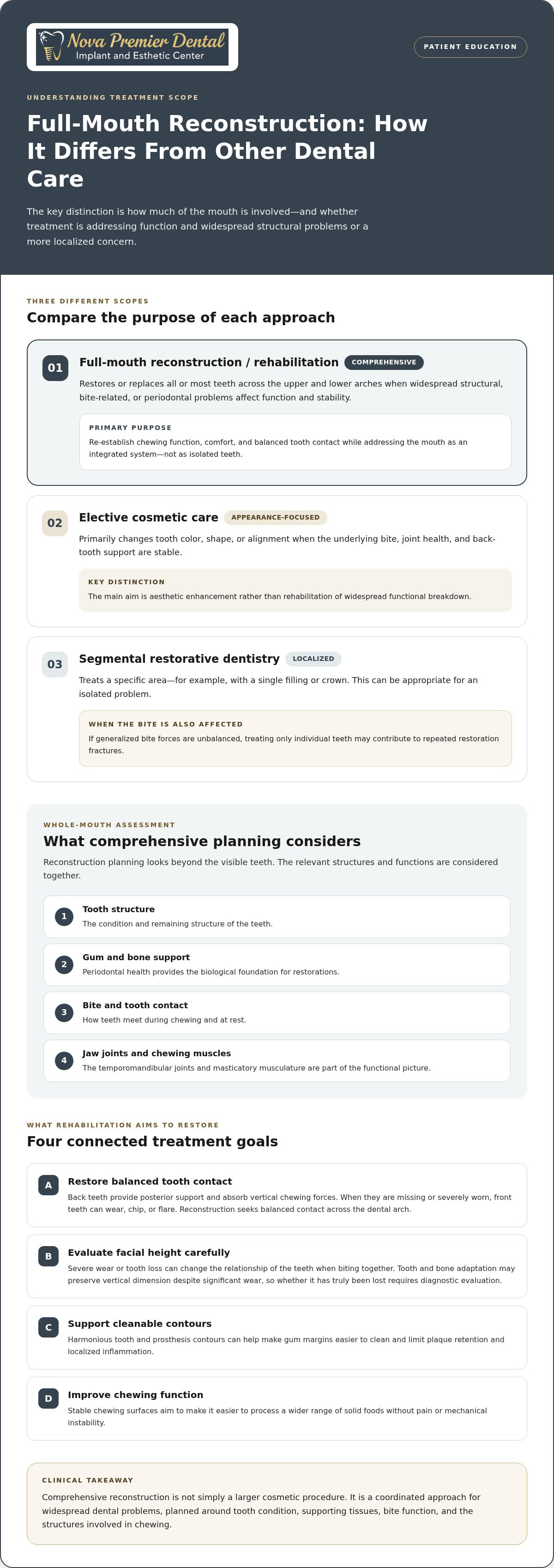
In dental literature and clinical practice, the terms full mouth reconstruction, full mouth rehabilitation, and full mouth restoration are largely synonymous. However, it is clinically helpful to differentiate between these procedures and purely elective cosmetic dentistry:
- Full Mouth Reconstruction / Rehabilitation: Indicated when multiple structural, occlusal, or periodontal failures threaten the health and functional viability of the dentition. Treatment is medically and functionally necessary to restore normal mastication, stop progressive destruction of tooth structure, or replace missing teeth.
- Smile Makeover / Elective Cosmetic Care: Primarily focuses on aesthetic enhancements—such as minor tooth color, shape, or alignment adjustments—often in a patient whose underlying bite, joint health, and posterior support (back teeth) are already stable.
- Segmental Restorative Dentistry: Treating isolated areas, such as placing a single crown or filling. While appropriate for localized issues, applying segmental dentistry to generalized occlusal breakdown can inadvertently lead to repeated restoration fractures if underlying bite forces are unbalanced.
The Goals of Comprehensive Oral Rehabilitation
A structured reconstruction aims to achieve several primary clinical objectives:
- Restoring Occlusal Stability and posterior support: Posterior teeth (premolars and molars) protect anterior teeth by absorbing vertical chewing forces. When back teeth are missing or severely worn, anterior teeth can wear down rapidly, chip, or flare outward. Reconstruction re-establishes balanced contact across the entire dental arch.
- Evaluating and Restoring Vertical Dimension of Occlusion (VDO): VDO refers to the measured vertical height of the face when teeth are fully biting together. Severe tooth wear or extensive tooth loss can alter this relationship. However, clinical evidence shows that continuous dentoalveolar compensation (where teeth and surrounding bone slowly erupt to maintain contact) often preserves VDO even with significant wear. Determining whether VDO has truly been lost or merely altered requires careful diagnostic evaluation rather than immediate assumptions.
- Protecting the Periodontium and Supporting Bone: Restoring harmonious contours to individual teeth and prostheses ensures that gingival margins can be cleaned effectively, minimizing plaque retention and localized inflammation.
- Improving Mastication and Nutrition: By establishing stable chewing platforms, patients are able to process a wider range of solid, nutrient-dense foods without pain or mechanical instability.
Clinical Indicators: Identifying Candidacy for Comprehensive Treatment
full mouth reconstruction is not an everyday procedure for minor dental concerns. It is typically indicated when widespread structural compromise makes localized treatments unpredictable. Clinical signs that often indicate the need for comprehensive rehabilitation include:
- Extensive Tooth Wear (Attrition, Erosion, and Abrasion): Severe loss of enamel and dentin caused by severe nocturnal bruxism (teeth grinding), parafunctional habits, dietary acids, or gastric reflux (GERD). When wear approaches the pulp tissue or causes repeated restoration failure, full-arch intervention may be warranted.
- Multiple Missing or Non-Restorable Teeth: Loss of multiple teeth without replacement can cause adjacent teeth to tip, drift, or over-erupt, leading to an uneven bite plane and poor load distribution.
- Generalized Periodontal Breakdown: Severe periodontitis results in alveolar bone resorption and tooth mobility. Once active periodontal disease is stabilized, reconstruction may be required to splint weakened teeth or replace missing units with implant-supported restorations.
- History of "Patchwork" Failures: Patients who have had individual crowns, fillings, and bridges placed over decades by different practitioners may experience mismatched bite planes, uneven contact points, and recurrent structural breakage.
- Trauma or Congenital Conditions: Severe facial injuries or developmental disorders such as amelogenesis imperfecta, dentinogenesis imperfecta, or ectodermal dysplasia that affect tooth structure and alignment across both arches.
The Impact of Severe Periodontal Disease
Periodontal health serves as the biological foundation for all restorative dentistry. Placing crowns, bridges, or dental implants in the presence of active, uncontrolled periodontitis significantly increases the risk of biological complications, such as recurrent infection, rapid bone loss, and peri-implantitis.
For patients presenting with advanced gum disease, treatment begins with non-surgical or surgical periodontal therapy to eliminate subgingival pathogens and establish tissue health. In cases where teeth exhibit hopeless mobility or severe horizontal and vertical bone loss, careful extraction protocols combined with bone ridge preservation may precede the fabrication of fixed or removable oral reconstruction prostheses.
Functional Decline and Daily Quality of Life
Chronic dental breakdown often leads to functional compensation. Patients frequently alter their chewing patterns to avoid painful or unstable teeth, shifting masticatory loads onto single quadrants. Over time, this unilateral chewing can exacerbate muscular fatigue or localized tooth fractures.
Many individuals also experience what clinicians describe as dental exhaustion—the psychological and logistical fatigue associated with recurring dental emergencies, broken restorations, and constant repair appointments. A comprehensive reconstruction aims to break this cycle by providing a stable, unified treatment plan with predictable maintenance requirements.
The Clinical Process: Planning and Executing Full Mouth Reconstruction
full mouth reconstruction requires careful diagnostic planning and systematic treatment sequencing. Because every restoration influences the surrounding teeth and bite, treatment must follow structured clinical stages rather than ad-hoc procedures. Detailed explanations of these phases can also be explored in our guide on what full mouth reconstruction involves.
Phase 1: Comprehensive Diagnostic Records
Before any irreversible tooth preparation begins, an extensive set of diagnostic baseline records is gathered:
- High-Resolution Cone Beam Computed Tomography (CBCT): 3D radiographic imaging provides precise assessment of jawbone volume, density, nerve pathways, and maxillary sinus locations. This data is critical when planning dental implant placement and bone grafting procedures.
- Digital Impressions and Articulated Casts: High-precision intraoral digital scans or physical impressions capture the upper and lower arches. These models are mounted on a semi-adjustable or fully adjustable dental articulator using a facebow transfer to simulate the patient’s actual jaw movements.
- Temporomandibular Joint (TMJ) Assessment: Checking for joint sounds (clicking, popping, crepitus), range of motion, muscle tenderness, and deviations upon opening to confirm joint stability prior to altering occlusal schemes.
- Periodontal Charting and Endodontic Evaluation: Documenting pocket depths, attachment levels, furcation involvements, and checking the vitality of prospective abutment teeth.
Phase 2: Occlusal Analysis and the Diagnostic Wax-Up
The diagnostic wax-up is a fundamental planning tool in prosthodontic treatment. On the mounted casts, the clinician or specialized dental technician builds the proposed restorations in wax, adjusting tooth morphology, contact points, and the occlusal plane. This step determines:
- Whether sufficient restorative space exists for materials like zirconia, lithium disilicate, or porcelain-fused-to-metal.
- The ideal position and angulation for dental implants relative to the planned crowns (restoratively driven implant placement).
- Whether the vertical dimension of occlusion needs to be altered, and if so, by how many millimeters.
Phase 3: Disease Control and Preparatory Therapy
Before definitive prosthetics can be manufactured, the oral environment must be biologically sound:
- Active caries (decay) is excavated and restored with provisional materials.
- Teeth with pulpal pathology undergo endodontic (root canal) treatment.
- Periodontal therapy stabilizes bone and soft tissues.
- Surgical interventions, such as ridge augmentation, sinus floor elevation, or tooth extractions, are performed and allowed appropriate healing time.
Phase 4: Provisional (Transitional) Restorations
Provisionalization is perhaps the most critical step in a full mouth reconstruction. High-strength acrylic or composite transitional restorations, designed directly from the approved diagnostic wax-up, are placed in the patient’s mouth.
These provisional restorations serve several key diagnostic functions:
- Functional Testing: They confirm that the patient can chew comfortably at the new bite position and that the masticatory muscles adapt without strain or pain.
- Phonetic Evaluation: Speech patterns (especially "S," "F," and "V" sounds) are checked to ensure anterior teeth are neither too long nor positioned too far forward.
- Aesthetic Verification: The patient evaluates tooth shape, smile line, and lip support, allowing refinements to be made before definitive materials are fabricated.
- Biological Response: Gingival tissues heal around well-contoured provisional margins, creating natural emergence profiles for final crowns and implant restorations.
Patients typically function with provisional restorations for several weeks to months, providing an objective test period to confirm comfort and occlusal stability.
Phase 5: Definitive Restoration Fabrication and Delivery
Once the provisional phase confirms optimal function and aesthetics, precise impressions of the provisionals and underlying preparations are captured. The dental laboratory duplicates the tested occlusal contours in durable, biocompatible materials.
Depending on the clinical scenario, final restorations may include single dental crowns, fixed bridges, onlays, implant-supported hybrid prostheses, or removable implant overdentures. Restorations are cemented or screw-retained, bite relationships are systematically verified, and maintenance protocols are established.
Specialist vs. General Dentist: Understanding Prosthodontic Care
General dentists provide essential oral healthcare, delivering crucial preventive services, routine diagnostic examinations, periodontal therapy, and routine restorative treatments such as fillings and single crowns. Many general practitioners successfully manage uncomplicated restorative procedures every day.
When extensive tooth loss, severe bite changes, or complex restorative problems affect multiple areas, referral to a prosthodontist may be appropriate. Prosthodontists complete additional specialty training focused on restoring and replacing teeth and managing complex restorative problems.
Prosthodontic Specialty Training and Board Certification
Following dental school, prosthodontists complete three additional years of rigorous, full-time residency training in an accredited hospital or university program. This advanced curriculum emphasizes:
- Occlusal biomechanics, jaw kinesiology, and TMJ physiology.
- Fixed, removable, maxillofacial, and implant prosthodontics.
- Management of severe dental wear, congenital anomalies, and traumatic defects.
- Advanced laboratory techniques, biomaterials science, and digital design workflows.
Dr. Peterson Huang completed specialty training in prosthodontics and holds board certification through the American Board of Prosthodontics and the Royal College of Dentists of Canada.
Nova Premier Dental is a private prosthodontic specialty dental office in Falls Church. Peterson Huang, DMD, MS, FACP, FRCDC is a dentist and dual board-certified prosthodontist.
Patients seeking care from a prosthodontist in Northern Virginia often include individuals whose cases involve complex implant positioning, limited restorative space, or prior prosthetic complications requiring comprehensive revision.
Collaborative, Multidisciplinary Treatment Planning
Comprehensive reconstruction often requires close collaboration among dental specialists. In complex cases, a prosthodontist frequently coordinates the restorative plan alongside periodontists, oral and maxillofacial surgeons, and orthodontists. By establishing the definitive restorative goals beforehand (restoratively driven planning), the surgical and periodontal therapies are guided by the planned final position of each tooth and implant.
Biomaterials and Structural Longevity
Material selection in full mouth rehabilitation is tailored to patient-specific parameters, such as parafunctional habits, restorative clearance, and aesthetic visibility:
- Monolithic Zirconia: Exceptionally high flexural strength (typically 900–1200 MPa), making it resistant to chipping; well-suited for posterior teeth and patients with severe bruxism.
- Lithium Disilicate (e.g., E.max): Offers high translucency and natural optical qualities alongside good mechanical strength (approximately 360–500 MPa); ideal for anterior restorations where cosmetic integration is paramount.
- Porcelain-Fused-to-Metal (PFM) or Gold Alloys: Long-standing clinical track records with exceptional marginal fit, often preferred in situations requiring precise partial denture clasp engagement or specific minimal tooth reduction.
Clinical note on longevity: It is critical to distinguish between dental implant fixture survival (the titanium screw integrating into the jawbone) and the functional lifespan of prosthetic components. While literature shows high long-term implant survival rates (often exceeding 90–95% over 10 to 15 years in healthy bone), mechanical components—such as ceramic veneers, retaining screws, prosthetic teeth, and attachments—experience normal wear over time and may require maintenance, repair, or replacement during the patient's life.
Treatment Timeline and Practical Considerations
Undergoing full mouth rehabilitation is a significant clinical undertaking that requires patient commitment and clear communication. The timeline varies based on clinical complexity:
- Uncomplicated Tooth-Borne Restorations: Cases involving full-arch crowns or onlays without required bone grafting or extractions typically take between 2 to 4 months from diagnostic wax-up to final cementation.
- Implant-Supported Rehabilitations: When extractions, ridge augmentation, or sinus floor elevations are necessary, treatment can span 6 to 12 months (or longer) to allow for complete osseointegration and biological bone remodeling before final impressions are made. Provisional restorations maintain comfort and function throughout the healing intervals.
Managing Care and Financial Planning
Because full mouth reconstruction involves extensive diagnostic modeling, surgical therapies, specialized laboratory fabrication, and high-strength materials, it represents a substantial financial investment. Fees reflect the number of teeth involved, the necessity of surgical procedures (such as bone grafts or implants), and the complexity of the laboratory fabrication.
Nova Premier Dental offers in-house payment plans for qualifying patients, allowing treatment costs to be paid over several months.
What to Expect During an Initial Specialist Consultation
An initial reconstruction evaluation in our Falls Church office is primarily diagnostic and educational. Patients can expect:
- A detailed clinical conversation regarding specific chewing difficulties, pain history, and functional goals.
- Comprehensive extraoral and intraoral soft tissue, periodontal, and dental examinations.
- Low-radiation digital radiography, 3D CBCT imaging, and high-resolution intraoral photography.
- An objective discussion of clinical findings, exploring all realistic treatment pathways—including non-surgical alternatives, fixed vs. removable options, and staged treatment plans.
Frequently Asked Questions
How long does a full mouth reconstruction take from start to finish?
The overall duration depends on whether surgical intervention is required. Restorations placed purely on existing teeth typically require 8 to 16 weeks across multiple staged visits. If teeth require extraction, or if dental implants and bone grafting are planned, the process commonly ranges from 6 to 12 months. This extended timeline ensures that implants osseointegrate and bone grafts consolidate thoroughly before definitive prosthetics receive full chewing forces.
Is the full mouth reconstruction process painful?
Procedures are completed under local anesthesia to prevent pain during clinical appointments. For patients experiencing dental anxiety or undergoing multi-stage surgical appointments, sedation options may be discussed. Post-operative discomfort following tooth preparation or minor surgery is typically managed with over-the-counter anti-inflammatory medications (such as ibuprofen and acetaminophen) or short courses of prescribed analgesics. Transitional restorations are placed to protect prepared teeth against temperature sensitivity while healing.
Can I undergo full mouth reconstruction if I have severe gum disease?
Reconstruction cannot proceed while active, uncontrolled gum disease is present. Periodontal infection, deep pockets, and active inflammation compromise bone support and would undermine any new restorations. However, patients with a history of severe periodontitis can frequently undergo reconstruction once the disease is thoroughly treated, stabilized, and confirmed to be under control through rigorous periodontal therapy and consistent maintenance.
What is the difference between All-on-4 implants and a full mouth reconstruction?
All-on-4 (or full-arch fixed implant rehabilitation) is a specific technique used to replace an entire arch of missing or non-restorable teeth using four strategically placed dental implants supporting a single fixed acrylic or zirconia prosthesis. Full mouth reconstruction is a broader clinical term encompassing any comprehensive rehabilitation of both arches; it can involve preserving natural teeth with crowns, utilizing fixed bridges, combining partial dentures with implants, or utilizing full-arch implant bridges depending on individual diagnostic needs.
How long do full mouth reconstruction restorations last?
The lifespan of restorations depends on the materials used, oral hygiene, biological factors, and biting forces. While dental implants can remain integrated for decades, individual crowns, fixed bridges, and prosthetic components naturally experience wear. Studies indicate that high-quality crowns and bridges frequently function effectively for 10 to 20 years or longer with excellent plaque control, regular professional cleanings, and the consistent use of a custom nocturnal mouthguard to mitigate bruxism forces.
When is a referral to a prosthodontist necessary?
While general dentists capably handle many restorative situations, complex cases involving significant loss of vertical dimension, severe TMJ dysfunction related to occlusal changes, severe skeletal discrepancies, extensive full-arch implant rehabilitations, or repeated restoration breakage benefit from the dedicated training of a prosthodontist. Consulting a specialist provides advanced diagnostic insight into long-term mechanical and biological predictability.
If you have questions about complex restorative care or wish to explore treatment options for restoring broken, worn, or missing teeth, our Falls Church prosthodontic practice provides specialized care for patients throughout Northern Virginia, including McLean, Arlington, Tysons, and surrounding communities. Contact Nova Premier Dental to schedule a comprehensive restorative consultation.
Disclaimer
The information provided on this website and blog is intended for general educational and informational purposes only and should not be considered dental or medical advice, diagnosis, or treatment. Reading content on this website does not establish a doctor-patient relationship with Nova Premier Dental or Dr. Peterson Huang. Dental conditions and treatment needs vary from patient to patient. Individuals should consult directly with a qualified dental professional for personalized evaluation, diagnosis, and treatment recommendations. Do not delay seeking professional dental care based on information found on this website. While we strive to provide accurate and up-to-date information, no guarantee is made regarding the completeness, accuracy, or applicability of the content. Treatment outcomes may vary depending on individual circumstances. If you are experiencing a dental emergency or urgent oral health concern, please contact a licensed dental professional immediately or call 911 in the event of a medical emergency.


