


Article by
Peterson Huang DMD, MS, FACP, FRCDC
Dr. Peterson Huang is a dual board-certified prosthodontist serving Falls Church and Northern Virginia. He has been recognized as a Top Prosthodontist by Northern Virginia Magazine and Arlington Magazine and is affiliated with the Inova Fairfax Hospital Tumor Board. Dr. Huang focuses on dental implants, full mouth reconstruction, and complex restorative dentistry for patients who need advanced, comprehensive care.
Cosmetic dentistry refers to dental treatments that change the appearance of the teeth and smile, such as whitening, bonding, and porcelain veneers. Good cosmetic treatment also has to respect the health, function, and biology of the teeth and supporting tissues. This guide explains common options, how treatment is planned, the tradeoffs involved, and when evaluation by a prosthodontist may be useful for patients seeking cosmetic dentistry in Falls Church and across Northern Virginia.
What Is Cosmetic Dentistry?
Short answer: Cosmetic dentistry is the group of treatments intended mainly to improve the color, shape, size, position, or proportions of teeth. Many procedures also have restorative value, because they repair damaged teeth as well as change their appearance.
The line between cosmetic and restorative care is often blurred. Whitening is an elective, appearance-focused treatment. A crown on a cracked tooth is primarily restorative, but its shape and color still matter. A broader "smile makeover" combines several treatments under a single plan, so that the teeth, gums, and bite are considered together instead of one tooth at a time.
General dentists provide much of the preventive and restorative care that cosmetic treatment depends on, and many perform bonding, whitening, and veneers well. Prosthodontists complete additional specialty training focused on restoring and replacing teeth and managing complex restorative problems, so patients with extensive wear, missing teeth, or previous failed restorations are sometimes referred to or choose a specialist.
Common Cosmetic Concerns
- Discoloration: Surface (extrinsic) stains from food, drinks, or tobacco usually respond to whitening or cleaning. Intrinsic discoloration, which comes from within the tooth, may be caused by medications, trauma, or aging and can respond less predictably.
- Chips, cracks, and wear: These may result from trauma, large fillings, or bruxism (clenching or grinding). If the cause is not addressed, new restorations can be damaged as well.
- Gaps and shape differences: Small spaces or irregular tooth shapes can be treated with bonding or veneers, though orthodontic movement may be a more conservative option in some cases.
- Alignment and symmetry: Mild irregularities can sometimes be masked with restorations. Veneers do not move teeth, and when crowding is significant, orthodontics may be a better first step.
Goals of Smile Design
Smile design starts with the face, lips, gum line, and tooth proportions, and then plans the teeth to fit them. A natural result usually depends on realistic tooth shape and color, appropriate tooth length, and a healthy gum margin. Material choice matters as well: porcelain and composite resin each have strengths and limits. Healthy teeth and gums, and a stable bite (occlusion), are generally prerequisites before cosmetic work begins.
When Is a Prosthodontist Helpful for Cosmetic Treatment?
Short answer: A prosthodontist is not required for most simple cosmetic procedures, but specialist evaluation can be useful when cosmetic goals overlap with bite problems, extensive tooth wear, multiple missing teeth, or previous restorations that have failed.
A prosthodontist is a dentist who has completed an accredited specialty program, typically three years beyond dental school, in restoring and replacing teeth. Dr. Peterson Huang completed specialty training in prosthodontics and holds board certification through the American Board of Prosthodontics and the Royal College of Dentists of Canada. You can read more about his training on the Meet Dr. Huang page.
General Dentist and Prosthodontist: Different Scopes
| Situation | Often appropriate for | Consider specialist evaluation when |
|---|---|---|
| Whitening, small bonding repairs | General dentist | Rarely necessary |
| A few veneers or crowns in a healthy mouth | General dentist or prosthodontist | Bite or appearance requirements are demanding |
| Severe wear, suspected loss of vertical dimension | Prosthodontist often helpful | Multiple teeth need restoration and the bite must be rebuilt |
| Multiple missing teeth, implants plus cosmetic goals | Prosthodontist often helpful | Treatment requires coordinated sequencing |
| Previous cosmetic work has failed repeatedly | Either, after evaluating the cause | The cause is unclear or involves occlusion |
For a fuller comparison, see our article on prosthodontist vs. general dentist, or the overview of prosthodontic care in Northern Virginia.
Specialty training does not guarantee a better result than treatment by another qualified dentist. What it adds is experience with complex diagnosis and treatment planning, which becomes relevant mainly when the case is complicated.
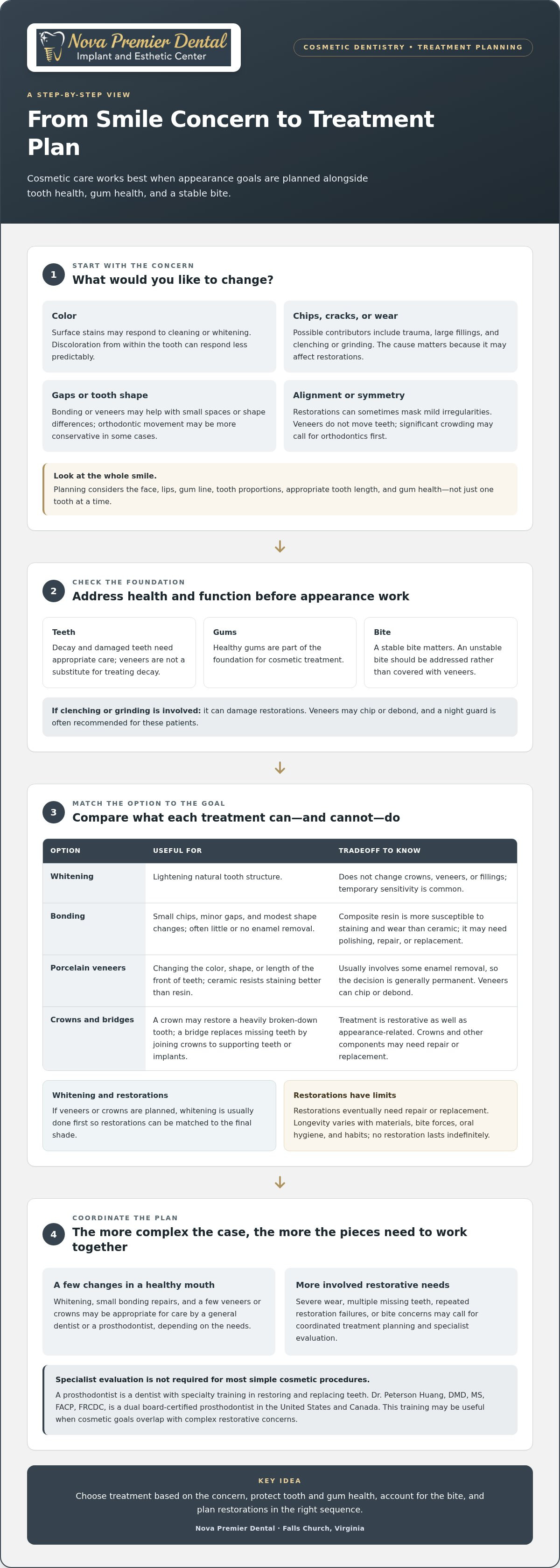
Veneers, Bonding, and Other Options Compared
Short answer: Bonding is a conservative, lower-cost option for small changes but is more prone to staining and chipping. Porcelain veneers are more stain-resistant and durable but typically require removing some enamel and are not reversible.
Porcelain Veneers
Veneers are thin ceramic shells bonded to the front of teeth. They can change color, shape, and length, and ceramic resists staining better than resin. Tradeoffs include:
- Most designs involve removing a small amount of enamel, so the decision is generally permanent.
- They can chip or debond, particularly in patients who clench or grind. A night guard is often recommended for these patients.
- They are not a substitute for treating decay, gum disease, or an unstable bite.
- Veneers and other restorations eventually need repair or replacement. Longevity varies with materials, bite forces, oral hygiene, and habits, and no restoration lasts indefinitely. For a discussion of the evidence, see how long veneers last. Our porcelain veneers page describes the procedure.
Dental Bonding
Bonding uses tooth-colored composite resin shaped directly on the tooth, often with little or no enamel removal. It suits small chips, minor gaps, and modest shape changes, and it can often be completed in one visit. Resin is generally more susceptible to staining and wear than ceramic and may need polishing, repair, or replacement over time.
Whitening
Whitening lightens natural tooth structure but does not change crowns, veneers, or fillings. Tooth sensitivity is a common temporary side effect. Because restorations do not whiten, patients who plan veneers or crowns usually whiten first so the restorations can be matched to the final shade. See our teeth whitening page for details.
Crowns and Bridges
When a tooth is heavily broken down, a crown may be needed for strength, not just appearance. Bridges replace missing teeth by joining crowns to supporting teeth or implants. Note that implant survival and the lifespan of the crown on top are separate matters: an implant can remain in place for many years while its crown or prosthetic components need repair or replacement. See crowns for more.
Full Smile Makeovers and Rehabilitation
When many teeth are worn, missing, or previously restored, treatment may involve crowns, veneers, implants, or a combination. In these cases planning focuses first on occlusion, restorative space, tooth prognosis, and gum health, with appearance planned alongside them. Teeth that cannot be reliably maintained may be better replaced than restored. Learn more about oral reconstruction.
How a Smile Makeover Is Planned and Carried Out
Short answer: Treatment typically proceeds from diagnosis, to design and trial, to preparation and temporary restorations, and finally to placement and adjustment. The exact steps and number of visits depend on the case.
- Examination and diagnosis. The dentist reviews your history and goals and evaluates teeth, gums, bite, jaw function, and existing restorations. Radiographs and photographs are typically used. Decay, gum disease, and bite problems are addressed first because they affect how long cosmetic work will function.
- Design and preview. A diagnostic wax-up or digital design, sometimes with a trial mock-up in the mouth, lets you see proposed tooth shapes and proportions and give feedback before irreversible steps. A preview is a planning tool, not a guarantee of the final result.
- Preparation and provisional restorations. If teeth are prepared, temporary restorations protect them and allow you to evaluate shape, speech, and comfort.
- Placement and adjustment. Final restorations are fitted, bonded or cemented, and the bite is checked and refined. A follow-up visit often assesses comfort and function.
A single bonding or whitening visit is common, while multiple veneers or crowns usually take several appointments over a few weeks. Complex rehabilitation can take longer.
Maintenance and Prognosis
- Regular examinations and professional cleanings help detect early decay, gum changes, and restoration wear. See dental exams and cleanings.
- Patients with bruxism or parafunction are commonly advised to wear a custom night guard.
- Avoid using teeth to open packaging or bite hard objects.
- Factors influencing durability include material choice, bite forces, remaining tooth structure, hygiene, and tobacco use.
Risks across cosmetic procedures include sensitivity, chipping or debonding, gum irritation, changes in bite, and the need for eventual replacement. Prepared teeth cannot be returned to their original state.
Cost, Insurance, and Payment
Cost depends on the number of teeth treated, materials, laboratory work, and case complexity. Dental insurance often does not cover treatment that is purely cosmetic, though it may contribute when a procedure is also restorative, such as a crown for a fractured tooth. Benefits and limits vary by plan, so a benefits check before treatment is sensible; our page on dental insurance and benefits has more information. Nova Premier Dental offers in-house payment plans for qualifying patients, allowing treatment costs to be paid over several months while patients enjoy their new smile.
A treatment that fails early and needs replacement can cost more over time than a more conservative or better-planned option, so durability and maintenance are reasonable factors to weigh alongside price. Photographs in the before and after gallery can help you understand typical outcomes, though results vary between patients.
Frequently Asked Questions
Does cosmetic dentistry hurt?
Whitening and bonding are often comfortable and may need little or no anesthesia. Veneer or crown preparation is typically done with local anesthesia. Some sensitivity afterward is common and usually temporary.
How long do veneers last?
There is no fixed lifespan. Clinical studies report that a majority of porcelain veneers remain in function over 10 years or more, but outcomes vary with the study, materials, and patient factors such as bruxism. Repairs or replacement may be needed.
Can cosmetic dentistry fix crooked teeth without braces?
Mild irregularities can sometimes be masked with veneers or bonding. These treatments do not move teeth, and significant crowding or bite problems may be better treated with orthodontics, sometimes followed by cosmetic work.
Will insurance cover cosmetic procedures?
Purely cosmetic procedures are commonly excluded. Restorative components may be partially covered depending on the plan.
What is the difference between a cosmetic dentist and a prosthodontist?
"Cosmetic dentist" is not a recognized dental specialty. It is a term some general dentists use to describe their focus. Prosthodontics is an ADA-recognized specialty centered on restoring and replacing teeth. Further information is available from the American Dental Association's MouthHealthy resource.
How do I maintain results?
Brush and floss daily, attend scheduled cleanings and exams, use a night guard if recommended, and avoid habits that stress restorations.
When to Seek Specialist Evaluation
Consider a prosthodontic consultation if you have significantly worn or fractured teeth, multiple missing teeth, jaw discomfort, or earlier cosmetic work that has repeatedly failed, or if you want a second opinion on an extensive treatment plan. If you have questions about a complex restorative or cosmetic concern, Nova Premier Dental, a prosthodontic specialty office in Falls Church, provides care for patients throughout Northern Virginia. You can contact the office to arrange a consultation.
Disclaimer
The information provided on this website and blog is intended for general educational and informational purposes only and should not be considered dental or medical advice, diagnosis, or treatment. Reading content on this website does not establish a doctor-patient relationship with Nova Premier Dental or Dr. Peterson Huang. Dental conditions and treatment needs vary from patient to patient. Individuals should consult directly with a qualified dental professional for personalized evaluation, diagnosis, and treatment recommendations. Do not delay seeking professional dental care based on information found on this website. While we strive to provide accurate and up-to-date information, no guarantee is made regarding the completeness, accuracy, or applicability of the content. Treatment outcomes may vary depending on individual circumstances. If you are experiencing a dental emergency or urgent oral health concern, please contact a licensed dental professional immediately or call 911 in the event of a medical emergency.


