


Article by
Peterson Huang DMD, MS, FACP, FRCDC
Dr. Peterson Huang is a dual board-certified prosthodontist serving Falls Church and Northern Virginia. He has been recognized as a Top Prosthodontist by Northern Virginia Magazine and Arlington Magazine and is affiliated with the Inova Fairfax Hospital Tumor Board. Dr. Huang focuses on dental implants, full mouth reconstruction, and complex restorative dentistry for patients who need advanced, comprehensive care.
Full mouth reconstruction cost varies widely because the treatment is not a single procedure. It is a plan tailored to each patient's teeth, bone, bite, and jaw joints, and the price depends on what that plan includes. This guide explains what determines the cost of full mouth reconstruction in Fairfax, VA and the surrounding Northern Virginia area, why quotes from different offices can differ, and what to ask when comparing them.
Nova Premier Dental is a private prosthodontic specialty dental office in Falls Church serving Northern Virginia. This article does not list fixed prices, because a reliable figure can only come from an examination, imaging, and a written treatment plan.
Key Takeaways
- Full mouth reconstruction is a comprehensive plan to restore function and appearance across both arches. It is not a single procedure.
- Total cost is driven mainly by how many teeth need treatment, whether implants or bone grafting are needed, the materials chosen, and the diagnostic and laboratory work involved.
- Quotes can differ because the treatment plans behind them differ. Comparing itemized plans is more useful than comparing totals.
- Many restorative procedures are appropriately performed by general dentists. A prosthodontist may be helpful when a case involves multiple missing teeth, complex bite problems, or previous restoration failures.
- Dental insurance usually covers only some components of reconstruction.
What Is Full Mouth Reconstruction?
Full mouth reconstruction, also called full mouth rehabilitation, is a coordinated plan to restore the health, function, and appearance of the teeth in both the upper and lower arches. It differs from simple tooth replacement because the plan considers how all the teeth, the gums, the supporting bone, and the bite work together. Patients are often referred for it after extensive tooth loss, advanced wear, multiple failing restorations, or a combination of these.
Prosthodontics is the dental specialty focused on restoring and replacing teeth, and prosthodontists receive additional specialty training in managing complex restorative cases. You can read more about full mouth rehabilitation on our site, or see a step-by-step overview in What Does Full Mouth Reconstruction Involve?
The Components of a Comprehensive Reconstruction
A plan may combine several treatments, depending on the condition of each tooth:
- Dental implants to replace missing teeth, supporting individual crowns, bridges, or full-arch prostheses.
- Crowns to protect teeth with limited remaining structure.
- Fixed bridges to replace missing teeth using adjacent teeth or implants for support.
- Porcelain veneers where the tooth structure is otherwise sound and appearance is a goal.
- Bone grafting or sinus augmentation when there is not enough bone to place implants in the planned positions. These procedures add cost and healing time, and they are not needed in every case.
- Removable options, such as partial or complete dentures, which have different costs, maintenance needs, and trade-offs than fixed treatment and are a reasonable choice for some patients.
Patients with jaw joint symptoms may also need evaluation for TMJ disorders. Jaw joint health is considered during planning, but worn teeth or bite changes are not assumed to cause jaw joint problems; the relationship is assessed case by case.
The Clinical Necessity vs. Cosmetic Desire
A smile makeover usually focuses on the visible front teeth and is often elective. Reconstruction is considered when function is affected, such as with widespread tooth loss, extensive decay, advanced wear, or multiple failing restorations. Tooth wear does not automatically mean the bite has lost vertical dimension, and grinding does not automatically lead to a collapsed bite. Diagnosis involves examining the teeth, the jaw joints, the bite, and the patient's history, then deciding what is actually needed. In some cases, a more limited treatment plan is the better choice.
Factors That Influence Full Mouth Reconstruction Cost
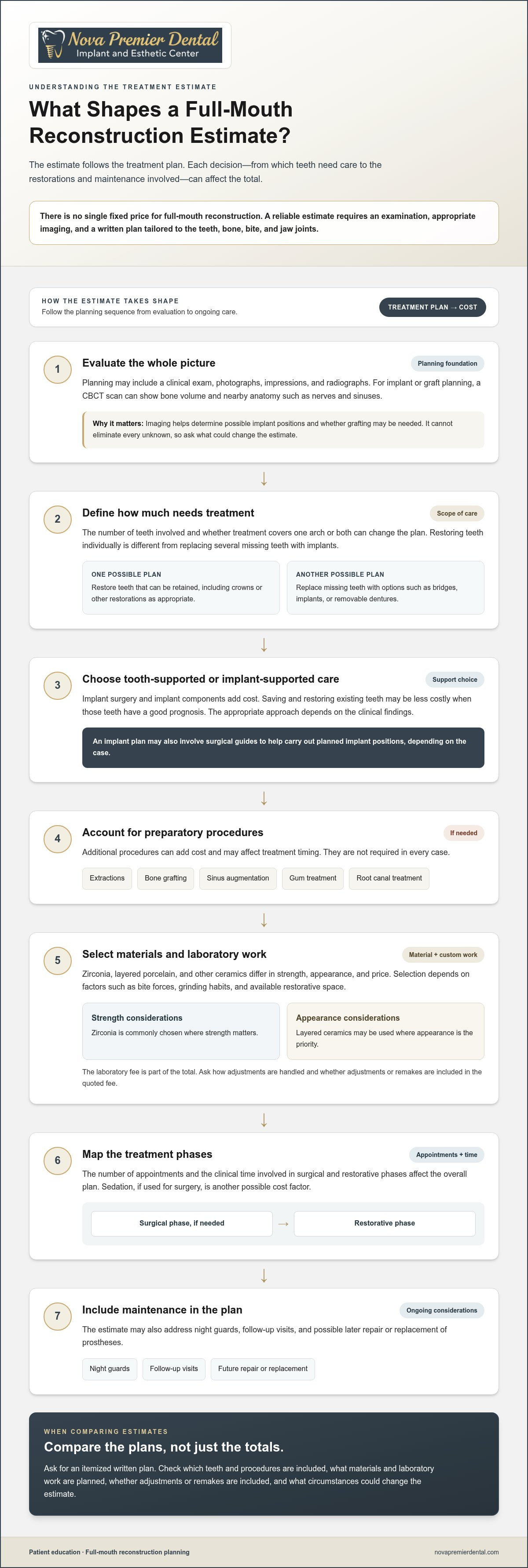
Costs in Northern Virginia reflect local overhead and laboratory fees, but the largest differences between quotes come from the treatment plan itself. The main factors are:
- Number of teeth treated: restoring one arch differs from restoring both, and treating each tooth with a crown differs from replacing several with implants.
- Implants versus tooth-supported restorations: implant surgery and components add cost, while saving and restoring existing teeth may be less costly when the teeth have a good prognosis.
- Preparatory procedures: extractions, bone grafting, sinus augmentation, gum treatment, or root canal treatment performed elsewhere.
- Materials: zirconia, layered porcelain, and other ceramics differ in strength, appearance, and price. Zirconia is commonly chosen where strength matters, while layered ceramics may be used where appearance is the priority. The right choice depends on bite forces, grinding habits, and available restorative space.
- Surgical and restorative phases: the number of appointments and clinical time involved in each.
- Sedation: if used for surgery.
- Maintenance items: night guards, follow-up visits, and later repair or replacement of prostheses.
Specialized Diagnostics and 3D Imaging
Planning typically begins with a clinical exam, photographs, digital or conventional impressions, and radiographs. When implants or grafting are being considered, a CBCT (cone-beam CT) scan provides a three-dimensional view of bone volume and anatomic structures such as nerves and sinuses. This imaging is intended to help determine where implants can be placed and whether grafting is needed before treatment begins, which can reduce unexpected changes to the plan. It cannot eliminate every unknown, so patients should ask what circumstances could change the estimate. For implant cases, surgical guides may be used to help carry out the planned implant positions.
Laboratory Quality and Customization
Crowns, bridges, and full-arch prostheses are fabricated by a dental laboratory, and the laboratory fee is part of the total cost. Custom-made restorations allow the dentist and technician to adjust shade, contour, and fit for each patient. Fit matters because poorly fitting margins can make cleaning more difficult. Ask your dentist how the lab work is handled and whether adjustments or remakes are included in the quoted fee.
When a Prosthodontist May Be Helpful
General dentists provide essential preventive and restorative care and appropriately perform many crowns, bridges, and other restorative procedures. Some patients with extensive needs choose to see a prosthodontist as well. Prosthodontists complete additional specialty training after dental school focused on restoring and replacing teeth and on managing complex restorative cases. That training may be valuable when a case involves several of the following:
- Multiple missing teeth or a failing full-arch restoration.
- Severe tooth wear or a bite that has changed over time.
- Limited restorative space or unusual implant positions.
- Previous restorations that have repeatedly fractured or loosened.
- Need for coordinated surgical and restorative planning.
Specialist care does not guarantee a better result than care from another qualified dentist, and not every patient needs it. For a deeper comparison, see Prosthodontist vs. General Dentist.
Dr. Huang's Training
Peterson Huang, DMD, MS, FACP, FRCDC, is a dentist and dual board-certified prosthodontist, with certification in prosthodontics in both the United States and Canada. Board certification involves examination by a specialty board. You can learn more about prosthodontic care in Northern Virginia on our authority page.
Why Repeat Treatment Adds Cost
Restorations that fail need to be repaired or redone, which adds cost and time. Failures have several possible causes, including implant position, inadequate restorative space, excessive bite forces from clenching or grinding, material choice, loose components, and difficulty with home care. Planning is intended to identify these risks before treatment begins, but no plan can remove them entirely. Implants and restorations also have different lifespans: an implant may remain in function for many years, while the crowns, bridges, or prostheses attached to it can wear, chip, or need replacement sooner. Learn more in Common Causes of Implant Restoration Failure.
Paying for Treatment and Using Dental Insurance
Dental insurance rarely covers an entire reconstruction. Most plans treat crowns, bridges, and sometimes implants as major services with annual maximums, waiting periods, and frequency limits. Coverage for implants varies widely by plan, so check your benefits for the specific procedures in your treatment plan. Ask for an itemized plan with procedure codes so your insurer can provide a pre-treatment estimate. More information is available on our dental insurance and benefits page.
Nova Premier Dental offers in-house payment plans for qualifying patients, allowing treatment costs to be paid over several months.
Questions to Ask When Comparing Quotes
- Which teeth are being saved, which are being replaced, and why?
- Are implants, grafting, extractions, and temporary restorations included?
- What materials are planned, and why are they suited to my bite?
- What imaging and diagnostics were used to develop the plan?
- Is a night guard recommended, and is it included?
- What are the alternatives, including less extensive or removable options?
- What maintenance and eventual replacement should I expect?
If you would like a second opinion or an evaluation of a complex restorative situation, Nova Premier Dental in Falls Church provides prosthodontic specialty care for patients throughout Northern Virginia, including Fairfax. You can contact our office to arrange a consultation. Bringing recent records, radiographs, and any existing treatment plans can help.
Frequently Asked Questions
Is full mouth reconstruction covered by dental insurance in Virginia?
Usually only in part. Plans often cover portions of crowns, bridges, or other restorative services, subject to annual maximums and limits. Implant coverage varies by plan. A pre-treatment estimate from your insurer can clarify what applies to your plan.
How long does the full mouth reconstruction process typically take?
The timeline depends on the plan. Treatment involving implants, extractions, or bone grafting requires healing time before final restorations, and the overall course can range from several months to longer. Your dentist can give an estimate based on your specific plan.
Can I get a full mouth reconstruction if I have significant bone loss?
Often, yes, but the plan may change. Bone grafting or sinus augmentation may be considered, or the plan may use fewer or differently positioned implants, or a different type of restoration. A CBCT scan helps evaluate what is possible.
What is the difference between a smile makeover and full mouth reconstruction?
A smile makeover typically addresses appearance, often involving the front teeth. Reconstruction addresses function and the health of teeth across both arches, and it may include aesthetic goals as well.
Are dental implants always necessary for a full mouth restoration?
No. Plans may rely on crowns, bridges, or removable prostheses when natural teeth can be maintained or when implants are not appropriate or desired. Each approach has trade-offs in cost, maintenance, comfort, and function.
What happens if I don't treat my failing teeth and wait longer?
It depends on the condition. Untreated decay, infection, or gum disease can progress, and teeth that might have been restored may eventually need extraction. Waiting can sometimes make treatment more extensive, though not in every case. An evaluation can clarify the prognosis of each tooth.
How do I know if I should see a prosthodontist instead of my regular dentist?
Your general dentist may be fully able to manage your care. A prosthodontist may be helpful if you have extensive tooth loss, a complex bite, repeated restoration failures, or want a second opinion on a large treatment plan. Your general dentist can often help decide whether a referral makes sense.
Disclaimer
The information provided on this website and blog is intended for general educational and informational purposes only and should not be considered dental or medical advice, diagnosis, or treatment. Reading content on this website does not establish a doctor-patient relationship with Nova Premier Dental or Dr. Peterson Huang. Dental conditions and treatment needs vary from patient to patient. Individuals should consult directly with a qualified dental professional for personalized evaluation, diagnosis, and treatment recommendations. Do not delay seeking professional dental care based on information found on this website. While we strive to provide accurate and up-to-date information, no guarantee is made regarding the completeness, accuracy, or applicability of the content. Treatment outcomes may vary depending on individual circumstances. If you are experiencing a dental emergency or urgent oral health concern, please contact a licensed dental professional immediately or call 911 in the event of a medical emergency.


