


Article by
Peterson Huang DMD, MS, FACP, FRCDC
Dr. Peterson Huang is a dual board-certified prosthodontist serving Falls Church and Northern Virginia. He has been recognized as a Top Prosthodontist by Northern Virginia Magazine and Arlington Magazine and is affiliated with the Inova Fairfax Hospital Tumor Board. Dr. Huang focuses on dental implants, full mouth reconstruction, and complex restorative dentistry for patients who need advanced, comprehensive care.
What if the most vulnerable part of your dental surgery isn't the titanium screw, but the prosthetic crown attached to it? While dental implants boast a 10-year success rate of approximately 97%, the mechanical components can still face significant challenges. It's common to feel a sense of dread when a restoration feels unstable or causes discomfort. You might worry about the financial loss or the physical pain of a failed procedure. Understanding the common causes of implant restoration failure is the first step toward protecting your investment and ensuring your long-term comfort.
At Nova Premier Dental, we believe elite care starts with specialized expertise. Whether you're visiting our Falls Church office for a consultation or seeking a second opinion, we focus on the meticulous engineering required for success. Dr. Peterson Huang is a dual board-certified specialist who utilizes advanced technology to prevent technical errors before they start. In this article, you'll learn why restorations fail, how a prosthodontist in Northern Virginia approaches complex cases, and how our in-house payment plans help you manage the cost of premium care over several months while you enjoy your new smile.
Key Takeaways
- Identify the vital distinction between the biological failure of an implant post and the mechanical failure of the prosthetic restoration.
- Discover the common causes of implant restoration failure, ranging from material structural fatigue to improper occlusal alignment.
- Learn how specialized restoration design prevents peri-implantitis by ensuring the site remains accessible for effective daily cleaning.
- Understand why advanced 3D planning and CBCT diagnostics are essential for creating a restoration that functions with precision and longevity.
- See how specialist-led care from a dual board-certified prosthodontist can be managed comfortably through personalized, in-house payment plans.
Understanding the Difference Between Implant and Restoration Failure
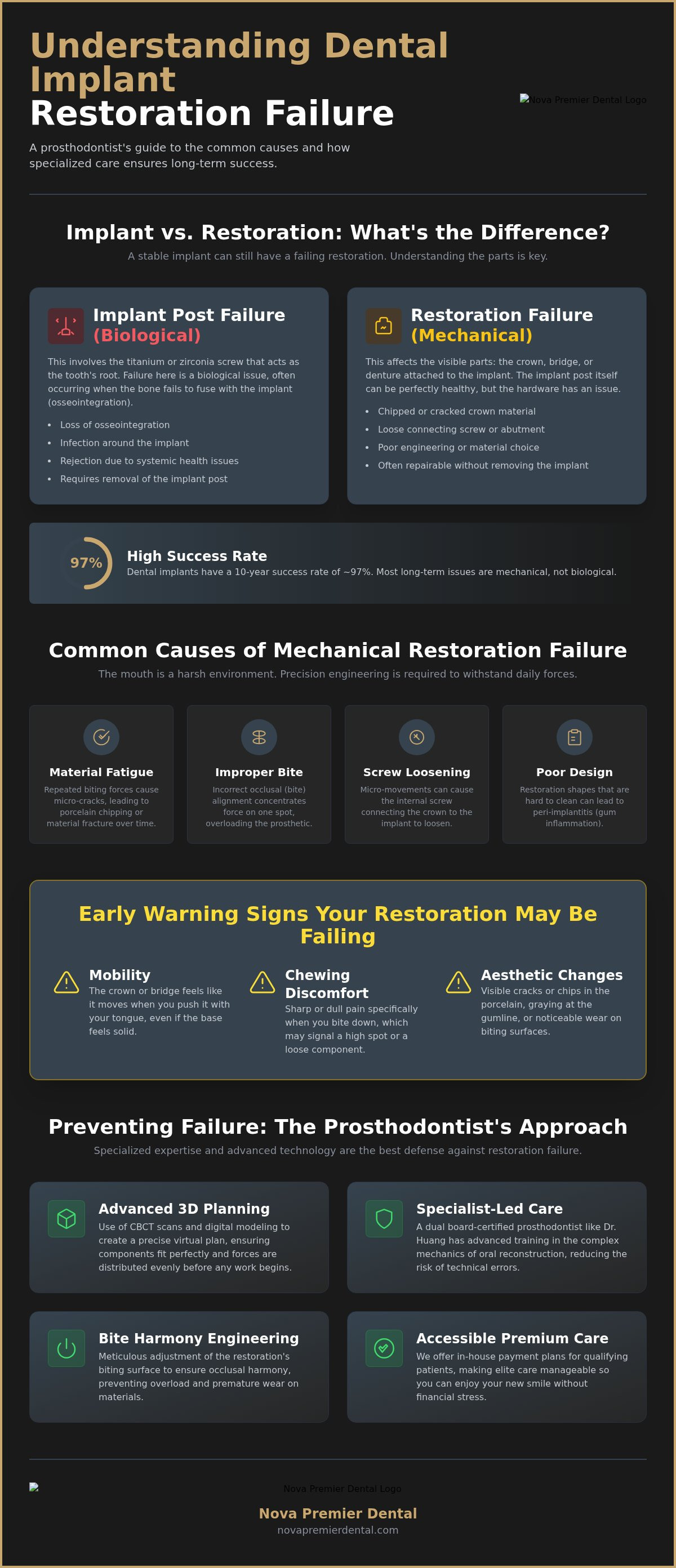
When patients experience issues with their dental work, they often assume the entire system has failed. However, it's vital to distinguish between the failure of the implant post itself and the failure of the prosthetic restoration. A dental implant is the titanium or zirconia screw that serves as a prosthetic root. True implant failure occurs when osseointegration, the process where bone fuses to the metal, is interrupted or lost. Conversely, restoration failure involves the visible components, such as crowns, bridges, or dentures. You can have a perfectly healthy, stable implant post while still suffering from a "failed" restoration due to poor engineering or material choice.
The abutment serves as the critical link between these two worlds. This small connector piece must be precisely fitted to prevent micro-movements that can lead to long-term complications. If the abutment or the screw holding the crown becomes loose, the restoration may feel unstable even if the foundation remains rock solid. Understanding Dental Implant Failure requires looking at the entire assembly as a complex mechanical system rather than a single unit. At Nova Premier Dental, Dr. Peterson Huang emphasizes that identifying the common causes of implant restoration failure begins with a meticulous evaluation of these individual parts.
Biological vs. Mechanical Failure
The distinction between biological and mechanical issues is the foundation of modern prosthodontics. Biological failure typically involves the living tissue, such as bone loss or infection around the dental implant. This is often seen in early stages or due to systemic health changes. Mechanical failure, however, focuses on the hardware. This is frequently the more common culprit in long-term cases where the implant has been in place for years. Common mechanical issues include:
- Porcelain chipping or delamination from the metal substructure.
- Fracture of the prosthetic material under heavy biting forces.
- Internal screw loosening or breakage.
- Wear and tear on the attachment points of removable dentures.
Signs Your Restoration May Be Failing
Recognizing the early warning signs can save you from more extensive repairs later. If you notice any of the following, it's time to consult a prosthodontist in Northern Virginia to assess the integrity of your work:
- Mobility: You feel the crown or bridge move slightly when you push it with your tongue, yet the base feels anchored.
- Chewing Discomfort: You experience sharp or dull pain specifically when biting down, which may indicate an alignment issue.
- Aesthetic Changes: You see visible cracks, grey lines at the gumline, or significant wear on the biting surfaces.
While these symptoms are concerning, many mechanical failures are repairable without removing the underlying implant. Early intervention ensures that a simple screw tightening or crown replacement doesn't evolve into a more complex biological problem.
Mechanical and Material Factors in Restoration Failure
Selecting the right materials is not just an aesthetic choice; it's a structural necessity. The mouth is a harsh environment where prosthetic components must withstand repetitive biting forces that can reach hundreds of pounds of pressure. One of the common causes of implant restoration failure is the use of materials that lack the necessary fracture toughness for a patient's specific bite force. While acrylic might suffice for temporary solutions, long-term success in oral reconstruction requires high-performance ceramics or metals that resist structural fatigue.
Material Fatigue and Porcelain Chipping
Zirconia has emerged as a gold standard in restorative dentistry due to its exceptional strength and resistance to cracking. However, even the strongest materials are subject to wear. Traditional porcelain-fused-to-metal crowns can suffer from "delamination," where the outer layer of porcelain chips away from its base. Dr. Peterson Huang meticulously evaluates each patient's occlusal (bite) forces before selecting a material. This personalized approach ensures your restoration is durable enough for high-stress areas without compromising the natural beauty of your smile.
The Role of Precision in Component Fit
Precision manufacturing is non-negotiable for long-term stability. A "micro-gap" as small as a few microns between the implant and the restoration can become a breeding ground for bacteria or lead to mechanical instability. Research published in The Etiology and Management of Dental Implant Failure highlights how mechanical overload and poor fit contribute to late-stage complications. Understanding these technical nuances helps patients recognize that many common causes of implant restoration failure are preventable through superior engineering.
Many practices use "one-size-fits-all" generic abutments to reduce costs, but these components often lack the sub-millimeter precision found in laboratory-milled parts. For patients in Falls Church, working with a prosthodontist in Northern Virginia who partners with elite dental labs is essential. These specialized labs create custom-milled components that provide a hermetic seal, significantly reducing the risk of screw loosening or bacterial leakage. This level of detail is what separates a standard procedure from a high-end medical reconstruction.
Investing in high-quality materials and precision engineering protects both your health and your finances. To make this level of elite care accessible, Nova Premier Dental offers in-house payment plans that allow you to manage the cost over several months while already enjoying the benefits of your restoration. You can schedule a comprehensive assessment to discuss your restorative options and ensure your smile is built to last.
Biological Challenges: Peri-Implantitis and Systemic Health
While mechanical integrity is crucial, the biological environment surrounding your prosthetic is equally decisive. Peri-implantitis represents the leading biological cause of late-stage failure. This inflammatory condition affects the soft and hard tissues around an integrated implant, potentially leading to progressive bone loss. It's frequently categorized among the common causes of implant restoration failure because an infected foundation cannot support even the most meticulously engineered crown. Unlike natural teeth, implants lack a periodontal ligament, making them more susceptible to rapid tissue destruction if bacteria are allowed to accumulate.
The Link Between Design and Oral Hygiene
The physical shape of your restoration directly influences your ability to maintain oral health. A common flaw in standard restorations is a "bulky" design that creates food traps or prevents floss from reaching the gumline effectively. At Nova Premier Dental, Dr. Peterson Huang designs specific contours that mirror natural tooth anatomy, promoting healthy gum attachment and easy access for hygiene. Specialized professional cleanings and exams are also essential. Implants require specific non-metallic instruments and specialized techniques to avoid scratching the titanium or zirconia surfaces, which could otherwise harbor harmful biofilm.
Patient Factors and Lifestyle Risks
Lifestyle choices and systemic health are equally influential in the long-term success of your reconstruction. Tobacco use and vaping are particularly detrimental because they constrict blood flow and impair the body's immune response. Patients with uncontrolled diabetes also face a heightened risk of inflammatory complications that can destabilize the implant site. At our Falls Church practice, we prioritize a thorough medical history review to identify these risks during the planning phase, ensuring that systemic conditions are managed before restorative work begins.
Mechanical stress from bruxism, or teeth grinding, can also jeopardize the biological bond by placing excessive lateral pressure on the supporting bone. We frequently prescribe custom night guards to shield your prosthetic from these destructive nocturnal forces. As a dual board-certified prosthodontist in Northern Virginia, Dr. Huang provides the specialized oversight needed to navigate these complex biological variables. Protecting your oral health is a long-term commitment. We support this by offering in-house payment plans for qualifying patients, allowing you to manage the cost of care over several months while enjoying the functional beauty of your new smile. Explore our homepage for more information on our advanced restorative services.
The Importance of Occlusal Harmony and Bite Alignment
Occlusion is the engineering blueprint of a functional smile. It refers to the complex science of how your upper and lower teeth meet during chewing, speaking, and resting. While a minor misalignment in natural teeth might result in slight wear, the same error in an implant system can be catastrophic. An unbalanced bite is one of the most significant yet frequently overlooked common causes of implant restoration failure. Without proper alignment, the repetitive forces of daily use can lead to mechanical fatigue that compromises the entire prosthetic assembly.
Why Implants Handle Force Differently
Natural teeth are anchored by the periodontal ligament, a specialized tissue that acts as a biological shock absorber. This ligament allows for microscopic movement, providing "give" when you bite into something hard. Dental implants lack this cushion. Because they are fused directly to the jawbone through osseointegration, they are completely rigid. Even a few microns of misalignment can lead to "overloading," a condition where excessive force is concentrated on a single point. This pressure can cause the porcelain crown to shatter or the internal abutment screw to snap. For patients undergoing full mouth reconstructions, Dr. Peterson Huang utilizes digital bite mapping technology to ensure that occlusal forces are distributed with mathematical precision across the entire arch.
Long-term Occlusal Wear and Adjustments
Your bite is not a static entity. As you age, natural teeth gradually wear down and shift, but an implant remains fixed in its original position. This discrepancy often creates "high spots" where the implant restoration begins to take on more force than it was designed to handle. Specialized follow-up care with a prosthodontist in Northern Virginia is essential to monitor these subtle changes. If you notice a clicking sound when chewing or a sensation that one tooth is hitting "sooner" than the others, your bite may be damaging your restoration. Addressing these common causes of implant restoration failure early can prevent the need for costly emergency repairs.
Maintaining a balanced bite is a vital component of protecting your restorative investment. To ensure these critical adjustments remain accessible, Nova Premier Dental offers in-house payment plans for qualifying patients. This allows you to manage the cost of elite maintenance over several months while your smile remains functional and comfortable. If your bite feels uneven, contact our Falls Church office today to schedule a comprehensive occlusal analysis.
Preventing Failure Through Specialized Prosthodontic Planning
Choosing a board-certified prosthodontist represents the most effective insurance against future complications. While many general practices offer restorative services, the specialized training of a prosthodontist focuses specifically on the physics and biology of complex tooth replacement. This advanced education allows for a deeper understanding of how to mitigate the common causes of implant restoration failure through proactive engineering rather than reactive repairs. By prioritizing the planning phase, we ensure that every component is optimized for your unique anatomical requirements.
Advanced Diagnostics at Nova Premier Dental
Our diagnostic phase utilizes elite technology to eliminate guesswork. We employ high-resolution CBCT scans and digital impressions to create a comprehensive three-dimensional map of your jawbone and existing dentition. This data allows us to perform virtual surgery before a single incision is made. By simulating the placement of dental implants in a digital environment, we can ensure optimal bone-to-implant contact and perfect prosthetic alignment. This level of precision is how we serve the Northern Virginia community with restorative work that stands the test of time.
A Long-Term Partnership for Oral Health
The Dr. Peterson Huang approach is rooted in customization rather than standardized, "same-day" solutions that may compromise long-term stability. We view every oral reconstruction as a long-term partnership. Specialized maintenance is vital; we monitor the integrity of your restorations and the health of the surrounding tissues at every visit. This meticulous oversight ensures that minor wear doesn't evolve into a significant mechanical or biological failure.
We understand that elite specialized care is a significant investment in your quality of life. To ensure that every patient can prioritize quality over cost, Nova Premier Dental offers personalized, in-house payment plans. These arrangements allow qualifying patients to manage the cost of their treatment over several months. You can begin enjoying the functional beauty of your new smile while comfortably handling the financial aspects of your care. Taking the first step toward a secure, lasting restoration begins with a conversation. We invite you to schedule your initial consultation at our Falls Church office to experience the difference that specialized prosthodontic planning makes.
Securing Your Restorative Success in Falls Church
Protecting your smile requires a shift from reactive care to proactive engineering. By understanding the common causes of implant restoration failure, you'll be able to make informed decisions about your oral health. Long-term success depends on the synergy between high-performance materials, precise occlusal alignment, and a foundation free from biological inflammation. Whether you're addressing material fatigue or seeking a balanced bite, specialized planning is the most reliable way to ensure your prosthetic functions as intended for years to come.
As a dual board-certified prosthodontist in Northern Virginia, Dr. Peterson Huang provides the expert oversight necessary for these complex cases. We invite you to schedule a consultation with Dr. Peterson Huang to ensure your restoration lasts a lifetime. At Nova Premier Dental, we offer in-house payment plans for qualifying patients. These plans allow you to manage the cost of elite care over several months while you're already enjoying the confidence of a restored smile. Your journey toward a functional and beautiful reconstruction starts with a team dedicated to perfection.
Frequently Asked Questions
Is it normal for a dental implant crown to feel loose?
A loose crown is never normal and requires immediate clinical attention to prevent the common causes of implant restoration failure. This sensation typically signifies a loosened internal screw or a breakdown of the dental cement rather than a failure of the implant post itself. If left unaddressed, the resulting micro-movement can damage the implant's internal threads or the abutment. Dr. Peterson Huang can quickly diagnose the issue to secure your prosthetic.
Can a failed dental implant restoration be repaired or replaced?
Yes, most mechanical restoration failures can be repaired or replaced without removing the integrated implant post. If a porcelain crown chips or an abutment screw breaks, we can often fabricate a new prosthetic that fits the existing foundation. However, if the failure is biological, such as advanced peri-implantitis, a more complex intervention may be necessary. Early diagnosis in our Falls Church office is the key to preserving your original investment and oral health.
How long should a high-quality implant restoration last?
While the titanium or zirconia implant post is designed to be a permanent solution, the restoration attached to it typically lasts between 10 and 15 years. Modern research shows a 10-year success rate of approximately 97% for the entire system. The longevity of your crown or bridge depends heavily on the precision of the initial bite alignment and your commitment to routine hygiene. Regular exams at Nova Premier Dental help extend this lifespan significantly.
Does smoking always cause implant restoration failure?
Smoking does not guarantee failure, but it significantly increases the risk of both early and late-stage complications. Nicotine constricts blood flow to the gingival tissues, which impairs the body's ability to fight off infections like peri-implantitis. This reduced healing capacity is one of the common causes of implant restoration failure among tobacco and vape users. We strongly recommend cessation programs to our Northern Virginia patients to ensure the best possible long-term outcomes for their reconstruction.
What is the difference between a general dentist and a prosthodontist for implants?
A prosthodontist is a specialist with three years of additional residency training dedicated specifically to oral reconstruction and tooth replacement. While general dentists provide a wide range of care, a board-certified prosthodontist manages the complex engineering and aesthetic nuances required for difficult cases. At our practice, we utilize specialized laboratory techniques to ensure your restoration is perfectly calibrated to your unique bite. You can find more details on our prosthodontist authority page.
What happens if my bone is too thin for a restoration?
Thin bone does not necessarily disqualify you from receiving a restoration, but it requires advanced planning. We utilize high-resolution CBCT scans to assess bone density and volume with sub-millimeter precision. If the site is insufficient, we may recommend bone grafting or specialized, narrow-diameter implants to create a stable foundation. This meticulous diagnostic phase ensures that the final restoration is supported by a secure biological base, preventing mechanical instability in the years following your procedure.
Are there specific foods I should avoid to prevent restoration damage?
You should generally avoid extremely hard or "shock-loading" foods that can cause porcelain to chip or screws to loosen. Items such as ice, hard candy, and unpopped popcorn kernels place localized stress on the restoration that can exceed its material strength. While your new teeth are designed for high function, they lack the natural shock-absorbing ligament of a real tooth. Maintaining a sensible diet and wearing a night guard if you grind your teeth will protect your prosthetic components.
How do in-house payment plans work for complex dental work?
Our practice offers personalized, in-house payment plans to help qualifying patients manage the cost of elite restorative care. These arrangements allow you to distribute your balance over several months, making high-end reconstruction more accessible without the need for third-party lending companies. This ensures you can prioritize the expertise of a specialist and premium materials while comfortably handling the financial investment. We believe that financial considerations shouldn't stand in the way of achieving a functional, healthy, and beautiful smile.
Disclaimer
The information provided on this website and blog is intended for general educational and informational purposes only and should not be considered dental or medical advice, diagnosis, or treatment. Reading content on this website does not establish a doctor-patient relationship with Nova Premier Dental or Dr. Peterson Huang. Dental conditions and treatment needs vary from patient to patient. Individuals should consult directly with a qualified dental professional for personalized evaluation, diagnosis, and treatment recommendations. Do not delay seeking professional dental care based on information found on this website. While we strive to provide accurate and up-to-date information, no guarantee is made regarding the completeness, accuracy, or applicability of the content. Treatment outcomes may vary depending on individual circumstances. If you are experiencing a dental emergency or urgent oral health concern, please contact a licensed dental professional immediately or call 911 in the event of a medical emergency.


