


Article by
Peterson Huang DMD, MS, FACP, FRCDC
Dr. Peterson Huang is a dual board-certified prosthodontist serving Falls Church and Northern Virginia. He has been recognized as a Top Prosthodontist by Northern Virginia Magazine and Arlington Magazine and is affiliated with the Inova Fairfax Hospital Tumor Board. Dr. Huang focuses on dental implants, full mouth reconstruction, and complex restorative dentistry for patients who need advanced, comprehensive care.
What if a dental restoration as minor as a single crown is actually the silent architect of your daily tension headaches? Many patients in Falls Church and McLean struggle with TMJ issues due to bite changes, often unaware that even a millimeter of misalignment can disrupt the delicate harmony of the jaw joint. You might feel a constant tightness in your temples or notice that your teeth no longer meet comfortably during meals.
It's frustrating to navigate chronic discomfort while wondering if your symptoms require a general practitioner or a specialist's precision. At Nova Premier Dental, we believe that understanding the structural foundation of your smile is the first step toward lasting relief. You'll discover how subtle shifts in dental alignment trigger complex disorders and how specialized care from a prosthodontist in Northern Virginia restores both function and comfort.
This guide previews the advanced diagnostic and reconstructive solutions provided by dual board-certified prosthodontist Dr. Peterson Huang. We'll detail how a stable, functional bite can look natural and feel effortless. To help you prioritize your health, we offer in-house payment plans for qualifying patients, allowing you to focus on your recovery while managing the cost of expert care over several months.
Key Takeaways
- Understand the tripod relationship between your dental occlusion and jaw joints to identify the structural cause of chronic tension.
- Learn how subtle shifts from missing teeth or worn restorations trigger TMJ issues due to bite changes and systemic discomfort.
- Recognize the difference between muscle-based tension and joint-related popping to better communicate your symptoms to a specialist.
- Discover the precision of prosthodontic diagnostics, including digital bite mapping and occlusal equilibration, for restoring structural balance.
- Explore how dual board-certified expertise and in-house payment plans provide a clear, manageable path to functional health and comfort.
The Relationship Between Dental Occlusion and TMJ Health
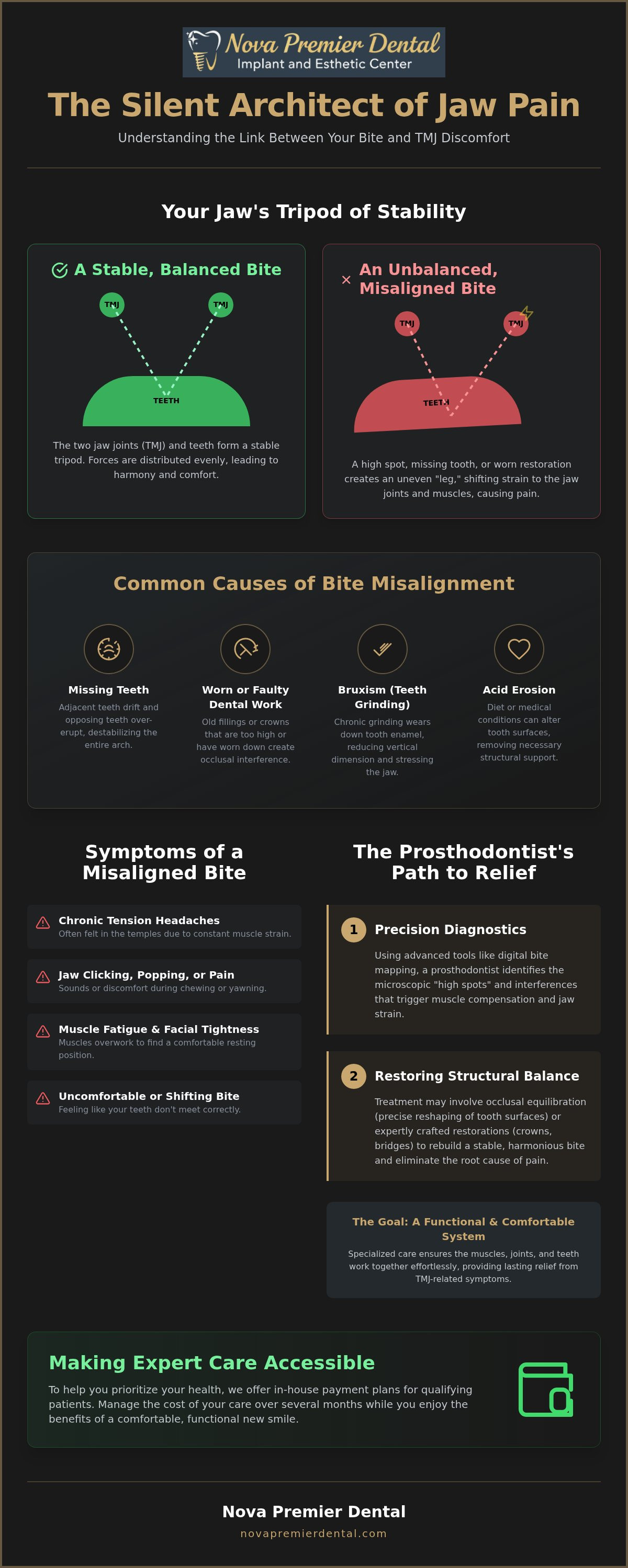
Dental occlusion refers to the precise manner in which your maxillary and mandibular teeth engage during closure. It's not merely a matter of having straight teeth; it's about the mechanical synergy of the entire masticatory system. Specialists often describe this as a tripod relationship. The two temporomandibular joints and the interlocking teeth form the three points of stability for your jaw. When this tripod is balanced, the jaw operates without friction or strain. However, when the teeth don't meet correctly, the "legs" of this tripod become uneven, shifting the burden to the surrounding tissues.
Pathological shifts in this balance often lead to significant Temporomandibular joint dysfunction. While natural wear occurs gradually over decades, TMJ issues due to bite changes typically arise from more abrupt disruptions like tooth loss or deteriorating dental work. Unlike the slow adaptation of natural aging, these sudden changes force the system into a state of constant compensation. This malocclusion compels the jaw muscles to overwork as they struggle to find a comfortable resting position, leading to the chronic tension many patients experience.
What is a 'Stable Bite'?
A stable bite exists when the muscles of mastication and the jaw joints function in complete harmony. Your posterior teeth play a critical role here. They support the vertical dimension of your face and shield the jaw joints from excessive compressive forces. Without this posterior support, the mandible can over-rotate, placing direct stress on the delicate discs within the TMJ. At Nova Premier Dental, we prioritize this structural integrity to ensure functional beauty that lasts. A stable bite prevents premature wear on the joints and ensures that the muscles remain relaxed during rest.
How Occlusal Interference Triggers TMJ Pain
Occlusal interference occurs when a single tooth or restoration makes contact before the others. Even a microscopic "high spot" can trigger a complex neurological response. Your brain recognizes the interference and subconsciously shifts the jaw to avoid the premature contact. This constant repositioning is a primary driver of TMJ issues due to bite changes. The cost of this compensation is high. Continuous muscle activity leads to fatigue, painful spasms, and eventually, chronic joint inflammation. Dr. Peterson Huang utilizes advanced diagnostics to identify these interferences, providing a foundation for effective TMJ and jaw joint treatment that addresses the root cause of discomfort.
Common Causes of Bite Changes Leading to TMJ Issues
While some practitioners dismiss bite changes as a natural consequence of aging, clinical evidence suggests that these shifts are often the result of specific mechanical failures. Chronic bruxism, or teeth grinding, creates a destructive cycle where the protective enamel is worn away. This loss of tooth structure reduces the vertical dimension of your bite, forcing the jaw joint to over-rotate during closure. Acid erosion from dietary habits or medical conditions can similarly alter the occlusal surfaces, leaving the jaw without its necessary structural support. Understanding TMJ disorder symptoms and causes is the first step in recognizing that your jaw pain is frequently a direct result of these physical changes.
Mechanical disruptions are the primary catalyst for TMJ issues due to bite changes. When the teeth no longer interlock as they should, the muscles of the face must work harder to find a stable resting position. This constant state of muscular activity leads to the tension and inflammation associated with joint dysfunction. Identifying the specific cause of your misalignment allows for a more targeted and effective treatment plan.
The Impact of Missing Teeth on Jaw Alignment
The loss of even a single tooth can destabilize the entire dental arch. Without the support of a neighbor, adjacent teeth begin to drift into the empty space. Simultaneously, the opposing tooth may undergo "supra-eruption," where it moves out of the bone because it no longer has a contact point to hold it in place. If multiple back teeth are missing, "posterior bite collapse" often follows. This condition shifts the entire chewing load to the front teeth, which are structurally incapable of handling such heavy forces. Utilizing dental implants to replace these missing units is often essential to restore the tripod of stability required for a healthy jaw.
Failing Restorations and Complex Bite Shifts
Dental restorations have a finite lifespan and can contribute to significant bite discrepancies as they fail. An old crown that has worn down no longer provides the vertical support your jaw requires. Conversely, a new restoration that is even slightly "high" can trigger immediate discomfort. Your brain detects this interference and subconsciously shifts the jaw to avoid the high spot, which is a leading cause of TMJ issues due to bite changes. While emergency denture repair can address immediate structural breaks, long-term relief requires a specialist's eye for detail. If you've noticed your bite feels "off" after recent dental work, Dr. Peterson Huang can perform a comprehensive evaluation to re-align your occlusion. Our practice provides in-house payment plans for qualifying patients, ensuring you can access elite care while managing the costs comfortably.
Symptoms of a Misaligned Bite and TMJ Dysfunction
Identifying the symptoms of a misaligned bite requires a clear distinction between muscular fatigue and internal joint derangement. Muscle-based pain often manifests as a dull, persistent ache in the cheeks or temples, while joint-based issues typically involve sharp sensations, often accompanied by audible clicking or popping. Many patients experience TMJ issues due to bite changes that present as referred pain. This occurs when the nerves surrounding the jaw joint transmit signals that the brain interprets as earaches, migraines, or neck tension. For those dealing with secondary symptoms like radiating discomfort, Dr. Horine Chiropractic can be a valuable resource for addressing issues like arm and hand numbness. Unlike general services, our specialized diagnostic approach identifies these subtle triggers before they lead to permanent joint damage.
The timing of your discomfort provides essential diagnostic clues. If you wake with a "morning jaw" characterized by stiffness, it often points to nocturnal bruxism. Conversely, pain that intensifies throughout the day suggests that your bite is forcing the muscles to work against your natural skeletal alignment during routine speech and mastication. Visual indicators are equally revealing. You might notice flattened tooth edges, small chips in your restorations, or notches at the gumline known as abfractions. These aren't simply signs of aging; they're evidence of excessive lateral forces from a pathological bite that requires professional intervention.
Left unaddressed, these symptoms tend to advance through three distinct stages. Stage one involves occasional clicking and manageable muscle soreness that may come and go. As the condition enters stage two, you'll notice a limited range of motion and chronic tension that no longer resolves with rest. Stage three represents a more severe phase where the internal disk of the jaw joint undergoes degenerative changes. Early intervention by Dr. Peterson Huang can often prevent this progression, protecting both your comfort and your long-term oral health.
When to Seek a Specialist in Falls Church
While many general dentists provide basic night guards, these appliances often act as a bandage rather than a cure. If your discomfort persists despite wearing a guard, it's a clear sign that the underlying structural cause remains. A comprehensive oral reconstruction evaluation is necessary to determine if TMJ issues due to bite changes are the primary driver of your pain. Patients from McLean and Arlington frequently seek our prosthodontist in Northern Virginia for his dual board-certified expertise in managing these complex cases. To ensure our elite care remains accessible, Nova Premier Dental offers in-house payment plans for qualifying patients, allowing you to manage the cost of your treatment over several months while you enjoy the benefits of a pain-free smile.
How a Prosthodontist Corrects Bite-Related TMJ Issues
Correcting TMJ issues due to bite changes requires a profound understanding of oral mechanics that extends far beyond general dental training. While conservative suggestions like soft diets or generic appliances provide temporary relief, they don't address the underlying structural disharmony. A prosthodontist approaches these challenges through a rigorous diagnostic phase, utilizing digital impressions and comprehensive bite mapping to visualize how your teeth interact. This data allows for precise occlusal equilibration, a process where we subtly reshape specific tooth surfaces to remove the interferences that force your jaw out of alignment. By eliminating these "high spots," we allow the muscles to finally relax into a natural, neutral position.
When the bite has been significantly altered by wear or tooth loss, simple adjustments aren't enough. In these complex cases, restorative reconstruction becomes necessary. We use high-end materials to rebuild lost tooth height, effectively "re-indexing" the bite to its proper vertical dimension. This often involves a coordinated effort; if the teeth are fundamentally out of position, we may work with orthodontic specialists to move the teeth before we begin the restorative process. This meticulous planning ensures that the final result isn't just aesthetically pleasing, but mechanically sound and sustainable for decades.
The Precision of Occlusal Analysis
In addition to mechanical corrections, adopting a holistic approach to wellness can significantly aid in the recovery process. Patients interested in how naturopathic care and root-cause healing support long-term health may find westridgeholistic.com to be a useful resource.
Achieving a balanced bite relies on the expert use of articulators, which are mechanical devices that a prosthodontist in Northern Virginia uses to simulate your jaw's unique movement patterns outside the mouth. This analysis is critical for navigating the complex relationship between Centric Relation (CR) and Maximum Intercuspation (MIP). While MIP is simply how your teeth currently fit together, it's often a pathological position that your body has adopted to avoid pain. Centric Relation is the most stable, repeatable position of the jaw joint. By aligning your bite with this skeletal foundation, we resolve the primary triggers of joint inflammation and muscle spasms.
Reconstructive Solutions for Long-Term Stability
For patients with extensive damage, crowns and fixed bridges serve as the building blocks for full mouth rehabilitation. These restorations are engineered to provide the posterior support necessary to shield the jaw joints from excessive pressure. Once the bite is restored, custom night guards are often prescribed to protect your new restorations from the destructive forces of nocturnal grinding. This comprehensive approach ensures that your functional beauty is matched by structural durability. To help you access this specialized level of care, Nova Premier Dental offers in-house payment plans for qualifying patients, allowing you to comfortably manage the cost of treatment over several months. If you're ready to find a permanent solution for your discomfort, Dr. Peterson Huang is here to provide the expert guidance you deserve.
Specialized TMJ Care at Nova Premier Dental
At Nova Premier Dental, we recognize that chronic jaw pain isn't just a physical burden; it's a quality-of-life issue that requires a definitive solution. Choosing the right practitioner is the most critical decision in your journey toward relief. While many dental offices offer general treatments, TMJ issues due to bite changes demand the specialized precision of a prosthodontist who understands the complex interplay between the teeth, muscles, and joints. Our modern facility in Falls Church is specifically equipped to manage these high-stakes cases, providing the Northern Virginia community with a sophisticated alternative to corporate dental environments. We combine clinical authority with a deeply personal commitment to individualized care, ensuring that every patient feels heard and supported throughout their restorative journey.
Why Choose a Dual Board-Certified Specialist?
Achieving board certification in prosthodontics requires a level of dedication that few practitioners pursue. It involves years of additional residency and a rigorous examination process by the American Board of Prosthodontics. As a dual board-certified specialist, Dr. Peterson Huang brings a meticulous, perfectionist approach to every case. This elite training is particularly valuable for Full Mouth Reconstruction, where the objective is to correct the bite at its source rather than simply masking the pain. By rebuilding the dental arches to support the jaw's natural skeletal alignment, Dr. Huang solves the mechanical failures that drive TMJ dysfunction. If you've been told your case is too complex or have struggled with ineffective night guards, a second opinion from a prosthodontist in Northern Virginia can provide the structural answers you've been seeking.
Planning Your Treatment in Falls Church
Planning your care begins with an intensive TMJ and jaw joint consultation. During this visit, we utilize advanced imaging and diagnostic tools to map your occlusion and identify the specific triggers of your discomfort. This data-driven approach ensures that your treatment plan is customized to your unique anatomy and long-term health goals. We also recognize that specialized reconstructive work is an investment in your future. To help manage this investment, our practice offers in-house payment plans for qualifying patients. These plans are designed to let you pay for your care over several months, making it easier to fit elite prosthodontic services into your budget. This allows you to focus entirely on your health and the comfort of your new smile without the stress of external third-party lending. Our goal is to provide a seamless, professional experience that restores both your functional health and your confidence.
Restoring Your Comfort and Functional Balance
Achieving relief from chronic jaw pain requires more than managing symptoms; it necessitates a structural correction of the underlying mechanics. As we've explored, TMJ issues due to bite changes are often the result of physical disruptions like tooth loss or worn restorations that destabilize the jaw joint's natural alignment. By choosing a prosthodontist in Northern Virginia, you're opting for a specialist who prioritizes functional beauty and long-term oral health through meticulous reconstruction.
Dual board-certified prosthodontist Dr. Peterson Huang, who has been recognized as a Top Dentist in Northern Virginia, provides the expert guidance necessary for complex cases at our specialized oral reconstruction facility. We understand that comprehensive care is a significant investment. To assist our patients, we offer in-house payment plans for qualifying individuals, allowing you to manage the cost of your treatment over several months while you begin to enjoy the benefits of a stable, pain-free bite.
Schedule your specialized TMJ consultation with Dr. Peterson Huang at Nova Premier Dental today and take the first step toward lasting relief. Your journey to a balanced, comfortable smile is our highest priority.
Frequently Asked Questions
Can a small change in my bite really cause severe TMJ pain?
Yes. Even a millimeter of discrepancy can disrupt the tripod relationship between your teeth and jaw joints. When one tooth hits before the others, your brain subconsciously shifts your jaw to avoid the interference. This constant compensation forces muscles into a state of chronic tension. At our Falls Church facility, we use digital mapping to identify these subtle interferences that trigger TMJ issues due to bite changes and systemic facial pain.
Will I need surgery to fix my bite-related TMJ issues?
Most patients find relief through non-surgical, definitive restorative care. While surgery is a last resort for severe joint degeneration, Dr. Peterson Huang focuses on correcting the mechanical cause of the pain. Solutions like occlusal equilibration or full mouth reconstruction using crowns and veneers often restore balance without invasive procedures. We offer in-house payment plans to help patients in McLean and Arlington manage the investment in these specialized restorative solutions.
How long does it take to see relief after a bite adjustment?
Relief timing depends on whether your pain is muscle-based or joint-based. Many patients feel an immediate "release" of muscle tension once a high spot is removed through equilibration. However, if the joint is inflamed, it may take several weeks for the tissues to heal and for the clicking to subside. Our prosthodontist in Northern Virginia monitors your progress closely to ensure the bite remains stable and comfortable during the healing phase.
Is a prosthodontist better than a general dentist for TMJ?
A prosthodontist is specifically trained in the complex architecture of the bite. While a general dentist handles routine care, a dual board-certified specialist has years of advanced training in oral reconstruction and occlusion. This expertise is vital for resolving TMJ issues due to bite changes that haven't responded to basic night guards. We provide a level of diagnostic precision that addresses the root cause of jaw dysfunction rather than just masking the symptoms.
Can missing back teeth cause my jaw to shift and click?
Yes, the loss of posterior teeth often leads to a condition called posterior bite collapse. Without the support of back teeth, your jaw over-rotates, placing direct pressure on the temporomandibular joint discs. This shift frequently causes the clicking or popping sounds you hear. Replacing missing teeth with dental implants at Nova Premier Dental restores the vertical dimension of your face and provides the structural stability your jaw requires.
What happens if I leave my misaligned bite untreated?
Leaving a misaligned bite untreated often leads to progressive joint and tooth degeneration. Over time, the constant strain can wear down enamel, cause teeth to chip, and lead to receding gums. In the later stages, the internal disc of the jaw joint may become permanently damaged or displaced. Seeking an evaluation in our Falls Church office early can prevent these irreversible changes and protect your long-term functional health and beauty.
Does insurance cover bite reconstruction for TMJ disorders?
Insurance coverage for TMJ treatment is often inconsistent because it falls into a gray area between medical and dental benefits. Many policies have specific exclusions for jaw joint disorders. To ensure our elite care remains accessible to the Northern Virginia community, we offer in-house payment plans for qualifying patients. These plans allow you to spread the cost of your reconstruction over several months while you enjoy the benefits of a stable, pain-free smile.
How do I know if my bite is the cause of my headaches?
Headaches caused by the bite typically follow specific patterns, such as waking up with tension in your temples. If your headaches intensify after eating or during periods of stress, it's likely that your jaw muscles are overworking to compensate for a misalignment. A specialized evaluation at Nova Premier Dental can confirm if your occlusion is the primary trigger. We serve patients across McLean, Great Falls, and Arlington who are seeking definitive answers for chronic facial pain.
Disclaimer
The information provided on this website and blog is intended for general educational and informational purposes only and should not be considered dental or medical advice, diagnosis, or treatment. Reading content on this website does not establish a doctor-patient relationship with Nova Premier Dental or Dr. Peterson Huang. Dental conditions and treatment needs vary from patient to patient. Individuals should consult directly with a qualified dental professional for personalized evaluation, diagnosis, and treatment recommendations. Do not delay seeking professional dental care based on information found on this website. While we strive to provide accurate and up-to-date information, no guarantee is made regarding the completeness, accuracy, or applicability of the content. Treatment outcomes may vary depending on individual circumstances. If you are experiencing a dental emergency or urgent oral health concern, please contact a licensed dental professional immediately or call 911 in the event of a medical emergency.


