


Article by
Peterson Huang DMD, MS, FACP, FRCDC
Dr. Peterson Huang is a dual board-certified prosthodontist serving Falls Church and Northern Virginia. He has been recognized as a Top Prosthodontist by Northern Virginia Magazine and Arlington Magazine and is affiliated with the Inova Fairfax Hospital Tumor Board. Dr. Huang focuses on dental implants, full mouth reconstruction, and complex restorative dentistry for patients who need advanced, comprehensive care.
When teeth wear down unevenly, break repeatedly, or go missing without replacement, the mechanical foundation supporting the lower half of the face begins to deteriorate. Over time, this progression can result in what clinicians term a collapsed bite—a condition marked by a significant decrease in the vertical space between the upper and lower jaws when closed. While the term sounds alarming, understanding how a collapsed bite develops, what it looks and feels like from a patient's perspective, and how to differentiate simple surface wear from true structural loss is the first step toward safeguarding your oral health and facial harmony.
For many individuals, the early signs are subtle: a favorite crown cracks unexpectedly, the front teeth begin to chip along the edges, or chewing denser foods requires noticeably more effort. Eventually, physical changes become more obvious, such as the chin appearing closer to the nose or persistent muscle fatigue around the cheeks and temples. At Nova Premier Dental, our clinical focus centers on helping individuals throughout Northern Virginia recognize these structural issues early, preserving remaining healthy dentition before extensive deterioration occurs.
What Is a Collapsed Bite from a Patient’s Perspective?
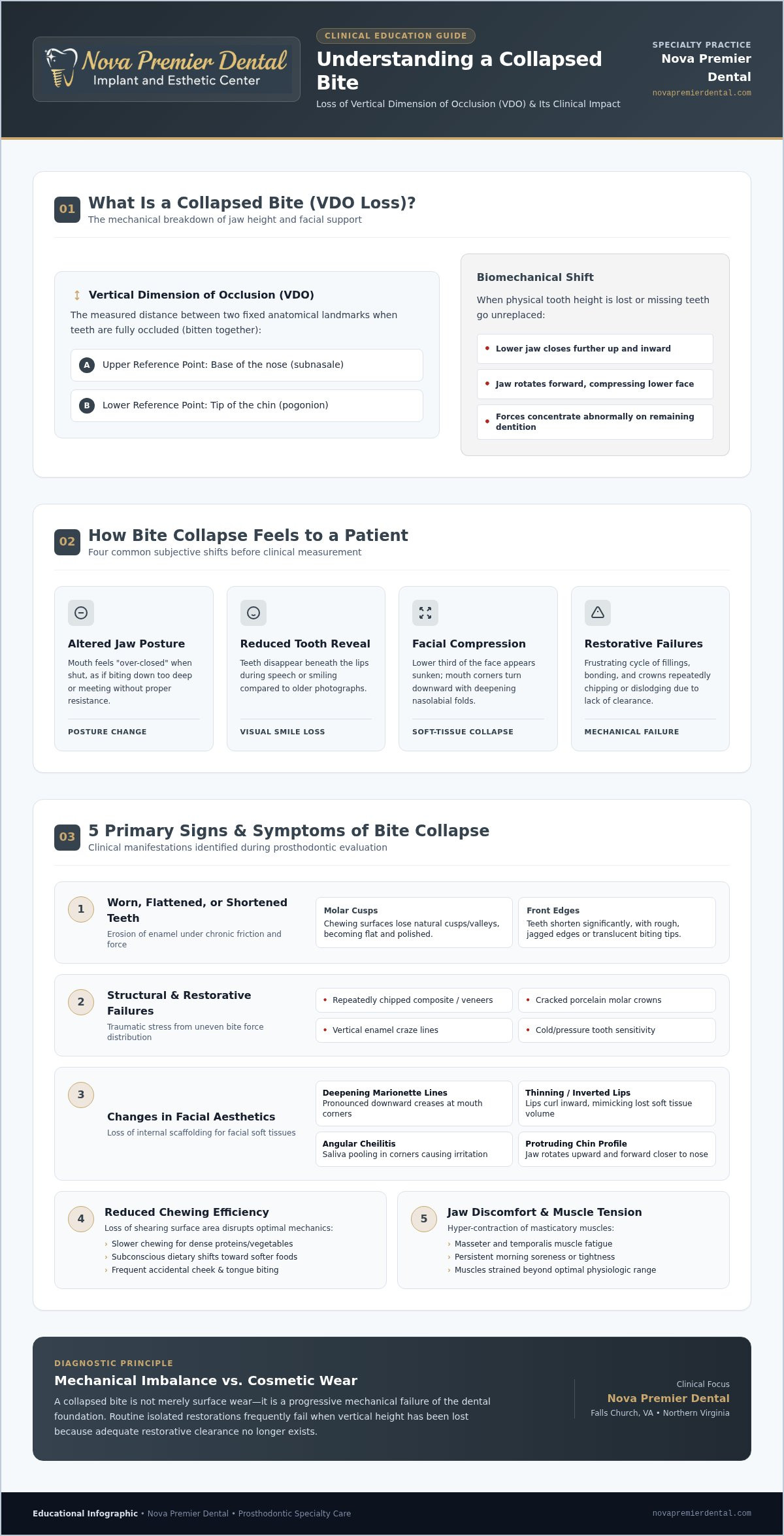
From a diagnostic standpoint, a collapsed bite refers to the clinical loss of the Vertical Dimension of Occlusion (VDO). VDO is the measured distance between two fixed points—one on the upper jaw (often near the base of the nose) and one on the lower jaw (the tip of the chin)—when the teeth are fully occluded, or bitten together. When this distance decreases, the lower jaw closes farther up and inward than it naturally should.
To an everyday observer, however, a collapsed bite rarely begins as a clinical measurement. Instead, it feels and looks like a gradual shift in how the mouth functions and appears:
- A change in jaw posture: You may notice that when your mouth is closed, your jaw feels over-closed, almost as if you are biting down too deep or your teeth meet without adequate resistance.
- Reduced "tooth reveal": When talking or smiling in photos, your teeth seem to disappear beneath the lips compared to older pictures where your smile was clearly visible.
- Facial compression: The lower third of your face can take on a compressed, sunken appearance, often causing the corners of the mouth to turn downward or creating deeper folds between the nose and the lips.
- Restorative frustration: You might experience a frustrating pattern where dental restorations—such as fillings, bonding, or single crowns—repeatedly chip, fracture, or dislodge because there is insufficient vertical space to accommodate them safely.
Unlike superficial cosmetic concerns, a collapsed bite represents an underlying mechanical failure. When teeth lose their physical height or missing teeth leave gaps in the dental arch, the balance of the entire chewing system is disrupted. Understanding this mechanical imbalance helps demystify why routine dental repairs often fail when vertical height has been compromised.
Recognizing the Signs and Symptoms of Bite Collapse
Because bite collapse typically develops slowly over years or even decades, many patients gradually adapt to the changes without realizing their bite is losing structural integrity. Familiarizing yourself with the primary signs and symptoms can help you determine whether your dental challenges stem from localized damage or an overarching structural shift.
1. Worn, Flattened, or Shortened Teeth
Enamel is the hardest substance in the human body, but under chronic friction and excessive force, it steadily erodes. In a collapsing bite, the chewing surfaces of molars can lose their natural cusps and valleys, becoming flat and polished. Similarly, front teeth may look significantly shorter, display rough or jagged edges, or become translucent at the biting tips where the enamel has grown paper-thin.
2. Structural and Restorative Failures
When the vertical height of the teeth decreases, bite forces are no longer distributed evenly across the dental arches. As a result, teeth and dental work absorb excessive, traumatic stress. Common indicators include:
- Repeatedly chipping front composite restorations or veneers.
- Cracking porcelain crowns on molar teeth.
- Vertical hairline fractures (craze lines) appearing across natural tooth enamel.
- Teeth that feel intermittently sensitive to cold or pressure due to micro-fractures and exposed dentin.
3. Changes in Facial Aesthetics
Your teeth and the underlying alveolar bone serve as the physical internal scaffolding for the lips and facial musculature. When vertical height diminishes, soft tissues lose their support. Patients often notice:
- Deepening Marionette Lines: Creases extending downward from the corners of the mouth become more pronounced.
- Thinning Lips: The upper and lower lips seem to curl inward (invert), giving the illusion of volume loss even when soft tissue volume remains unchanged.
- Angular Cheilitis: The over-closure of the lips can cause saliva to collect in the corners of the mouth, leading to chronic redness, cracking, and irritation.
- A "Protruding" Chin: Because the lower jaw rotates upward and forward as vertical height is lost, the chin may appear closer to the nose or more prominent in profile.
To learn more about how structural loss impacts facial aesthetics, review our detailed guide on facial changes from collapsed bites.
4. Reduced Chewing Efficiency and Dietary Adjustments
A stable bite acts like a set of well-aligned gears. When the teeth flatten or shift, the chewing surface area and shearing capability decrease. Patients often find that chewing dense proteins, raw vegetables, or crusty breads takes substantially longer, or they unconsciously begin favoring softer foods. Cheek and tongue biting can also become frequent, as the muscular boundaries of the mouth adjust to reduced intraoral space.
5. Jaw Discomfort and Muscle Tension
The muscles of mastication (the masseter, temporalis, and pterygoids) are designed to rest and fire within an optimal physiologic range. When vertical dimension is lost, these muscles are forced into a state of hyper-contraction to bring the teeth together. This muscular strain can manifest as:
- Morning soreness or tightness in the jaw joints or cheeks.
- Dull, tension-style headaches focused around the temples.
- Clicking, popping, or tenderness within the temporomandibular joints.
If you regularly wake up with facial pain or localized joint stiffness, exploring dedicated care for temporomandibular joint (TMJ) disorders can help clarify whether muscle hyperactivity is secondary to an unstable bite.
The Difference Between General Tooth Wear and True Loss of Vertical Dimension
One of the most critical distinctions in restorative dentistry is the difference between normal tooth wear and a true loss of vertical dimension. It is entirely possible to have visibly worn, shortened teeth without having a collapsed bite, and recognizing the difference determines the clinical approach required.
As human beings age, a mild degree of physiologic wear is normal. Tooth enamel naturally abrades over decades of chewing. In many cases, the human body adapts to this gradual loss through a biological process known as dentoalveolar compensation. When tooth structure slowly wears away at the incisal or occlusal edge, the underlying bone and surrounding periodontal tissues slowly remodel, allowing the tooth to gradually erupt further into the mouth. Because the tooth continues to meet its opposing partner, the patient's overall facial height—the vertical dimension of occlusion—often remains stable.
| Characteristic | General / Compensated Tooth Wear | True Loss of Vertical Dimension (Collapsed Bite) |
|---|---|---|
| Facial Proportions | Stable. Distance from nose to chin remains proportionate when biting down. | Altered. The lower third of the face appears compressed, with down-turned lips. |
| Restorative Space | Extremely limited. Teeth have erupted further, leaving little clearance between arches for restorations. | Spacious when the jaw is rested in its true anatomical position, but over-closed in bite. |
| Primary Cause | Slow, chronic surface attrition or mild erosion where the alveolar process had time to adapt. | Loss of back teeth (posterior support), severe rapid erosion/bruxism exceeding compensation, or worn dentures. |
| Muscular Impact | Minimal muscle fatigue; the jaw rests in its normal physiological posture. | Frequent muscle hyper-contraction, TMJ strain, and soreness due to over-closure. |
When tooth breakdown outpaces the body’s compensatory ability—or when structural supports (the back teeth) are lost entirely—true bite collapse occurs. Attempting to place crowns or restorations on worn teeth without determining whether the vertical dimension has collapsed is a primary reason restorative treatments fail. A comprehensive diagnostic analysis is essential to measure whether space must be managed, re-established, or maintained.
Primary Causes of a Collapsed Bite
A collapsed bite is rarely caused by a single isolated factor. More often, it represents the cumulative result of mechanical wear, biological conditions, and unaddressed dental changes occurring together.
1. Loss of Posterior Support (Missing Molars and Premolars)
The molars and premolars located in the back of the mouth serve as the structural pillars of your bite. They are anatomically designed to withstand tremendous biting and chewing forces—frequently exceeding 150 to 200 pounds of force per square inch. Front teeth (incisors and canines), by contrast, are designed for incising (cutting) food and guiding the jaw during side-to-side movements.
When back teeth are lost due to decay, fractures, or periodontal disease and are not replaced, the immense force of chewing shifts forward onto the delicate anterior teeth. This clinical phenomenon is called posterior bite collapse. Deprived of posterior support, the front teeth begin to splay outward (flaring), chip, wear down rapidly, or shift, allowing the jaw to over-close and reducing the vertical height of the face.
2. Severe Bruxism (Teeth Grinding and Clenching)
Bruxism involves non-functional grinding or clenching of the teeth, often occurring subconsciously during sleep. Over time, chronic friction strips away the protective enamel layer. Once enamel is breached, the softer underlying layer—dentin—is exposed. Dentin wears away up to seven times faster than enamel, leading to accelerated loss of tooth height.
Patients who suspect sleep-related grinding can explore specialized guidance on bruxism management and relief to identify interventions that protect natural structures before significant height is lost.
3. Chemical and Acid Erosion
While mechanical attrition involves tooth-on-tooth friction, chemical erosion dissolves the mineralized matrix of the teeth without mechanical contact. Chronic acid exposure softens the enamel, making it exceptionally vulnerable to rapid wear. Common sources of damaging acidity include:
- Gastroesophageal Reflux Disease (GERD): Stomach acid flowing up into the oral cavity chemically erodes the lingual (tongue-side) surfaces of upper teeth and the biting surfaces of lower molars.
- Dietary Acids: Frequent consumption of carbonated sodas, citrus fruits, sports drinks, or wine.
- Chronic Regurgitation: Conditions such as bulimia or chronic nausea that expose teeth repeatedly to gastric acids.
4. Worn, Ill-Fitting, or Aging Removable Dentures
Patients who wear full or partial dentures frequently experience bite collapse over time. Acrylic denture teeth naturally wear down from daily chewing. Simultaneously, the underlying jawbone (alveolar ridge) naturally resorbs and shrinks over the years when natural tooth roots are no longer present. As the denture teeth wear down and the supporting bone recedes, the prosthesis sinks closer to the jaw, progressively closing down the patient's bite height.
Why Accurate Clinical Diagnosis Matters
Because the human masticatory system is complex, diagnosing a collapsed bite requires looking far beyond a single tooth. Simply placing an individual crown on a worn front tooth without assessing the entire bite relationship can introduce premature contacts, increase the risk of fracture, and exacerbate joint pain.
A comprehensive clinical evaluation to assess vertical dimension typically incorporates several methodical diagnostic steps:
- Evaluation of Physiologic Rest Position (PRP): The clinician measures the face when the jaw muscles are completely relaxed. The difference between the jaw at rest and the jaw fully closed is known as the freeway space (typically 2 to 4 millimeters). An abnormally large freeway space often indicates that vertical height has been lost.
- Phonetic Analysis: Evaluating how teeth interact during specific speech sounds (such as the "s," "sh," or "ch" sounds) helps determine the closest speaking space. If teeth click together during speech, the bite may be too open; if there is excessive clearance, vertical height may be collapsed.
- Facial Landmark Measurement: Assessing the proportions between the forehead, nose, and lower third of the face helps confirm whether the lower facial height is anatomically balanced.
- Occlusal and TMJ Health Screening: Ensuring the jaw joints (condyles) are seated comfortably within their articular fossae prevents clinicians from rebuilding a bite in a strained or displaced position.
For more detailed technical insights on how dental specialists evaluate these measurements, read our clinical overview on restoring vertical dimension loss.
When to Seek an Evaluation from a Specialist
Many routine dental concerns can be managed effectively by a skilled general dentist. However, when multiple teeth are missing, existing restorations fail repeatedly, or the overall vertical dimension of the mouth is compromised, comprehensive diagnostic care becomes essential.
This is where consulting a board-certified prosthodontist can provide clarity. A prosthodontist is a dental specialist who has completed three additional years of rigorous, hospital- or university-based advanced residency training beyond dental school. This advanced education is devoted entirely to complex oral restoration, the biomechanics of occlusion (bite mechanics), dental implants, and full-mouth rehabilitation.
You may want to consider a specialist evaluation if you notice:
- More than two of your molars are missing, and you feel your front teeth hitting hard when you close your mouth.
- You have had multiple crowns or bonded fillings break within months of placement.
- Your smile has visibly shortened, and your front teeth appear thin, jagged, or translucent.
- You experience ongoing jaw tension, facial soreness, or neck aches that do not improve with routine nightguards.
- You wear complete or partial dentures that have not been replaced or re-evaluated in five or more years and your chin appears increasingly close to your nose.
At our Falls Church practice, Dr. Peterson Huang brings advanced expertise as a dual board-certified prosthodontist. Dr. Huang's specialized training enables him to diagnose subtle mechanical imbalances, evaluate remaining natural tooth structure, and determine whether a patient requires targeted conservative maintenance or a coordinated plan to re-establish stable vertical height. You can learn more about how specialist training applies to complex conditions by reviewing our resource on prosthodontic care in Northern Virginia.
Understanding Long-Term Prognosis and Maintenance
When bite collapse is identified and addressed, the objective is never simply to make teeth look longer; it is to establish a stable, biologically compatible foundation where teeth, muscles, and jaw joints function harmoniously. The long-term prognosis of any restorative approach depends heavily on identifying and mitigating the underlying causes that led to the collapse originally.
For instance, if nocturnal bruxism was the primary contributor to enamel wear, fabricating a custom-fitted, hard acrylic occlusal splint is essential to protect newly restored surfaces from ongoing night-time forces. If chemical reflux or dietary acidity caused the erosion, collaborating with a primary care physician or gastroenterologist ensures that internal acid exposure is properly managed.
Diligent daily hygiene, routine periodontal maintenance, and ongoing occlusal checkups ensure that forces remain evenly distributed across the arches as years pass. With proactive management and an accurate diagnostic baseline, patients experiencing bite collapse can protect their remaining natural dentition, regain chewing confidence, and restore comfortable facial support.
Schedule a Comprehensive Evaluation
If you have noticed changes in your smile height, frequent chipping of restorations, or persistent chewing fatigue, understanding your current bite stability is the first step toward long-term oral health. Nova Premier Dental offers in-house payment plans for qualifying patients, allowing treatment costs to be paid over several months while patients enjoy their new smile.
If you have questions about bite changes or complex restorative concerns, Nova Premier Dental in Falls Church provides prosthodontic specialty care for patients throughout Northern Virginia. We welcome you to contact our team to arrange an initial evaluation and diagnostic discussion.
Disclaimer
The information provided on this website and blog is intended for general educational and informational purposes only and should not be considered dental or medical advice, diagnosis, or treatment. Reading content on this website does not establish a doctor-patient relationship with Nova Premier Dental or Dr. Peterson Huang. Dental conditions and treatment needs vary from patient to patient. Individuals should consult directly with a qualified dental professional for personalized evaluation, diagnosis, and treatment recommendations. Do not delay seeking professional dental care based on information found on this website. While we strive to provide accurate and up-to-date information, no guarantee is made regarding the completeness, accuracy, or applicability of the content. Treatment outcomes may vary depending on individual circumstances. If you are experiencing a dental emergency or urgent oral health concern, please contact a licensed dental professional immediately or call 911 in the event of a medical emergency.


