


Article by
Peterson Huang DMD, MS, FACP, FRCDC
Dr. Peterson Huang is a dual board-certified prosthodontist serving Falls Church and Northern Virginia. He has been recognized as a Top Prosthodontist by Northern Virginia Magazine and Arlington Magazine and is affiliated with the Inova Fairfax Hospital Tumor Board. Dr. Huang focuses on dental implants, full mouth reconstruction, and complex restorative dentistry for patients who need advanced, comprehensive care.
A dental implant consultation is a diagnostic visit. Its purpose is to determine whether implants are appropriate for you, what type of restoration would suit your mouth, and what preparatory treatment may be needed. It is not a commitment to treatment. If you are looking for a dental implant consultation in Falls Church, this guide explains what the evaluation typically involves, what information the clinician needs, and what questions to ask.
What a Dental Implant Consultation Is For
Short answer: The consultation evaluates your overall oral health, the site of the missing tooth or teeth, the available bone, your bite, and your medical history, so that you can decide among the available options with accurate information.
An implant is a titanium or titanium-alloy post placed in the jaw that supports a crown, bridge, or denture. Because the implant must integrate with bone (a process called osseointegration) and then withstand years of chewing forces, planning begins with the whole mouth, not only the empty space. The visit usually covers:
- whether implants, a fixed bridge, a removable partial denture, or no replacement are reasonable options;
- whether other problems, such as active gum disease or decay, should be treated first;
- what the likely sequence and general timeline of treatment would be;
- the risks, limitations, and maintenance requirements of each option.
Why Early Planning Affects Outcomes
Several factors that influence implant success can be identified before any surgery:
- Bite (occlusion): How your upper and lower teeth meet determines the forces an implant crown will receive. Clenching or grinding (bruxism, a type of parafunction) increases mechanical loading and may raise the risk of complications such as loosened screws or fractured porcelain.
- Restorative space: There must be enough room between the jaws and adjacent teeth for the implant and crown. See not enough space for a crown or implant for more detail.
- Systemic health: Conditions such as poorly controlled diabetes, smoking, certain medications, and prior head and neck radiation can affect healing and long-term implant health. Your medical history is reviewed for this reason, and your physician may be consulted.
- Expectations about timing: Healing time varies with bone quality, whether grafting or extraction is needed, and the type of restoration. A clinician can give a realistic range only after examining you.
Treatment Planning Before Surgery
At the end of the evaluation you should receive a written or clearly explained plan describing the proposed implant positions, any grafting, the type of final restoration, and the sequence of visits. Implant position matters because it influences both function and how easily the restoration can be cleaned; the article why implant position matters explains this further. More information on the procedure itself is available on our dental implants page.
Who Provides Implant Care: General Dentists and Prosthodontists
Many implants are placed or restored by general dentists, oral and maxillofacial surgeons, periodontists, and prosthodontists, often working as a team. General dentists provide essential preventive and restorative care and may appropriately restore implants, and many do so well. Implant treatment is not limited to one specialty.
Prosthodontists complete additional specialty training focused on restoring and replacing teeth and managing complex restorative problems. That training can be particularly relevant when:
- several teeth are missing or the whole arch needs replacement;
- the bite is worn, unstable, or has changed over time;
- previous restorations have failed or the cause of failure is unclear;
- bone loss, limited restorative space, or a history of head and neck cancer complicates the plan;
- a patient wants a second opinion before committing to extensive treatment.
Dr. Peterson Huang completed specialty training in prosthodontics and holds board certification through the American Board of Prosthodontics and the Royal College of Dentists of Canada. He is a dentist with the credentials DMD, MS, FACP, FRCDC. You can read more about Dr. Huang's training and background. Nova Premier Dental is a private prosthodontic specialty dental office in Falls Church serving Northern Virginia; our page on prosthodontic care in Northern Virginia describes the scope of that care. For a more detailed comparison, see prosthodontist vs general dentist. A referral from your general dentist is helpful for sharing records but is not generally required to schedule an evaluation; confirm with the office when you call.
What Happens During the Evaluation
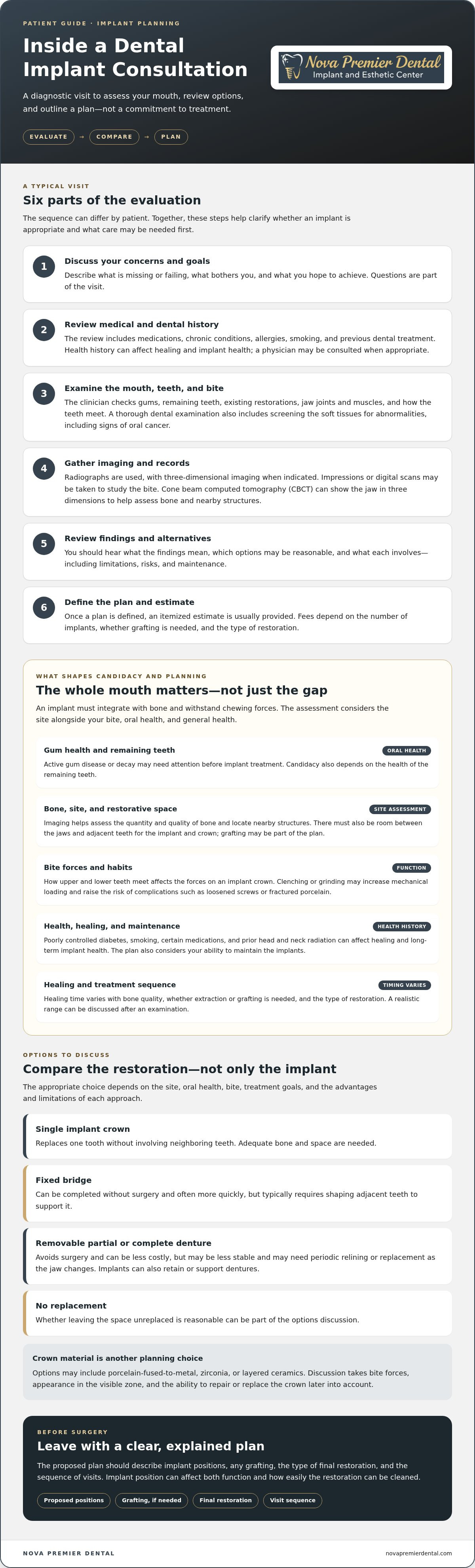
Appointments differ by patient, but a typical sequence is:
- Discussion of concerns and goals. You describe what is missing or failing, what bothers you, and what you hope to achieve. Questions are part of the visit.
- Medical and dental history review. This includes medications, chronic conditions, allergies, smoking, and previous dental treatment.
- Clinical examination. The clinician assesses the gums, remaining teeth, existing restorations, jaw joints and muscles, and the way the teeth meet. An oral soft-tissue screening for abnormalities, including signs of oral cancer, is a standard part of a thorough dental examination (see dental exams and cleanings).
- Imaging and records. Radiographs and, when indicated, three-dimensional imaging are obtained. Impressions or digital scans of the teeth may be taken to study the bite.
- Review of findings and options. You are told what the findings mean, what the alternatives are, and what each involves.
- Written estimate and next steps. Fees depend on the number of implants, any grafting, and the type of restoration, so an itemized estimate is usually provided once a plan is defined.
Comparing Restorative Options
The discussion typically compares:
- Single implant crown: replaces one tooth without involving neighboring teeth, but requires adequate bone and space.
- Fixed bridge: can be completed without surgery and often more quickly, but typically requires shaping adjacent teeth to support it.
- Removable partial or complete dentures: avoid surgery and can be less costly, but may be less stable and can require periodic relining or replacement as the jaw changes. Implants can be used to retain or support dentures.
The choice of crown material (for example, porcelain-fused-to-metal, zirconia, or layered ceramics) is also discussed, taking into account bite forces, esthetics in the visible zone, and the ability to repair or replace the crown later.
How Candidacy and Bone Health Are Assessed
Short answer: Candidacy depends mainly on the health of the gums and remaining teeth, the quantity and quality of bone at the planned site, your general health, and your ability to maintain the implants. Imaging is used to measure bone and locate nearby structures.
Imaging and Digital Planning
Standard two-dimensional X-rays show only part of the picture. Cone beam computed tomography (CBCT) produces a three-dimensional image of the jaw. When it is indicated, it can show:
- bone height, width, and density at the proposed site;
- the location of the inferior alveolar nerve in the lower jaw;
- the position of the maxillary sinus in the upper jaw;
- anatomical features such as concavities that affect implant angulation.
This information can be combined with scans of the teeth in planning software so that the implant position is determined according to the intended final crown. A surgical guide may then be used to help transfer the plan to the mouth; see dental implant surgical guides for how they work. Guides assist accuracy but do not remove the need for surgical judgment, and they do not guarantee a particular healing experience.
If Bone Volume Is Limited
Low bone volume is common after long-standing tooth loss, gum disease, or trauma, and it does not always rule out implants. Options may include:
- Bone grafting at the time of extraction or as a separate procedure, which usually adds healing time;
- Sinus augmentation in the upper back jaw;
- Shorter or narrower implants, or alternative positions, when appropriate;
- A non-implant option, such as a bridge or denture, if grafting is undesirable or risks outweigh benefits.
Grafting and certain surgical steps are often performed by an oral surgeon or periodontist, and coordinated care between specialists is common. The article Am I a candidate for dental implants? covers candidacy in more depth.
Gum Health and Preparatory Treatment
Periodontal disease, untreated decay, and a worn or unstable bite are usually addressed before or alongside implant placement, because inflammation around implants (peri-implant mucositis and peri-implantitis) is associated with a history of periodontitis and with poor plaque control. When many problems coexist, the plan may be staged as part of broader oral reconstruction.
Expectations, Risks, and Longevity
Implant treatment has risks that should be discussed at the consultation, including infection, failure to integrate, nerve or sinus complications, and later problems around the implant. It is important to distinguish two things:
- Implant survival refers to the fixture remaining in the jaw. Systematic reviews generally report high survival over follow-up periods of five to ten years, though results vary with patient factors, implant site, and study design.
- Restoration longevity is separate. Crowns, bridges, denture attachments, and screws can wear, loosen, chip, or fracture and may need repair or replacement. See why implant crowns loosen and common causes of implant restoration failure.
Implants require ongoing home care and professional maintenance visits. Smoking, poor oral hygiene, uncontrolled diabetes, and a history of periodontitis are recognized risk factors for peri-implant disease. For general patient information, the National Institute of Dental and Craniofacial Research and the American Dental Association's MouthHealthy site offer overviews of implants.
Preparing for Your Visit
The following can make the appointment more productive:
- a list of current medications and medical conditions, and the name of your physician;
- recent dental X-rays or records from your current dentist, if available;
- dental insurance information (see dental insurance and benefits); coverage for consultations, imaging, and implants varies by plan, so verifying your benefits beforehand is advisable;
- written questions, such as the alternatives to implants, expected healing time, the maintenance schedule, and what happens if a component needs replacement.
Common Questions
Is the consultation painful? Examination and imaging are generally comfortable. No surgery is performed at an evaluation visit.
How long does it take? The length depends on the complexity of your case and which records are taken; ask the office when scheduling.
Can an implant be placed the same day? Usually the consultation is separate from surgery, because planning, imaging review, and treatment of other conditions often come first. Whether a same-day approach is appropriate depends on your individual situation.
Will I learn the cost? Once a plan is defined, you can receive an estimate. If a plan requires further records or staged treatment, the estimate may be provided in phases. Nova Premier Dental offers in-house payment plans for qualifying patients, allowing treatment costs to be paid over several months.
Summary and Next Steps
A good implant consultation should leave you with a clear understanding of your diagnosis, the alternatives (including not replacing the tooth), the risks and maintenance involved, and a defined sequence of treatment. You are free to seek a second opinion at any point.
If you have questions about a complex restorative or prosthodontic concern, Nova Premier Dental in Falls Church provides prosthodontic specialty care for patients throughout Northern Virginia, and you can contact the office to arrange an evaluation.
Disclaimer
The information provided on this website and blog is intended for general educational and informational purposes only and should not be considered dental or medical advice, diagnosis, or treatment. Reading content on this website does not establish a doctor-patient relationship with Nova Premier Dental or Dr. Peterson Huang. Dental conditions and treatment needs vary from patient to patient. Individuals should consult directly with a qualified dental professional for personalized evaluation, diagnosis, and treatment recommendations. Do not delay seeking professional dental care based on information found on this website. While we strive to provide accurate and up-to-date information, no guarantee is made regarding the completeness, accuracy, or applicability of the content. Treatment outcomes may vary depending on individual circumstances. If you are experiencing a dental emergency or urgent oral health concern, please contact a licensed dental professional immediately or call 911 in the event of a medical emergency.


