

Article by
Peterson Huang DMD, MS, FACP, FRCDC
Dr. Peterson Huang is a dual board-certified prosthodontist serving Falls Church and Northern Virginia. He has been recognized as a Top Prosthodontist by Northern Virginia Magazine and Arlington Magazine and is affiliated with the Inova Fairfax Hospital Tumor Board. Dr. Huang focuses on dental implants, full mouth reconstruction, and complex restorative dentistry for patients who need advanced, comprehensive care.
Implant-supported dentures are full-arch prostheses that attach to dental implants placed in the jawbone instead of resting on the gums alone. For people in Falls Church and across Northern Virginia whose conventional dentures slip, this design can improve retention and stability. It does not suit every patient, and the type of prosthesis, the number of implants, and the long-term maintenance all depend on individual anatomy and bite forces.
What Are Implant-Supported Dentures?
Short answer: An implant-supported denture is a complete-arch prosthesis that connects to two or more dental implants through attachments or abutments. Conventional dentures rely on suction and soft-tissue contact. These dentures are retained mechanically by the implants.
An implant is a titanium or titanium-alloy post placed in the jaw. An abutment is the connecting component that extends through the gum tissue and holds the prosthesis, either directly or through an attachment such as a ball, locator, or bar. The prosthesis may be removable by the patient or fixed so that only a dentist can remove it.
Implants integrate with bone through osseointegration, a direct structural and functional connection between living bone and the implant surface. Healing time varies by patient, bone quality, and the protocol used, so your clinician should give you an individual estimate.
How Implants Provide Stability
The number of implants varies with the arch, the bone available, the prosthesis design, and the forces on the teeth. Published clinical guidance commonly describes two implants for a mandibular overdenture, and fixed full-arch prostheses often use four to six or more implants. These are general patterns and not fixed rules. A maxillary arch often has softer bone and may need a different plan.
- Ball or locator attachments: Individual implants have small attachments that snap into the denture. They are simple to maintain, and the attachment inserts wear and need periodic replacement.
- Bar-retained designs: A bar joins several implants, and the denture clips onto it. This can distribute forces across implants and may suit certain arches, but it needs careful hygiene access under the bar.
- Fixed prostheses: The prosthesis attaches to the implants with screws and is not removed by the patient.
Many patients find that retention is much better than with conventional dentures, which can reduce the need for adhesive. Some movement can still occur with removable designs, and a good result depends on the prosthesis fit and the bite.
Why Prosthetic Planning Matters
Implant surgery and prosthesis design are linked. A prosthodontist is a dental specialist who completes additional residency training in restoring and replacing teeth, including complex cases. General dentists provide a great deal of the preventive and restorative care patients need, and many place or restore implants appropriately. Some patients are managed by a team, with a surgeon or periodontist placing implants and a prosthodontist designing the restoration.
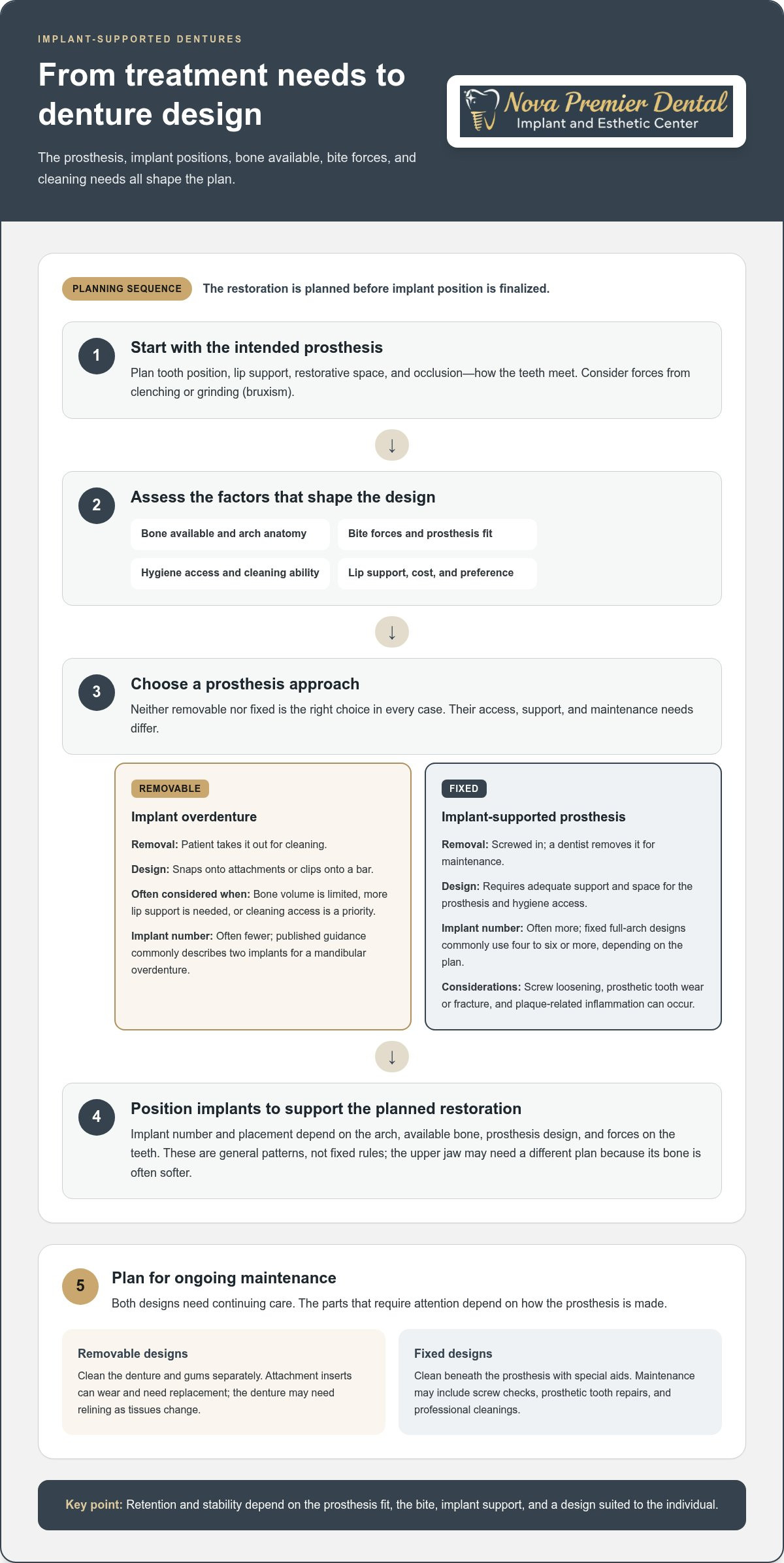
Planning starts with the final prosthesis: tooth position, lip support, restorative space, occlusion (how the teeth meet), and the forces from clenching or grinding (bruxism). Implant position follows from that plan. For more on why placement matters, see why implant position matters.
Dr. Peterson Huang (Peterson Huang, DMD, MS, FACP, FRCDC) is a dentist and a dual board-certified prosthodontist, certified in prosthodontics in the United States and Canada. Dr. Peterson Huang completed specialty training in prosthodontics and holds board certification through the American Board of Prosthodontics and the Royal College of Dentists of Canada. He practices at Nova Premier Dental, a private prosthodontic specialty dental office in Falls Church serving Northern Virginia.
Fixed vs. Removable Implant Dentures: Key Differences
Short answer: A removable implant overdenture snaps onto implants and is taken out by the patient for cleaning. A fixed implant-supported prosthesis is screwed to the implants and is removed only by a dentist. Neither is better in every case. The choice depends on bone, the number of implants, hygiene ability, lip support, bite forces, cost, and preference.
| Factor | Removable overdenture | Fixed prosthesis |
|---|---|---|
| Removal | Patient removes daily | Dentist removes for maintenance |
| Typical implant number | Often fewer | Often more, depending on design |
| Cleaning | Denture and gums cleaned separately | Cleaning under the prosthesis with special aids |
| Lip and facial support | Denture flange can add support | Support depends on design and available space |
| Typical maintenance | Attachment inserts, relines, denture wear | Screw checks, repair of prosthetic teeth, professional cleanings |
| Cost | Generally lower | Generally higher |
Fixed Implant-Supported Dentures
Fixed prostheses are sometimes called fixed hybrids or implant bridges, and approaches such as All-on-4 fall into this category. They usually feel more like natural teeth to patients because they do not move. They require sufficient bone or implant positions that allow adequate support, and enough restorative space for the prosthesis and for hygiene access. Complications can include screw loosening, fracture or wear of prosthetic teeth, and plaque-related inflammation around implants. Patients who grind their teeth may need a night guard. More detail is on our permanent dentures page.
Removable Implant Overdentures
Overdentures are often chosen when bone volume is limited, when more lip support is needed, or when easy access for cleaning is a priority. They are generally less costly than fixed prostheses. Attachments wear with repeated insertion and need replacement, and the denture base may need relining as tissues change. A conventional denture is a prosthesis that still requires regular care, and our guide on when to replace dentures covers that process.
Biological Considerations: Bone, Chewing, and Facial Support
Short answer: After tooth loss, the alveolar bone that supported the teeth gradually resorbs. Implants transmit functional load to the bone and may help limit resorption around them, but they do not stop bone change entirely.
Jawbone Changes After Tooth Loss
Bone resorption after extraction is well documented. Its rate varies with the individual, the jaw, and factors such as denture wear and systemic health. Conventional dentures rest on the ridge and do not transmit load to bone in the way implants do. Reduced bone height can affect denture stability and, in some patients, lower facial support. Facial appearance changes also come from aging and other factors, so bone loss should not be assumed to be the only cause. Implants can reduce bone changes in the areas they occupy, though some peri-implant bone remodeling is expected, and conditions such as peri-implantitis can cause further loss.
Chewing Function
Studies of masticatory performance generally find that implant-retained prostheses improve chewing ability and patient satisfaction compared with conventional complete dentures. Reported efficiency figures vary between studies and measurement methods, so no single percentage applies to every patient. Fixed designs often provide the most bite force, and overdentures typically fall between conventional dentures and fixed prostheses. Patients still need to adapt to the prosthesis, and food choices may need some adjustment at first. For wider treatment planning, see what full mouth reconstruction involves.
The American College of Prosthodontists and other professional organizations describe mandibular implant overdentures as a standard of care option for edentulous patients (the McGill consensus statement, 2002, and the York consensus, 2009, are commonly cited). You can read more at the American College of Prosthodontists.
Evaluation, Process, and Timeline
Short answer: Treatment generally includes an examination, imaging, planning, surgery, healing, and fabrication of the final prosthesis. The timeline depends on bone condition, whether teeth need to be extracted, grafting needs, and the design chosen.
- Evaluation: A medical and dental history, a dental exam, assessment of the existing dentures, and 3D imaging such as cone-beam CT to evaluate bone volume and anatomy.
- Planning: Choosing between fixed and removable, deciding implant number and position, and determining whether grafting or tooth extraction is needed. Surgical guides can help transfer the plan to the mouth; see how surgical guides are used.
- Implant placement: Performed under local anesthesia, with sedation options depending on the patient and the clinician. Postoperative instructions are outlined in after dental implant surgery. Discomfort after surgery is common and is usually managed with prescribed or over-the-counter medication.
- Healing: Implants integrate with bone over a period that varies by patient. Some protocols allow a provisional prosthesis during healing, depending on the stability of the implants and the case.
- Final prosthesis: The final prosthesis is fabricated after the tissues and implants are stable, with bite and esthetic evaluation before delivery.
- Maintenance: Regular examinations, hygiene visits, radiographs as indicated, and checks of screws, attachments, and prosthetic wear.
Who Is a Candidate?
Candidacy depends on general health, bone, gum health, medications, smoking status, and ability to maintain hygiene. Conditions such as uncontrolled diabetes, a history of head and neck radiation, or certain medications affect planning and risk, and may require coordination with the patient's physician. Bone loss does not automatically exclude someone; options include bone grafting, different implant positions, or an overdenture. See also whether you are a candidate for dental implants.
Prognosis, Complications, and Longevity
Implant survival and prosthesis longevity are different things. Systematic reviews report high implant survival over 5 to 10 years in appropriate patients, although results vary by study, population, and definition of success. The prosthesis usually has a shorter service life: attachments, denture teeth, screws, and acrylic may need repair or replacement. Possible complications include:
- Peri-implant mucositis and peri-implantitis
- Screw or abutment loosening
- Fracture or wear of prosthetic teeth or framework
- Attachment wear in overdentures
- Implant failure to integrate, which is uncommon but possible
Smoking, poor hygiene, a history of periodontitis, and unmanaged bruxism are associated with higher complication risk. Learn more about common causes of implant restoration failure.
If a denture tooth breaks or the prosthesis loosens, contact your dentist rather than attempting repairs at home. Our practice also handles emergency denture repair.
Cleaning and Daily Care
Removable overdentures should be removed and cleaned daily, and the gums and attachments cleaned too. Fixed prostheses require brushing plus interdental brushes, floss threaders, or a water flosser, as advised by your clinician. Professional maintenance visits at intervals set by your dentist are important for both types.
Cost and Payment
The cost depends on the number of implants, the type of prosthesis, materials, grafting, sedation, and laboratory work. Fixed prostheses generally cost more than overdentures. A written treatment plan with fees helps patients compare options. Nova Premier Dental offers in-house payment plans for qualifying patients, allowing treatment costs to be paid over several months.
When to See a Prosthodontic Specialist
Specialist evaluation may be helpful when there is significant bone loss, a failed prior restoration, severe tooth wear, a collapsed bite, a history of head and neck cancer treatment, or the need to coordinate surgery and a complex prosthesis. Many patients are treated well by their general dentist, and referral is a matter of case complexity, not a judgment on prior care. To compare provider types, see prosthodontist vs. general dentist, or learn about prosthodontic care in Northern Virginia.
Frequently Asked Questions
How many implants are needed to support a full denture?
It varies. Two implants are commonly used for a lower overdenture, and fixed prostheses often use four to six or more, depending on bone, arch, and design.
Is the surgery painful?
Placement is done with anesthesia. Soreness, swelling, and bruising afterward are common and usually improve over several days with the care your clinician recommends.
Can I upgrade my existing dentures?
Sometimes. A well-fitting denture can occasionally be modified to attach to implants, while others need replacement. An evaluation will determine this.
How long do they last?
Implants can function for many years in appropriate patients, but no one can guarantee a specific lifespan. Prosthetic components typically need periodic maintenance, repair, or replacement.
If you have questions about replacing a full arch of teeth, Nova Premier Dental in Falls Church provides prosthodontic specialty care for patients throughout Northern Virginia. You can contact the office to arrange a consultation.
Disclaimer
The information provided on this website and blog is intended for general educational and informational purposes only and should not be considered dental or medical advice, diagnosis, or treatment. Reading content on this website does not establish a doctor-patient relationship with Nova Premier Dental or Dr. Peterson Huang. Dental conditions and treatment needs vary from patient to patient. Individuals should consult directly with a qualified dental professional for personalized evaluation, diagnosis, and treatment recommendations. Do not delay seeking professional dental care based on information found on this website. While we strive to provide accurate and up-to-date information, no guarantee is made regarding the completeness, accuracy, or applicability of the content. Treatment outcomes may vary depending on individual circumstances. If you are experiencing a dental emergency or urgent oral health concern, please contact a licensed dental professional immediately or call 911 in the event of a medical emergency.


