

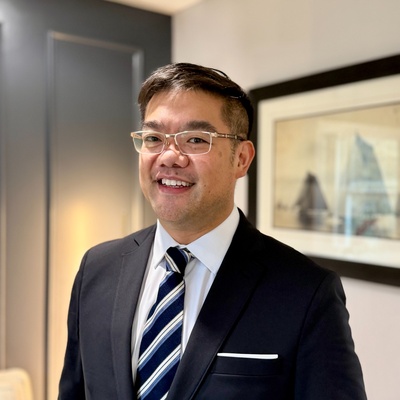
Article by
Peterson Huang DMD, MS, FACP, FRCDC
Dr. Peterson Huang is a dual board-certified prosthodontist serving Falls Church and Northern Virginia. He has been recognized as a Top Prosthodontist by Northern Virginia Magazine and Arlington Magazine and is affiliated with the Inova Fairfax Hospital Tumor Board. Dr. Huang focuses on dental implants, full mouth reconstruction, and complex restorative dentistry for patients who need advanced, comprehensive care.
What is Specialty Dental Care vs. General Dentistry?
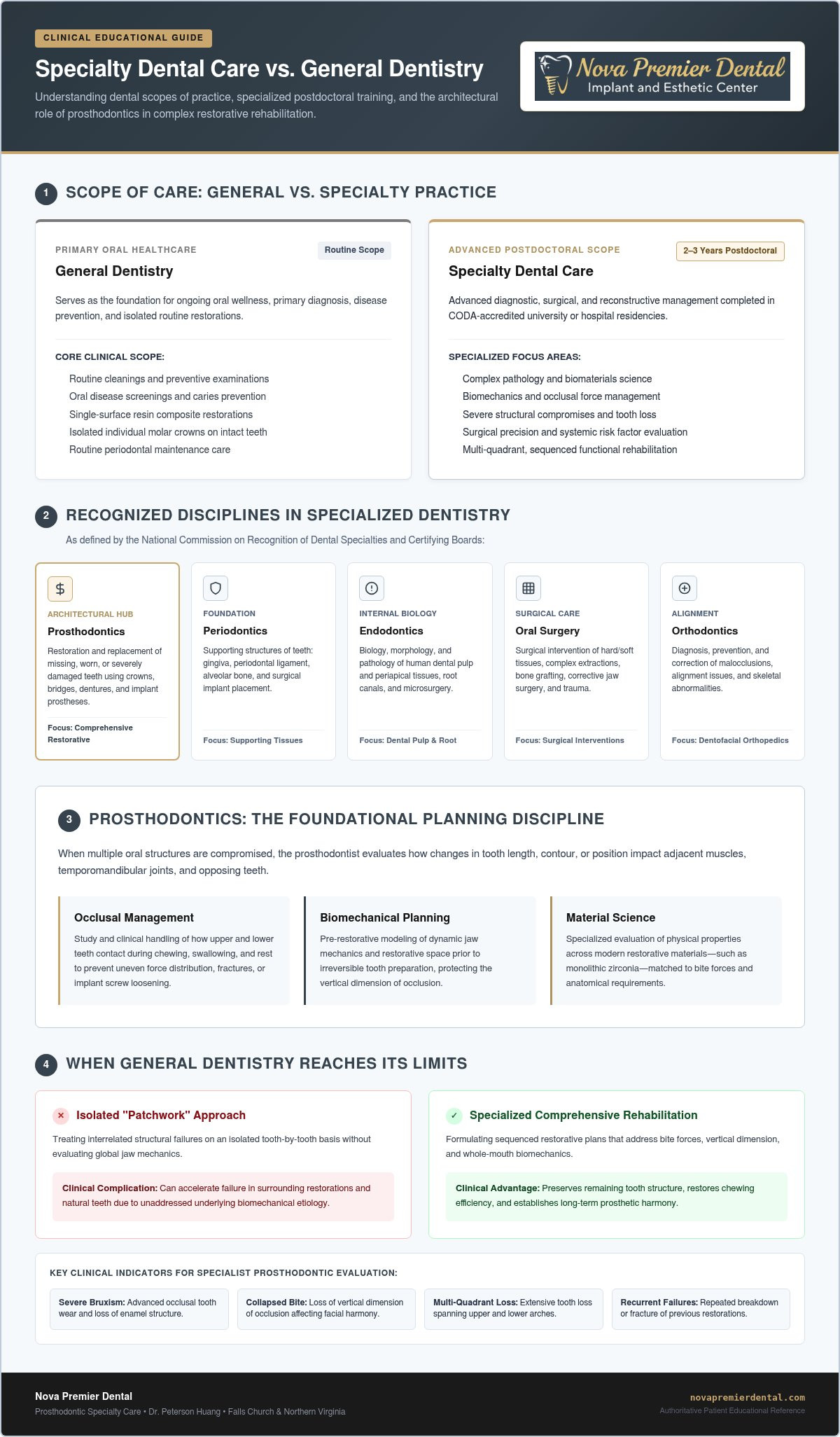
In modern healthcare, dentistry encompasses both broad primary care and highly focused specialty disciplines. While general dentists serve as the essential foundation for primary oral healthcare—providing preventive examinations, routine cleanings, basic restorations, and oral disease screenings—specialty dental care refers to advanced diagnostic, surgical, and reconstructive treatments performed by practitioners who have completed extensive postdoctoral residency training accredited by the Commission on Dental Accreditation (CODA).
Understanding the distinction between general and specialty care is critical when facing complex dental diagnoses. A general dentist manages overall wellness and can treat a wide variety of routine conditions. However, when clinical challenges involve severe structural tooth loss, unstable bites, advanced periodontal breakdown, or extensive functional rehabilitation, collaborative care or direct referral to a specialist often provides the targeted expertise necessary to address intricate biological and biomechanical requirements.
Specialty care is defined not merely by the procedures performed, but by the depth of diagnostic planning and specialized training behind them. Specialists spend two to three additional years in hospital- or university-based residency programs following dental school. During this period, their education focuses intensely on complex pathology, biomaterials science, surgical precision, and restorative mechanics. This rigorous training equips specialists to evaluate systemic factors, analyze severe structural compromises, and execute intricate treatment sequences that general dental training is not designed to cover in depth.
The Recognized Dental Specialties
The National Commission on Recognition of dental specialties and Certifying Boards officially recognizes distinct dental disciplines, each focused on a specific anatomical structure, patient demographic, or clinical pathology:
- Prosthodontics: The specialty dedicated to the restoration and replacement of missing, worn, or severely damaged teeth using prostheses such as crowns, bridges, complete and partial dentures, and implant-supported restorations.
- Periodontics: Focuses on the prevention, diagnosis, and treatment of diseases affecting the supporting structures of the teeth (gingiva, periodontal ligament, and alveolar bone) and the surgical placement of dental implants.
- Endodontics: Concentrates on the biology, morphology, physiology, and pathology of the human dental pulp and periapical tissues, primarily performing root canal therapy and apical microsurgery.
- Oral and Maxillofacial Surgery: Specializes in surgical interventions of the hard and soft tissues of the mouth, jaws, and facial structures, including complex extractions, bone grafting, corrective jaw (orthognathic) surgery, and facial trauma repair.
- Orthodontics and Dentofacial Orthopedics: Focuses on the diagnosis, prevention, and correction of malocclusions, dental alignment issues, and neuromuscular and skeletal abnormalities of developing or mature orofacial structures.
Among these branches, prosthodontics occupies an architectural role in comprehensive restorative treatment. When multiple oral structures are compromised simultaneously, the prosthodontist evaluates how changes to one element—such as tooth length, contour, or position—will affect the adjacent muscles, joints, and opposing teeth.
When General Dentistry Reaches Its Limits
General dentists frequently manage straightforward restorative procedures with predictability. A single-surface resin composite filling, an isolated crown on an intact molar, or routine periodontal maintenance are well within the generalist's typical scope. However, clinical complications arise when a patient presents with multiple interrelated problems: severe occlusal wear from bruxism, a collapsed vertical dimension of occlusion, extensive tooth loss across several quadrants, or repeated failures of previous restorations.
In such scenarios, addressing problems on an isolated tooth-by-tooth basis creates the risk of "patchwork" dentistry. Treating individual teeth independently without evaluating overall jaw mechanics and bite forces can accelerate failure in the surrounding restorations. To prevent this, general practitioners often consult or partner with specialists like Dr. Peterson Huang to formulate comprehensive treatment sequences that address the underlying biomechanical etiology rather than simply patching recurrent symptoms. Learning more about the distinction between oral rehabilitation vs. patchwork dentistry can help patients understand why an integrated plan is essential for long-term health.
Prosthodontics: The Foundation of Specialty Restorative Care
Prosthodontics is unique because it serves as the foundational planning discipline for complex reconstructive dentistry. While surgeons address bone and soft-tissue foundations, a prosthodontist designs the definitive functional restoration, ensuring that prosthetic teeth harmonize with the temporomandibular joints, masticatory musculature, and facial aesthetics. When patients require advanced rehabilitation, working with a dedicated prosthodontist in Northern Virginia provides access to specialized diagnostic strategies designed to preserve remaining tooth structure and restore chewing efficiency.
A central tenet of prosthodontics is occlusal management—the study and clinical handling of how the upper and lower teeth contact during chewing, swallowing, and at rest. If occlusal forces are distributed unevenly across the dental arch, restorations can fracture, natural teeth may become mobile or hyper-sensitive, and dental implants can experience crestal bone loss or mechanical screw loosening. Specialized prosthodontic planning models these dynamic forces prior to initiating irreversible tooth preparation.
Material science is another core dimension of prosthodontic training. Modern restorative options extend far beyond standard porcelain-fused-to-metal (PFM). A prosthodontist evaluates the physical properties of:
- Monolithic Zirconia: Exceptionally durable with high flexural strength, suited for posterior quadrants and heavy bruxers where restorative space is limited.
- Lithium Disilicate: Highly aesthetic glass-ceramic with balanced optical translucency and adhesive bond strength, commonly utilized for anterior crowns, veneers, and partial-coverage restorations.
- High-Performance Polymers and Titanium: Used within hybrid framework designs for full-arch implant prostheses to distribute stress and absorb masticatory load efficiently.
Dual Board Certification: A Measured Standard of Training
All prosthodontists complete three years of intensive postgraduate residency training beyond dental school. However, a select group pursues the rigorous, multi-part examination process required to achieve board certification through the American Board of Prosthodontics (ABP). This credential verifies that the practitioner has presented complex treated clinical cases to a panel of peers, defended their scientific reasoning, and demonstrated an advanced grasp of biological principles, dental materials, and clinical execution.
Dual board certification represents an even higher level of peer validation across clinical disciplines. When evaluating complex treatment plans, this training provides patients with assurance that clinical decisions are anchored in evidence-based protocols. While board certification does not guarantee a specific biological outcome—as every patient's healing and compliance vary—it confirms that the clinician has been independently evaluated and certified at the highest standard recognized by the profession.
The Prosthodontic Approach to Oral Reconstruction
Prosthodontic treatment begins long before any tooth is prepared or an implant placed. The process begins with exhaustive diagnostic data collection, including high-resolution intraoral imaging, diagnostic models mounted on semi-adjustable or fully adjustable articulators, and three-dimensional cone beam computed tomography (CBCT).
Using this data, the prosthodontist performs a diagnostic wax-up—either physically in wax or through virtual design software. This diagnostic prototype establishes the ideal length, contour, inclination, and occlusal contact points of the planned teeth. From this blueprint, surgical guides can be generated for the periodontist or oral surgeon placing dental implants, ensuring that fixtures are placed in precise positions to support the final restorations without compromising hygiene or biological width.
When Should You Seek a Dental Specialist?
Specialty evaluation is not necessary for routine dental needs; general dentists are fully equipped to manage standard checkups, preventive cleanings, and simple restorations. However, certain clinical conditions warrant the input of a dental specialist to minimize the risk of complications and ensure structural stability.
| Clinical Scenario | Primary Care (General Dentist) | Specialty Care (Prosthodontist / Specialist) |
|---|---|---|
| Isolated Cavity or Small Fracture | Direct composite filling or standard crown | Referral typically unnecessary unless part of systemic collapse |
| Single Missing Tooth (Abundant Bone) | Routine implant restoration or 3-unit bridge | Recommended if aesthetic zone demands high-precision emergence profile |
| Severe Tooth Wear (Collapsed Bite) | Symptom management, night guard | Comprehensive occlusal rehabilitation and vertical dimension adjustment |
| Multiple Missing Teeth / Failing Dentures | Standard conventional complete dentures | Implant-supported overdentures, fixed full-arch hybrid restorations |
| Chronic Jaw Pain & Unstable Occlusion | Initial splint therapy, muscle relaxants | Advanced occlusal equilibration, reconstructive joint-bite alignment |
Specific Clinical Indicators
Patients often seek or are referred for specialty care when specific clinical signs emerge:
- Progressive Tooth Wear and Erosion: When teeth become flattened, chipped, or noticeably shorter due to severe sleep bruxism, dietary erosion, or gastroesophageal reflux disease (GERD), the bite can collapse. Restoring worn teeth requires careful re-establishment of the vertical dimension of occlusion (VDO) so that adequate restorative space is created without causing muscular strain.
- Multiple Missing or Compromised Teeth: Replacing several adjacent teeth often requires coordinating complex fixed bridges or implant-supported prosthetics to prevent excessive structural loads on the remaining natural dentition.
- Chronic Prosthetic Instability: Loose, uncomfortable, or fractured removable appliances often indicate severe ridge resorption or misaligned bite distribution. In urgent cases, services such as professional emergency denture repair can resolve immediate structural breaks, while comprehensive adjustments re-establish functional suction and stability.
- Maxillofacial and Oncologic Deficits: Patients who have undergone surgical resections for head-and-neck cancer, or those born with congenital defects like cleft palate, require specialized prostheses (such as obturators) to restore speech, swallowing, and mastication.
Complex Cases: Full Mouth Reconstruction
When decay, periodontal disease, or occlusal trauma impacts the majority of teeth across both dental arches, a patient may require a comprehensive oral reconstruction. This multi-phase process rehabilitates the aesthetic appearance, biological health, and mechanical function of the entire masticatory system.
Reconstructing an entire mouth requires detailed treatment sequencing. A specialist systematically stabilizes acute periodontal inflammation and active decay, evaluates individual tooth prognoses, tests provisional restorations to confirm that speech and joint function are comfortable, and then transitions to final restorations fabricated from durable, highly biocompatible ceramics. The objective is not merely cosmetic enhancement, but establishing an equilibrium where forces are dispersed safely across the jaw.
Advanced Procedures in Specialty Restorative Care
Specialty dental practices utilize focused clinical workflows and materials designed to withstand substantial masticatory stresses over time.
Dental Implants as a Specialty Discipline
The success of dental implant therapy relies heavily on restorative planning rather than surgical placement alone. Historically, implants were sometimes placed wherever bone volume was greatest, often leaving the restorative dentist with steep angles, compromised aesthetics, and biological challenges that made plaque removal difficult.
Modern specialty care uses a "prosthetically driven" philosophy. Before surgical placement, the desired final tooth position is determined digitally. Three-dimensional planning software aligns the implant trajectory directly through the center of the planned crown. This allows for:
- Screw-Retained Restorations: Avoiding the use of subgingival dental cements, which are a documented risk factor for peri-implant mucositis and peri-implantitis.
- Ideal Emergence Profiles: Contouring the restorative component smoothly from the circular implant platform to the natural anatomical cross-section of a tooth at the gum line.
- Full-Arch Fixed Solutions: Utilizing strategies like the All-on-4 permanent denture, where four or more strategically placed implants support a rigid, full-arch prosthetic bridge, providing stability for edentulous patients.
Specialized TMJ and Jaw Joint Considerations
Restorative dentistry cannot be separated from the health of the temporomandibular joint (TMJ). The joints, muscles, and teeth function as an integrated biomechanical unit. When the bite is misaligned, the lateral pterygoid and masseter muscles often compensate, leading to muscle fatigue, tension headaches, and localized orofacial pain.
Prosthodontists diagnose these conditions by differentiating between intracapsular disorders (structural problems within the joint itself, such as disc displacement) and extracapsular muscular disorders. Treatment may involve targeted occlusal adjustments, muscle deprogramming appliances, or customized rigid night guards designed to distribute nocturnal grinding forces evenly across the dental arches, protecting both the natural teeth and restorative porcelain.
Advanced Fixed Prosthetics
When teeth require reinforcement due to deep decay, previous root canal therapy, or extensive fractures, custom crowns are fabricated to exact margins. A specialist evaluates the ferrule effect—the height of natural vertical tooth structure remaining above the gum line—which is critical for preventing root fracture under lateral load. If insufficient tooth structure remains, surgical crown lengthening or orthodontic extrusion may be recommended prior to crown placement to protect long-term tooth retention.
Choosing a Specialist in Falls Church and Northern Virginia
When selecting a dental specialist, patients should consider training, clinical philosophy, and practice structure. In an era where corporate dental service organizations (DSOs) frequently acquire practices and prioritize high-volume patient turnover, independent, private practices offer an environment focused on thorough diagnosis and individualized, continuity-driven care.
At Nova Premier Dental, our Falls Church prosthodontic practice serves communities throughout Northern Virginia—including McLean, Arlington, Tysons, Great Falls, and Fairfax. Led by Dr. Peterson Huang, the clinic focuses on advanced prosthodontics, complex restorative treatment, and rehabilitative care. Each treatment plan is tailored to the patient’s anatomical conditions, biological risks, and functional goals.
Planning Your Treatment and In-House Payment Options
Because complex restorative treatments often involve multiple steps, advanced materials, and coordinated surgical stages, treatment costs reflect the high degree of precision, customization, and laboratory support required. Transparent financial planning helps patients move forward with treatment on manageable terms.
Nova Premier Dental offers in-house payment plans for qualifying patients, allowing treatment costs to be paid over several months while patients enjoy their new smile. Structured arrangements make it possible to address complex oral health needs without unnecessary delays that could lead to further structural deterioration.
Frequently Asked Questions About Specialty Dental Care
What is the difference between a general dentist and a prosthodontist?
A general dentist provides essential primary care, including preventive checkups, routine cleanings, basic fillings, and overall oral disease management. A prosthodontist is a specialist who has completed three additional years of accredited postdoctoral training focused exclusively on the replacement and complex restoration of teeth. Prosthodontists handle challenging cases involving extensive tooth wear, full-mouth reconstructions, complex implant treatments, and bite rehabilitation.
Do I need a referral from my regular dentist to see a specialist?
In most dental practices, a formal referral from a general dentist is not legally or clinically required to schedule a consultation. Many patients seek a prosthodontic consultation directly for a second opinion, or because they recognize that their dental needs involve complex restorative work. However, prosthodontists routinely collaborate closely with referring general dentists, maintaining open communication to ensure coordinated care.
How long does a full mouth reconstruction usually take?
The timeline for full mouth reconstruction varies widely based on individual clinical needs. Cases that require periodontal therapy, bone grafting, or dental implant integration may take six to twelve months or longer to allow for adequate biological healing. Throughout this period, patients wear functional, well-designed provisional (temporary) restorations so they can chew and speak comfortably while the final restorations are fabricated.
Why is specialized planning important for dental implants?
Dental implants must be positioned with precision to ensure long-term mechanical stability, bone preservation, and aesthetic harmony. Specialists use a prosthetically driven planning workflow, using 3D imaging to position implants according to the ideal location of the final teeth. This planning reduces the risk of biomechanical complications, such as screw loosening, bone loss, or restorations that are difficult to clean.
Can a prosthodontist help with ill-fitting or loose dentures?
Yes. Prosthodontists receive extensive training in complete and partial removable prosthodontics. They evaluate the anatomy of the alveolar ridge, analyze the bite, and determine whether a denture requires relining, occlusal adjustment, complete redesign, or conversion to an implant-supported overdenture to restore stability and retention.
What should I expect during an initial prosthodontic consultation?
A specialty consultation is an in-depth diagnostic appointment. The specialist conducts a thorough examination of your teeth, periodontal tissues, bite mechanics, and jaw joints. This appointment generally includes high-resolution digital imaging, an evaluation of your previous dental history, and a detailed discussion regarding your functional concerns, restorative options, treatment sequence, and prognosis.
If you have questions about a complex restorative or prosthodontic concern, Nova Premier Dental in Falls Church provides prosthodontic specialty care for patients throughout Northern Virginia.
Disclaimer
The information provided on this website and blog is intended for general educational and informational purposes only and should not be considered dental or medical advice, diagnosis, or treatment. Reading content on this website does not establish a doctor-patient relationship with Nova Premier Dental or Dr. Peterson Huang. Dental conditions and treatment needs vary from patient to patient. Individuals should consult directly with a qualified dental professional for personalized evaluation, diagnosis, and treatment recommendations. Do not delay seeking professional dental care based on information found on this website. While we strive to provide accurate and up-to-date information, no guarantee is made regarding the completeness, accuracy, or applicability of the content. Treatment outcomes may vary depending on individual circumstances. If you are experiencing a dental emergency or urgent oral health concern, please contact a licensed dental professional immediately or call 911 in the event of a medical emergency.


