


Article by
Peterson Huang DMD, MS, FACP, FRCDC
Dr. Peterson Huang is a dual board-certified prosthodontist serving Falls Church and Northern Virginia. He has been recognized as a Top Prosthodontist by Northern Virginia Magazine and Arlington Magazine and is affiliated with the Inova Fairfax Hospital Tumor Board. Dr. Huang focuses on dental implants, full mouth reconstruction, and complex restorative dentistry for patients who need advanced, comprehensive care.
Choosing between dentures and dental implants involves more than cost or appearance. The two options differ in how they are supported, how they affect the jawbone, how they are maintained, and which patients they suit. This guide explains those differences so you can have an informed conversation with your dentist. Nova Premier Dental is a private prosthodontic specialty dental office in Falls Church serving Northern Virginia, and the information below reflects the questions we hear most often from patients weighing these options.
Key Takeaways
- Conventional dentures are removable prostheses supported by gum tissue and underlying bone. Dental implants are titanium posts placed in the jaw to support crowns, bridges, or dentures.
- Implants transmit chewing forces to the jawbone, which may help reduce bone loss in the area of the implant. Bone loss still varies by patient, and conventional dentures can be a sound, appropriate choice for many people.
- Implants generally involve more surgery, a longer timeline, and a higher initial cost. Dentures are typically faster and non-surgical but usually need relines, adjustments, and eventual replacement.
- Candidacy depends on bone volume, general health, gum health, and bite forces. Grafting or implant-supported dentures may be options when bone is limited.
- An implant fixture and the prosthesis attached to it have different lifespans. The crown, bridge, or denture may need repair or replacement even when the implant remains stable.
How Dentures and Dental Implants Differ
The central distinction is support. A conventional denture rests on the gums and the bone beneath them. A dental implant is anchored within the jawbone. A prosthodontist is a dentist with additional specialty training in replacing and restoring teeth, and many treatment plans combine both approaches, such as an implant-supported denture. General dentists also provide dentures and implant restorations routinely and appropriately; specialist referral is most useful for complex or high-risk situations.
What Are Traditional Dentures?
Conventional dentures are removable appliances with an acrylic base, usually tinted to resemble gum tissue, that holds teeth made of porcelain or resin. Complete dentures replace all teeth in an arch. Partial dentures replace some teeth and typically attach to remaining natural teeth with a framework.
Retention comes from close adaptation to the tissues, natural suction (more reliable in the upper jaw), and sometimes adhesives. Advantages include a shorter timeline, no surgery, and a lower initial cost. Limitations include reduced stability in some patients, particularly on the lower jaw, a need for periodic relines as tissues change, and eventual replacement. Many people wear dentures comfortably for years, and well-made dentures are a legitimate long-term option.
The Mechanics of Dental Implants
An implant restoration has three parts: the titanium implant fixture placed in the bone, an abutment that connects through the gum, and the visible prosthesis, such as a crown, bridge, or denture. After placement, the bone typically bonds to the implant surface in a process called osseointegration. Implants can replace a single tooth, support a bridge, or retain a full arch. For general background, see this overview of dental implants. Our page on dental implants describes the options we provide.
Bone Health After Tooth Loss
After a tooth is removed, the alveolar bone that held it gradually remodels and shrinks, a process called resorption. The amount and speed vary considerably between individuals and are influenced by factors such as the reason for tooth loss, gum disease, systemic health, and the type of prosthesis worn.
An implant transfers chewing forces into the jaw, which may help maintain bone around the implant. This is a possible benefit rather than a guarantee, and implants do not stop all bone changes in the mouth. Conventional dentures distribute forces over the surface of the ridge, and resorption can continue under them, which is one reason relines or remakes become necessary. This does not make dentures harmful; it means they require ongoing monitoring.
Osseointegration and Implant Success
Osseointegration is the direct structural bond between living bone and the titanium surface. It allows the implant to bear chewing loads. Whether it occurs reliably depends on bone quality, healing, gum health, smoking status, and certain medical conditions. Implant survival rates reported in the peer-reviewed literature are generally high, but they vary by study, implant site, and patient factors, so your dentist should discuss individual risk rather than a single figure.
Facial Changes After Tooth Loss
Loss of teeth and bone can change how the lower face is supported, and some people notice reduced lip support or a shortened distance between nose and chin. Dentures can be designed to restore lip support, and implant-supported prostheses may offer additional support in some cases. Neither option can be said to permanently preserve facial structure. Tooth position and bite height are evaluated as part of planning; our article on facial changes and collapsed bites discusses these considerations further. You can read about Dr. Peterson Huang's training and background on his profile page.
Comparing Function, Longevity, and Maintenance
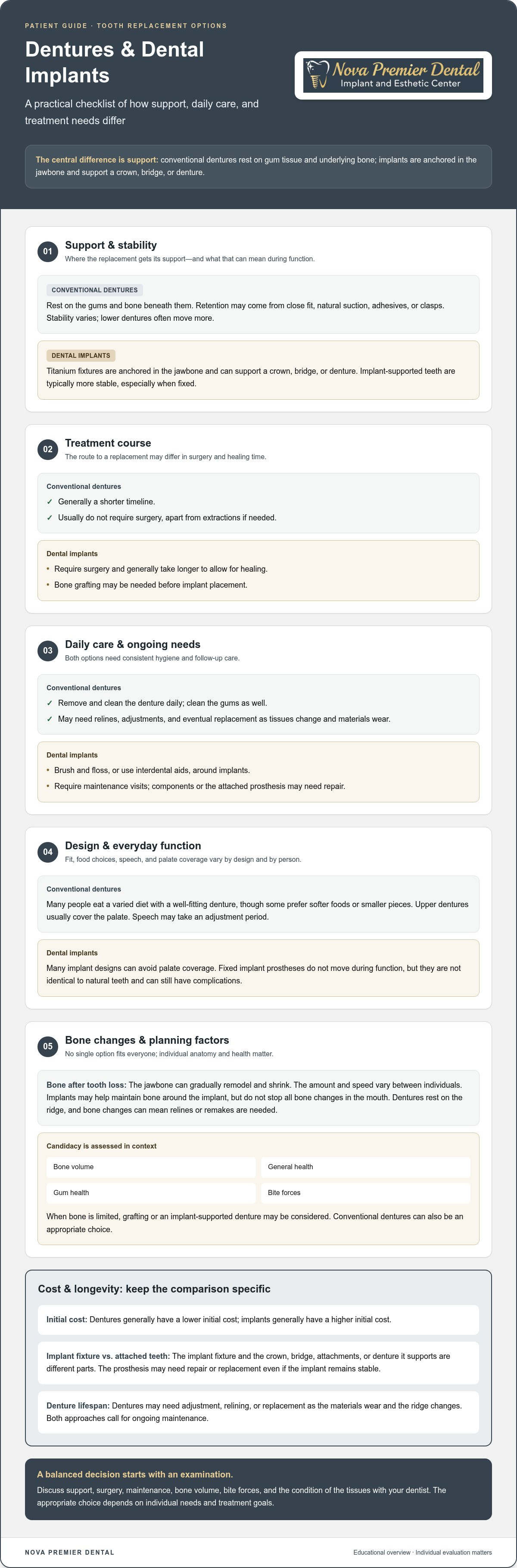
| Factor | Conventional Dentures | Dental Implants |
|---|---|---|
| Support | Gum tissue and bone; suction, adhesive, or clasps | Implants anchored in the jawbone |
| Surgery | Usually none, apart from extractions if needed | Required; may need grafting first |
| Timeline | Generally shorter | Generally longer, to allow healing |
| Chewing stability | Varies; lower dentures often move more | Typically more stable, especially when fixed |
| Palate coverage | Upper dentures usually cover the palate | Many implant designs can avoid palate coverage |
| Cleaning | Remove and clean daily; clean the gums | Brush and floss or use interdental aids around implants |
| Ongoing needs | Relines, adjustments, replacement | Maintenance visits; possible component or prosthesis repair |
| Initial cost | Generally lower | Generally higher |
Specific percentages for chewing efficiency vary between studies and patient groups, so we avoid quoting them here. In general, patients with stable implant-supported prostheses report easier chewing of firmer foods than with loose conventional dentures, though results differ from person to person.
Daily Function and Eating
A well-fitting denture lets many people eat a varied diet, though some choose softer foods or cut food into smaller pieces. Speech may require an adjustment period; our guide on speaking with dentures offers practical tips. Fixed implant prostheses do not move during function, which many patients find helpful, but they are not identical to natural teeth and can still experience complications.
Longevity and Maintenance
It is important to separate the implant fixture from what is attached to it. The fixture can remain in place for many years, but crowns, bridges, attachments, and dentures wear and may need repair or replacement. Conventional dentures also need replacement over time as materials wear and the ridge changes; our article on when to replace dentures describes the signs.
Implants still require careful home hygiene, since inflammation around them (peri-implant mucositis and peri-implantitis) can lead to bone loss. Dentures need daily cleaning, nightly removal as advised by your dentist, and periodic professional adjustment. Both options benefit from regular dental exams and cleanings. If a prosthesis breaks, emergency denture repair may be available.
Who Is a Candidate for Each Option?
Evaluation typically includes a medical history, oral examination, gum assessment, and 3D or other radiographic imaging to assess bone volume, nerve and sinus locations, and the space available for the prosthesis. Bite forces, grinding habits, and opposing teeth are also considered, since heavy parafunction can increase the risk of prosthetic complications. Our article on candidacy for dental implants covers this in more detail.
Systemic and lifestyle factors matter. Poorly controlled diabetes, smoking, certain medications, prior head and neck radiation, and untreated periodontal disease can affect healing and long-term implant health. These are risk factors to weigh, not automatic disqualifiers. Conventional dentures may be the better choice for patients who prefer to avoid surgery, have medical conditions that make surgery inadvisable, or want a shorter and less costly route.
When Bone Is Limited: Grafting and Sinus Lifts
Bone grafting adds bone material to a deficient area, and a sinus lift increases bone height in the upper back jaw. These procedures extend treatment by an amount that depends on the type of graft and your healing, so your timeline should be confirmed during planning. Alternatives include shorter or narrower implants where appropriate, or an implant-supported overdenture using fewer implants. Our oral reconstruction page describes related services.
Time, Cost, and Practical Considerations
Dentures can often be delivered within a series of appointments over a few weeks, while implant treatment commonly spans several months because of healing. Implants generally cost more initially, but total cost over time depends on maintenance, repairs, and replacement of prostheses for either option. A written treatment plan can help you compare. Nova Premier Dental offers in-house payment plans for qualifying patients, allowing treatment costs to be paid over several months.
When a Prosthodontic Evaluation May Help
Peterson Huang, DMD, MS, FACP, FRCDC, is a dentist and dual board-certified prosthodontist (United States and Canada) who leads Nova Premier Dental. Prosthodontists complete additional specialty training in complex restorative treatment. A specialist evaluation may be useful if you have:
- Extensive tooth loss or failing restorations in both arches
- Significant bone loss or a history of failed implants or dentures
- Severe tooth wear or questions about bite height
- Limited restorative space or unusual jaw relationships
- A history of head and neck cancer or other conditions affecting the mouth
Many straightforward cases are handled well by general dentists. For a comparison, see prosthodontist vs. general dentist.
Frequently Asked Questions
Which is more comfortable: dentures or dental implants?
Comfort varies. Implant-supported prostheses are typically more stable, which many patients find more comfortable, while well-fitted conventional dentures are comfortable for many others. Sore spots from dentures can usually be corrected with adjustments.
How much do dental implants cost compared to dentures?
Implants usually involve a higher initial cost than conventional dentures. Exact fees depend on the number of implants, any grafting, and the type of prosthesis, so a consultation and written plan are needed. Nova Premier Dental offers in-house payment plans for qualifying patients, allowing treatment costs to be paid over several months.
Can I switch from dentures to dental implants later?
Often, yes. If bone has resorbed over time, grafting or a different implant design may be needed, and your existing dentures can sometimes be converted or used as a guide for the new prosthesis.
How long does treatment take?
Dentures generally take weeks. Implants generally take months because the bone needs time to heal around them, and grafting adds time. Your dentist can give an estimate based on your case.
Do implants look more natural than modern dentures?
Both can look natural when well designed. Implant crowns emerge from the gum like natural teeth, and fixed prostheses avoid a visible denture base. Appearance depends on tooth shape, shade, gum contours, and lip support planning.
What if I don't have enough bone for implants?
Options may include bone grafting, sinus lifting, shorter or angled implants, or implant-supported overdentures. Conventional dentures remain an option when these are not suitable.
Why see a prosthodontist for implants?
A prosthodontist has additional training in planning and restoring complex cases, which can be helpful when many teeth, bite changes, or bone limitations are involved. General dentists also place and restore implants, and the right choice depends on case complexity.
If you have questions about tooth replacement or a complex restorative concern, Nova Premier Dental in Falls Church provides prosthodontic specialty care for patients throughout Northern Virginia. You can contact the office to arrange a consultation.
Disclaimer
The information provided on this website and blog is intended for general educational and informational purposes only and should not be considered dental or medical advice, diagnosis, or treatment. Reading content on this website does not establish a doctor-patient relationship with Nova Premier Dental or Dr. Peterson Huang. Dental conditions and treatment needs vary from patient to patient. Individuals should consult directly with a qualified dental professional for personalized evaluation, diagnosis, and treatment recommendations. Do not delay seeking professional dental care based on information found on this website. While we strive to provide accurate and up-to-date information, no guarantee is made regarding the completeness, accuracy, or applicability of the content. Treatment outcomes may vary depending on individual circumstances. If you are experiencing a dental emergency or urgent oral health concern, please contact a licensed dental professional immediately or call 911 in the event of a medical emergency.


