


Article by
Peterson Huang DMD, MS, FACP, FRCDC
Dr. Peterson Huang is a dual board-certified prosthodontist serving Falls Church and Northern Virginia. He has been recognized as a Top Prosthodontist by Northern Virginia Magazine and Arlington Magazine and is affiliated with the Inova Fairfax Hospital Tumor Board. Dr. Huang focuses on dental implants, full mouth reconstruction, and complex restorative dentistry for patients who need advanced, comprehensive care.
When evaluating tooth replacement options, comparing conventional removable prosthetics and implant-supported restorations involves understanding distinct clinical approaches. Selecting between these treatments requires balancing anatomical health, functional demands, personal medical history, and procedural timelines. General dentists routinely provide quality restorative care, including both dentures and implant restorations. However, patients presenting with extensive bone loss, complex bite relationships, or multi-unit edentulism often benefit from the diagnostic insight of a prosthodontic specialist. Understanding the dentures vs implants pros and cons provides an objective basis for deciding how best to restore oral function and aesthetics.
Dr. Peterson Huang, DMD, MS, FACP, FRCDC, is a dentist and dual board-certified prosthodontist certified in prosthodontics in both the United States and Canada. At Nova Premier Dental, our goal is to provide clear, evidence-based guidance on tooth replacement. This guide examines the mechanical differences, biological responses, diagnostic evaluations, procedural commitments, and ongoing maintenance associated with both conventional dentures and dental implants.
Key Takeaways
- Foundational Mechanics: Conventional dentures rest directly on the alveolar ridge and mucosal tissues, whereas dental implants rely on osseointegration to anchor directly into the jawbone.
- Alveolar Bone Health: Dental implants transfer functional occlusal loads into the alveolar bone, which can help preserve localized bone volume. Removable dentures do not stimulate deep bone and require periodic adjustments as the ridge naturally resorbs.
- Clinical Trade-Offs: Traditional dentures offer a non-surgical, adaptable treatment with lower initial costs. Implants require surgical planning and healing intervals, but they offer greater stability and do not rely on oral adhesives.
- Longevity Distinctions: Implant titanium fixtures often have high long-term survival rates, but the attached prostheses, crowns, and mechanical components still require routine maintenance, wear monitoring, and eventual replacement.
- Specialist Evaluation: Complex restorative cases involving severe resorption, interocclusal space limitations, or systemic health factors benefit from comprehensive diagnostic planning by a prosthodontist.
Dentures vs. Implants Pros and Cons: Defining the Restoration Path
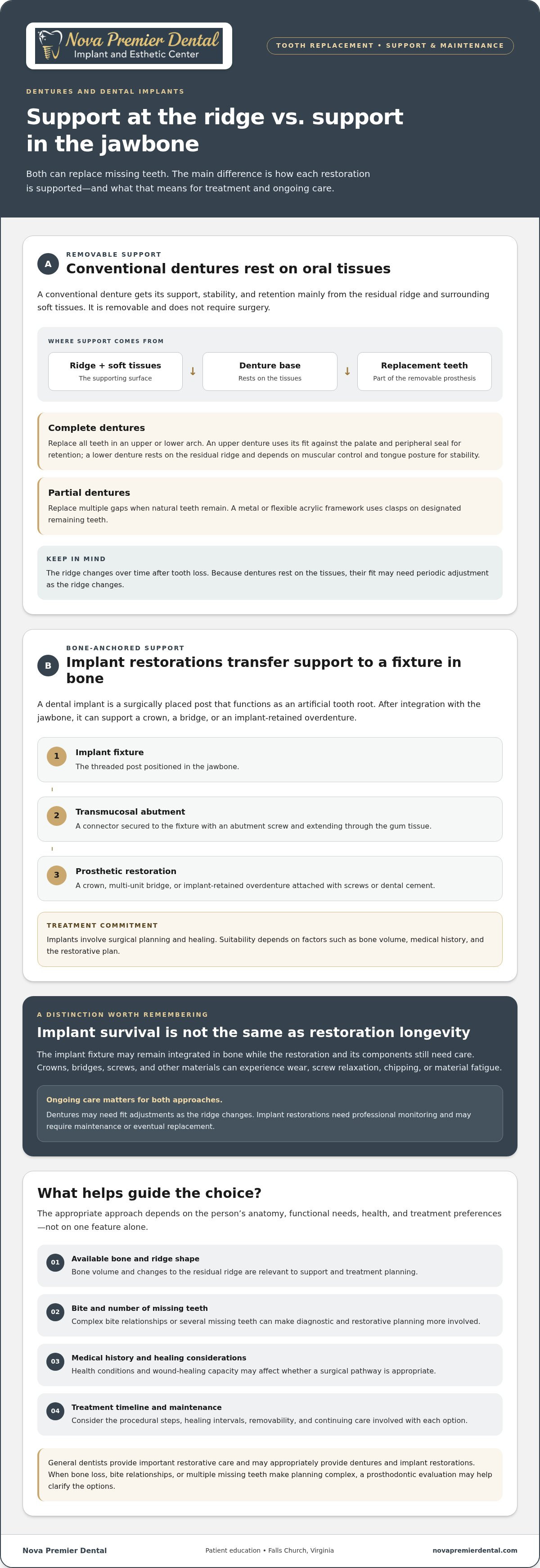
To evaluate the dentures vs implants pros and cons, one must first recognize the fundamental mechanical differences between the two modalities. Conventional dentures are removable prostheses designed to replace missing natural dentition and adjacent mucosal structures. They derive support, stability, and retention primarily from the underlying residual alveolar ridge, hard palate, and peripheral soft tissues.
In contrast, dental implants are biocompatible titanium or ceramic posts surgically positioned into the maxilla or mandible. They serve as artificial tooth roots that support individual crowns, fixed bridges, or complete overdentures. While both systems aim to restore chewing ability, phonetics, and smile appearance, their biological interfaces and clinical trajectories differ substantially.
The Role of Traditional Dentures in Modern Restorative Care
Conventional dentures remain a reliable, predictable option for many individuals experiencing extensive or complete tooth loss. They are broadly categorized into two forms:
- Complete Dentures: Indicated when all teeth across the maxillary (upper) or mandibular (lower) arch are absent. Maxillary dentures utilize peripheral seal and suction against the palate for retention, while mandibular dentures rest on the lower residual ridge, relying on muscular control and tongue posture for stability.
- Partial Dentures: Indicated when natural, healthy teeth remain in the arch. These prosthetics use a metal or flexible acrylic framework with mechanical clasps that anchor onto designated abutment teeth, filling multiple gaps while helping prevent remaining teeth from drifting.
A primary clinical benefit of conventional dentures and partial dentures is that they do not require surgical intervention. This non-invasive fabrication pathway makes them suitable for patients with unmanaged systemic conditions, compromised wound-healing capacity, or insufficient bone volume where grafting is not feasible. Modern prosthodontic techniques use cross-linked polymethyl methacrylate (PMMA) acrylics and layered composite or porcelain teeth to accurately reproduce natural gingival contours and tooth shades.
Dental Implants: Biological Integration and Structural Support
Dental implants rely on osseointegration, a physiological process first documented by Per-Ingvar Brånemark, wherein living osteoblasts deposit bone matrix directly onto the microscopic surface irregularities of a titanium fixture. This creates structural and functional ankylosis between living bone and a load-bearing implant.
A complete implant restoration generally consists of three distinct elements:
- The Implant Fixture: The threaded post embedded into the alveolar bone.
- The Transmucosal Abutment: A connector secured to the fixture using an abutment screw, protruding through the gum tissue.
- The Prosthetic Restoration: The definitive restoration, which may be a single crown, a multi-unit bridge, or an implant-retained overdenture, attached via retaining screws or dental cements.
It is clinically important to distinguish between implant survival (the continued mechanical integration and retention of the titanium post in bone) and prosthesis longevity. While implant fixtures demonstrate favorable long-term survival rates across clinical literature, the overlying restorative materials experience normal mechanical wear, screw relaxation, chipping, and material fatigue over time, necessitating long-term professional supervision.
Biological Impact: Bone Health and Jaw Structure Considerations
The alveolar bone is a tooth-dependent tissue. Its primary biological function is to support the roots of erupted teeth and distribute functional loads generated during mastication. Mechanotransduction—the conversion of mechanical strain into cellular biochemical signals—signals osteocytes to maintain local bone density and architecture.
When teeth are extracted or lost due to periodontal disease, this internal physiological loading ceases. Evaluating tooth replacement options requires careful consideration of how each modality interacts with residual alveolar bone over months and years.
Bone Resorption Patterns with Conventional Dentures
Following extraction, the residual alveolar ridge undergoes continuous and irreversible remodeling, a process known as residual ridge resorption (RRR). This physiological resorption occurs most rapidly during the first 6 to 12 months following tooth loss, but it continues at a gradual pace throughout life.
Because conventional dentures rest on the surface mucosa, they compress underlying soft tissues and transmit compressive forces across the bone surface rather than tensile forces within the bone trabeculae. Over extended periods, this external load can accelerate vertical and horizontal bone loss, especially on the narrower mandibular ridge. As bone volume decreases:
- Dentures gradually lose their baseline fit, leading to mechanical movement, food impaction, and mucosal sore spots.
- Periodic relines or tissue conditioning procedures become necessary to adjust the intaglio (inner) surface to the changing ridge.
- Extensive resorption over decades can lead to a reduced lower facial height (vertical dimension of occlusion), which may contribute to a more folded or compressed appearance of the perioral tissues.
Implants and Osseointegration: Load Transfer to Alveolar Bone
Dental implants transfer functional masticatory forces directly into the trabecular and cortical bone surrounding the fixture. This internal loading helps maintain local bone volume around the fixture, mitigating disuse atrophy in the immediate area. In clinical cases involving comprehensive oral reconstruction, strategically placed implants can help maintain localized ridge height and support surrounding facial contours.
However, implants do not prevent all forms of bone alteration. Peri-implant tissues remain vulnerable to biological complications such as peri-implant mucositis and peri-implantitis—an inflammatory lesion affecting the soft tissues and leading to progressive supporting bone loss around an osseointegrated fixture. Diligent oral hygiene, regular professional cleanings, and careful occlusal adjustment are essential to reduce the risk of biological complications.
Comprehensive Comparison: Function, Comfort, and Daily Maintenance
Restoring masticatory function, clear articulation, and patient comfort requires weighing the practical differences between removable and fixed restorations. Below is a clinical comparison of common restorative modalities for complete or partial tooth loss.
| Restoration Type | Support Mechanism | Stability & Retention | Maintenance Requirements | Surgical Requirement |
|---|---|---|---|---|
| Complete Denture | Mucosa and residual alveolar bone | Moderate (maxillary suction; mandibular muscular control) | Daily removal, soaking, mechanical cleaning; periodic relining | None (unless pre-prosthetic bone recontouring is needed) |
| Removable Partial Denture (RPD) | Mucosa and remaining natural abutment teeth | Mechanical retention via clasps; stable when well-designed | Removal after meals and nightly; plaque control around abutments | None (unless abutment restorations or extractions are indicated) |
| Implant-Supported Overdenture | Implants (locators/bar) and residual alveolar mucosa | High retention; minimizes lateral displacement during function | Nightly removal of overdenture; daily brushing around implant abutments | Surgical placement of 2 to 4 implants per arch |
| Fixed Implant Prosthesis | Rigidly anchored to osseointegrated implants | Fixed (non-removable by patient); functions like natural dentition | Interdental brushes, water flossers, specialized floss; periodic clinical checks | Surgical placement of 4 to 8 implants per arch; possible bone grafting |
Dietary and Functional Considerations
Masticatory performance varies significantly depending on the underlying support system:
- Conventional Dentures: Chewing efficiency with full dentures is naturally lower than with natural teeth due to mucosal mobility, absence of periodontal ligament proprioception, and reduced maximum bite force. Patients often need to cut fibrous, tough, or hard foods into smaller pieces and chew bilaterally to prevent dislodging the prosthetic base. Maxillary dentures also cover the hard palate, which can alter temperature sensation and tactile perception of food textures.
- Implant Restorations: Because implant fixtures are anchored in bone, they allow for higher functional loading. Patients with fixed implant prostheses or well-retained overdentures generally experience broader dietary flexibility, accommodating firmer foods without prosthesis displacement.
Phonetic adaptation also differs. Traditional dentures introduce a foreign acrylic volume across the palate or sublingual space, which can temporarily alter sibilant ("s", "z") or fricative ("f", "v") sounds until oral musculature adapts. Fixed implant prostheses minimize palatal coverage, generally shortening the phonetic adjustment period.
Maintenance, Prosthesis Longevity, and Long-Term Considerations
The daily care routines and long-term upkeep of each system involve distinct responsibilities:
Conventional Denture Maintenance: Removable prosthetics must be taken out at night to allow vascular relief to the mucosal tissues and prevent fungal colonization (such as denture stomatitis). They should be cleansed using a soft denture brush and non-abrasive cleanser, then submerged in water or mild soaking solutions. Because the residual ridge gradually remodels, conventional dentures typically require professional relining or replacement every 5 to 7 years to restore intimate adaptation to the tissue.
Implant Care and Component Upkeep: Implants require meticulous plaque management. Peri-implant tissues lack the complex periodontal ligament fibers that seal natural teeth, rendering the peri-implant pocket susceptible to bacterial infiltration. Patients with fixed prostheses must use specialized cleaning aids, such as superfloss, interproximal brushes, or oral irrigators, to clean beneath the prosthetic framework. Overdentures require replacement of internal retention nylon inserts (locator caps) periodically as mechanical friction wears down the components.
Determining Candidacy: Diagnostic Evaluation and Treatment Planning
Selecting the most appropriate restorative treatment requires a thorough clinical assessment. Evaluating whether a patient is a suitable candidate for conventional prostheses, implant-retained solutions, or fixed restorations involves detailed anatomical, systemic, and behavioral considerations.
A comprehensive dental exam forms the initial diagnostic foundation. In specialized prosthodontic evaluation, three-dimensional Cone Beam Computed Tomography (CBCT) imaging is utilized to evaluate:
- Alveolar Ridge Dimensions: Height, width, and morphological contours of available bone.
- Vital Anatomical Boundaries: Distance to the inferior alveolar nerve canal, mental foramina, and maxillary sinus floors.
- Bone Quality and Density: Assessing cortical thickness and trabecular architecture to guide implant sizing and surgical protocol.
- Interocclusal Restorative Space: Measuring the vertical distance between the opposing arch and the soft tissue to ensure sufficient space exists for prosthetic housings, framework thickness, and aesthetic materials.
Clinical Indications for Removable Dentures
Conventional complete or partial dentures remain the preferred or necessary treatment path under specific clinical circumstances:
- Severe Ridge Atrophy with Grafting Contraindications: Patients exhibiting profound resorption who are unwilling or medically unable to undergo extensive bone augmentations, sinus lifts, or nerve repositioning.
- Systemic Medical Risk Factors: Individuals with unmanaged endocrine disorders (such as uncontrolled diabetes), undergoing active bisphosphonate therapy for skeletal pathologies, or receiving head-and-neck radiation therapy, where surgical osseointegration failure or osteoradionecrosis presents elevated risk.
- Short-Term or Immediate Restoration: Transitional dentures used during active periodontal therapy or as immediate interim prostheses while extractions heal.
Clinical Indications and Evaluation for Dental Implants
Patients who present with healthy periodontium, favorable systemic health, and adequate alveolar bone are candidates for implant placement. Key diagnostic factors include:
- Periodontal and Caries Health: Active periodontal disease in remaining teeth must be controlled before implant placement to minimize pathogen transmission to peri-implant sites.
- Occlusal Relationships and Parafunction: Severe bruxism, clenching, or irregular bite relationships require careful management. Patients who grind their teeth exert high non-axial forces that can lead to mechanical complications, such as screw loosening, porcelain chipping, or prosthetic fracture, often necessitating protective night guards post-treatment.
- Smoking and Nicotine Use: Smoking impairs microvascular blood flow and wound healing, contributing to higher statistical rates of implant failure and peri-implant bone loss. Cessation protocols are discussed prior to planning surgical interventions.
Specialist Care and Restorative Planning at Nova Premier Dental
Managing extensive tooth replacement often crosses into complex clinical scenarios involving collapsed vertical dimension, uneven tooth wear, or severe tissue loss. In these situations, prosthodontic planning ensures that every phase of treatment—from initial extractions to final prosthesis delivery—is coordinated with precision.
The Role of Prosthodontic Specialty Care
A prosthodontist is a dental specialist who has completed three additional years of rigorous, accredited post-doctoral residency training dedicated to restoring and replacing teeth. While general dentists capably handle many restorative situations, complex cases involving full-mouth rehabilitation, severe ridge deficiencies, or failed prior restorations benefit from specialized prosthodontic expertise. Learn more about Dr. Peterson Huang and his background in managing advanced reconstructive cases.
At our Falls Church practice, prosthodontic treatment planning prioritizes functional stability and material compatibility. Treatment involves careful analysis of speech patterns, facial proportions, and temporomandibular joint movement to ensure the definitive restoration functions harmoniously within the masticatory system.
Treatment Costs and Financial Considerations
Evaluating treatment pathways involves reviewing both upfront costs and ongoing maintenance requirements. Conventional dentures generally carry lower initial expenses, but they involve recurring costs over time, including periodic soft relines, hard lab relines, tissue conditioners, and eventual replacement every several years.
Implants require a larger initial investment due to diagnostic CBCT imaging, surgical placement, possible grafting materials, precision abutments, and custom lab fabrication. To assist patients in managing restorative care, Nova Premier Dental offers in-house payment plans for qualifying patients, allowing treatment costs to be paid over several months while patients enjoy their new smile. Detailed treatment estimates and insurance benefit breakdowns are provided during diagnostic consultations to maintain complete transparency.
Securing Long-Term Oral Health and Function
The choice between conventional dentures and dental implants is not a simple either-or decision; it depends entirely on your anatomical framework, medical history, functional requirements, and personal goals. Conventional dentures remain an indispensable, non-surgical therapy that reliably restores aesthetic form and baseline function. Meanwhile, dental implants offer structural stability, local bone preservation, and restorations that function similarly to natural teeth.
Nova Premier Dental is a private prosthodontic specialty dental office in Falls Church serving Northern Virginia. If you are experiencing extensive tooth loss or struggling with an existing prosthesis, a comprehensive prosthodontic consultation can clarify your options and establish a clear plan tailored to your health. Contact our Falls Church office to schedule an evaluation with Dr. Peterson Huang and explore the most effective path forward for your smile.
Frequently Asked Questions
Are dental implants more painful than getting dentures fitted?
Denture fabrication is non-surgical, involving impressions, bite registrations, and try-in appointments without surgical incisions. However, new dentures often cause temporary mucosal irritation, pressure points, and sore spots as soft tissues adjust to the rigid base. Dental implant placement involves minor oral surgery performed under local anesthesia. Most patients report mild to moderate post-operative tenderness localized to the surgical site, which is typically managed for several days with over-the-counter or mild prescribed analgesics.
How long do traditional dentures last compared to dental implants?
Traditional dentures typically require replacement or laboratory relining every 5 to 7 years. This is not due to material failure alone, but because the underlying alveolar bone gradually resorbs, altering the fit and occlusal balance. Dental implant fixtures, when successfully osseointegrated and maintained with diligent oral hygiene, demonstrate high long-term survival rates. However, the prosthetic teeth, acrylic bases, abutment screws, or crowns attached to the implants will experience mechanical wear and may need maintenance, relining, or replacement over time.
Can I switch from dentures to implants later in life?
Yes, many patients who have worn conventional dentures transition to implant-supported overdentures or fixed bridges. However, extended denture wear often coincides with progressive bone resorption. In these cases, diagnostic CBCT scans are needed to assess remaining bone volume. If bone height or width is insufficient, pre-prosthetic bone grafting or sinus augmentation may be indicated before implants can be placed.
What is the success rate of dental implants for older adults?
Chronological age itself is not a contraindication to implant therapy. Clinical studies show that healthy older adults demonstrate implant osseointegration rates comparable to younger cohorts. Candidacy depends primarily on physiological health, controlled systemic conditions (such as stable cardiovascular status and controlled glycemic levels), and adequate bone architecture rather than age alone.
How do I clean implant-supported dentures vs. traditional ones?
Conventional dentures must be removed daily and brushed with a non-abrasive denture paste, then soaked overnight in water or a mild enzymatic cleanser. Removable implant overdentures also require daily removal and cleaning, alongside brushing around the exposed locator abutments and along the gumline. Fixed implant restorations cannot be removed by the patient and must be cleaned using interdental brushes, specialized dental floss designed for bridges, and water flossers to clean under the framework and around each implant fixture.
Does dental insurance typically cover dentures or implants?
Dental insurance coverage varies widely based on individual employer contracts and benefit plans. Many traditional insurance policies classify conventional dentures as a major restorative benefit, partially covering their fabrication. Coverage for dental implants has expanded in recent years, though some plans may provide benefits only for the overlying crown or prosthetic component rather than the surgical fixture itself. A detailed pre-treatment estimate submitted by our administrative team helps clarify out-of-pocket responsibilities.
What happens if a denture breaks unexpectedly?
If a conventional or implant denture fractures, chips, or loses an acrylic tooth, it should be evaluated professionally. Patients should not attempt do-it-yourself repairs with household adhesives, which can damage the acrylic resin and distort the intaglio surface, causing tissue irritation or improper bite alignment. We provide evaluations for emergency denture repair to inspect the fracture line, assess occlusal stresses that may have contributed to the break, and restore the prosthesis using laboratory-grade resins.
Disclaimer
The information provided on this website and blog is intended for general educational and informational purposes only and should not be considered dental or medical advice, diagnosis, or treatment. Reading content on this website does not establish a doctor-patient relationship with Nova Premier Dental or Dr. Peterson Huang. Dental conditions and treatment needs vary from patient to patient. Individuals should consult directly with a qualified dental professional for personalized evaluation, diagnosis, and treatment recommendations. Do not delay seeking professional dental care based on information found on this website. While we strive to provide accurate and up-to-date information, no guarantee is made regarding the completeness, accuracy, or applicability of the content. Treatment outcomes may vary depending on individual circumstances. If you are experiencing a dental emergency or urgent oral health concern, please contact a licensed dental professional immediately or call 911 in the event of a medical emergency.


