


Article by
Peterson Huang DMD, MS, FACP, FRCDC
Dr. Peterson Huang is a dual board-certified prosthodontist serving Falls Church and Northern Virginia. He has been recognized as a Top Prosthodontist by Northern Virginia Magazine and Arlington Magazine and is affiliated with the Inova Fairfax Hospital Tumor Board. Dr. Huang focuses on dental implants, full mouth reconstruction, and complex restorative dentistry for patients who need advanced, comprehensive care.
What if the most affordable way to replace a missing tooth today actually becomes your most expensive health liability over the next decade? Many patients visiting Nova Premier Dental feel a natural hesitation when evaluating the choice between a partial denture vs implant. It's understandable to feel self-conscious about gaps or frustrated by the inability to enjoy favorite foods. You might worry about restorations looking artificial or slipping at inconvenient moments, yet the decision involves more than just immediate aesthetics.
As a dual board-certified prosthodontist in Northern Virginia, Dr. Peterson Huang provides the specialized expertise necessary to navigate these complex reconstructive choices. This guide clarifies the clinical, financial, and lifestyle differences between these paths so you can protect your remaining healthy teeth. We'll examine how dental implants act as a biological investment in bone preservation while partial dentures offer a non-surgical alternative. You'll also learn how our in-house payment plans help you manage the total cost of ownership over ten years, ensuring your long-term oral health remains a priority.
Key Takeaways
- Understand why dental implants offer nearly 100% of natural chewing power compared to the functional limitations of removable appliances.
- Evaluate the partial denture vs implant debate through the lens of bone preservation and the long-term protection of your adjacent healthy teeth.
- Learn how systemic health factors and lifestyle preferences determine whether a multi-month implant journey or a faster denture solution is clinically appropriate.
- Discover how in-house payment plans allow you to manage the investment in high-end oral reconstruction over several months while enjoying your new smile.
- Recognize the clinical value of a dual board-certified prosthodontist in achieving a restoration that balances functional beauty with meticulous precision.
Fundamentals of Tooth Replacement: Partial Dentures vs. Dental Implants
Choosing to restore your smile at Nova Premier Dental involves more than filling a gap; it requires a deep understanding of how the upper and lower teeth interact. The primary objective of any oral reconstruction is to re-establish proper occlusion and prevent the remaining teeth from shifting into the empty space. When a tooth is lost, the surrounding bone begins to resorb, and neighboring teeth often tilt toward the vacancy. Choosing between a partial denture vs implant requires a balanced evaluation of your long-term functional goals and clinical needs.
At our practice, Dr. Peterson Huang utilizes his perspective as a dual board-certified prosthodontist in Northern Virginia to guide this selection process. His advanced training allows him to diagnose the underlying structural needs of the jaw, ensuring that whichever restoration you choose supports the health of your entire mouth. This specialized diagnostic approach differentiates a high-end restorative plan from a standard general dental service.
How Partial Dentures Work
A removable partial denture (RPD) is a traditional appliance designed to replace one or several missing teeth. These restorations typically consist of replacement teeth attached to a gum-colored acrylic base. In many cases, a precision-milled metal framework provides additional rigidity and strength. The device stays in place using specialized metal or tooth-colored clasps that "anchor" onto your existing healthy teeth. Because they don't require surgery or bone grafting, RPDs are often viewed as a non-invasive entry point for patients seeking immediate functional restoration. However, they rely heavily on the strength of the anchor teeth to remain stable during chewing.
The Anatomy of a Dental Implant
A dental implant is a sophisticated, three-part system designed to mimic the entire structure of a natural tooth. The process begins with a titanium post that acts as a prosthetic root. Through a biological process called osseointegration, this post forms a permanent bond with your jawbone. Once stable, an abutment is attached to the post, which finally supports a custom-made dental crown. Unlike dentures, implants function independently. They don't require support from neighboring teeth, which preserves the integrity of your remaining natural dentition. This independence is a significant factor when weighing the benefits of a partial denture vs implant for long-term health.
Stability and Longevity: A Clinical Comparison
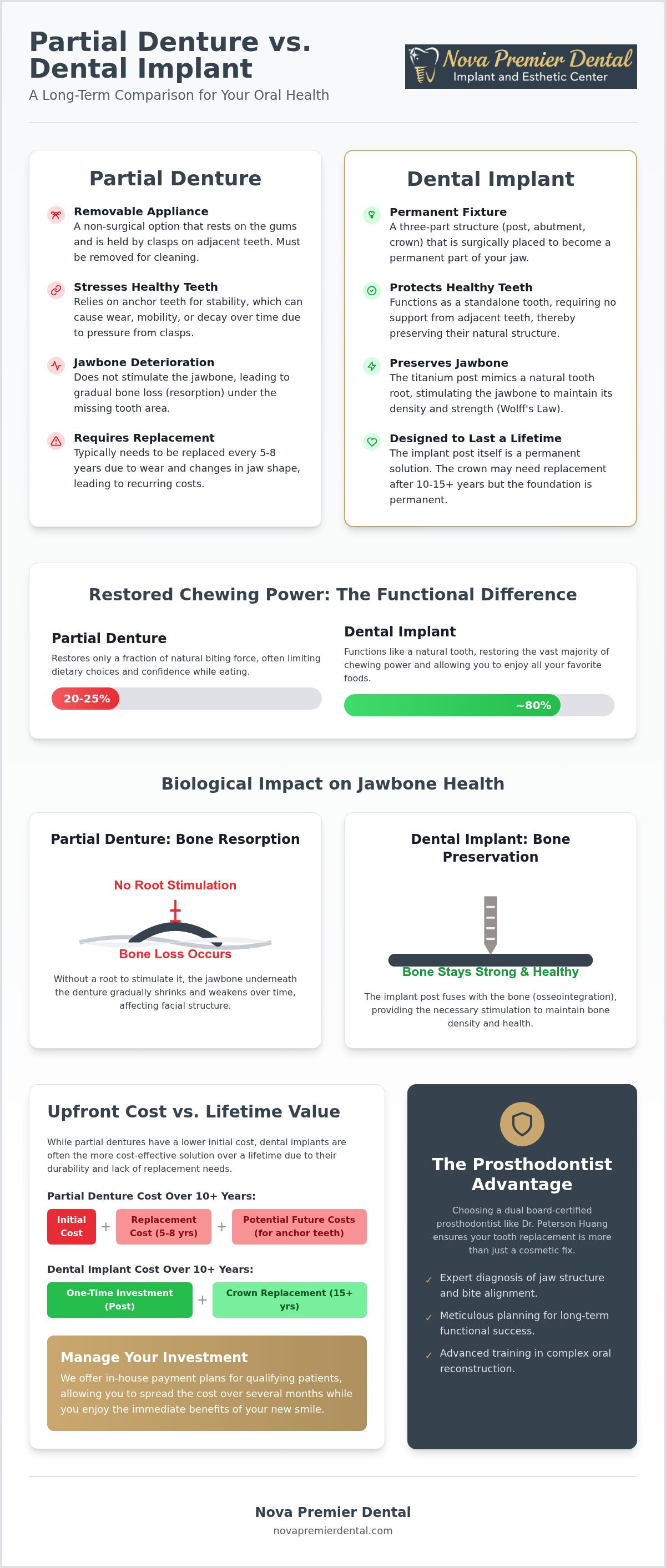
The clinical performance of a partial denture vs implant is most evident during the simple act of eating. Research indicates that removable appliances typically restore only 20 to 25 percent of natural biting force. In contrast, dental implants can restore nearly 80 percent of natural chewing power because they transfer energy directly into the maxillary or mandibular bone. This difference isn't just about comfort; it's about the long-term survival of your remaining dentition.
Partial dentures rely on anchor teeth for stability. These neighboring teeth endure significant lateral stress from the metal clasps, which can eventually lead to tooth mobility or increased decay risk. Choosing an implant-based oral reconstruction avoids this neighboring tooth burden entirely. While a partial denture typically requires replacement every 5 to 8 years due to wear and fit changes, the titanium post of a dental implant is designed to last a lifetime with proper care. This makes the long-term maintenance of a partial denture vs implant a critical factor in your decision.
The Biological Impact on Jawbone Health
A critical clinical concept known as Wolff’s Law explains that bone remains healthy and dense only when it is regularly stimulated. Natural tooth roots provide this stimulation. When you choose a dental implant, the titanium post mimics this root, signaling the body to maintain bone density in that area. Conversely, dentures rest on top of the gums. Without internal stimulation, the jawbone begins a process of resorption, or melting away. This bone loss can eventually lead to a sunken facial appearance and make future restorative work more complex. If you are concerned about existing bone loss, you might consider scheduling a specialized evaluation at our Falls Church practice.
Stability in Daily Life
Daily function involves more than just chewing. Fixed implants provide total stability during speech, eliminating the clicking or shifting sounds sometimes associated with removable frames. Patients with partial dentures often find certain foods, such as raw vegetables or crusty breads, difficult to manage. Implants remove these dietary restrictions, allowing for a diverse and nutritious diet. Beyond physical function, the psychological security of knowing your teeth are permanent and non-removable provides a level of social confidence that removable options often struggle to match. This peace of mind is why many patients prefer the expertise of a prosthodontist in Northern Virginia when seeking a permanent solution.
Candidacy and Lifestyle: Which Option Fits You?
Selecting the most appropriate restoration involves a meticulous evaluation of your systemic health and personal priorities. At Nova Premier Dental, we consider factors like healing capacity, which can be influenced by conditions such as uncontrolled diabetes or long-term smoking. These elements are critical when deciding on a partial denture vs implant, as they directly impact the success of surgical integration. Your body's ability to recover is the primary clinical guide for any long-term restorative plan.
The timeline for these procedures varies significantly. A partial denture offers nearly immediate gratification, often completed in just a few weeks. In contrast, the implant journey is a multi-month process that prioritizes biological stability over speed. If your jawbone has thinned due to long-term tooth loss, a bone graft for dental implant may be required to create a robust foundation. This specialized step ensures that even patients with significant resorption can eventually enjoy the benefits of a permanent tooth replacement through a comprehensive oral reconstruction.
When a Partial Denture is the Right Choice
A removable appliance is often the most prudent choice for patients where surgery is contraindicated due to complex medical histories. In some cases, Dr. Peterson Huang may recommend a partial denture as a transitional tool. This allows for functional restoration while other areas of the mouth are being treated or while we plan for future tooth loss. The non-invasive nature and rapid delivery make it an excellent short-term or specialized long-term solution for specific clinical profiles where surgical intervention isn't ideal.
When an Implant is the Superior Solution
Dental implants are the premier choice for replacing a single tooth when the surrounding teeth are perfectly healthy. This approach avoids placing stress on neighbors with denture clasps or metal frames. Active individuals often prefer implants because they don't require the daily maintenance of adhesives or specialized soaking solutions. For those seeking a restoration that feels indistinguishable from a natural tooth, the expertise of a prosthodontist in Northern Virginia ensures the final result is both functionally superior and aesthetically seamless. It's the closest science can get to giving you your natural tooth back.
The Investment Perspective: Upfront Costs vs. Lifetime Value
Analyzing the financial commitment of a partial denture vs implant requires looking beyond the initial invoice. In the Northern Virginia market, the upfront cost of a removable appliance is lower than a single tooth implant. However, this initial price tag is only the beginning of the story. Partial dentures involve ongoing expenses that many patients overlook, including specialized cleaning solutions, adhesives, and periodic professional relines to adjust for bone resorption. These maintenance costs accumulate steadily over the years.
Over a 20 year horizon, the "Total Cost of Ownership" often shifts in favor of the implant. A high quality dental implant post is designed to last a lifetime, with only the crown needing replacement after 15 to 20 years of normal wear. Conversely, a partial denture typically requires full replacement every 5 to 8 years. When you factor in three or four replacements plus the recurring maintenance fees, the permanent solution becomes a more predictable and often more economical financial choice for long term oral health.
Managing the Cost of Excellence
We believe that financial considerations shouldn't stand in the way of receiving the highest standard of care. At Nova Premier Dental, we offer in-house payment plans for qualifying patients. These arrangements allow you to spread the cost of your treatment over several months. This flexibility ensures you can manage the investment comfortably while already enjoying the functional and aesthetic benefits of your new smile. Our administrative team also works closely with you to maximize any available insurance benefits for your restorative procedures.
The Value of a Specialist’s Precision
The true value of a restoration is found in its longevity and the absence of "failure costs." Choosing a board-certified prosthodontist like Dr. Peterson Huang ensures that your treatment plan is engineered with mathematical precision. His dual board certification signifies a level of expertise that reduces the risk of complications or the need for early revisions. When weighing a partial denture vs implant, investing in specialist level care means you are paying for a restoration that looks, feels, and functions correctly from day one. To discuss how these long term savings apply to your specific case, you can contact our Falls Church office for a professional consultation.
The Nova Premier Advantage: Why a Prosthodontist Matters
A prosthodontist is a specialist dedicated to the replacement and restoration of teeth. Think of them as the architects of a smile. While general dentistry focuses on routine maintenance and prevention, prosthodontics involves the intricate engineering of complex oral systems. At Nova Premier Dental, this expertise is elevated by Dr. Peterson Huang. He holds dual board certifications, a distinction that represents the pinnacle of clinical excellence. This means he's met the rigorous standards of two separate medical boards, proving his mastery of both the surgical and restorative phases of care. This background is essential when weighing a partial denture vs implant; it ensures the final restoration is designed with a comprehensive understanding of both mechanical function and facial aesthetics. You aren't just getting a replacement tooth; you're receiving a medically engineered solution.
Advanced Oral Reconstruction in Falls Church
Our practice serves patients from Falls Church, McLean, and Arlington who require more than a standard appliance. We utilize state-of-the-art digital scanners and 3D imaging to ensure precise implant placement, which significantly reduces the risk of long-term complications. For those choosing dentures, we prioritize custom-shading and artistic contouring. This ensures your restoration disappears into your smile rather than looking like a generic prosthetic. This meticulous attention to detail is particularly vital during a full mouth reconstruction. In complex cases, we coordinate every aspect of the bite to prevent jaw joint strain and premature wear on the new restorations.
Your Path to a Restored Smile
The journey begins with a detailed consultation where we listen to your lifestyle goals and clinical concerns. We don't believe in one-size-fits-all solutions. Instead, we engage in a collaborative process to determine if a partial denture vs implant is the superior choice for your unique biological profile. You'll receive an individualized treatment plan that outlines every step of the restorative process, including a clear breakdown of how our in-house payment plans can help manage the investment. By partnering with a prosthodontist in Northern Virginia, you're choosing a path toward functional beauty and a lifetime of oral health. We invite you to take the first step toward reclaiming your smile and your confidence with a team that values perfectionism.
Secure Your Future Smile Today
The decision between a partial denture vs implant ultimately depends on your clinical needs and long-term lifestyle goals. While removable appliances provide a rapid and non-invasive solution for missing teeth, dental implants offer a permanent biological replacement that protects your jawbone and provides near-natural chewing power. Understanding the total cost of ownership over a decade reveals that the investment in stability often outweighs the convenience of a temporary fix.
At Nova Premier Dental, we are dedicated to helping patients across Falls Church, McLean, Arlington, and Fairfax achieve functional beauty. Led by dual board-certified prosthodontist Dr. Peterson Huang, our team provides the meticulous precision your reconstruction deserves. We offer in-house payment plans for qualifying patients, allowing you to manage the cost of care over several months while you're already enjoying the benefits of your new smile. You don't have to navigate these complex health decisions alone. We invite you to schedule your specialized consultation with Dr. Huang to discover which restorative path is right for you. Your journey toward a confident, healthy smile starts with a single expert conversation.
Frequently Asked Questions
Why would a dentist recommend partial dentures instead of implants?
Clinicians often recommend partial dentures when systemic health concerns, such as uncontrolled diabetes or heavy smoking, might impede the osseointegration required for implants. Additionally, if a patient has insufficient bone volume and chooses to avoid grafting procedures, a removable appliance provides a non-surgical alternative. This choice allows for immediate functional restoration while ensuring the patient's overall health isn't compromised by invasive procedures that their body may not be equipped to handle.
Can I switch from a partial denture to an implant later on?
Switching from a partial denture vs implant is a common clinical pathway, though it often requires a preliminary bone graft. Because dentures don't stimulate the jawbone, the bone in the gap area naturally resorbs over time. Before an implant can be placed, Dr. Peterson Huang must ensure there's enough density to support the titanium post. He evaluates these cases carefully to rebuild the foundation necessary for a successful transition.
Is the surgery for dental implants painful for older patients?
Dental implant surgery is a highly controlled, minimally invasive procedure that is well-tolerated by patients of all ages. We utilize precise local anesthesia to ensure comfort during the placement. Most patients report that the recovery is comparable to a simple tooth extraction. Systemic health and healing capacity are more significant factors than chronological age. Our prosthodontist in Northern Virginia prioritizes a gentle approach to ensure every patient feels secure.
How long do partial dentures typically last before needing replacement?
Removable partial dentures typically have a service life of 5 to 8 years before they require a full replacement. Over this period, the acrylic teeth and base endure significant wear from daily chewing. As the underlying jawbone changes shape, the appliance will lose its precision fit, leading to discomfort or instability. Routine professional evaluations are necessary to determine when a reline or a completely new restoration is clinically required for your long-term health.
Will a partial denture damage my remaining natural teeth?
Partial dentures can place unintended stress on your remaining natural teeth. The metal clasps used for stability can act as plaque traps, increasing the risk of localized decay if hygiene isn't meticulous. The lateral forces exerted on "anchor" teeth during chewing can eventually lead to tooth mobility. This is a primary reason why many patients eventually transition to implants, which function independently without relying on the support of neighboring healthy dentition.
How do I clean a dental implant compared to a partial denture?
A dental implant is maintained exactly like a natural tooth through daily brushing and flossing. There are no specialized adhesives or soaking solutions required. In contrast, partial dentures must be removed every night and cleaned with a non-abrasive brush and a specialized cleanser. They also require soaking to keep the material hydrated. This difference in maintenance is often a deciding factor for active patients seeking a seamless, low-maintenance addition to their daily routine.
Does insurance cover dental implants or partial dentures more often?
Most PPO insurance plans categorize partial dentures as "major" services, typically covering approximately 50 percent of the cost. Coverage for dental implants is less consistent; while many plans cover the prosthetic crown, they may exclude the surgical post. To help manage any remaining balance, Nova Premier Dental offers in-house payment plans for qualifying patients. These plans allow you to distribute the investment over several months while enjoying your restored smile.
What happens if I don’t replace a missing tooth at all?
Failing to replace a missing tooth triggers a bone loss cascade and structural shifting. Neighboring teeth often tilt into the vacant space, disrupting your occlusion and potentially leading to TMJ disorders. The lack of stimulation causes the jawbone to resorb, which can eventually alter your facial aesthetics and cause a sunken appearance. Timely intervention with a partial denture vs implant prevents these long-term complications and preserves the integrity of your entire oral system.
Disclaimer
The information provided on this website and blog is intended for general educational and informational purposes only and should not be considered dental or medical advice, diagnosis, or treatment. Reading content on this website does not establish a doctor-patient relationship with Nova Premier Dental or Dr. Peterson Huang. Dental conditions and treatment needs vary from patient to patient. Individuals should consult directly with a qualified dental professional for personalized evaluation, diagnosis, and treatment recommendations. Do not delay seeking professional dental care based on information found on this website. While we strive to provide accurate and up-to-date information, no guarantee is made regarding the completeness, accuracy, or applicability of the content. Treatment outcomes may vary depending on individual circumstances. If you are experiencing a dental emergency or urgent oral health concern, please contact a licensed dental professional immediately or call 911 in the event of a medical emergency.


