


Article by
Peterson Huang DMD, MS, FACP, FRCDC
Dr. Peterson Huang is a dual board-certified prosthodontist serving Falls Church and Northern Virginia. He has been recognized as a Top Prosthodontist by Northern Virginia Magazine and Arlington Magazine and is affiliated with the Inova Fairfax Hospital Tumor Board. Dr. Huang focuses on dental implants, full mouth reconstruction, and complex restorative dentistry for patients who need advanced, comprehensive care.
A denture that feels loose, has cracked, or has started to cause sore spots raises a practical question: can it be repaired, or does it need to be replaced? The answer depends on what has changed. Sometimes the denture itself is damaged. In other cases the denture is intact, but the gums and jawbone beneath it have changed shape. This guide explains how to tell the difference, what each option involves, and when a prosthodontic evaluation may help. It is written by Nova Premier Dental, a private prosthodontic specialty dental office in Falls Church serving Northern Virginia.
Key Takeaways
- Repair generally suits localized damage, such as a chipped tooth, a clean crack in the base, or a broken clasp, in a denture that otherwise fit well.
- A reline adjusts the fit of the tissue-side surface when the gums have changed. It is a separate procedure from repair.
- Replacement is usually considered when the fit, bite, or material condition can no longer be corrected with repair or reline.
- Persistent looseness often reflects changes in the gums and jawbone rather than a defect in the denture, so a clinical evaluation is more reliable than a visual guess.
- Implant-supported options exist for patients who want more stability, though they involve surgery, cost, and ongoing maintenance.
Denture Repair vs. Replacement: What Is the Difference?
A denture repair restores a specific mechanical problem without making a new appliance. Examples include reattaching a tooth, joining a fractured base, or replacing a clasp. A replacement means fabricating a new denture, which involves new impressions, bite records, try-in appointments, and a laboratory process.
The decision between denture repair vs replacement is not only about the visible damage. It also depends on how well the denture still fits your mouth, how it distributes bite forces, and the condition of the acrylic and teeth. A prosthodontist, a dentist with additional specialty training in replacing teeth, evaluates these factors together. Many general dentists also repair and reline dentures competently, and for straightforward problems that is often entirely appropriate. For more complex situations, such as several prior repairs, bite changes, or questions about implants, a prosthodontic evaluation in Northern Virginia can add useful diagnostic detail. Our comparison of prosthodontists and general dentists explains when each may be the right choice.
Delaying evaluation of a poorly fitting denture is not always harmful, but a loose appliance can concentrate pressure on small areas of gum, which may cause sores. It can also make chewing less comfortable. A cracked denture can also lengthen over time if used, which may turn a simple repair into a more complicated one.
How Long Dentures Typically Last
There is no single lifespan for dentures. Acrylic bases and teeth wear with chewing, cleaning, and time, while the gums and bone under the denture change at different rates in different people. Dentures are commonly reassessed every several years, but the right timing depends on fit, wear, hygiene, and any changes in your health. If you are not sure how old your denture is or how it has held up, an examination is a better guide than a calendar. Our article on when to replace dentures covers this in more detail.
Why Home Repairs Are Not Recommended
Household glues, including super glue, are not designed for use in the mouth. Some contain chemicals that are not intended for prolonged contact with oral tissue, and they can leave residue that makes a later professional repair harder. A misaligned home repair can also change the fit of the denture and irritate the gums. If a denture breaks, keep all the pieces, avoid wearing it if the edges are sharp, and have it assessed. Store-bought adhesives and reline kits may be used temporarily by some patients, but they are not a substitute for a clinical assessment.
When Denture Repair Is a Reasonable Choice
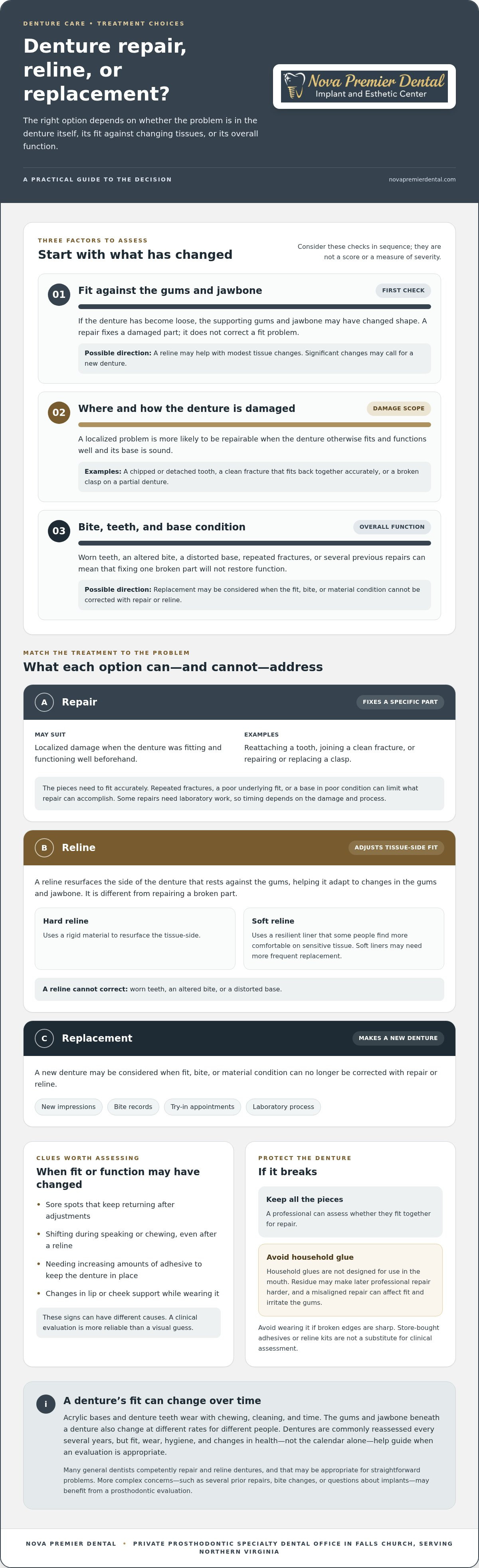
Repair is generally a reasonable option when the denture was fitting and functioning well before a specific event, such as being dropped, and the damage is localized. In that situation, the underlying fit has not changed, so restoring the broken part may be enough.
Repairs typically involve joining the fractured pieces or bonding a replacement tooth with denture-grade resin. Some repairs can be completed quickly, while others require laboratory work. Timing depends on the type of damage and the laboratory process involved. If you need prompt help, Nova Premier Dental provides emergency denture repair. We also describe the process in our guide to same-day denture repair, though availability depends on the nature of the damage.
Common Repairable Scenarios
- Chipped or detached denture teeth: A tooth can often be replaced or reshaped if the base is sound.
- A single, clean fracture in the base: A break that fits back together accurately may be joined and reinforced.
- Bent or broken clasps on a partial denture: Clasps can often be adjusted or replaced, although repeated bending of metal can weaken it.
Repair is less likely to be successful when the denture has fractured repeatedly, when pieces do not fit together precisely, or when the underlying fit was already poor. In those cases, a repair may restore the shape but not the function.
Repair vs. Reline: What Is the Difference?
A repair fixes broken parts. A reline resurfaces the tissue-side of the denture so it adapts to gums and bone that have changed. A hard reline uses a rigid material, while a soft reline uses a resilient liner that some patients find more comfortable on sensitive tissue. Soft liners may need more frequent replacement. How often a reline is needed varies by patient, and the American Dental Association notes that dentures may need to be adjusted, relined, or remade as the mouth changes (ADA oral health topics: dentures).
A reline can improve fit, but it cannot correct worn teeth, an altered bite, or a base that has become distorted. If a reline would only postpone a larger problem, replacement may be the more practical path.
Signs That a New Denture May Be Needed
Looseness is often assumed to be a repair issue, but it more commonly reflects changes in the supporting tissues. After teeth are lost, the jawbone ridge can gradually reduce in size, and the rate varies between individuals. As the ridge changes, a denture made to the earlier shape no longer fits closely. A reline can compensate for modest change, but significant change may call for a new denture.
Fit and Comfort Indicators
- Sore spots that keep returning after adjustments
- A denture that shifts during speaking or chewing even after a reline
- Needing increasing amounts of adhesive to keep the denture in place
- Changes in how your lips and cheeks are supported when the denture is in
Changes in appearance around the mouth can be associated with worn teeth or changes in bite height, but they have several possible causes, including natural aging, so they are a reason for evaluation rather than a diagnosis by themselves. For more on this topic, see our article on facial changes and collapsed bites.
Condition of the Denture Itself
- Multiple prior repairs: Repeated repairs can leave a base that is uneven or less reliable.
- Worn teeth: Teeth that have flattened may chew less efficiently. Wear can also change the bite relationship, which a clinician evaluates as part of the assessment.
- Porosity, staining, or odor: Acrylic is slightly porous, and over time it can absorb stains and odors that professional cleaning does not fully remove.
- Poor aesthetics: A new denture allows tooth size, shape, and shade to be reconsidered.
Persistent sores, white patches, or areas that do not heal should be examined promptly, since they are not always caused by the denture. Dr. Peterson Huang, DMD, MS, FACP, FRCDC, is a dentist and prosthodontist certified in both the United States and Canada, and his training and background are described on his profile page.
Implant-Supported Alternatives to Conventional Dentures
Conventional dentures remain a well-established option. They are removable, non-surgical, and can be adjusted or replaced as the mouth changes. Their main tradeoffs are that they rest on the gums, so stability and chewing comfort depend on the shape of the ridge. Some patients find that this limits their comfort over time.
Dental implants are another option. They are titanium or ceramic posts placed in the jawbone that can support a prosthesis. Implants may help maintain bone in the area where they are placed and can improve stability, but they do not prevent all bone change, and not every patient is a candidate. Placement requires surgery, healing time, and adequate bone and health. You can read more in our dental implants overview or our guide Am I a Candidate for Dental Implants?
Implant Overdentures and Fixed Full-Arch Options
An implant-supported overdenture attaches a removable denture to a small number of implants, typically with snap-type attachments. It generally offers more retention than a conventional denture, and the denture can be removed for cleaning. The attachments wear and need periodic replacement.
A fixed full-arch prosthesis, including approaches such as All-on-4, is secured to implants and is not removed by the patient. It requires careful planning of implant position, the space available for the prosthesis, and the patient's bite forces. Fixed prostheses need professional maintenance, and complications can include loosening of screws, wear or fracture of the prosthetic material, and hygiene challenges beneath the prosthesis. Our pages on permanent dentures describe this approach further.
Comparing Costs and Longevity
Cost comparisons depend on the individual plan, so a general figure would not be reliable. Several points are useful to consider instead:
- Conventional dentures usually cost less initially but may need relines, repairs, and eventual remaking.
- Implant treatment involves a higher initial cost and surgical care.
- Implant survival and prosthesis longevity are different things. An implant may remain in place for many years while the denture, crown, or attachments on it wear and need repair or replacement.
- Outcomes vary with oral hygiene, bite forces, general health, and tobacco use.
Nova Premier Dental offers in-house payment plans for qualifying patients, allowing treatment costs to be paid over several months.
What a Prosthodontic Denture Evaluation Includes
An evaluation for a broken or poorly fitting denture usually involves reviewing your symptoms and history, examining the denture and the soft tissues, and assessing the fit, bite, and appearance. Your clinician may also look at the condition of the bone, any remaining teeth, and whether implants might be an option. Records such as impressions, photographs, or imaging may be used when planning a new prosthesis.
Prosthodontists receive additional training in complex tooth replacement, which can be helpful when several factors are involved, for example, worn teeth, prior failed restorations, or the need to coordinate implants with a full-arch prosthesis. This does not mean a specialist is needed for every denture problem, and many routine repairs and relines are handled well in general practice. Our page on oral reconstruction describes how more extensive treatment is planned. Patients can also view before and after examples, though results vary between individuals.
If you have questions about a denture repair or replacement, contact Nova Premier Dental in Falls Church, which provides prosthodontic specialty care for patients throughout Northern Virginia.
Frequently Asked Questions
How much does it cost to repair a broken denture?
Cost depends on the type of damage, the materials, and whether laboratory work is required. A single tooth replacement is typically simpler than a multiple fracture or a clasp on a partial denture. A fee can be given after the denture is examined. Dental insurance may apply to some services, and our insurance and benefits page has more information.
Can I fix a broken denture with super glue?
This is not recommended. Household adhesives are not intended for use in the mouth, may irritate tissue, and can interfere with a later professional repair. If the denture breaks, keep all pieces and have it examined.
How long does a denture repair take?
It varies. Some repairs can be completed in a short appointment, while others need laboratory time. Please contact the office to ask about current timing for your situation.
Will insurance cover a repair or a replacement?
Coverage differs between plans. Many plans have frequency limits and waiting periods for replacement dentures, and repairs and relines may be categorized differently. Checking your plan's details or asking the office to help verify benefits is the most reliable approach.
Is being fitted for a new denture painful?
Impressions and try-in appointments are generally not painful. New dentures can cause sore spots or a period of adjustment as the tissues and muscles adapt, and follow-up adjustments are a normal part of the process. See our guide on caring for new dentures for what to expect.
How do I know if my jawbone has changed enough to need a new denture?
Signs that suggest change include looseness that returns soon after a reline, recurring sore spots, and increasing reliance on adhesive. Only a clinical examination, sometimes with imaging, can confirm whether the supporting tissues have changed enough that a new denture is the better option.
Are payment options available for a replacement denture?
Nova Premier Dental offers in-house payment plans for qualifying patients, allowing treatment costs to be paid over several months.
Disclaimer
The information provided on this website and blog is intended for general educational and informational purposes only and should not be considered dental or medical advice, diagnosis, or treatment. Reading content on this website does not establish a doctor-patient relationship with Nova Premier Dental or Dr. Peterson Huang. Dental conditions and treatment needs vary from patient to patient. Individuals should consult directly with a qualified dental professional for personalized evaluation, diagnosis, and treatment recommendations. Do not delay seeking professional dental care based on information found on this website. While we strive to provide accurate and up-to-date information, no guarantee is made regarding the completeness, accuracy, or applicability of the content. Treatment outcomes may vary depending on individual circumstances. If you are experiencing a dental emergency or urgent oral health concern, please contact a licensed dental professional immediately or call 911 in the event of a medical emergency.


