


Article by
Peterson Huang DMD, MS, FACP, FRCDC
Dr. Peterson Huang is a dual board-certified prosthodontist serving Falls Church and Northern Virginia. He has been recognized as a Top Prosthodontist by Northern Virginia Magazine and Arlington Magazine and is affiliated with the Inova Fairfax Hospital Tumor Board. Dr. Huang focuses on dental implants, full mouth reconstruction, and complex restorative dentistry for patients who need advanced, comprehensive care.
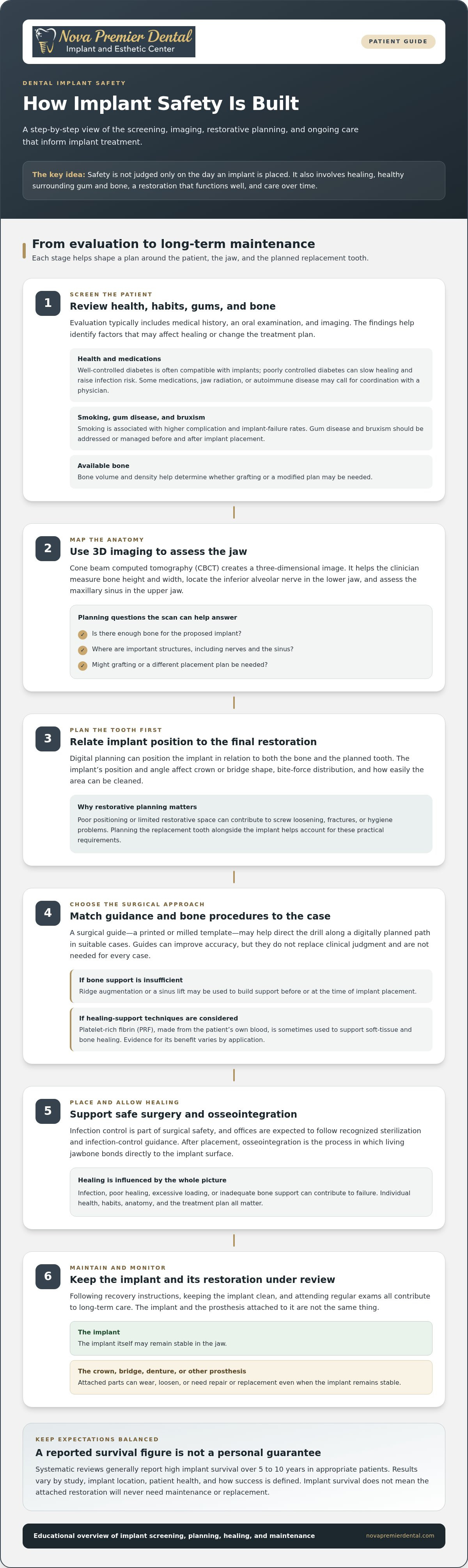
Dental implant surgery is a well-established procedure with high reported implant survival in appropriate candidates, but safety depends on more than the statistic. It depends on careful patient screening, accurate imaging, thoughtful planning of the final tooth, sound surgical technique, and long-term maintenance. This guide explains what contributes to a safe dental implant surgery, what the risks are, how technology such as 3D imaging is used, and when specialist evaluation may be helpful.
At Nova Premier Dental, a private prosthodontic specialty dental office in Falls Church serving Northern Virginia, implant treatment is planned around the final restoration. Dr. Peterson Huang, DMD, MS, FACP, FRCDC, is a dentist and dual board-certified prosthodontist (certified in prosthodontics in the United States and Canada). You can read about Dr. Huang's training and background on his bio page.
Key Takeaways
- Implant survival is generally high in healthy, well-screened patients, but individual results vary with health, habits, bone, and maintenance.
- Three-dimensional (CBCT) imaging and guided planning help identify nerves, sinuses, and bone volume before surgery.
- Implant surgery is performed by many qualified providers, including general dentists, periodontists, and oral surgeons. A prosthodontist's added training is in restoring and replacing teeth, which may be useful in complex cases.
- Following recovery instructions, keeping the implant clean, and attending regular exams all affect long-term outcomes.
What Makes Dental Implant Surgery Safe?
Safe implant surgery means the implant is placed with minimal risk to surrounding structures, heals successfully, and can be restored and maintained over time. Success is not measured only on the day of placement. It also includes healthy gum and bone tissue around the implant and a restoration that functions well.
Published systematic reviews generally report high implant survival over 5 to 10 years in appropriate patients. These figures vary by study, implant location, patient health, and how success is defined, so they should not be read as a guarantee for any individual. It is also important to separate the survival of the implant itself from the lifespan of the crown, bridge, denture, or other prosthesis attached to it. Prosthetic parts can wear, loosen, or need repair or replacement even when the implant remains stable.
Compared with a fixed bridge, an implant-supported crown does not require reshaping adjacent teeth, and the implant may help preserve bone locally at the tooth site. Bridges and conventional dentures remain reasonable options in many situations, and the right choice depends on your health, anatomy, preferences, and budget.
The Biological Foundation of a Safe Implant
Osseointegration is the process by which living jawbone bonds directly to the implant surface, which is what allows the implant to support chewing forces. Implants are made from biocompatible materials, most commonly titanium and, in some designs, zirconia. True allergic-type rejection is uncommon. Failures are more often related to infection, poor healing, excessive loading, or inadequate bone support.
Identifying the Ideal Candidate for Surgery
Screening before surgery reduces avoidable complications. It typically includes a medical history, oral examination, and imaging. Factors that affect planning include:
- Diabetes: well-controlled diabetes is often compatible with implants, while poorly controlled diabetes can slow healing and raise infection risk.
- Smoking: reduces blood flow and is associated with higher rates of complications and implant failure.
- Bone volume and density: may require grafting or a modified plan.
- Medications and conditions: such as certain bone-affecting drugs, radiation to the jaws, or autoimmune disease, which may call for coordination with your physician.
- Gum disease and bruxism: should be addressed or managed before and after implant placement.
For more detail, see Am I a Candidate for Dental Implants?
How Imaging and Digital Planning Reduce Surgical Risk
Cone beam computed tomography (CBCT) produces a three-dimensional image of the jaws. Unlike a flat two-dimensional X-ray, it lets the clinician measure bone height and width, locate the inferior alveolar nerve in the lower jaw, and assess the position of the maxillary sinus in the upper jaw. These details help determine whether an implant can be placed safely, where, and whether grafting is needed.
Precision Through 3D Digital Workflows
With CBCT data, the implant position can be planned digitally in relation to both the bone and the planned tooth. A surgical guide, a printed or milled template, can then help direct the drill along the planned path. Guides can improve accuracy in suitable cases, but they do not remove the need for clinical judgment, and not every case requires one. Read more about surgical guides and why implant position matters.
Planning from the final tooth backward is central to prosthodontic reasoning. The position and angle of the implant affect how the crown or bridge can be shaped, how bite forces are distributed, and how easily the area can be cleaned. Poor position or limited restorative space can contribute to screw loosening, fractures, or hygiene problems. See common causes of implant restoration failure.
Innovations in Bone Grafting and Tissue Management
When bone is insufficient, procedures such as ridge augmentation or sinus lift may be used to build support before or at the time of implant placement. Autologous concentrates such as platelet-rich fibrin (PRF), made from the patient's own blood, are sometimes used to support soft-tissue and bone healing, though evidence for their benefit varies by application. Less invasive techniques may reduce discomfort in some cases, but the best approach depends on the defect and the patient.
Infection control is also part of surgical safety. Offices are expected to follow recognized sterilization and infection-control guidance, such as that published by the Centers for Disease Control and Prevention.
Who Should Place and Restore Dental Implants?
Many implants are placed and restored successfully by general dentists, periodontists, and oral and maxillofacial surgeons. Experience, training, and the complexity of the case matter more than title alone. There is no direct evidence that a particular specialty guarantees a better outcome than another qualified clinician.
A prosthodontist is a dentist who has completed an additional accredited residency focused on restoring and replacing teeth, including complex implant-supported prostheses, full-arch treatment, and cases involving bite problems or significant tooth loss. Specialist evaluation may be helpful when:
- several or all teeth are being replaced;
- there is significant bone loss, tooth wear, or a history of failed restorations;
- restorative space is limited or the bite is unstable;
- the patient has had head and neck radiation or other complicating medical factors.
Ask any provider how many similar cases they treat, how they plan the restoration, what happens if a complication arises, and who will provide follow-up care. Our comparison, prosthodontist vs. general dentist, explains this further.
Specialist vs. General Dentist: A Comparison
| Consideration | General dentist | Prosthodontist |
|---|---|---|
| Typical role | Preventive care and routine restorations; many provide implant restorations or placement | Specialty care in restoring and replacing teeth, often for complex cases |
| Additional training | Dental school; optional continuing education | Accredited postgraduate specialty residency |
| Common fit | Single-tooth or straightforward cases | Multiple implants, full-arch, bite or wear concerns, failed prior treatment |
| Coordination | May refer surgical or complex portions | May place implants or coordinate with a surgeon or periodontist |
Bite Forces, Alignment, and Peri-Implantitis
Peri-implantitis is an inflammatory disease around an implant that can lead to bone loss. Its main driver is bacterial plaque, and risk is higher with a history of periodontitis, smoking, and poor cleaning access. Restoration design that allows effective hygiene, along with a balanced bite, is one factor that may help reduce risk. Bruxism (clenching or grinding) can increase stress on implant components and porcelain, but it is a risk factor to manage rather than a certain cause of failure.
Preparation, Surgery Day, and Recovery
A pre-surgical consultation generally includes a medical review, examination, CBCT imaging, discussion of tooth-replacement options, and a plan for sedation or anesthesia if needed. Share all medications and supplements, and let the team know if you have heart, bone, or immune conditions.
The Day of Surgery: Safety Protocols
Local anesthesia is used for implant placement, with optional sedation depending on the patient and procedure. Vital signs are monitored when sedation is used. Afterward you receive written instructions; our after dental implant surgery instructions cover details.
In general, expect some swelling, mild bleeding, and soreness over the first several days, often controlled with medications your clinician recommends. Contact the office if you notice:
- fever or swelling that worsens after the first few days;
- bleeding that does not slow with gentle pressure;
- pain that increases rather than eases;
- numbness or tingling that persists beyond the expected anesthetic period;
- a loose implant or restoration, or pus or bad taste at the site.
Ensuring Long-Term Success and Stability
Healing and osseointegration commonly take a few months, though timing varies with bone quality, location, and whether grafting was done. Some patients receive a temporary tooth earlier, and the final restoration is placed only once the implant is judged stable. During healing, follow dietary guidance, usually soft foods and avoiding pressure on the site.
Over the long term, home care and professional maintenance matter. Regular dental exams and cleanings allow monitoring of gum health, bone levels on X-rays, and the condition of the restoration. A custom night guard may be recommended for patients who clench or grind. If a crown loosens, see why implant crowns come loose.
Treatment Planning for Complex Implant Cases
Complex cases are planned by considering the patient's anatomy, bite, and the type of final restoration before surgery is scheduled. Photographs of completed cases can help patients understand typical results; see our before and after gallery. Individual results differ.
Nova Premier Dental offers in-house payment plans for qualifying patients, allowing treatment costs to be paid over several months.
Summary
Safe implant surgery relies on thorough screening, three-dimensional imaging, planning that starts from the final restoration, appropriate surgical technique, and lifelong maintenance. No provider can guarantee an outcome, but understanding the process helps you ask better questions. If you have questions about a complex restorative or prosthodontic concern, Nova Premier Dental in Falls Church provides prosthodontic specialty care for patients throughout Northern Virginia.
Frequently Asked Questions
Are dental implants safe for seniors with bone loss?
Age alone is not a contraindication. What matters is general health, medications, healing capacity, and the amount of available bone. Bone grafting, sinus lifts, or shorter or angled implants may be options in some cases. Our page on implant considerations for seniors has more information.
How painful is the dental implant surgery recovery?
Discomfort varies. Many patients describe it as manageable, with soreness and swelling that are most noticeable in the first few days. Recovery depends on the number of implants, whether grafting was done, and individual healing. Follow your clinician's medication guidance.
What are the most common risks of dental implant surgery?
Risks include infection, bleeding, delayed healing, nerve irritation or injury, sinus complications in the upper jaw, and implant failure to integrate. Later risks include peri-implantitis and mechanical problems with the restoration. Imaging and careful planning can reduce some of these risks but cannot eliminate them.
How long does it take for a dental implant to be considered stable?
Osseointegration commonly takes several months, but timing depends on bone quality, location, and the protocol used. Stability is confirmed clinically and sometimes radiographically before the final restoration is placed.
Can my body reject a dental implant?
Immune-type rejection of titanium is rare. Implants more often fail because of infection, lack of integration, overload, or smoking-related healing problems. Allergy to titanium is uncommon; tell your clinician if you have known metal sensitivities.
How do I know if my dentist is qualified to perform implant surgery?
Ask about their implant-specific training, how many cases similar to yours they have treated, and how complications are handled. Many general dentists, periodontists, oral surgeons, and prosthodontists are qualified. For complex or full-arch treatment, a team approach or specialist referral may be appropriate.
What is the success rate of dental implants?
Systematic reviews report high implant survival at 5 to 10 years in appropriate patients, but rates differ by study, patient factors, and implant location. Ask your clinician how these figures apply to your situation. Crowns and other prostheses may need maintenance or replacement sooner than the implant itself.
Are there any long-term side effects of dental implants?
Implants are not associated with systemic side effects in most patients. The main long-term concerns are peri-implant inflammation, bone loss around the implant, and wear or loosening of the restoration. Good home care, regular professional monitoring, and management of grinding habits can help reduce these risks.
Disclaimer
The information provided on this website and blog is intended for general educational and informational purposes only and should not be considered dental or medical advice, diagnosis, or treatment. Reading content on this website does not establish a doctor-patient relationship with Nova Premier Dental or Dr. Peterson Huang. Dental conditions and treatment needs vary from patient to patient. Individuals should consult directly with a qualified dental professional for personalized evaluation, diagnosis, and treatment recommendations. Do not delay seeking professional dental care based on information found on this website. While we strive to provide accurate and up-to-date information, no guarantee is made regarding the completeness, accuracy, or applicability of the content. Treatment outcomes may vary depending on individual circumstances. If you are experiencing a dental emergency or urgent oral health concern, please contact a licensed dental professional immediately or call 911 in the event of a medical emergency.


