


Article by
Peterson Huang DMD, MS, FACP, FRCDC
Dr. Peterson Huang is a dual board-certified prosthodontist serving Falls Church and Northern Virginia. He has been recognized as a Top Prosthodontist by Northern Virginia Magazine and Arlington Magazine and is affiliated with the Inova Fairfax Hospital Tumor Board. Dr. Huang focuses on dental implants, full mouth reconstruction, and complex restorative dentistry for patients who need advanced, comprehensive care.
If you view a dental implant as merely an expensive tooth replacement, you are missing the most critical part of the equation. It is natural to wonder are dental implants worth it when faced with significant upfront costs, especially if you have struggled with the daily frustration of avoiding your favorite foods or hiding your smile. Many patients at Nova Premier Dental come to us after realizing that traditional dentures, which often slip or feel bulky, cannot provide the permanence or confidence they desire for their oral health.
We understand that you want a restorative solution that functions much like your natural teeth. This guide offers a clinical and financial overview to help you decide whether implants fit your long-term health goals. As a dual board-certified prosthodontist in Northern Virginia, Dr. Peterson Huang plans each case around the final restoration. We offer in-house payment plans for qualifying patients. Below we cover benefits, longevity, cost, risks, maintenance, and alternatives.
Key Takeaways
- Are dental implants worth it? For suitable candidates they can offer significant long-term value, but the answer depends on health, anatomy, complexity, cost, and maintenance.
- An implant fixture may last many years, while crowns, bridges, and attachments may need repair or replacement over time.
- Bridges, removable partial dentures, complete dentures, and waiting are all reasonable options in certain situations.
- Risks such as peri-implantitis, screw loosening, and failed integration are reduced, not eliminated, by careful planning and ongoing follow-up.
- Nova Premier Dental offers in-house payment plans for qualifying patients.
Evaluating the Long-Term Value of Dental Implants
The short answer: for many suitable candidates, implants offer significant long-term value, though the upfront cost is higher than most alternatives. Patients often feel "sticker shock," yet the cost is best weighed over many years, alongside maintenance and the eventual repair or replacement of the restoration. At Nova Premier Dental, Dr. Peterson Huang, a prosthodontist in Northern Virginia, evaluates each case individually.
What Makes a Dental Implant Unique?
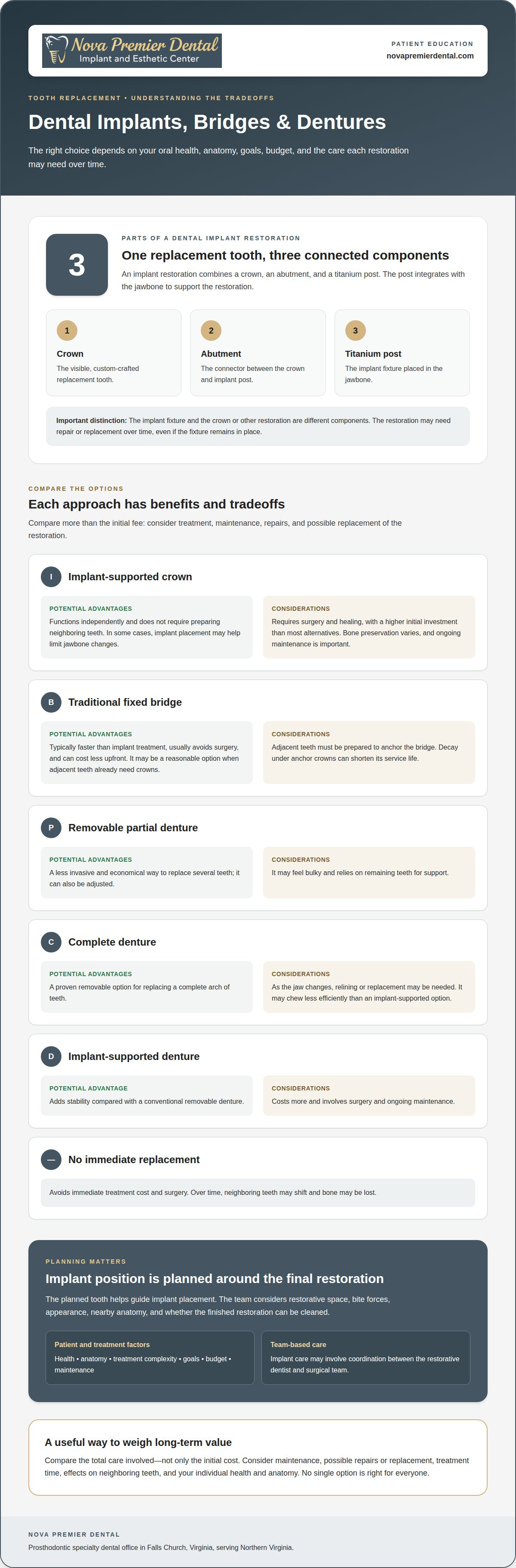
A dental implant is the only restorative option that replaces both the visible crown and the underlying root. This structure consists of a biocompatible titanium post, an abutment, and a custom-crafted crown. For a comprehensive overview of dental implants, it's helpful to understand osseointegration. This is the biological process where the jawbone physically fuses with the titanium post, creating a foundation as stable as a natural tooth. Because they function independently, implants don't require the grinding down of healthy neighboring teeth, a common requirement for traditional fixed bridges. This independence preserves your remaining natural dentition and simplifies long-term maintenance.
The Lifestyle Impact of Permanent Restoration
Compared with certain removable alternatives, implant-supported restorations can improve chewing function, stability, comfort, and confidence. Some patients no longer need adhesives or nightly soaking. These benefits vary by patient, and implants are not the best choice for everyone. Learn more about dental implants and oral reconstruction.
The Biological ROI: How Implants Protect Your Jawbone and Facial Structure
When a tooth is lost, the jawbone no longer receives stimulation from natural biting forces, and bone can gradually shrink in height and width. Implants placed in the jaw transmit chewing forces to bone and may help limit this change in some cases. This is one factor in deciding whether are dental implants worth it for you.
Bone preservation varies by patient, and other options may be appropriate when bone, health, or budget limit implant treatment. Nova Premier Dental offers in-house payment plans for qualifying patients.
Preventing Facial Collapse and Premature Aging
As the jawbone resorbs, the lower face can lose support, and lips and cheeks may look thinner. Preserving bone with implants may help support facial contours in selected cases. Evaluating options soon after tooth loss gives you more choices, since bone volume is easier to work with early.
Traditional fixed bridges typically involve preparing the adjacent teeth to serve as anchors, which is acceptable when those teeth already need crowns. An implant can preserve adjacent teeth in selected cases and helps prevent neighboring teeth from drifting into the gap. If you are weighing your options, you may want to schedule a clinical evaluation.
Implants vs. Bridges and Dentures
Selecting a tooth replacement involves more than upfront fees. To judge are dental implants worth it, compare total cost over time, including maintenance, repairs, and replacement of the restoration. Each option below has genuine advantages.
Implants vs. Fixed Bridges
A traditional bridge is typically faster, usually avoids surgery, and can cost less upfront. Its drawbacks are that adjacent teeth must be prepared, and decay under anchor crowns can shorten its service life. An implant crown avoids preparing neighboring teeth but requires surgery, healing time, and a higher initial investment. Our restorative dentistry guide offers more detail.
Implants vs. Removable Dentures
Removable partial dentures are the least invasive and most economical way to replace several teeth and are easily adjusted, but they can feel bulky and rely on remaining teeth for support. Complete dentures are a proven option, though they may need relines or replacement as the jaw changes and may chew less efficiently than implant-supported options. Implant-supported dentures, including permanent dentures, add stability but cost more and require surgery and maintenance. Choosing no immediate replacement avoids cost and surgery, but neighboring teeth may shift and bone may be lost over time.
Dr. Peterson Huang reviews each of these options with patients so the choice reflects health, anatomy, goals, and budget.
Why Does Implant Position Matter?
Prosthodontists receive advanced training in restoring and replacing missing teeth, including complex implant-supported restorations. Their expertise can be especially valuable in cases involving multiple missing teeth, challenging occlusion, esthetic concerns, or full-mouth rehabilitation. Outcomes depend on patient health, surgical planning, restorative design, and maintenance. Implant care is often interdisciplinary, and general dentists and surgical specialists contribute essential skills. For complex cases, see our full-mouth rehabilitation approach.
Why a Specialist is the Architect of Your Smile
Restoration-driven planning starts with the final tooth and works backward. Implant position relative to the planned restoration, available restorative space, occlusion, esthetics, nearby anatomy, and how easily the patient can clean the result all guide placement. Dr. Peterson Huang plans with the surgical team so these factors are settled before surgery.
Advanced Technology and Surgical Precision
We use 3D CT imaging and computer-generated surgical guides to help plan placement and avoid structures such as nerves and sinuses. Planning and follow-up reduce risks but do not eliminate them. To discuss your plan, schedule a consultation with our team.
Investing in Your Smile at Nova Premier Dental: Specialist Care and Flexible Options
At Nova Premier Dental, we recognize that treatment is both a clinical and a financial decision. Our Falls Church practice, led by Dr. Peterson Huang, evaluates each patient individually. Total cost depends on the number of teeth, any supplemental procedures such as bone grafting, and the restoration chosen.
Making Specialized Care Accessible in Northern Virginia
Our practice serves patients from McLean, Great Falls, Arlington, and throughout Northern Virginia. Care begins with a comprehensive evaluation and imaging to map your anatomy, followed by a personalized plan.
For your first consultation, bring a list of current medications and any previous dental records. Feel free to ask about materials, healing timelines, and how the restoration will be matched to your natural teeth. We invite you to schedule a consultation to discuss your options.
Securing the Future of Your Oral Health
For suitable candidates, implants provide significant long-term value. The right choice depends on individual health, anatomy, complexity, cost, and maintenance, and a comprehensive clinical evaluation is the best way to decide among implants, bridges, dentures, or waiting.
Dr. Peterson Huang, our prosthodontist in Northern Virginia, welcomes questions at Nova Premier Dental in Falls Church, Virginia. You are welcome to schedule a consultation whenever you are ready.
Frequently Asked Questions
How long do dental implants actually last?
The implant fixture can function for many years, but no implant is guaranteed to last a lifetime. The crown, bridge, or attachments on top often need repair or replacement sooner, and longevity depends on hygiene, professional maintenance, bite forces, and overall health. Compare this with fixed bridges, which also need periodic care.
Is the dental implant procedure painful?
Most patients report that the surgical phase is remarkably comfortable due to the use of advanced local anesthetics and optional sedation. The jawbone itself has very few pain-sensing nerves, making the placement of the post less invasive than many expect. Post-operative discomfort is typically manageable with over-the-counter medication and subsides within a few days. Our team at Nova Premier Dental prioritizes a steady, reassuring environment to minimize patient anxiety.
What is the success rate of dental implants for smokers?
Smoking is a recognized risk factor for implant complications, including impaired healing and peri-implantitis. Periodontal disease and some medical conditions also raise risk. During your consultation with Dr. Peterson Huang, we will discuss how your health history affects planning.
Can I get dental implants if I have significant bone loss?
Bone loss can limit implant treatment, but bone grafting or sinus augmentation may help in some cases. Whether it is appropriate depends on your anatomy and health, and alternatives exist when it is not.
How much do dental implants cost in Northern Virginia?
The total investment for dental implants in Northern Virginia depends on the number of teeth being replaced and the need for preparatory surgeries like bone grafting. Because every case is highly individualized, we provide a detailed cost breakdown during your clinical evaluation. To help make this elite level of care accessible, we offer in-house payment plans for qualifying patients, allowing you to manage payments over several months while enjoying your new teeth.
What happens if a dental implant fails?
If an implant fails to integrate or becomes infected, it may need to be removed and the site allowed to heal. Depending on the cause, a new implant may be possible after treatment. Careful planning and follow-up reduce risk but cannot eliminate it.
Are dental implants covered by dental insurance?
Many dental insurance plans now offer partial coverage for implants, typically categorizing them as a major restorative service. While coverage often covers up to 50 percent of the procedure, annual maximums and waiting periods may apply. Our administrative team works closely with you to maximize your available benefits. For any remaining balance, our practice provides in-house payment plans for qualifying patients to ensure your care remains a comfortable financial reality.
How do I care for my dental implants after the procedure?
Brush twice daily, clean between the teeth daily, and attend routine cleanings and exams. Implants cannot decay, but the surrounding tissue can develop peri-implant mucositis, which can progress to peri-implantitis if untreated. Prosthetic parts can also wear, loosen, or fracture, and grinding (bruxism) adds stress, so long-term professional maintenance is necessary.
Disclaimer
The information provided on this website and blog is intended for general educational and informational purposes only and should not be considered dental or medical advice, diagnosis, or treatment. Reading content on this website does not establish a doctor-patient relationship with Nova Premier Dental or Dr. Peterson Huang. Dental conditions and treatment needs vary from patient to patient. Individuals should consult directly with a qualified dental professional for personalized evaluation, diagnosis, and treatment recommendations. Do not delay seeking professional dental care based on information found on this website. While we strive to provide accurate and up-to-date information, no guarantee is made regarding the completeness, accuracy, or applicability of the content. Treatment outcomes may vary depending on individual circumstances. If you are experiencing a dental emergency or urgent oral health concern, please contact a licensed dental professional immediately or call 911 in the event of a medical emergency.


