


Article by
Peterson Huang DMD, MS, FACP, FRCDC
Dr. Peterson Huang is a dual board-certified prosthodontist serving Falls Church and Northern Virginia. He has been recognized as a Top Prosthodontist by Northern Virginia Magazine and Arlington Magazine and is affiliated with the Inova Fairfax Hospital Tumor Board. Dr. Huang focuses on dental implants, full mouth reconstruction, and complex restorative dentistry for patients who need advanced, comprehensive care.
What a Prosthodontist Does for Denture Patients
Short answer: A prosthodontist is a dentist who has completed additional accredited specialty training in replacing missing teeth and restoring complex bite and jaw problems. Many people with dentures are treated well by general dentists. A prosthodontist is one option that may be especially useful when the case is complicated, such as a long-standing ill-fitting denture, significant bone loss, or a plan that involves implants.
Prosthodontics is a specialty recognized by the American Dental Association. It involves the diagnosis, planning, and rehabilitation of patients with missing or damaged teeth. Prosthodontic residency programs are accredited and typically add about three years of training after dental school. Training covers complete and partial dentures, implant-supported prostheses, crowns and bridges, and reconstruction after trauma, disease, or cancer treatment.
General dentists provide essential preventive and restorative care, and many make dentures and restore implants appropriately. The difference is in the scope of training, not in whether one is "good" and the other is not. For a straightforward case, a general dentist may be entirely suitable. For readers deciding between the two, our article on prosthodontist vs. general dentist covers the question in more detail.
Dr. Huang's Training and Credentials
Dr. Peterson Huang (Peterson Huang, DMD, MS, FACP, FRCDC) is a dentist and dual board-certified prosthodontist, with prosthodontic certification in both the United States and Canada. He practices at Nova Premier Dental, a private prosthodontic specialty dental office in Falls Church that serves Northern Virginia, including patients from Arlington.
When Specialist Evaluation May Be Worth Considering
- Dentures that have never fit comfortably despite several adjustments or remakes
- Substantial jawbone loss that makes a lower denture hard to keep stable
- Planning for implant-supported dentures or a fixed full-arch prosthesis
- Worn teeth, a changed bite, or jaw joint symptoms alongside tooth loss
- A history of cancer treatment or surgery affecting the mouth or jaw
Credentials are one factor. Distance, scheduling, and comfort with the clinician also matter, and the right choice depends on the complexity of your situation.
Types of Dentures and Related Options
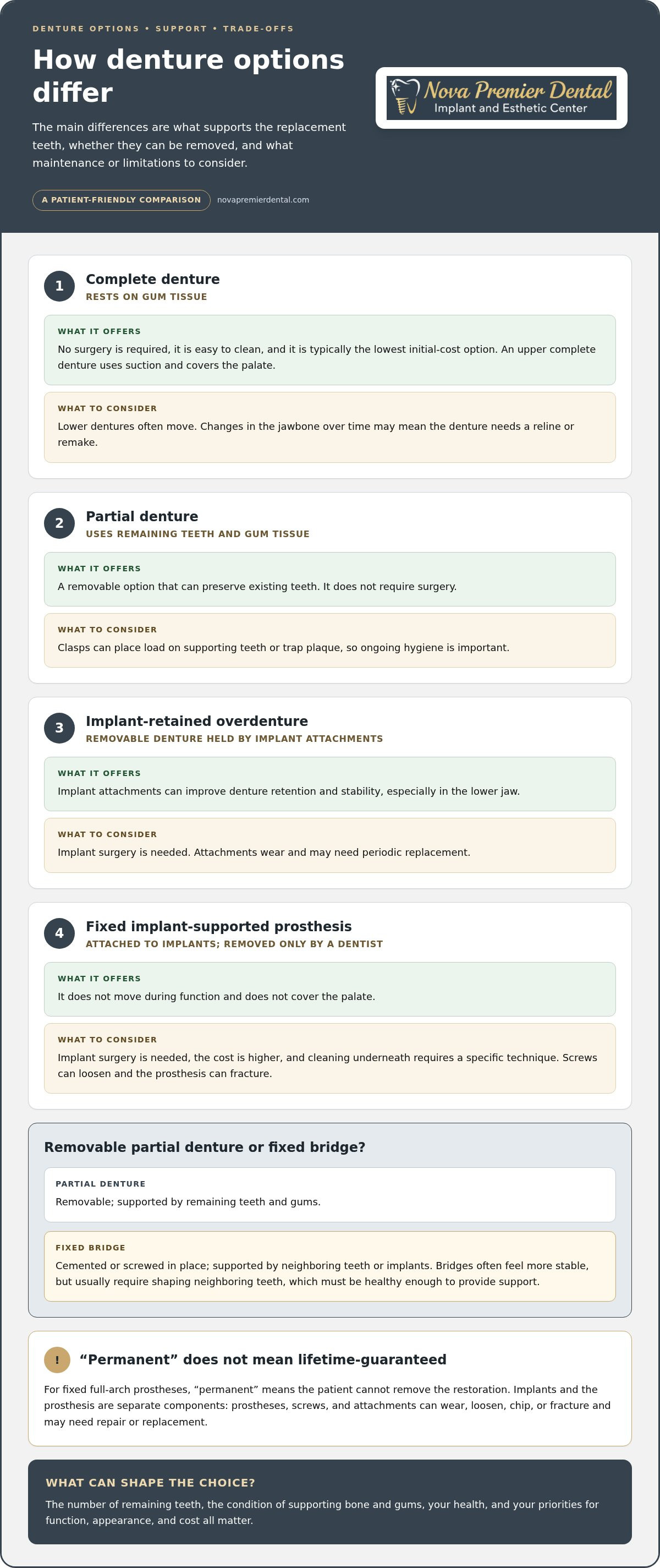
Short answer: The main options are complete dentures, partial dentures, and implant-supported prostheses, which may be removable or fixed. The best choice depends on how many teeth remain, the condition of the supporting bone and gums, your health, and your priorities for function, appearance, and cost.
| Option | How it is supported | Main advantages | Main limitations |
|---|---|---|---|
| Complete denture | Rests on gum tissue; the upper uses suction and palate coverage | No surgery required; typically the lowest initial cost; easy to clean | Lower dentures often move; bone changes over time may require relines or remakes |
| Partial denture | Clasps or precision attachments on remaining teeth, plus gum tissue | Preserves existing teeth; no surgery | Clasps can load or trap plaque on supporting teeth; needs ongoing hygiene |
| Implant-retained overdenture | Implants hold a removable denture through attachments | Improved retention and stability, especially for the lower jaw | Surgery needed; attachments wear and need periodic replacement |
| Fixed implant-supported prosthesis | Implants support a prosthesis removed only by the dentist | Does not move during function; no palate coverage | Surgery; higher cost; cleaning underneath requires specific technique; complications such as screw loosening or prosthesis fracture can occur |
Partial Dentures vs. Dental Bridges
A partial denture is removable and replaces teeth using the remaining teeth and gums for support. A fixed bridge is cemented or screwed in place and relies on adjacent teeth or implants. Bridges often feel more stable, but they usually require shaping the neighboring teeth, and they are only suitable when those teeth are healthy enough to serve as support. More detail on dentures and partial dentures is available on our services page.
Removable vs. Fixed Implant Options
Fixed full-arch prostheses, sometimes called permanent dentures or "All-on-4" style restorations, are attached to implants and are not taken out by the patient. The term "permanent" refers to the patient being unable to remove them, not to a lifetime guarantee. Implants themselves generally have high survival rates in published studies, but the prosthesis, its screws, and its attachments are separate components that can wear, loosen, chip, or fracture and may need repair or replacement. See our overview of permanent dentures for how these are planned.
Patients also report differences in sensation. A fixed prosthesis usually has no palate coverage, which some people find improves taste and comfort, while removable dentures cover more tissue.
Dentures, Jawbone, and Facial Support
Short answer: After teeth are lost, the bone that held them gradually remodels and shrinks (resorption). Dentures resting on gum tissue do not stimulate the bone the way tooth roots do, and implants can change how force is transmitted to the jaw. Neither approach is guaranteed to stop bone loss.
Bone resorption is greatest in the first year after extraction and continues more slowly afterward, with wide variation between individuals. Factors include the reason for tooth loss, how long the area has been without teeth, denture pressure, smoking, systemic conditions, and some medications. The lower jaw often shows more visible change, which is one reason lower dentures commonly lose stability over time.
Implants are anchored in bone and transmit chewing forces to it, and studies suggest they may help limit bone loss around the implant compared with tissue-supported dentures. However, implants can themselves be affected by peri-implant bone loss from inflammation, bite overload, or poor hygiene. Facial appearance also changes naturally with age, and changes in the lower face after tooth loss vary by person. A well-designed prosthesis can support the lips and cheeks, but results cannot be promised.
How Dentures Are Evaluated and Planned
Short answer: Planning begins with a clinical exam, imaging, and a review of your history, then moves to trial setups that let you and the dentist evaluate fit, bite, and appearance before the final denture is made.
Diagnostic Evaluation
- Medical and dental history: including medications, prior radiation, dry mouth, and any history of jaw surgery.
- Oral exam: assessing gum health, ridge shape, remaining teeth, jaw joints, and existing prostheses.
- Imaging: panoramic or 3D cone beam CT (CBCT) images can show bone volume and anatomy when implants are being considered. Our page on implant surgical guides explains how planning translates to placement.
- Bite assessment: evaluating occlusion (how the teeth or denture teeth meet), jaw relationships, and available restorative space for the planned prosthesis.
Typical Treatment Steps
- Consultation and records: exam, imaging, and impressions or scans.
- Treatment planning: discussing options, trade-offs, sequencing, and cost.
- Preparation: extractions, treatment of gum disease or decay, and in some cases bone or soft-tissue procedures. Instructions for after tooth extraction help with healing.
- Jaw relationship records and try-in: a wax try-in of the teeth lets you evaluate appearance, tooth position, lip support, and speech before final processing.
- Implant placement (if applicable): followed by a healing period before the final prosthesis. Timelines vary by case, so your dentist should give an estimate based on your situation.
- Delivery and adjustment: checking fit and bite, with follow-up visits for sore spots or refinements.
The number of visits and the overall duration depend on the type of denture, healing needs, and whether implants are involved.
Materials and Aesthetics
Short answer: Denture bases are usually acrylic resin, and teeth may be acrylic or porcelain. Zirconia and other ceramics are more often used in fixed implant prostheses. Each material involves trade-offs in wear, weight, repairability, and appearance.
- Acrylic resin: lightweight, relatively easy to adjust and repair, but can stain and wear over time.
- Zirconia: a strong ceramic with good stain resistance, but it can be more costly, and under heavy bite forces the opposing teeth or the prosthesis veneering may be affected. Chipping of layered ceramics can occur.
- Metal frameworks: add strength to partial dentures and some implant prostheses; some patients prefer to avoid metal, which should be discussed with the dentist if you have a known allergy.
For a natural look, the dentist considers tooth shape, shade, and arrangement in relation to your lips, smile line, and facial proportions. Using a try-in to preview these choices helps avoid teeth that look uniform or overly bulky. Material choice also matters for patients who clench or grind (bruxism), because heavy parafunctional forces increase the risk of wear and fracture.
Living With Dentures: Adjustment and Maintenance
Short answer: Expect an adjustment period for speaking and eating, regular follow-up, and periodic relines or replacement as your mouth changes.
- Adjustment: new dentures often feel bulky at first, and speech and chewing usually improve with practice. Our guide to the first 30 days with new dentures and tips on speaking with dentures may help.
- Daily care: remove and clean dentures daily with a soft brush and non-abrasive cleanser, and remove them for sleep unless advised otherwise. Clean implant prostheses as instructed, since plaque around implants can cause inflammation.
- Checkups: regular exams allow the dentist to check the fit, bite, soft tissues, and any implants or attachments.
- Repairs: cracks, loose teeth, or broken clasps should be assessed professionally rather than repaired at home with adhesives, which can distort the denture. See our information on emergency denture repair.
Signs a Denture May Need Relining or Replacement
- Looseness, rocking, or the need for increasing amounts of adhesive
- Recurring sore spots or irritation
- Difficulty chewing or changes in speech
- Cracks, worn teeth, or a bite that looks or feels different
Dentures commonly need relining or replacement as the supporting tissues change, but the timing varies. See when to replace dentures for more.
Cost and Insurance Considerations
Costs vary widely with the type of denture, number of implants, materials, and any preparatory treatment, so this article does not quote figures. A written treatment plan with itemized fees is the best way to compare options. Dental insurance often covers part of conventional dentures, and coverage for implant-related care varies by plan, so it is worth checking your benefits in advance; see our page on dental insurance and benefits.
Nova Premier Dental offers in-house payment plans for qualifying patients, allowing treatment costs to be paid over several months.
It is also reasonable to consider the long-term picture: removable dentures usually have lower upfront cost but need relines and remakes, while implant-supported options cost more initially and carry their own maintenance needs.
Choosing a Provider: Questions Worth Asking
Whether you are in Arlington or elsewhere in Northern Virginia, a few questions can help you compare providers regardless of specialty:
- What are my options, and what are the limitations of each?
- How many cases like mine have you treated, and what complications can occur?
- What will the try-in process look like before the final prosthesis?
- What follow-up, repair, and maintenance are included?
- Who performs surgery and who performs the restorative work?
Nova Premier Dental is a short drive from Arlington for patients who want a prosthodontic evaluation, though you should weigh travel time against your needs, particularly if frequent adjustments are expected. You can read more about prosthodontic care in Northern Virginia before deciding.
Frequently Asked Questions
Can a prosthodontist fix my existing, ill-fitting dentures?
Often, yes. Depending on the problem, options include a reline, adjustment of the bite, repair, or a remake. If bone loss has progressed significantly, adding implants to stabilize the denture may also be discussed.
Is a prosthodontist better than a general dentist for dental implants?
Not necessarily. Many general dentists and other specialists place and restore implants successfully. A prosthodontist's training emphasizes designing the final prosthesis and managing complex bite and restorative situations, which can be helpful in more complicated cases.
How long does getting dentures take?
It depends on the type of denture, whether extractions or implants are needed, and healing. Your dentist can provide a timeline specific to your plan.
Does insurance cover prosthodontic care?
Many plans cover part of dentures and some restorative procedures, but benefits, waiting periods, and annual limits vary. Ask your insurer and the practice to verify your benefits before treatment.
Next Steps
If you have questions about a complex restorative or prosthodontic concern, Nova Premier Dental in Falls Church provides prosthodontic specialty care for patients throughout Northern Virginia. You can contact the office to ask about an evaluation.
This article is for general education and does not replace an individual examination or personalized treatment advice.
Disclaimer
The information provided on this website and blog is intended for general educational and informational purposes only and should not be considered dental or medical advice, diagnosis, or treatment. Reading content on this website does not establish a doctor-patient relationship with Nova Premier Dental or Dr. Peterson Huang. Dental conditions and treatment needs vary from patient to patient. Individuals should consult directly with a qualified dental professional for personalized evaluation, diagnosis, and treatment recommendations. Do not delay seeking professional dental care based on information found on this website. While we strive to provide accurate and up-to-date information, no guarantee is made regarding the completeness, accuracy, or applicability of the content. Treatment outcomes may vary depending on individual circumstances. If you are experiencing a dental emergency or urgent oral health concern, please contact a licensed dental professional immediately or call 911 in the event of a medical emergency.


