


Article by
Peterson Huang DMD, MS, FACP, FRCDC
Dr. Peterson Huang is a dual board-certified prosthodontist serving Falls Church and Northern Virginia. He has been recognized as a Top Prosthodontist by Northern Virginia Magazine and Arlington Magazine and is affiliated with the Inova Fairfax Hospital Tumor Board. Dr. Huang focuses on dental implants, full mouth reconstruction, and complex restorative dentistry for patients who need advanced, comprehensive care.
When an adult tooth is lost to trauma, deep decay, or periodontal disease, evaluating replacing missing teeth options involves both biological and mechanical considerations. A missing tooth affects more than oral aesthetics; it alters the balance of the dental arches, shifts occlusal loads to remaining teeth, and leads to ongoing remodeling of the underlying alveolar bone.
Every restorative method carries distinct indications, clinical advantages, procedural limitations, and maintenance requirements. Understanding these clinical factors allows patients to make informed decisions alongside their dental providers. Whether addressing a single missing premolar or complete edentulism (total tooth loss), modern restorative dentistry provides several predictable pathways to re-establish oral function, maintain proper chewing mechanics, and protect long-term oral health.
The Biological Impact of Missing Teeth: Why Functional Restoration Is Essential
The dental arch functions as a continuous, unified biomechanical system. When a tooth is removed, that balance is interrupted, initiating progressive structural and anatomical changes in the jawbone and surrounding dentition.
Bone Loss and Jaw Integrity
Alveolar bone resorption is the primary biological consequence of tooth loss. Alveolar bone exists specifically to support and anchor the roots of the teeth. Through everyday mastication (chewing), mechanical forces transmit through the tooth crown and root into the periodontal ligament, stimulating osteocytes and promoting continuous bone remodeling.
When a tooth root is removed, this localized mechanical stimulation ceases. In response, the body resorbs the non-stimulated bone tissue. Clinical literature in the Journal of Prosthetic Dentistry demonstrates that the greatest volume of residual ridge resorption occurs within the first six to twelve months following an extraction, with both horizontal (width) and vertical (height) bone loss continuing at a gradual rate throughout life.
Over time, unchecked bone resorption reduces the physical ridge necessary to support future restorations. In multi-tooth or full-arch tooth loss, advanced bone atrophy may reduce the lower facial height—a measurement clinically known as vertical dimension of occlusion (VDO). When the vertical dimension diminishes significantly, the soft tissues around the lips and cheeks lose their underlying support, contributing to changes in lip posture and facial profile.
The Relationship Between Missing Teeth and TMJ Health
When a space is left unaddressed, adjacent and opposing teeth naturally migrate over time:
- Mesial drifting and tilting: The teeth behind the empty space tend to tip or drift forward into the gap.
- Super-eruption (hyper-eruption): The opposing tooth in the opposite arch often erupts further out of its bone socket because it no longer meets resistance during bite contact.
This shifting alters the occlusal plane and disrupts harmonious contacts when the jaw closes or slides during chewing. Such interferences can alter normal jaw movements. In patients with missing molars, the loss of posterior support forces the anterior (front) teeth to absorb heavier mechanical loads than they were anatomically designed to tolerate, which can lead to accelerated incisal wear, chipping, or mobility.
While an altered bite does not universally cause temporomandibular joint dysfunction (TMD), uneven distribution of occlusal forces and altered chewing mechanics may place increased strain on the masticatory muscles and the temporomandibular joints in susceptible patients. Diagnosing these patterns early is an essential part of comprehensive restorative care.
Comparing Options for Single and Multiple Tooth Replacement
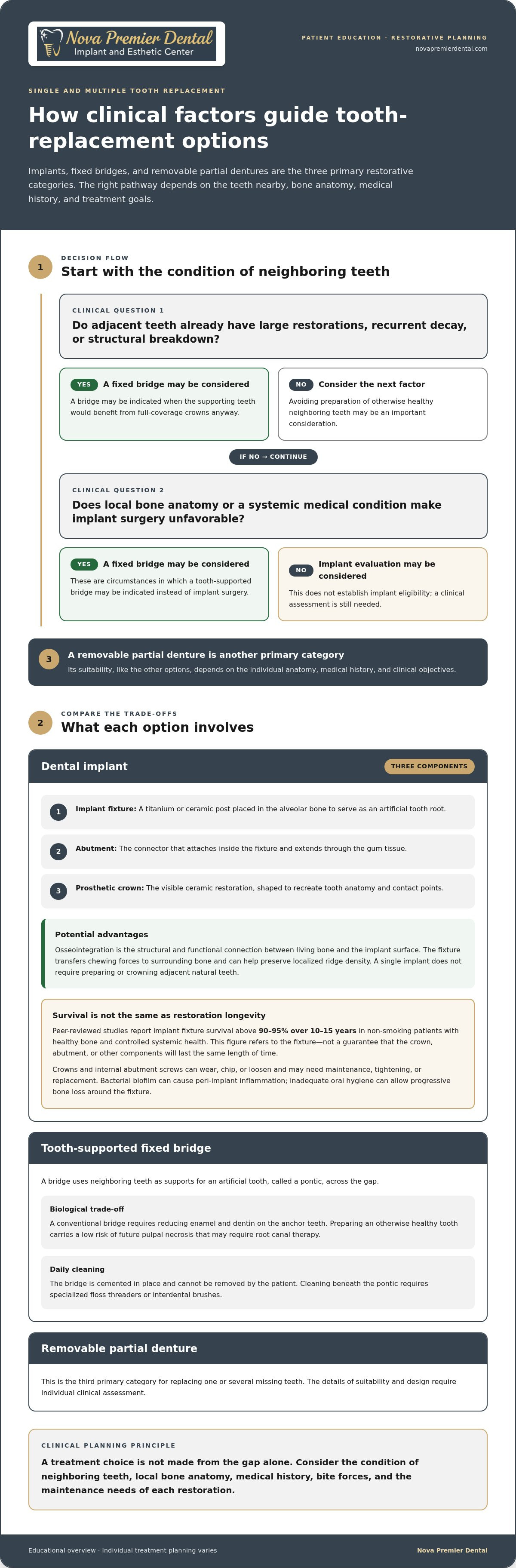
When one or several teeth are missing, three primary restorative categories exist: endosseous dental implants, tooth-supported fixed dental bridges, and removable partial dentures. Each treatment targets specific anatomical conditions, patient medical histories, and clinical objectives.
Dental Implants: Biological and Mechanical Considerations
A single dental implant consists of three separate components:
- The Implant Fixture: A biocompatible titanium or ceramic post surgically placed into the alveolar bone, serving as an artificial tooth root.
- The Abutment: A connector piece that attaches securely inside the implant fixture and extends through the gingiva (gum tissue).
- The Prosthetic Crown: The visible ceramic tooth restoration custom-milled to replicate natural coronal anatomy and contact points.
The primary biological advantage of an implant is osseointegration—the structural and functional connection between living bone and the surface of a load-bearing artificial implant. Because the implant post transfers occlusal forces directly into the surrounding bone tissue, it helps preserve localized alveolar ridge density, a benefit not offered by surface-resting restorations.
Furthermore, an implant is entirely self-supporting. Placing a single dental implant does not require modifying, prepping, or crowning adjacent natural teeth. For patients seeking a focused solution for tooth loss, our team provides comprehensive evaluations for dental implants at our Falls Church practice.
Clinical Limitations and Longevity Distinctions: It is important to distinguish between implant fixture survival and prosthetic longevity. High-quality peer-reviewed studies report implant fixture survival rates above 90–95% over 10 to 15 years in non-smoking patients with healthy bone and controlled systemic health. However, the prosthetic crown and internal abutment screw are subject to mechanical wear, chipping, or screw loosening over time and may require maintenance, tightening, or replacement. Implants are also susceptible to peri-implant mucositis and peri-implantitis—an inflammatory condition caused by bacterial biofilm that can lead to progressive bone loss around the fixture if oral hygiene is inadequate.
Fixed Bridges vs. Dental Implants
A tooth-supported fixed dental bridge replaces one or more missing teeth by utilizing adjacent healthy teeth (abutments) to suspend an artificial tooth (pontic) across the gap.
- Indications: Fixed bridges are frequently indicated when adjacent teeth already have large restorations, recurrent decay, or structural breakdown that would benefit from full-coverage crowns anyway, or when local bone anatomy or systemic medical conditions make implant surgery unfavorable.
- The Clinical Trade-Off: Fabricating a conventional bridge requires reducing natural enamel and dentin from the anchor teeth to make room for crown copings. If an otherwise pristine, unrestored tooth must be aggressively prepared to anchor a bridge, the long-term biological cost to that tooth (including a low risk of future pulpal necrosis requiring root canal therapy) must be considered.
- Longevity and Maintenance: Fixed bridges are cemented in place and cannot be removed by the patient. Daily flossing requires the use of specialized floss threaders or interdental brushes to clean beneath the pontic. While bridges provide stable chewing function, the underlying bone beneath the pontic will undergo natural remodeling over time. Studies indicate conventional bridges have an average functional lifespan of 10 to 15 years, often eventually failing due to recurrent decay at the crown margins of the abutment teeth.
Removable Partial Dentures (RPDs)
A removable partial denture consists of prosthetic replacement teeth attached to a pink acrylic base, typically supported by a cast metal or flexible polymer framework. RPDs utilize mechanical clasps or precision attachments that rest on designated natural anchor teeth to maintain retention and stability.
- Indications: Often selected when multiple teeth are missing across different quadrants of the same arch, when distal abutment teeth (back molars) are missing, or when anatomical bone loss precludes bridge or implant placement without extensive grafting.
- Trade-Offs: Because RPDs are removable and tissue-supported, their chewing efficiency is lower than that of fixed restorations. Clasps can exert non-axial lateral forces on anchor teeth during insertion and removal, and the acrylic base does not arrest ongoing bone resorption beneath the saddles. Careful hygiene and periodic relining are necessary to accommodate gradual ridge changes.
Comparison of Single and Multiple Tooth Replacement Options
| Feature | Dental Implant (Single) | Fixed Dental Bridge | Removable Partial Denture |
|---|---|---|---|
| Impact on Adjacent Teeth | None; independent fixture | Requires enamel reduction of abutment teeth | Uses clasps; minor enamel preparations (rests) |
| Alveolar Bone Preservation | Stimulates bone via osseointegration | Bone resorbs slowly beneath the pontic | Bone resorbs beneath tissue-supported bases |
| Surgical Requirement | Yes (implant placement, optional grafting) | No | No |
| Hygiene Protocol | Brushing and standard flossing | Floss threaders or water flossers under pontic | Removed daily for manual cleaning and soaking |
| Prosthetic Maintenance | Periodic screw checks; crown replacement if worn | Margin checks; replacement if decay develops | Periodic relines or clasp adjustments required |
Advanced Solutions for Full-Arch Tooth Replacement
When an entire arch of teeth is compromised or missing, treatment planning shifts toward stabilizing jaw relationships, establishing correct vertical dimension, and providing functional load distribution. Patients facing total tooth loss have both removable and non-removable prosthodontic options.
Traditional Complete Removable Dentures
A complete denture rests directly upon the oral mucosa and residual alveolar ridge. Upper (maxillary) Dentures achieve retention through peripheral seal and intimate contact with the hard palate, relying on atmospheric pressure and saliva. Lower (mandibular) dentures sit across the thin, horseshoe-shaped mandibular ridge, flanked by dynamic tongue and cheek musculature.
- Advantages: Dentures do not require surgical procedures (unless pre-prosthetic bone recontouring is needed) and carry the lowest initial cost for full-arch tooth replacement.
- Anatomical Limitations: Lower dentures often present retention challenges because there is no palatal seal, and mobile oral tissues frequently dislodge the appliance during speech or mastication. Furthermore, continuous mucosal pressure can accelerate residual ridge resorption over time, requiring relines every few years to re-establish stability.
Implant-Supported Overdentures
An implant-retained or implant-supported overdenture is a removable prosthesis that clips onto dental implants (typically two to four implants in the mandible, and four or more in the maxilla) using specialized locators, ball attachments, or a milled bar.
This approach combines the ease of removable hygiene with mechanical stabilization. The implants prevent horizontal shifting, eliminate denture slippage, and direct a portion of chewing forces into the underlying bone rather than exclusively onto the soft gum tissue. The retentive plastic inserts inside the denture cap require periodic replacement as they undergo mechanical wear during daily insertion and removal.
Fixed Full-Arch Implant Bridges
For patients seeking a non-removable prosthesis, fixed full-arch bridges—often planned using four, five, or six strategically distributed implants per arch—provide a rigid, permanent solution. In these designs, an engineered dental bridge fabricated from high-strength monolithic zirconia or a titanium-reinforced acrylic framework is screwed directly into the implants.
This restoration stays permanently in place and can only be removed by a dentist for professional hygiene evaluations. Because it does not require palatal acrylic coverage, phonetic adaptation is faster, and taste perception is unimpeded. However, candidate selection requires precise diagnostic evaluation of vertical restorative space, smile line height, bone density, and individual parafunctional habits (such as night-time teeth grinding or clenching).
The Role of a Prosthodontist in Restorative Care
General dentists provide foundational preventive, diagnostic, and restorative care, and many routinely perform straightforward bridge placements, partial dentures, and single-implant restorations. However, when tooth replacement involves severe bone resorption, complex bite misalignment, multiple missing teeth across opposing arches, or history of failed restorations, seeking a specialist evaluation can provide significant diagnostic clarity.
A prosthodontist is a dental specialist who has completed three additional years of accredited post-doctoral residency training beyond general dental school, focused exclusively on the restoration and replacement of complex missing teeth, maxillofacial structures, and severe occlusal dysfunction.
At Nova Premier Dental, our clinical director, Peterson Huang, DMD, MS, FACP, FRCDC, is a dual board-certified prosthodontist. Dr. Huang completed his specialty training in prosthodontics and earned board certification through both the American Board of Prosthodontics in the United States and the Royal College of Dentists of Canada. His clinical practice focuses on diagnosing complex bite conditions and engineering personalized treatment plans for multi-unit and full-mouth rehabilitations.
Prosthodontists focus heavily on mechanical and biological factors that influence long-term restorative outcomes, including:
- Interocclusal and Restorative Space: Ensuring adequate vertical room exists for restorative materials to withstand bite forces without fracturing.
- Implant Angulation and Distribution: Planning three-dimensional implant trajectory based on the ideal final prosthetic tooth position rather than simply placing an implant wherever bone is currently thickest.
- Occlusal Scheme Design: Balancing contact points across the arches to prevent lateral shear stress on natural roots and implant fixtures, especially for patients with a history of bruxism.
- Emergence Profile: Shaping crowns and custom abutments to transition smoothly through the gum tissue, allowing effective at-home flossing and plaque removal.
To learn more about how specialized restorative treatment planning differs, explore our dedicated resource on prosthodontic care in Northern Virginia or read about Dr. Huang’s background and training.
Evaluating Treatment Costs and Clinical Planning
The cost of tooth replacement varies considerably based on the chosen treatment modality, anatomical needs, and material specifications. A comprehensive evaluation requires diagnostic imaging, such as low-dose cone beam computed tomography (CBCT), which provides a three-dimensional view of bone topography, nerve canals, and sinus cavities.
Key Factors Influencing Treatment Investment
- Anatomical Site Preparation: If a tooth has been missing for several years, localized bone grafting, ridge augmentation, or sinus floor elevation may be necessary before an implant fixture can achieve mechanical stability.
- Material Selection: High-performance monolithic zirconia, custom-milled titanium abutments, and cross-linked composite denture teeth carry different laboratory fabrication costs than traditional cast base metals or standard acrylics, but they offer distinct wear characteristics and mechanical strength.
- Prosthesis Complexity: Single-tooth replacements involve localized componentry, whereas full-arch implant bridges require extensive cross-arch stabilization, precision surgical guides, and customized master casts.
Dental insurance policies differ regarding coverage for tooth replacement. Many plans provide partial allowances for traditional bridges or removable dentures, but they may limit or exclude surgical implant coverage or impose annual maximum payout caps. To support treatment sequencing, Nova Premier Dental offers in-house payment plans for qualifying patients, allowing treatment costs to be paid over several months while patients enjoy their new smile.
Frequently Asked Questions About Replacing Missing Teeth
What is the most economical way to replace missing teeth?
A removable partial denture (RPD) or conventional full denture typically represents the lowest upfront financial cost. However, because tissue-supported dentures do not stimulate alveolar bone, residual ridge resorption continues over time. Patients often require periodic relines, tissue conditioners, or appliance replacements over the course of their lives, which should be factored into total long-term care costs.
Can I replace a tooth that has been missing for several years?
Yes. Even if a tooth has been missing for a long period, replacement remains possible. Because bone resorption naturally occurs following extraction, bone volume may have diminished and adjacent teeth may have drifted. A clinical exam and 3D CBCT scan determine whether bone grafting is needed prior to implant placement or if orthodontic space reopening is indicated before placing a bridge or implant.
Are dental implants worth the higher initial investment compared to dentures?
For qualifying patients, dental implants provide clear biomechanical advantages. They do not rely on adjacent teeth for support, they preserve the surrounding alveolar bone through osseointegration, and they offer chewing efficiency close to that of natural teeth. However, overall value depends on patient health, bone quality, aesthetic expectations, and willingness to maintain rigorous oral hygiene to prevent peri-implant disease.
How long does the dental implant process take from start to finish?
The standard timeline ranges from three to nine months, depending on clinical complexity. If bone grafting is performed at the time of extraction, three to four months of consolidation may be required before placing the implant fixture. After fixture placement, an osseointegration period of roughly three to four months is typically observed before attaching the permanent abutment and final crown. In select full-arch cases with high primary bone stability, immediate provisional restorations can be placed on the day of surgery.
Does insurance cover the cost of replacing missing teeth?
Coverage depends entirely on your specific employer-sponsored or private dental insurance policy. Many policies classify implants as an elective or major service and may only cover an equivalent amount matching the cost of a removable denture or fixed bridge (the "least expensive alternative treatment" clause). Our administrative team assists patients by submitting pre-treatment clinical estimates to outline benefits clearly.
What happens if I choose not to replace a missing back molar?
While an unreplaced back molar is not visible when smiling, leaving the space open can lead to functional changes. The opposing molar may super-erupt into the empty space, complicating future dental care. Additionally, the remaining teeth are forced to absorb heavier chewing loads (loss of posterior support), which can accelerate structural tooth wear or tipping over time.
Is the procedure for replacing missing teeth painful?
Procedures are performed under local anesthesia to ensure comfort during treatment. For surgical implant placement, local anesthetic blocks sensation in the bone and surrounding soft tissue; because bone tissue has few sensory nerve endings, most patients report that post-operative discomfort is manageable with over-the-counter pain medications like ibuprofen or acetaminophen for a few days following surgery.
When should I consult a prosthodontist instead of a general dentist?
While general dentists manage many single-tooth replacements successfully, consulting a prosthodontist is advisable if you have multiple missing teeth, severe bite collapse, jaw joint discomfort, significant bone atrophy, or previous restorative work that has repeatedly failed. A specialist provides focused training in complex treatment sequencing and full-arch reconstruction.
Taking the Next Step in Restorative Treatment
Every clinical situation is distinct. Choosing between an endosseous implant, a tooth-supported bridge, or a specialized removable prosthesis requires a comprehensive examination of your oral anatomy, remaining tooth structure, and functional goals.
If you have questions about your restorative options or need an evaluation for complex dental concerns, our specialty team is here to assist you. If you would like to explore your options with Dr. Peterson Huang, you can contact our Falls Church dental practice to schedule a comprehensive restorative consultation.
Disclaimer
The information provided on this website and blog is intended for general educational and informational purposes only and should not be considered dental or medical advice, diagnosis, or treatment. Reading content on this website does not establish a doctor-patient relationship with Nova Premier Dental or Dr. Peterson Huang. Dental conditions and treatment needs vary from patient to patient. Individuals should consult directly with a qualified dental professional for personalized evaluation, diagnosis, and treatment recommendations. Do not delay seeking professional dental care based on information found on this website. While we strive to provide accurate and up-to-date information, no guarantee is made regarding the completeness, accuracy, or applicability of the content. Treatment outcomes may vary depending on individual circumstances. If you are experiencing a dental emergency or urgent oral health concern, please contact a licensed dental professional immediately or call 911 in the event of a medical emergency.


