


Article by
Peterson Huang DMD, MS, FACP, FRCDC
Dr. Peterson Huang is a dual board-certified prosthodontist serving Falls Church and Northern Virginia. He has been recognized as a Top Prosthodontist by Northern Virginia Magazine and Arlington Magazine and is affiliated with the Inova Fairfax Hospital Tumor Board. Dr. Huang focuses on dental implants, full mouth reconstruction, and complex restorative dentistry for patients who need advanced, comprehensive care.
Temporomandibular disorders (TMD) are a group of conditions affecting the jaw joint and the muscles used for chewing. Symptoms such as jaw pain, clicking, limited opening, and headaches have several possible sources, and finding the cause usually takes a careful evaluation. If you are looking for a TMJ treatment specialist in Arlington, VA, this guide explains how TMD is evaluated, which conservative and restorative options exist, and when specialist input may be useful.
Nova Premier Dental is a private prosthodontic specialty dental office in Falls Church serving Northern Virginia. Peterson Huang, DMD, MS, FACP, FRCDC, is a dentist and dual board-certified prosthodontist, with prosthodontic certification in both the United States and Canada.
Key Takeaways
- "TMJ" is the joint itself; "TMD" is the term for disorders of the joint and chewing muscles.
- Jaw pain, headaches, and ear discomfort can have several causes, so diagnosis should consider more than the bite.
- Most TMD is managed first with conservative, reversible care. Surgery is uncommon.
- Tooth wear, clenching, and bite changes are associated with jaw symptoms in some people, but they do not necessarily cause TMD.
- A prosthodontist can help when TMD overlaps with complex restorative needs, though many dentists appropriately treat TMD.
What Is TMD, and Who Evaluates It?
No single specialty owns TMD care. General dentists, prosthodontists, oral and maxillofacial surgeons, orofacial pain specialists, physical therapists, and physicians may all be involved. Many general dentists provide appropriate evaluation and splint therapy. A prosthodontist, who completes specialty training in restoring and replacing teeth and managing complex restorative cases, may be a useful resource when jaw symptoms occur alongside missing, worn, or heavily restored teeth.
Understanding Temporomandibular Joint Disorder (TMD)
The temporomandibular joint is a sliding hinge connecting the lower jaw to the skull. A small articular disc cushions the joint, and muscles such as the masseter and temporalis move it. TMD can involve the muscles, the disc, the joint surfaces, or a combination. According to the National Institute of Dental and Craniofacial Research, causes are often multifactorial and may include jaw injury, arthritis, clenching or grinding, and stress. Occlusion (how the teeth meet) is one factor clinicians consider, but research has not shown that bite discrepancies reliably cause TMD.
The Role of a Prosthodontist in TMJ Care
Prosthodontic training emphasizes occlusion, tooth restoration, and the planning of complex treatment. This is relevant when a splint, crowns, or a larger restorative plan must be coordinated with jaw comfort. It does not mean specialist care guarantees better outcomes than care from another qualified dentist. You can read more about prosthodontic care in Northern Virginia and how it differs from general dentistry.
Recognizing Symptoms of TMJ Disorder
Common symptoms include jaw or facial pain, pain when chewing, clicking or popping, limited opening, jaw locking, and tenderness in the muscles near the ear and temple. Symptoms often fluctuate and may improve on their own.
Beyond Jaw Pain: Headaches, Earaches, and Facial Tension
Muscle pain from the jaw can be felt in the temples, face, or around the ear. Some people with TMD also report tension-type headaches, and ear fullness or pain without an ear infection. These symptoms are not specific to TMD. Headaches and earaches have many other causes, so a medical evaluation, such as with a physician or ENT, is appropriate when the source is unclear. Bruxism (clenching or grinding) is associated with jaw muscle soreness in some patients, though the relationship varies. For more on this topic, see our page on bruxism.
When Popping and Clicking Signal a Structural Issue
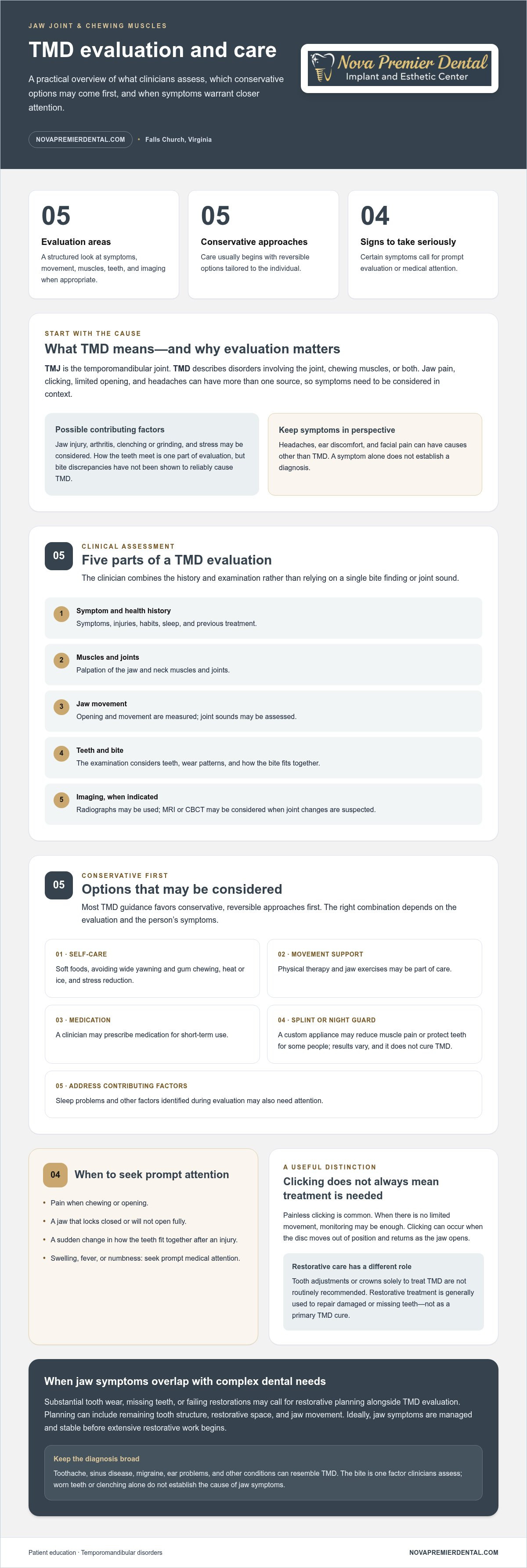
Clicking is common and often painless. It can occur when the disc moves out of position and returns as the jaw opens (disc displacement with reduction). Painless clicking without limited movement frequently needs no treatment beyond monitoring. Evaluation is more important when you have:
- Pain with chewing or opening
- A jaw that locks closed or will not open fully
- A sudden change in how your teeth fit together after an injury
- Swelling, fever, or numbness, which warrant prompt medical attention
A locked jaw should be evaluated promptly. Grinding can also wear or fracture crowns and veneers, which is one reason protective appliances are considered for restorative patients.
How TMD Is Evaluated
A TMD evaluation typically includes:
- A history of symptoms, injuries, habits, sleep, and prior treatment
- Palpation of the jaw and neck muscles and joints
- Measurement of jaw opening and movement, and listening for joint sounds
- An examination of the teeth, wear patterns, and bite
- Radiographs, and sometimes advanced imaging such as MRI or CBCT when joint changes are suspected
Examining the bite is part of the process, but findings are interpreted cautiously. Worn teeth do not by themselves show that vertical dimension has been lost, and bruxism does not automatically lead to a collapsed bite or to TMD. A second opinion can be helpful if previous treatment has not clarified the cause.
Comprehensive Oral Reconstruction Assessment
When a patient has substantial tooth wear, missing teeth, or failing restorations in addition to jaw symptoms, restorative planning may be needed. This involves assessing remaining tooth structure, restorative space, and how the jaw moves, with the aim of building a stable, comfortable bite. Jaw symptoms should ideally be managed and stable before extensive restorative work is started. See our overview of oral reconstruction for more on this type of planning.
Distinguishing TMD from Other Orofacial Pain
Several conditions can resemble TMD, including toothache, sinus disease, trigeminal neuralgia, migraine, and ear problems. Sleep-disordered breathing can also be associated with morning jaw pain and bruxism, and may need physician evaluation. Getting the diagnosis right matters because treatment for one condition may not help another.
TMJ Treatment Options: From Conservative Care to Restorative Work
Most guidance, including from NIDCR, favors conservative and reversible approaches first. These include:
- Self-care: soft diet, avoiding wide yawning and gum chewing, heat or ice, and stress reduction
- Physical therapy and jaw exercises
- Short-term medications prescribed by a clinician
- Occlusal splints or night guards
- Treatment of contributing factors such as sleep problems
Irreversible treatments, such as adjusting teeth or placing crowns solely to treat TMD, are not routinely recommended. Restorative work is generally chosen to repair damaged or missing teeth, not as a primary TMD cure.
Custom Orthotics and Night Guards for Jaw Comfort
Custom night guards and occlusal splints are made from impressions or scans of your teeth, so they fit accurately and can be adjusted. Over-the-counter guards are not custom fit and may be bulky or poorly retained. The evidence suggests splints may reduce muscle pain or protect teeth for some patients, but results vary and they do not cure TMD. Adjustments over follow-up visits are common, and guards need periodic replacement as they wear. You can read more in our guide to a custom night guard for bruxism.
Botox and Restorative Interventions
Botulinum toxin injected into the masseter muscles can reduce muscle activity and may help some patients with clenching-related muscle pain. Evidence for its use in TMD is still evolving, effects are temporary, and risks can include weakness while chewing and changes in facial contour. It is typically considered after conservative measures. Details are available on our page about Botox for TMJ and migraines.
Where teeth are worn, fractured, or missing, crowns or veneers may be needed to restore function. Material choice and bite design take parafunction into account, and a protective night guard is often recommended afterward. Surgery or joint procedures, such as arthrocentesis, are reserved for a small number of cases with structural joint problems that do not respond to conservative care.
When to Seek a Specialist Evaluation
Consider an evaluation if jaw symptoms persist beyond a few weeks, interfere with eating, or accompany significant tooth wear or failing restorations. Your treatment plan should be individualized, because TMD varies considerably between patients. Nova Premier Dental is in Falls Church, a short drive for many Arlington residents. Nova Premier Dental offers in-house payment plans for qualifying patients, allowing treatment costs to be paid over several months. You can review before and after examples of restorative cases, but these do not predict individual results.
Summary
TMD is usually managed conservatively, and diagnosis should consider the muscles, joint, teeth, and other possible sources of pain. If you have questions about a complex restorative or prosthodontic concern alongside jaw symptoms, contact Nova Premier Dental in Falls Church.
Frequently Asked Questions
What is the difference between TMJ and TMD?
TMJ is the temporomandibular joint, the hinge connecting the jaw to the skull. TMD refers to the disorders affecting that joint and the associated chewing muscles.
Can a prosthodontist fix my chronic headaches?
Not necessarily. Headaches have many causes. If your headaches are related to jaw muscle tension or clenching, a splint and other TMD care may help some patients. A physician should evaluate headaches whose cause is unclear.
How much does TMJ treatment cost in Arlington, VA?
Cost depends on the evaluation, imaging, and treatments needed, so it cannot be stated without an exam. A written estimate can be provided after evaluation.
Is Botox an effective treatment for jaw clenching?
It may reduce muscle activity and pain in some patients, but evidence is limited, results are temporary, and it is not a cure. It is usually considered after conservative options.
Will I need surgery to fix my TMJ disorder?
Most people do not. Surgery is uncommon and reserved for specific structural problems that have not responded to conservative treatment.
How long does it take to see results from TMJ therapy?
Timelines vary. Some people notice less muscle tension within weeks of starting self-care or a splint, while others need longer or a different approach. Follow-up visits help adjust the plan.
What should I bring to my first TMJ consultation?
Bring recent dental imaging, relevant medical records, a list of medications and symptoms, and any night guards you have used.
Disclaimer
The information provided on this website and blog is intended for general educational and informational purposes only and should not be considered dental or medical advice, diagnosis, or treatment. Reading content on this website does not establish a doctor-patient relationship with Nova Premier Dental or Dr. Peterson Huang. Dental conditions and treatment needs vary from patient to patient. Individuals should consult directly with a qualified dental professional for personalized evaluation, diagnosis, and treatment recommendations. Do not delay seeking professional dental care based on information found on this website. While we strive to provide accurate and up-to-date information, no guarantee is made regarding the completeness, accuracy, or applicability of the content. Treatment outcomes may vary depending on individual circumstances. If you are experiencing a dental emergency or urgent oral health concern, please contact a licensed dental professional immediately or call 911 in the event of a medical emergency.


