


Article by
Peterson Huang DMD, MS, FACP, FRCDC
Dr. Peterson Huang is a dual board-certified prosthodontist serving Falls Church and Northern Virginia. He has been recognized as a Top Prosthodontist by Northern Virginia Magazine and Arlington Magazine and is affiliated with the Inova Fairfax Hospital Tumor Board. Dr. Huang focuses on dental implants, full mouth reconstruction, and complex restorative dentistry for patients who need advanced, comprehensive care.
The cost of full mouth reconstruction depends on the extent of treatment, and the lowest initial quote does not always reflect the total cost over time. If you are wondering how to afford full mouth reconstruction without compromising the clinical quality of your care, a clear diagnosis and a staged plan can make the expense easier to manage.
At Nova Premier Dental, a private prosthodontic specialty practice in Falls Church serving Northern Virginia, Peterson Huang, DMD, MS, FACP, FRCDC, a dual board-certified prosthodontist (certified in prosthodontics in the United States and Canada), plans complex restorative care in stages. This guide explains phased treatment, insurance and tax-advantaged accounts, and payment options. Nova Premier Dental offers in-house payment plans for qualifying patients, allowing treatment costs to be paid over several months.
Key Takeaways
- A cosmetic smile makeover and a functional reconstruction differ in scope: reconstruction addresses occlusion (bite), tooth structure, and supporting tissues.
- Phased treatment planning can divide how to afford full mouth reconstruction into manageable clinical and financial stages.
- Thorough diagnosis and planning can reduce the likelihood of repeat treatment, though no outcome is guaranteed.
- HSA or FSA funds, insurance benefits, and in-house payment plans for qualifying patients may help with costs.
What Is Full Mouth Reconstruction?
A full mouth reconstruction is a comprehensive restorative treatment plan that rebuilds or restores the teeth in both the upper and lower jaws. People researching how to afford full mouth reconstruction should know that it is usually driven by function and oral health rather than appearance alone. Unlike a "smile makeover," which focuses on cosmetic changes such as porcelain veneers, a reconstruction addresses the biological and mechanical foundation of the mouth. Dr. Huang, a prosthodontist in Northern Virginia, plans these cases so that restorations are coordinated with the occlusion, jaw joints, and facial muscles.
The Clinical Scope of Total Restoration
This process goes far beyond placing new teeth. It requires a deep understanding of bone density, soft tissue health, and jaw alignment. A successful oral reconstruction often integrates various modalities to achieve a stable result:
- Dental implants: These replace missing tooth roots and can help maintain bone stimulation while providing support for prostheses.
- Custom-milled crowns: These restore the strength and shape of teeth damaged by decay or trauma.
- Occlusal (bite) correction: Aligning how the upper and lower teeth meet to reduce uneven forces on teeth and restorations.
The diagnostic phase is a key part of the process. It involves imaging and occlusal analysis to create a treatment plan that anticipates mechanical risks. Without careful planning, even durable materials can fail early. Understanding this complexity is the first step in learning how to afford full mouth reconstruction, since accurate planning supports a more reliable cost estimate.
Who Benefits Most from This Comprehensive Approach?
People who need this care often have severe tooth wear (attrition), widespread decay, or multiple missing teeth that limit chewing and speaking. Some have had repeated single-tooth repairs while an underlying bite problem, such as bruxism (clenching or grinding), remained unaddressed. A comprehensive plan evaluates these underlying factors. Oral health is also associated with general health, and difficulty chewing can affect diet, but reconstruction should not be presumed to cure systemic conditions.
Key Factors Influencing the Cost of Oral Reconstruction
The total cost depends on several clinical variables. The primary drivers are the number of teeth requiring treatment and the complexity of the bite. Correcting a jaw relationship problem or severe attrition increases the planning and restorative requirements. A specialized oral reconstruction involves restorative and sometimes surgical care beyond routine maintenance. Prosthodontists complete additional specialty training in restorative and reconstructive dentistry, which is why they commonly manage complex cases; general dentists provide excellent care for most dental needs and often collaborate on these cases.
Auxiliary procedures often form the biological foundation of the work. If you have bone loss after tooth loss, bone grafting or sinus augmentation may be needed to support dental implants. Periodontal therapy may also be needed so the gum tissue is healthy enough to support new restorations. These steps are often required for predictable results, and addressing them early can reduce the chance of additional treatment later.
Materials and Longevity
The choice between porcelain and zirconia affects both cost and durability. Material selection depends on tooth position, bite forces, and esthetic needs. Lower-cost materials may be suitable in some situations but can be more prone to fracture or wear in others. Implant fixture survival and the longevity of crowns, bridges, and attachments are separate matters: prostheses may need repair or replacement over time even when the implant itself remains stable.
The Diagnostic and Planning Phase
Planning typically uses Cone Beam Computed Tomography (CBCT) and digital impressions to evaluate anatomy. This information helps reduce unexpected changes during treatment and supports a more accurate financial plan. You can meet Dr. Huang for a consultation to receive an individualized breakdown of these factors. To begin an assessment, you can contact our Falls Church office.
Ways to Manage the Financial Commitment
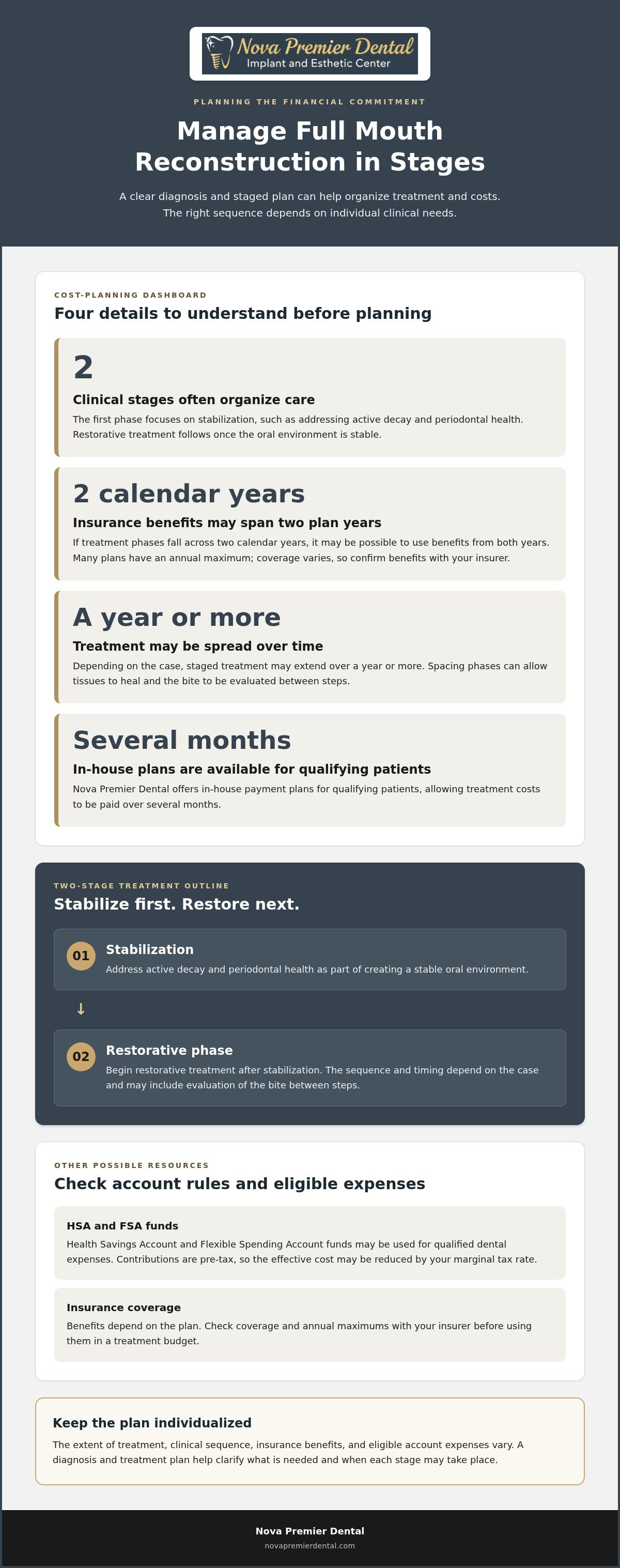
Common ways to manage the cost include phased treatment, insurance benefits, HSA or FSA funds, and in-house payment plans. Many patients ask how to afford full mouth reconstruction without high-interest debt. At Nova Premier Dental, financial planning is discussed alongside the clinical plan so that you understand the sequence and cost of each stage.
Review your dental insurance benefits. Many plans have an annual maximum, so timing treatment phases across two calendar years may allow you to use two years of benefits. Benefits vary by plan, so confirm your coverage with your insurer; our administrative team can help coordinate this.
Phased Treatment: The Specialist's Approach to Budgeting
Phased treatment planning is one of the most practical ways to manage cost. Dr. Huang can often divide reconstruction into clinical stages. The first phase focuses on stabilization, including active decay and periodontal health. Once the oral environment is stable, the restorative phase begins. This full mouth reconstruction explained by prosthodontists notes that staging can also allow tissues to heal and let the bite be evaluated between steps. Depending on the case, treatment may be spread over a year or more, reducing the need for a single large payment.
Leveraging Tax-Advantaged Accounts
Health Savings Accounts (HSA) and Flexible Spending Accounts (FSA) can be used for qualified dental expenses. Because contributions are made pre-tax, the effective cost may be reduced by your marginal tax rate. Consider coordinating your treatment start with your employer's open enrollment period, and confirm eligible expenses and limits with your plan administrator or tax advisor.
Nova Premier Dental offers in-house payment plans for qualifying patients, allowing treatment costs to be paid over several months. As a prosthodontist in Northern Virginia, Dr. Huang's team will review the plan and costs with you before treatment begins.
Specialist Care and Long-Term Costs
Repeat treatment is a real financial risk in complex restorative dentistry, and careful diagnosis and occlusal planning can help reduce it. Patients searching for how to afford full mouth reconstruction may focus on the lowest upfront price, but the cost of restorations over time also depends on bite forces, materials, hygiene, and maintenance. Planning the occlusion to distribute forces appropriately can lower the risk of complications such as fractured porcelain or implant-related problems, though complications can still occur. For more on the differences in training and scope, read our comparison of a Prosthodontist vs General Dentist.
Dr. Huang's Credentials
A prosthodontist completes additional residency training after dental school focused on restoring oral function and esthetics. Peterson Huang, DMD, MS, FACP, FRCDC, completed specialty training in prosthodontics and holds board certification in prosthodontics in both the United States and Canada. Restorations have a limited service life and need maintenance; many last years to decades, but longevity varies with materials, bite forces, oral hygiene, and follow-up care.
Avoiding the Hidden Costs of Dental Failure
Mechanical complications, such as a fractured bridge or a failed implant, can require additional treatment and new prostheses. A plan that accounts for your jaw relationship and occlusion may reduce that risk. Bite forces and parafunction such as bruxism can contribute to wear and restoration damage, and are often evaluated in patients with TMJ disorders, although the relationship between bite and TMJ symptoms is complex and not fully established. To discuss your situation, you can schedule a consultation with Dr. Huang.
Payment Options at Nova Premier Dental
Nova Premier Dental is a private prosthodontic specialty practice in Falls Church serving Northern Virginia. We review the clinical rationale and expected costs of each phase so you can make an informed decision, and we discuss how to afford full mouth reconstruction at your consultation.
In-House Payment Plans
Nova Premier Dental offers in-house payment plans for qualifying patients, allowing treatment costs to be paid over several months. You work directly with our administrative team to set a schedule that fits the treatment plan.
Your First Visit with Dr. Peterson Huang
The first step is a comprehensive consultation. During this visit, Dr. Peterson Huang, a prosthodontist in Northern Virginia, will perform a diagnostic assessment that includes imaging and an evaluation of your teeth, gums, and bite. You can also review our before and after cases; individual results vary. To schedule a visit, contact our team.
Summary: Planning and Paying for Reconstruction
Full mouth reconstruction is a long-term investment in oral function and health. Phased treatment, insurance timing, HSA or FSA funds, and in-house payment plans can make the cost more manageable. Working with a dual board-certified prosthodontist in Northern Virginia can support careful planning, though no restoration is guaranteed to last indefinitely. Nova Premier Dental offers in-house payment plans for qualifying patients, allowing treatment costs to be paid over several months.
At Nova Premier Dental, you can schedule an assessment with Dr. Huang and discuss your goals and costs.
Schedule a Consultation with Dr. Huang
Frequently Asked Questions
Is full mouth reconstruction covered by dental insurance?
Many dental insurance plans provide partial coverage for restorative procedures, often at a percentage after deductibles, and are limited by an annual maximum. Coverage varies by plan. Our administrative team can help you use your benefits, sometimes by timing phases across two calendar years.
Can I do my full mouth reconstruction in stages to save money?
Often, yes. Phasing is a clinical strategy that stabilizes oral health before final restorations. It is a key part of how to afford full mouth reconstruction, since it spreads the financial commitment over time and allows tissues to heal.
Why can a prosthodontist's fee differ from a general dentist's?
A prosthodontist in Northern Virginia has completed three additional years of specialty residency beyond dental school, focused on restorative and reconstructive care. Fees reflect the complexity of the case, and general dentists provide high-quality care for many restorative needs. Complex cases may benefit from specialist planning.
What happens if I delay my full mouth reconstruction due to cost?
Delaying treatment can allow problems such as tooth wear, decay, or bone loss to progress, and teeth may shift after tooth loss. This may make treatment more complex, sometimes requiring procedures such as bone grafting. A clinical evaluation can help determine how urgent your situation is.
Do you offer payment plans?
Nova Premier Dental offers in-house payment plans for qualifying patients, allowing treatment costs to be paid over several months.
How long does a typical full mouth reconstruction last?
Longevity varies. Individual restorations such as crowns and bridges often last many years, and some last decades, but they can chip, wear, or loosen and may need repair or replacement. Implant fixtures may have high survival rates, but the prosthetic parts attached to them have a separate service life. Bite forces, bruxism, oral hygiene, materials, and regular maintenance all influence outcomes.
Are there tax benefits to paying for major dental work?
Dental treatment is generally a qualified medical expense. You may use pre-tax HSA or FSA funds, and in some cases expenses that exceed a threshold percentage of adjusted gross income may be deductible. Rules vary, so consult a tax professional.
What is the first step to getting a cost estimate for my smile?
The first step is a consultation with Dr. Huang at Nova Premier Dental. The visit includes a clinical examination and imaging, which allow us to provide a personalized cost estimate and discuss how to afford full mouth reconstruction in your situation.
Disclaimer
The information provided on this website and blog is intended for general educational and informational purposes only and should not be considered dental or medical advice, diagnosis, or treatment. Reading content on this website does not establish a doctor-patient relationship with Nova Premier Dental or Dr. Peterson Huang. Dental conditions and treatment needs vary from patient to patient. Individuals should consult directly with a qualified dental professional for personalized evaluation, diagnosis, and treatment recommendations. Do not delay seeking professional dental care based on information found on this website. While we strive to provide accurate and up-to-date information, no guarantee is made regarding the completeness, accuracy, or applicability of the content. Treatment outcomes may vary depending on individual circumstances. If you are experiencing a dental emergency or urgent oral health concern, please contact a licensed dental professional immediately or call 911 in the event of a medical emergency.


