


Article by
Peterson Huang DMD, MS, FACP, FRCDC
Dr. Peterson Huang is a dual board-certified prosthodontist serving Falls Church and Northern Virginia. He has been recognized as a Top Prosthodontist by Northern Virginia Magazine and Arlington Magazine and is affiliated with the Inova Fairfax Hospital Tumor Board. Dr. Huang focuses on dental implants, full mouth reconstruction, and complex restorative dentistry for patients who need advanced, comprehensive care.
When researching the cost of dental implants in Northern VA, patients often encounter a wide range of estimates. A dental implant is not an off-the-shelf product with a fixed price tag; rather, it is an individualized surgical and restorative treatment plan designed to replace missing teeth. The total fee depends on pre-surgical requirements, the anatomical site, the number of teeth being replaced, and the restorative materials selected.
Understanding what goes into this investment requires examining the individual components of implant therapy, the difference between surgical fixture placement and prosthetic restoration, the biological factors that affect treatment complexity, and how specialized prosthodontic planning helps ensure predictable, functional outcomes over time.
What Components Make Up the Cost of Dental Implants?
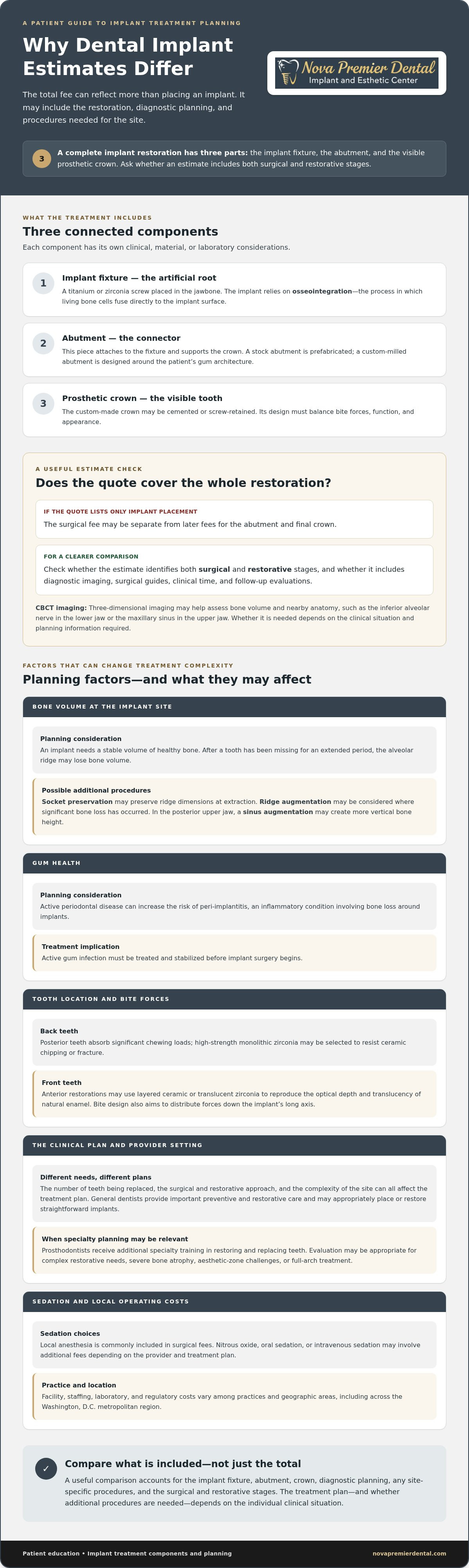
A complete dental implant restoration is comprised of three distinct clinical parts, each carrying its own laboratory, material, and clinical fees:
- The Implant Fixture (Post): A surgical-grade titanium or zirconia screw that is surgically placed into the alveolar bone, serving as an artificial tooth root.
- The Abutment: A connector piece that attaches securely to the implant fixture and extends through the gum tissue to support the visible restoration.
- The Prosthetic Crown: The custom-fabricated replacement tooth that is cemented or screw-retained onto the abutment, restoring masticatory function and aesthetics.
In addition to these three components, comprehensive implant quotes may include diagnostic imaging, surgical guides, clinical time, and follow-up evaluations. Three-dimensional cone-beam computed tomography (CBCT) imaging may help the clinician evaluate bone volume and important anatomical landmarks, such as the inferior alveolar nerve in the lower jaw and the maxillary sinus in the upper jaw. The need for CBCT depends on the clinical situation and the information required for treatment planning.
The Implant Post and Abutment
The implant post relies on a biological process called osseointegration, in which living bone cells fuse directly to the biocompatible titanium surface. The quality and manufacturing tolerances of the implant system directly influence cellular attachment and mechanical stability. Reputable implant manufacturers invest heavily in surface treatment research, biomechanical testing, and strict quality control standards. Using generic or non-indexed hardware can lead to long-term complications such as screw loosening, inflammatory soft-tissue reactions, or component fatigue under daily chewing forces.
Abutments can be prefabricated (stock) or custom-milled. While stock abutments have a lower upfront laboratory cost, they feature a generic circular collar that does not mimic the natural anatomical cross-section of a tooth. A custom CAD/CAM abutment is designed specifically to support the patient's individual gum architecture. By sculpting an appropriate emergence profile—the transitional contour where the crown emerges from beneath the gumline—custom abutments facilitate thorough plaque removal, maintain healthy peri-implant tissues, and support natural aesthetic contours.
The Custom Prosthetic Crown
The prosthetic crown is the only component visible above the gumline, but its design involves complex biomechanical considerations. The cost of an implant crown reflects the skill of the restorative dentist and the specialized dental laboratory technician who fabricates it.
Material selection depends heavily on the location of the tooth and the patient's bite forces. Posterior (back) teeth absorb significant masticatory loads, often requiring high-strength monolithic zirconia to prevent ceramic chipping or catastrophic fracture. Anterior (front) teeth demand layered ceramic or translucent zirconia formulations that replicate the optical depth, translucency, and subtle shade variations of natural enamel. The restorative dentist must balance strength and aesthetics while establishing an occlusal (bite) scheme that distributes forces down the long axis of the implant post.
Why Northern Virginia Dental Implant Costs Vary
Patients comparing treatment estimates across Northern Virginia will notice substantial price differences between practices. Several clinical, technological, and logistical factors explain this variation:
- Surgical and Restorative Phasing: Some practices quote only the surgical fee for placing the implant fixture, leaving patients with separate fees later for the abutment and final crown. A complete estimate should identify both surgical and restorative stages.
- Practitioner Training and Specialty: General dentists provide routine preventive and restorative care and may appropriately place or restore straightforward implants. Prosthodontists complete additional specialty training focused on restoring and replacing teeth and managing complex restorative problems. Consultation with a prosthodontist may be appropriate for complex restorative needs, severe bone atrophy, aesthetic-zone challenges, or full-arch treatment.
- Geographic Operating Overhead: Facility, staffing, laboratory, and regulatory costs vary among practices and geographic areas, including across the Washington, D.C. metropolitan region.
- Sedation and Anesthesia: Local anesthesia is commonly included in surgical fees, but nitrous oxide, oral sedation, or intravenous sedation may involve additional fees depending on the provider and treatment plan.
The Role of Pre-Surgical Procedures
An implant requires a stable volume of healthy bone to achieve initial mechanical stability and long-term osseointegration. When a tooth has been missing for an extended period, the alveolar ridge undergoes natural bone resorption (atrophy). If bone volume is inadequate, pre-surgical or concurrent procedures are required, which adjust the overall treatment cost:
- Socket Preservation (Bone Grafting at Extraction): Placing particulate bone graft material immediately after tooth extraction preserves ridge height and width, creating a solid base for future implant placement.
- Ridge Augmentation: For areas where significant bone loss has already occurred, guided bone regeneration using specialized barrier membranes and bone graft materials may be necessary prior to implant placement.
- Sinus Augmentation (Sinus Lift): In the posterior upper jaw, the maxillary sinus floor often drops (pneumatizes) after tooth loss. A sinus lift gently elevates the sinus membrane and introduces bone graft material to create sufficient vertical bone height for an implant post.
- Periodontal Therapy: Active periodontal (gum) disease harbor bacteria that increase the risk of peri-implantitis—an inflammatory condition causing bone loss around implants. Any active gum infection must be treated and stabilized before surgical therapy begins.
Technology and Precision
Modern implantology integrates digital diagnostic data to optimize placement. Utilizing intraoral optical scanners instead of traditional putty impressions improves patient comfort and creates highly accurate virtual models of the dental arches. When digital scans are merged with 3D CBCT data, clinicians can plan implant positioning restoratively—determining where the crown should ideally sit in the bite, and working backward to position the implant fixture in optimal bone. You can explore advanced restorative techniques at Nova Premier Dental to see how digital workflows support clinical predictability.
From this virtual plan, a 3D-printed surgical guide may be fabricated. Guided surgery can help transfer a planned implant position to the surgical site, although the result still depends on the patient's anatomy, the guide's fit, and clinical execution. Digital workflows and surgical guides may add diagnostic or laboratory fees and are not necessary for every case.
When Prosthodontic Evaluation May Be Helpful
A prosthodontist is a dentist who focuses on restoring and replacing teeth, including the management of complex restorative problems. Prosthodontists complete additional specialty training focused on restoring and replacing teeth and managing complex restorative problems.
At Nova Premier Dental, a private prosthodontic specialty dental office in Falls Church serving Northern Virginia, Dr. Peterson Huang, DMD, MS, FACP, FRCDC, provides prosthodontic care. Dr. Peterson Huang completed specialty training in prosthodontics and holds board certification through the American Board of Prosthodontics and the Royal College of Dentists of Canada.
A prosthodontic evaluation may be useful when treatment involves multiple missing teeth, complex bite considerations, limited restorative space, significant bone loss, previous implant complications, or replacement of teeth in the aesthetic zone.
- Restorative-Driven Planning: Implant position is evaluated in relation to the planned crown, bite, available bone, and surrounding teeth and tissues. Detailed planning principles are further outlined in our discussion on why implant position matters.
- Occlusal Biomechanics: Implants do not possess a periodontal ligament, the shock-absorbing tissue that surrounds natural teeth. Bite contacts and prosthesis design therefore require careful evaluation to address forces that may contribute to ceramic fractures, screw loosening, or bone loss.
- Managing Compromised Restorative Space: Patients with severely worn teeth, altered bites, or teeth that have drifted into an edentulous space may need additional diagnostic evaluation and staged treatment. The appropriate approach depends on the cause of the problem, the patient's goals, and the condition of the remaining teeth and tissues.
Minimizing Mechanical and Biological Complications
It is important to distinguish between implant fixture survival and prosthetic longevity. An implant may remain integrated with bone while the overlying crown, bridge, denture, retaining screw, or attachment requires repair, adjustment, or replacement. The condition of the tissues, oral hygiene, smoking, medical history, bite forces, maintenance, and the design and materials of the restoration can all affect clinical outcomes. Individual longevity cannot be guaranteed.
Common complications include ceramic chipping, retention screw loosening, loss of cement, or peri-implant mucositis. When an implant is misaligned, lateral chewing forces place excessive shear stress on the retaining screw, which can lead to screw fatigue or irreversible fixture damage. Patients can read more about biological and mechanical risks in our review of common causes of implant restoration failure. By applying rigorous biomechanical principles from initial diagnosis, specialized prosthodontic planning minimizes these costly maintenance cycles.
Aesthetic and Functional Considerations in Prosthetic Design
Replacing a tooth in the "aesthetic zone" (the visible upper front teeth) is one of the most challenging procedures in modern dentistry. It requires managing not only the ceramic color and translucency of the crown, but also the surrounding soft tissue. The gingival margin must harmonize with adjacent teeth, and interdental papillae (the triangular gum tissue between teeth) must be preserved or sculpted to prevent dark triangular gaps.
A prosthodontist utilizes specialized provisional (temporary) crowns to gently train and contour the soft tissues during the healing phase before the final impression is taken. Patients seeking comprehensive reconstructive solutions can learn more about this standard of care on our Northern Virginia prosthodontist specialty page.
Implants vs. Traditional Restorations: A Long-Term Cost Comparison
When calculating the true cost of tooth replacement, patients should weigh the initial financial investment against the ongoing maintenance, expected lifespan, and biological impact of each alternative.
| Restoration Option | Initial Relative Cost | Expected Longevity | Impact on Adjacent Teeth & Bone | Ongoing Maintenance Needs |
|---|---|---|---|---|
| Single Dental Implant | Moderate to High | Varies by implant site, patient factors, maintenance, and restoration | Usually does not require preparation of adjacent teeth; bone changes may still occur around the implant site. | Routine hygiene, professional cleanings, and periodic evaluation of the implant and crown. |
| Fixed Dental Bridge | Moderate | Varies with the condition of the supporting teeth, hygiene, bite forces, and materials | May require preparation of adjacent teeth; the ridge beneath the artificial tooth may change over time. | Cleaning beneath the bridge, professional examinations, and possible repair or replacement. |
| Removable Partial Denture | Low | Varies with fit, wear, oral changes, and maintenance | May place forces on supporting teeth; the residual ridge can change after tooth loss. | Periodic adjustments, relines, repairs, and possible replacement. |
Maintenance and Biological Considerations of Removable Dentures
Removable partial or full dentures generally have a lower initial cost than some implant-based options. They rest on the soft tissue and residual ridge rather than replacing a tooth root. After tooth loss, the supporting ridge may change in shape and volume over time, which can affect denture fit and stability.
As the bone recedes, dentures lose their fit, resulting in sore spots, reduced chewing efficiency, and instability. Patients must pay for periodic soft relines, hard laboratory relines, and eventual remake of the prostheses every several years. Furthermore, prolonged bone loss in the jaw can alter facial support. Patients seeking greater stability frequently evaluate implant-retained options, such as an overdenture or a permanent implant-supported denture, which combine the security of implants with full-arch tooth replacement.
Fixed Bridges: Considerations for Adjacent Teeth
A traditional tooth-supported fixed bridge replaces a missing tooth by crowning the natural teeth on either side of the space (the abutment teeth) and suspending an artificial tooth (pontic) between them. While a bridge avoids surgical bone grafting and is completed in a shorter timeframe, it introduces biological trade-offs:
- Irreversible Enamel Removal: Intact, healthy adjacent teeth must be permanently reshaped and reduced to serve as retainers.
- Recurrent Decay Risk: The margin where the bridge meets the natural tooth structure is susceptible to bacterial plaque. If decay develops beneath one anchor crown, the entire multi-unit bridge must be removed and replaced.
- Bone Loss Under the Pontic: Because there is no root stimulating the bone where the tooth was lost, the alveolar ridge beneath the pontic gradually recedes, sometimes leaving an aesthetic gap over time.
To learn more about fixed bridge designs, structural limitations, and indications, explore our guide to fixed dental bridges. While a bridge may carry a comparable upfront cost to an implant in some clinical cases, an implant leaves adjacent teeth untouched and independent, allowing standard flossing and isolating future dental issues to a single site.
Managing the Investment: Payment Planning in Northern Virginia
Because dental implant therapy represents a significant personal health investment, understanding payment structures and insurance coverage is an essential component of planning care.
Dental Insurance Realities
Dental insurance coverage for implants varies widely. A plan may provide benefits for some parts of treatment, such as extraction, implant placement, or the restorative crown, but deductibles, waiting periods, exclusions, plan limitations, and annual maximums can substantially affect the amount paid by the insurer. Review the specific policy before treatment; dental insurance and benefits information may help with that discussion.
Prior to beginning treatment, a specialized dental office will submit a detailed pre-treatment estimate to your insurer. This clarifies allowable fees, deductible responsibilities, and coverage limits for each clinical code (e.g., CBCT imaging, extraction, graft, fixture placement, custom abutment, and crown).
Treatment Sequencing and Financial Planning
One advantage of dental implant treatment is that it proceeds in distinct stages. The sequence depends on the condition of the tooth, bone and soft tissues, whether grafting is needed, the implant site, and the healing response.
- Diagnostic & Planning Phase: Clinical examination, appropriate imaging, evaluation of the bite, and treatment planning.
- Surgical & Grafting Phase: Tooth extraction, site preservation or bone grafting when indicated, and implant fixture placement.
- Healing Phase (Osseointegration): A healing period allows bone to integrate with the implant surface when the clinical conditions are appropriate.
- Restorative Phase: Soft-tissue shaping when needed, digital scan or impression, laboratory fabrication, and delivery of the final restoration.
Because these stages may occur at different appointments, financial obligations may also be distributed over time. Nova Premier Dental offers in-house payment plans for qualifying patients, allowing treatment costs to be paid over several months.
Initial Evaluation and Diagnostic Planning
Determining an accurate fee for dental implant therapy requires an individualized clinical examination. Generic telephone quotes cannot account for underlying bone density, smile line height, functional bite stresses, or soft-tissue architecture. During an initial consultation, the clinician evaluates oral health history, examines the joint and occlusal scheme, reviews 3D CBCT scans, and presents a written treatment plan outlining the phases, options, and associated costs clearly.
Frequently Asked Questions About Dental Implant Costs
How much do dental implants cost per tooth in Northern Virginia?
The total fee for a single dental implant depends on the diagnostic evaluation, surgical placement, abutment, definitive crown, laboratory procedures, and any required extraction or bone grafting. A clinical examination and written treatment plan are needed to provide an individualized estimate.
Does dental insurance cover the cost of dental implants?
Many modern dental plans offer partial benefits for dental implants, frequently contributing toward the extraction, surgical fixture, or prosthetic crown. However, benefits are subject to plan deductibles, waiting periods, and annual maximums. A pre-treatment authorization helps determine exact out-of-pocket amounts before care begins.
Why are dental implants initially more expensive than traditional bridges?
Implant therapy involves advanced three-dimensional imaging, surgical placement of a biocompatible fixture into bone, custom milling of individual titanium or zirconia abutments, and specialized restorative lab fabrication. While a bridge carries a lower upfront surgical investment, it requires altering adjacent natural teeth and often incurs replacement costs over a patient's lifetime if decay occurs under the retainer crowns.
What does a bone graft add to the total cost?
The cost of bone grafting depends on the location and extent of bone loss, the materials used, and the surgical approach. A socket-preservation graft may differ substantially in complexity and fee from a ridge augmentation or sinus augmentation. The clinician should explain whether grafting is indicated and how it affects the treatment plan.
Is an implant worth the investment for a single back molar?
Back molars commonly receive substantial chewing forces. Replacing a missing molar may help restore posterior chewing support, but the benefits and risks depend on the opposing tooth, adjacent teeth, bone volume, bite, hygiene, and overall treatment plan. A clinician should also evaluate whether replacement is needed and compare an implant with a bridge, removable partial denture, or no replacement.
How do I choose between a general dentist and a prosthodontist?
General dentists provide vital preventive, diagnostic, and restorative care, and many successfully place and restore routine dental implants. When treatment involves complex bite issues, multiple missing teeth, significant bone loss, previous implant complications, or replacement in the aesthetic zone, a prosthodontic consultation may help clarify treatment options and sequencing.
If you have questions about tooth replacement options or wish to discuss an individualized treatment plan, Nova Premier Dental in Falls Church provides prosthodontic specialty care for patients throughout Northern Virginia. You are invited to contact our office to schedule a comprehensive restorative consultation.
Disclaimer
The information provided on this website and blog is intended for general educational and informational purposes only and should not be considered dental or medical advice, diagnosis, or treatment. Reading content on this website does not establish a doctor-patient relationship with Nova Premier Dental or Dr. Peterson Huang. Dental conditions and treatment needs vary from patient to patient. Individuals should consult directly with a qualified dental professional for personalized evaluation, diagnosis, and treatment recommendations. Do not delay seeking professional dental care based on information found on this website. While we strive to provide accurate and up-to-date information, no guarantee is made regarding the completeness, accuracy, or applicability of the content. Treatment outcomes may vary depending on individual circumstances. If you are experiencing a dental emergency or urgent oral health concern, please contact a licensed dental professional immediately or call 911 in the event of a medical emergency.


