


Article by
Peterson Huang DMD, MS, FACP, FRCDC
Dr. Peterson Huang is a dual board-certified prosthodontist serving Falls Church and Northern Virginia. He has been recognized as a Top Prosthodontist by Northern Virginia Magazine and Arlington Magazine and is affiliated with the Inova Fairfax Hospital Tumor Board. Dr. Huang focuses on dental implants, full mouth reconstruction, and complex restorative dentistry for patients who need advanced, comprehensive care.
What if temporary crowns could help evaluate a full-mouth treatment plan before definitive restorations are made? In complex reconstruction, provisional restorations can provide information about how a proposed bite feels, whether speech is affected, and how the teeth function in everyday activities. It’s understandable to wonder whether a temporary result will match the final one, or what changes are worth reporting during the evaluation period.
Provisional restorations can be useful, but they aren’t exact previews of the final restorations. Materials, contours, and fit may differ. This article explains what clinicians may assess, how to share feedback about comfort, chewing, speech, and appearance, and how those observations can inform planning. It also considers the limits of prototype restorations, so you can approach decisions about definitive treatment with clearer expectations.
Key Takeaways
- Temporary crowns and other provisional restorations can help assess comfort, bite, speech, and appearance before definitive treatment, but they don't guarantee an identical final result.
- Tooth condition, existing restorations, and available restorative space all influence how a prototype is planned.
- During the evaluation period, note when or where you experience concerns with your bite, speech, cleaning access, or appearance, and share those details with your clinician rather than adjusting the restoration yourself.
- In full mouth reconstruction planning, feedback from temporary crowns and prototype restorations helps inform design decisions and discussion of definitive treatment options.
Why temporary crowns matter in full mouth reconstruction planning
A provisional restoration is a temporary replacement used while treatment is being completed or evaluated. In full mouth reconstruction planning, temporary crowns and other prototype restorations can help the clinician assess how proposed changes work beyond the appearance of individual teeth. The relationship among restorations matters: a change to one tooth may affect how the teeth meet, speech, or overall appearance. Learn about oral reconstruction treatment.
What can a provisional restoration help assess?
Depending on the clinical findings and planned restorations, a provisional may offer an opportunity to evaluate bite comfort, speech, appearance, and everyday function. For example, a patient may notice that certain words feel different or that the teeth seem to meet unevenly while chewing. These observations can be considered alongside examination findings. The role of a provisional depends on the treatment plan; it may not be intended to test every aspect of a reconstruction.
Why a prototype is not a promise of the final result
A provisional is a working restoration, not a guarantee of how definitive treatment will look or feel. Its material and contours may differ from those of the final crown, bridge, or other restoration, and the final design may change as planning develops. A comfortable prototype is useful feedback, but it cannot predict every aspect of the definitive result.
For complex restorative needs, a prosthodontist’s specialty training may inform how teeth and planned restorations are assessed. Learn about prosthodontic care in Northern Virginia and Dr. Peterson Huang’s training and background.
How bite, tooth condition, and restorative space shape the prototype
A prototype must be planned around the teeth and their function, not only the desired shape of each crown. In full mouth reconstruction planning, the clinician considers how the upper and lower teeth meet during chewing, which teeth may support restorations, and whether there’s enough room for the proposed designs.
Why the bite matters when several teeth are restored
Occlusion is the way the upper and lower teeth contact during function. When several teeth are restored, their contact patterns interact. A restoration that meets too early or bears concentrated force may feel uncomfortable or change how forces are distributed. The clinician evaluates these contacts alongside symptoms and other findings; no single bite measurement determines the right design for every patient.
Restorative space is the room available for a restoration to fit while maintaining useful form and function. If extensive wear or a proposed change in vertical dimension is involved, the distance between the jaws when the teeth meet may also need consideration. Bruxism or other habits that place repeated forces on teeth can influence design and maintenance discussions. The prototype is assessed in light of these factors, rather than treated as a standalone test.
How existing teeth and restorations influence treatment choices
Remaining tooth structure, existing restoration condition, and each tooth’s prognosis help determine whether a tooth may support a crown or bridge. If a tooth isn’t a suitable support, an implant-supported option may be considered when clinically appropriate. These choices affect the planned arrangement and how the restorations work together. The prosthodontic care available at Nova Premier Dental includes individualized consideration of restorative needs.
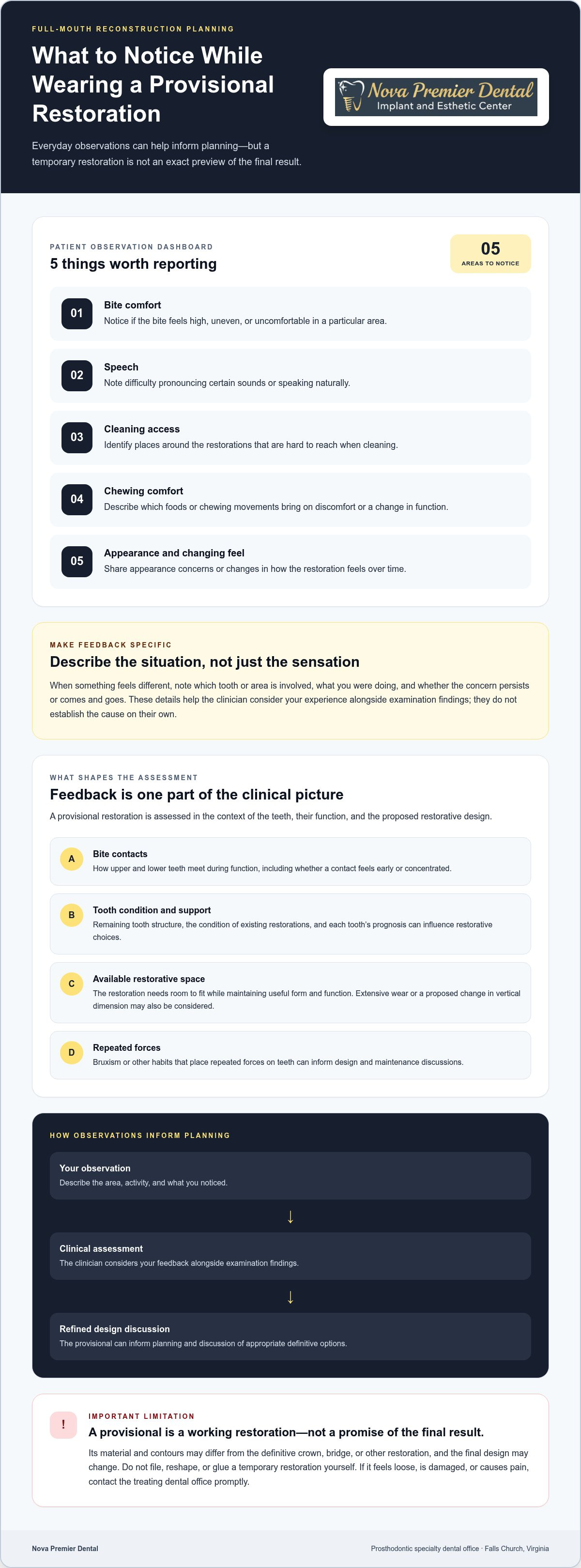
What to notice and discuss while wearing prototype restorations
Temporary crowns and prototype restorations can provide useful observations for full mouth reconstruction planning, but your experience is only one part of the clinical assessment. Pay attention to changes during ordinary activities and describe them specifically: which tooth or area is involved, what you were doing, and whether the concern persists or comes and goes.
Which changes are useful to report?
Consider keeping a brief note on changes such as:
- A bite that feels high or uncomfortable in a particular area.
- Difficulty pronouncing certain sounds or speaking naturally.
- Places that are hard to reach when cleaning around the restorations.
- Changes in chewing comfort, including which foods or movements bring them on.
- Appearance concerns, or a change in how the restoration feels over time.
These details help the clinician assess the restoration in context; they don't establish the cause on their own. Consulting a trusted dental reference or professional source on provisional restorations may offer additional background.
What should patients avoid doing themselves?
Don't file, reshape, or glue a temporary restoration at home. Those changes can affect its fit or make it harder for the clinician to assess. If it feels loose, is damaged, or causes pain, contact the treating dental office promptly. The clinician can examine it and decide whether an adjustment or another step is appropriate. Follow any care instructions provided for your specific restoration.
For an evaluation of restorative concerns, contact Nova Premier Dental, a prosthodontic specialty dental office in Falls Church serving Northern Virginia.
How a prosthodontist uses prototype feedback to refine reconstruction planning
Prototype feedback is considered alongside clinical findings, not in isolation. The prosthodontist evaluates the teeth and restorations, reviews the patient’s observations, reassesses the design, and then discusses appropriate definitive options. If a patient reports that a particular area feels high during chewing, for example, the clinician can examine the contacts and consider whether the contour or bite arrangement needs adjustment.
How feedback informs the next planning conversation
The review may include bite contacts, restoration contours, appearance, speech, and daily function. Some concerns may lead to a design change; others may require further assessment or discussion of alternatives. Recommendations remain individualized and may change as new clinical information develops. A prototype informs decisions, but temporary restorations cannot guarantee that definitive restorations will look or feel identical. The relationship among temporary crowns, prototype restorations, full mouth reconstruction planning is shaped by both clinical reassessment and patient priorities.
A prosthodontist’s specialty training may be useful when planning involves multiple teeth, complex restorative needs, or coordination between function and appearance. General dentists also provide important restorative care, and many appropriately manage crown and bridge treatment. The right approach depends on the patient’s findings and the complexity of the case. Learn about full mouth rehabilitation planning and how treatment options are considered in context.
For patients considering temporary crowns, prototype restorations, full mouth reconstruction planning, the goal is a careful discussion of what the evaluation can and cannot establish before definitive treatment. Dr. Peterson Huang, DMD, MS, FACP, FRCDC, is a dentist and dual board-certified prosthodontist in the United States and Canada. If you have questions about complex restorative treatment, you’re welcome to discuss your concerns with Nova Premier Dental, a private prosthodontic specialty dental office in Falls Church serving Northern Virginia.
Make your next treatment conversation more informed
Temporary crowns and prototype restorations can make full mouth reconstruction planning a more collaborative process by giving you a chance to describe how proposed changes fit your daily life. Your observations are one part of the decision, alongside the condition of your teeth and the clinician’s assessment. The next step is a clear conversation about which findings matter, what can be adjusted, and what tradeoffs may come with definitive options.
You don’t need to arrive with technical answers. Bring specific questions and notes about what feels comfortable, what doesn’t, and what matters most to you. That can help keep the discussion grounded in your priorities while the clinical details are considered.
For guidance about complex restorative planning, discuss your concerns with Nova Premier Dental in Falls Church, a private prosthodontic specialty dental office serving Northern Virginia. A thoughtful conversation can help you understand your options and feel more prepared for the decisions ahead.
Frequently Asked Questions
Are temporary crowns used as prototypes during full mouth reconstruction?
Sometimes. A temporary crown may serve mainly to cover a prepared tooth while definitive treatment is completed, or it may be designed to help evaluate a proposed restoration. The distinction matters: not every provisional crown is intended as a diagnostic prototype. In more involved cases, the clinician can explain what the specific temporary restorations are meant to help assess.
Can temporary crowns change the final full mouth reconstruction plan?
Yes. Findings during the provisional phase may lead the clinician to adjust a restoration’s shape, reconsider how teeth meet, or revisit the sequence of treatment. For example, if a temporary bridge places strain on a supporting tooth, its prognosis may need further consideration before definitive treatment is chosen. Patient feedback contributes to these decisions, but it’s weighed with examination findings and other clinical factors.
How long do prototype restorations need to be worn?
There isn’t one standard wearing period for every prototype. The appropriate duration depends on what the clinician is evaluating, the restorations involved, and other treatment needs. Follow the schedule provided for your case rather than deciding on your own that the trial is complete. If you’re unsure whether an observation period is finished, ask the treating dental office before proceeding to definitive restorations.
What should I do if a temporary crown feels high or becomes loose?
Contact the treating dental office and describe what you notice, such as which tooth feels high or when the crown began moving. Don’t file, reshape, or glue it yourself. If the crown comes off, keep it safe and ask the office how to proceed. Patients in Falls Church and nearby McLean, Great Falls, Arlington, Fairfax, Tysons, and Annandale can seek guidance from their treating dental team.
Do temporary crowns guarantee that permanent crowns will feel the same?
No. A temporary crown can help assess a proposed shape or bite, but it can’t guarantee the permanent crown will feel identical. The final restoration may use different materials or contours, and its fit is evaluated separately. If the provisional feels comfortable, that’s useful information to share, not a promise that every detail of the definitive crown will match.
Disclaimer
The information provided on this website and blog is intended for general educational and informational purposes only and should not be considered dental or medical advice, diagnosis, or treatment. Reading content on this website does not establish a doctor-patient relationship with Nova Premier Dental or Dr. Peterson Huang. Dental conditions and treatment needs vary from patient to patient. Individuals should consult directly with a qualified dental professional for personalized evaluation, diagnosis, and treatment recommendations. Do not delay seeking professional dental care based on information found on this website. While we strive to provide accurate and up-to-date information, no guarantee is made regarding the completeness, accuracy, or applicability of the content. Treatment outcomes may vary depending on individual circumstances. If you are experiencing a dental emergency or urgent oral health concern, please contact a licensed dental professional immediately or call 911 in the event of a medical emergency.


