


Article by
Peterson Huang DMD, MS, FACP, FRCDC
Dr. Peterson Huang is a dual board-certified prosthodontist serving Falls Church and Northern Virginia. He has been recognized as a Top Prosthodontist by Northern Virginia Magazine and Arlington Magazine and is affiliated with the Inova Fairfax Hospital Tumor Board. Dr. Huang focuses on dental implants, full mouth reconstruction, and complex restorative dentistry for patients who need advanced, comprehensive care.
A broken implant crown can look alarming, but it doesn’t automatically mean the implant in your jaw has failed. The visible crown, the connecting parts beneath it, and the implant fixture in the bone are separate components, and the source of the problem matters when deciding whether to replace an implant crown or consider implant restoration repair.
It’s understandable to worry that chewing or waiting could make the damage worse. If the crown feels loose, is chipped, or has come off, avoid chewing on that side and arrange a professional evaluation. An examination can help determine whether the issue is limited to the crown or involves a screw, another component, the bite, or the implant itself.
This article explains what may have broken, how clinicians assess a broken implant crown, and when smoothing or repairing it may be appropriate. You’ll also learn what can make replacement the better option and why identifying the cause of the damage is important before a new restoration is made.
Key Takeaways
- A damaged crown doesn’t automatically mean the implant in the jaw has failed; identifying which component is affected is an important first step.
- Bite forces, grinding, restoration design, and implant position may contribute to damage, so the cause should be assessed rather than assumed.
- Learn how clinicians decide whether to replace an implant crown or consider implant restoration repair for a broken implant crown.
- Before an evaluation, avoid forceful chewing on the area, don’t manipulate loose parts, and don’t use household adhesives.
What Is a Broken Implant Crown, and Does It Mean the Implant Failed?
A broken implant crown doesn’t, by itself, mean the implant in the jaw has failed. An implant restoration includes the visible crown and the components that connect it to the implant body. Crown damage and implant-body problems are not interchangeable diagnoses. A chip may involve only the crown, while movement could involve a connecting component or the implant itself.
Which parts make up an implant crown restoration?
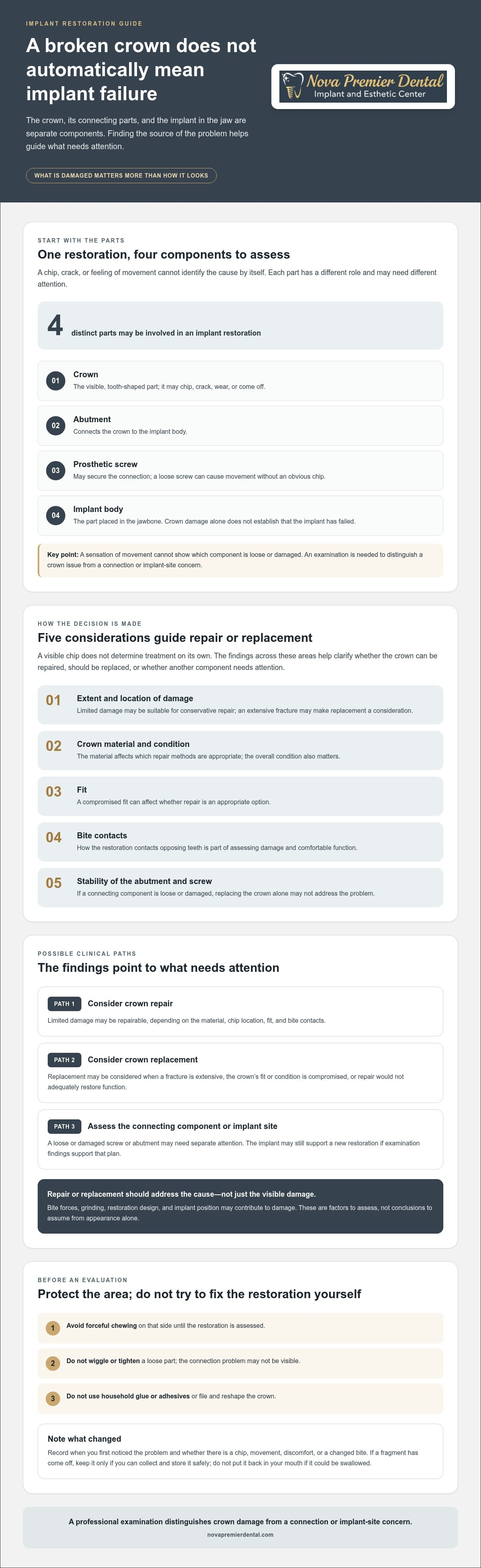
The implant body is the part placed in the jawbone. An abutment connects it to the crown, and a prosthetic screw may secure the connection. The crown is the visible, tooth-shaped part. Because these components work together, a sensation of movement doesn’t reveal which one is loose or damaged. An examination is needed to distinguish a crown problem from an issue involving its connections or the implant site.
What changes should prompt an evaluation?
Arrange an evaluation if you notice a chip, crack, missing crown, movement, discomfort, or a sudden change in how your teeth meet. A restoration that feels high when you bite may reflect an altered contact, but that sensation alone can’t identify the cause. Assessment considers the crown, its connections, the bite, and the implant site to clarify what needs attention.
Why Implant Crowns Break, Loosen, or Wear
Wear, chipping, fracture, or loosening can have more than one contributing factor, and the visible damage alone may not reveal the cause. The way the upper and lower teeth contact, the restoration’s shape and material, and the implant’s position can all influence how force reaches the crown and its connecting parts. These are factors to assess, not conclusions to draw from appearance alone.
A clinician may examine the crown for cracks or wear, assess whether the abutment and screw are stable, check the surrounding tissues, and evaluate how the restoration contacts opposing teeth. Implant position can affect how a crown is shaped and loaded; the Mayo Clinic’s overview of dental implant surgery explains the placement process and the role of the jawbone in supporting an implant.
How can bite forces and bruxism affect an implant restoration?
Clenching or grinding, known as bruxism, may expose a crown or its components to repeated or concentrated forces. A bite contact that is heavier on one restoration may also affect how load is distributed. A night guard may be appropriate for some patients, but the decision depends on an individual assessment of the bite, symptoms, and restoration.
Why do the abutment, screw, and crown need separate evaluation?
A fractured crown may show visible damage, while a loose screw or abutment can cause movement without an obvious chip. Similar sensations can have different causes, so examination findings guide whether further diagnostic assessment is appropriate. Identifying the cause matters because repair or replacement should address the condition contributing to the damage, not just its visible result.
If you’re unsure whether to replace an implant crown or consider implant restoration repair, an evaluation can clarify what needs attention. A prosthodontic evaluation at Nova Premier Dental can help assess complex crown and implant-restoration concerns.
Repair or Replace an Implant Crown: How the Decision Is Made
A visible chip doesn’t determine treatment on its own. The decision depends on the damage’s extent and location, the crown’s material and condition, its fit, bite contacts, and whether the abutment or screw is stable. If the examination shows that the implant is healthy and the problem is limited to the restoration, the implant may remain in place.
When might a crown repair be considered?
Limited damage may be suitable for conservative repair, though that depends on the case. The crown material affects which repair methods are appropriate, while the chip’s location, fit, and bite contacts help determine whether a repair can restore comfortable function. Nova Premier Dental’s crown restoration options include factors relevant to evaluating damaged crowns.
When might replacing the crown be considered?
Replacement may be considered if a fracture is extensive, the crown’s fit or condition is compromised, or repair would not adequately restore function. A loose or damaged screw or abutment may need separate attention, since replacing the crown alone may not address the component problem. The implant may still support a new restoration if the clinical findings support that plan. Dental implant treatment information provides broader context about implant care.
An individualized examination helps determine whether repair, replacement, or attention to a connecting component is appropriate. For an assessment of implant crowns and restoration options, contact Nova Premier Dental.
What to Do Before an Implant Restoration Repair Visit
Until the restoration is assessed, avoid forceful chewing on that side and don’t wiggle or try to tighten any loose part. A crown that moves may have a connection problem that isn’t visible, and manipulating it could complicate evaluation. Don’t use household glue or adhesives, file or reshape the crown, or attempt to alter the implant components. These measures can damage the restoration or interfere with professional repair.
What information can help during the assessment?
Make a note of when you first noticed the problem and what changed: a chip, movement, discomfort, or a different bite. If a crown fragment has come off, bring it only if you can collect and store it safely. Don’t put a loose piece back in your mouth if there’s a risk of swallowing it. This history can help the clinician assess the restoration alongside the examination findings.
When may prosthodontic evaluation be useful?
A prosthodontic assessment may be helpful if the damage involves several components, the crown’s design or fit is in question, or bite forces may be contributing. Prosthodontists receive advanced training in the restoration and replacement of teeth, including how crown design and bite contacts relate to function. Dr. Peterson Huang, DMD, MS, FACP, FRCDC, is a dentist and dual board-certified prosthodontist, with prosthodontic certifications in the United States and Canada. You can learn about Dr. Huang’s training and background.
Seek prompt clinical advice if you have significant pain, swelling, or marked instability. These symptoms don’t identify the cause on their own, but they warrant timely assessment. For a broken implant crown, an individualized evaluation can clarify whether to repair or replace the crown and what to do about any affected components. Nova Premier Dental, a private prosthodontic specialty dental office in Falls Church serving Northern Virginia, welcomes patients seeking an assessment of implant restorations.
Take the Next Step Toward a Stable Restoration
Once the damaged restoration has been assessed, discuss what matters most to you, such as comfortable chewing, appearance, or preserving a serviceable part of the existing restoration when clinically appropriate. The clinician can explain the reasoning behind the proposed plan, what it is intended to address, and any limitations. This conversation helps you understand the choices before treatment begins.
If you’re weighing whether to replace an implant crown or repair a broken implant crown, the decision should follow the examination rather than a general rule. Ask how the recommended approach relates to the condition of the crown and its supporting components, and what care the restoration may need afterward. Clear expectations can make the next step easier to plan.
For individualized care involving implant restorations and crowns, learn about prosthodontic care at Nova Premier Dental in Falls Church. A considered assessment can help you move forward with a plan suited to your needs.
Frequently Asked Questions
What should I do with a broken implant crown fragment?
If you can retrieve the fragment easily, place it in a clean container and bring it to your appointment. Don’t force it back into place or try to reshape it, since that could alter the edges or fit. Avoid chewing on the fragment. If the remaining crown feels loose, has a sharp edge, or causes pain, contact your dental office for guidance about what to do before your evaluation.
Can I use temporary dental cement or superglue on an implant crown?
Don’t use superglue or try to bond a damaged implant crown yourself. Temporary dental cement also shouldn’t be applied without instructions from your dental office, since the crown’s design and the condition of its connections affect what’s appropriate. If it has come off, keep it safe and avoid chewing on that side. A clinician can assess the parts and advise whether the crown can be repositioned or needs treatment.
How long does it take to replace an implant crown?
There isn’t one timeline that applies to every replacement. The sequence depends on what the examination shows, including whether the abutment or screw needs attention and what is involved in designing and making the restoration. For example, a case limited to the crown may require different steps from one involving a connecting component. Your clinician can outline the expected process after assessing the restoration and planning the appropriate implant restoration repair or replacement.
Will a replacement implant crown look exactly like the original?
An exact match can’t be promised, but the replacement can be planned in relation to the surrounding teeth. Shade and shape are part of the decision, as are available space, gum contours, material, and bite. These factors may limit which aesthetic changes are practical. Before replacing a crown, discuss what you’d like to preserve or adjust so the clinician can consider appearance alongside fit and function.
Disclaimer
The information provided on this website and blog is intended for general educational and informational purposes only and should not be considered dental or medical advice, diagnosis, or treatment. Reading content on this website does not establish a doctor-patient relationship with Nova Premier Dental or Dr. Peterson Huang. Dental conditions and treatment needs vary from patient to patient. Individuals should consult directly with a qualified dental professional for personalized evaluation, diagnosis, and treatment recommendations. Do not delay seeking professional dental care based on information found on this website. While we strive to provide accurate and up-to-date information, no guarantee is made regarding the completeness, accuracy, or applicability of the content. Treatment outcomes may vary depending on individual circumstances. If you are experiencing a dental emergency or urgent oral health concern, please contact a licensed dental professional immediately or call 911 in the event of a medical emergency.


