


Article by
Peterson Huang DMD, MS, FACP, FRCDC
Dr. Peterson Huang is a dual board-certified prosthodontist serving Falls Church and Northern Virginia. He has been recognized as a Top Prosthodontist by Northern Virginia Magazine and Arlington Magazine and is affiliated with the Inova Fairfax Hospital Tumor Board. Dr. Huang focuses on dental implants, full mouth reconstruction, and complex restorative dentistry for patients who need advanced, comprehensive care.
Does food catching beside an implant crown mean the implant is failing? Not necessarily. Repeated food around an implant crown can be frustrating, especially when you’re unsure whether an implant crown gap is normal or how to clean it without irritating your gum.
The cause may involve the implant contacts, the crown’s shape, or changes in the surrounding gum and teeth. An interproximal contact is where the crown meets a neighboring tooth; the emergence profile is the way the crown contours through the gum. These details affect where food collects and how easily you can clean the area. This article explains how contact differs from contour, what observations can help a dental professional assess the problem, and how to approach implant hygiene without forcing tools into a space. Food trapping alone doesn’t establish that an implant has failed, but a persistent change is worth discussing at an examination.
Key Takeaways
- Food around an implant crown can have several explanations; a gap doesn’t automatically mean the implant has failed.
- Learn how implant contacts and the crown’s interproximal contact and emergence profile can affect where food collects and how easily you can clean.
- Notice where food catches and whether the pattern has changed, then share those observations at an examination.
- For implant hygiene, clean gently and don’t force floss or another cleaning aid through a tight or painful area.
Why Food Gets Caught Around an Implant Crown
Food collecting around an implant crown can have several restorative or anatomical explanations. Neighboring teeth may not meet as expected, the crown’s shape may create a ledge, or the gum tissue may have changed. The sensation alone can’t identify the cause or establish that the implant has failed. A food trap near an implant crown is a reason to notice where it occurs, not to assume what is wrong.
What patients mean by an implant crown gap
“Gap” can describe different spaces. An interproximal contact is where neighboring teeth or restorations meet. If that contact is open, food may lodge between the implant crown and the adjacent tooth. A separate space may be visible beside the crown near the gum. These spaces aren’t interchangeable, and their significance can’t be determined reliably from appearance alone. A dental examination can clarify which area is involved.
Why contact and contour are different
Contact describes how the sides of two neighboring teeth or restorations relate. It doesn’t describe the crown’s entire shape. The emergence profile is the crown’s contour as it extends from the implant area through the gum. Its shape can influence where food collects and how accessible the area is for cleaning, even when neighboring surfaces touch.
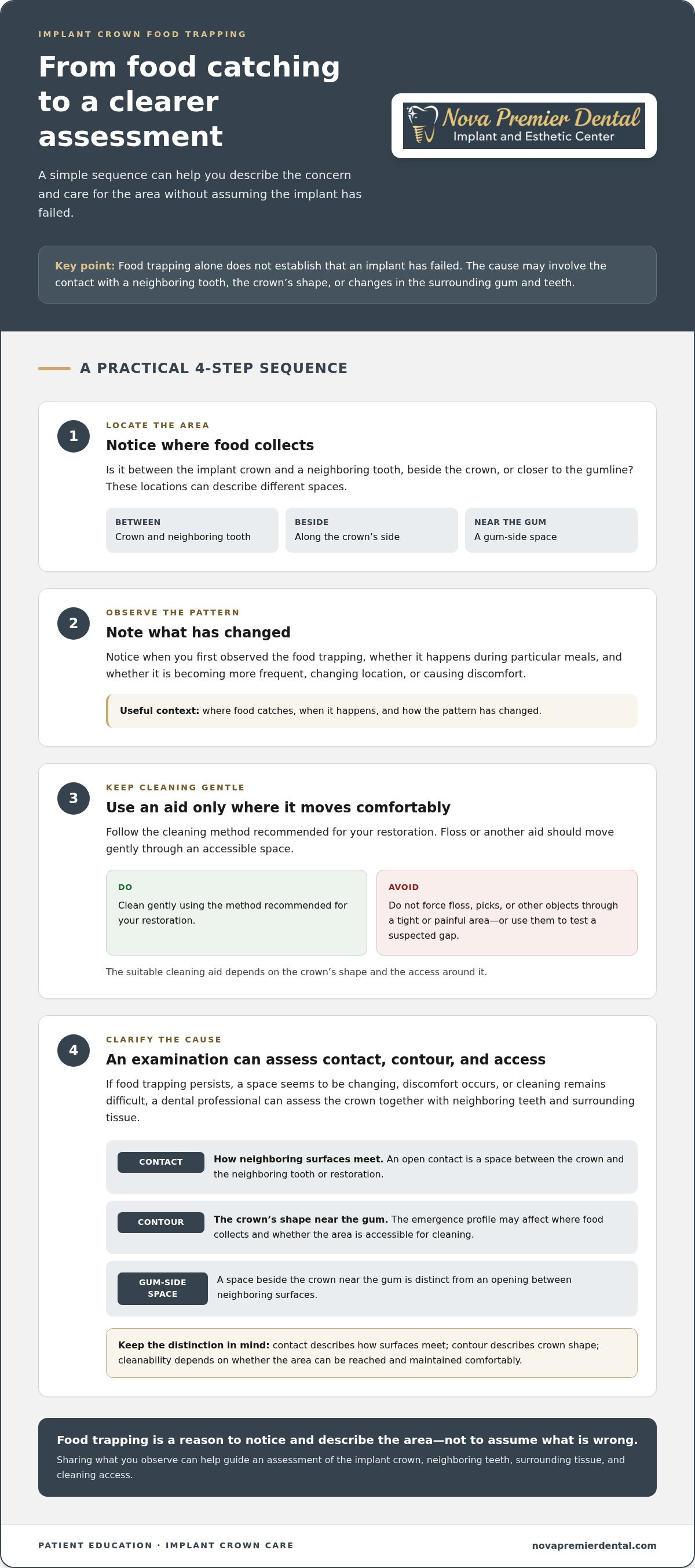
Contact describes how neighboring surfaces meet; contour describes the crown’s shape; cleanability depends on whether the area can be reached and maintained comfortably. These distinctions can help make an implant crown gap easier to describe without presuming its cause. An implant includes components such as a fixture, abutment, and crown; the dental implant overview summarizes these parts.
Noticing whether food catches between teeth or nearer the gum can help explain the concern during an examination. If you’d like to discuss a persistent implant crown concern with Nova Premier Dental in Falls Church, you can use the practice contact page.
How Implant Crown Contact and Emergence Profile Affect Food Trapping
An implant crown and a neighboring natural tooth are supported differently. The implant is anchored to bone, while a natural tooth has a periodontal ligament that allows slight movement under pressure. This difference can affect how their neighboring surfaces relate over time. Food catching between them may prompt an assessment of the contact, but crown shape and gum-side spaces also matter.
What an interproximal contact examination considers
A dental professional assesses how the implant crown’s side meets the neighboring tooth or restoration, along with where and when food catches. Whether the issue is new, occurs during particular meals, or is accompanied by discomfort can add useful context. There isn’t one universal contact measurement or shape that suits every mouth; the relationship is considered alongside the surrounding teeth and restorations.
How the emergence profile relates to cleanability
The emergence profile is the crown’s contour as it rises from the implant area through the gum. Its form must be considered with the nearby tissue and the space available for cleaning. A contour may influence how food is deflected and whether hygiene aids can access the area, but its appearance alone doesn’t predict symptoms or tissue changes.
| What may be observed | What it describes |
|---|---|
| Contact opening | A space between the crown and neighboring tooth or restoration. |
| Contour concern | A crown shape that may create a ledge or make cleaning access difficult. |
| Gum-side space | An area beside the crown near the gum, which is different from an opening between neighboring surfaces. |
Contact describes how neighboring surfaces meet; emergence profile describes the crown’s shape near the gum, so each requires separate assessment alongside cleanability. This distinction can help explain why food catches without assuming a cause. For information about implant and crown care, Nova Premier Dental provides prosthodontic care in Falls Church.
How to Clean Around an Implant Crown and What to Observe
Clean gently using the method recommended for your restoration. If food repeatedly catches, note where it collects and whether the pattern changes instead of probing the area. Implant hygiene needs vary with the crown’s shape and the access around it, so a tool that works elsewhere in your mouth may not suit this site.
What to note before an evaluation
Notice whether food catches between the implant crown and a neighboring tooth, beside the crown, or closer to the gumline. Record when you first noticed the problem and whether it is becoming more frequent, changing location, or causing discomfort. These details can help a dental professional understand what you’re experiencing. Don’t test a suspected gap by pushing floss, picks, or other objects into it.
Choose cleaning aids without forcing them
Floss or another aid should move gently through an accessible space. Don’t force it through a tight or painful area. The suitable tool depends on the restoration and your individual access. Nova Premier Dental’s guidance on oral hygiene aids and information about dental implants address care for teeth and implant restorations.
When an examination can help
Arrange an examination if food trapping persists, a space seems to be changing, you have discomfort, or cleaning remains difficult. A clinician can assess the crown, neighboring teeth, surrounding tissue, and hygiene access together. Share where food catches and what you’ve noticed over time; this context helps guide the evaluation without assuming that a particular correction is needed.
How a Prosthodontic Evaluation Can Clarify an Implant Crown Gap
An examination can help distinguish an open contact from a crown-contour concern or a space near the gum. A clinician considers the implant crown, neighboring teeth, surrounding tissue, symptoms, and whether the area can be cleaned comfortably. A visible space alone doesn’t determine what treatment, if any, is appropriate.
What the clinician may assess
The evaluation may include how the crown meets adjacent teeth or restorations, its contour near the gum, the condition of neighboring teeth, and access for daily cleaning. If clinically relevant, the bite and restorative design may also be considered. Your description of where food catches and whether the concern has changed helps provide context. Management depends on the findings; adjustment or replacement isn’t automatic.
Where prosthodontic training may be relevant
Prosthodontists receive advanced training in restoring and replacing teeth, including crown design and evaluation. Many dentists provide appropriate restorative care, while specialist input may be helpful in complex situations. Dr. Peterson Huang, DMD, MS, FACP, FRCDC, is a dentist and dual board-certified prosthodontist with prosthodontic certifications in the United States and Canada; you can learn more about Dr. Huang’s training and background. Nova Premier Dental’s Falls Church practice provides implant and crown care, and its prosthodontic information for Northern Virginia explains the specialty.
Take the Next Step Toward Comfortable Implant Care
If food catches around an implant crown, pay attention to what feels different during eating and cleaning rather than trying to diagnose the space yourself. A perceived implant crown gap can involve the relationship between implant contacts, the crown’s contour, or access for implant hygiene. Understanding whether the concern relates to an interproximal contact or the emergence profile can help guide a focused conversation with a dental professional.
You don’t need to have the right technical terms or know what treatment might be needed. Sharing when the issue began, where food collects, and whether cleaning is uncomfortable gives the clinician useful context for deciding what to assess and whether any next step is appropriate.
For a persistent concern, connect with Nova Premier Dental about an implant crown evaluation. A clearer understanding of the area can help you move forward with a practical plan for care.
Frequently Asked Questions
Why does food get stuck between my implant crown and the next tooth?
Food may catch because the crown and neighboring tooth don’t meet closely, or because the crown’s shape or nearby gum area creates a place where food collects. The sensation alone can’t identify the cause. Notice whether it happens in the same spot or with particular foods, and whether it’s becoming more frequent. A dental examination can assess the crown and adjacent tooth together.
Is a gap around an implant crown normal?
It depends on where the space is and how it relates to the surrounding teeth and gum. A visible space doesn’t by itself show that the crown or implant has a problem, and some spaces reflect the anatomy of the area. If an implant crown gap seems new, is changing, or traps food repeatedly, arrange an examination rather than judging it by appearance alone.
Can an implant crown lose contact with the neighboring tooth?
The contact relationship can change or become noticeable over time, but the reason varies from person to person. Comparing the current space with what you remember, or mentioning when you first noticed it, can help provide context. Don’t try to restore the contact yourself with a toothpick or another object. If food repeatedly catches or the space appears to be changing, have the area assessed.
How do I clean around an implant crown when food gets trapped?
Use the cleaning method recommended for your restoration, and stop if floss or another aid meets resistance or causes pain. Don’t force it through. For food around an implant crown, note where it catches and whether a particular aid is difficult to use. Suitable tools depend on the crown’s shape and access, so an examination can help guide implant hygiene without irritating the area.
Does food trapping around an implant crown mean the implant is failing?
No. Food trapping is a symptom, not a diagnosis, and it doesn’t establish implant failure. A clinician can assess the restoration and surrounding area to understand what may be contributing, especially if the concern persists or changes. Discomfort or difficulty keeping the area clean is also useful to mention. The findings, rather than food trapping alone, guide whether any treatment is appropriate.
Disclaimer
The information provided on this website and blog is intended for general educational and informational purposes only and should not be considered dental or medical advice, diagnosis, or treatment. Reading content on this website does not establish a doctor-patient relationship with Nova Premier Dental or Dr. Peterson Huang. Dental conditions and treatment needs vary from patient to patient. Individuals should consult directly with a qualified dental professional for personalized evaluation, diagnosis, and treatment recommendations. Do not delay seeking professional dental care based on information found on this website. While we strive to provide accurate and up-to-date information, no guarantee is made regarding the completeness, accuracy, or applicability of the content. Treatment outcomes may vary depending on individual circumstances. If you are experiencing a dental emergency or urgent oral health concern, please contact a licensed dental professional immediately or call 911 in the event of a medical emergency.


