


Article by
Peterson Huang DMD, MS, FACP, FRCDC
Dr. Peterson Huang is a dual board-certified prosthodontist serving Falls Church and Northern Virginia. He has been recognized as a Top Prosthodontist by Northern Virginia Magazine and Arlington Magazine and is affiliated with the Inova Fairfax Hospital Tumor Board. Dr. Huang focuses on dental implants, full mouth reconstruction, and complex restorative dentistry for patients who need advanced, comprehensive care.
Could a dental evaluation before radiation affect when cancer treatment begins? It can inform the plan, but it doesn’t automatically mean treatment will be delayed. Head and neck radiation dental care often starts with a pre-radiation dental evaluation, sometimes called cancer dental clearance, to identify oral health concerns that may need attention before treatment.
It’s understandable to wonder whether teeth will need to be removed, what radiation may mean for your mouth, and how dental care fits into an already demanding treatment schedule. The evaluation is not a universal checklist or a guarantee against complications. Its findings help your dental and oncology teams weigh the condition and location of each concern alongside the planned radiation field and timing.
This article explains what the assessment may involve, what information can help your dental provider, and which questions to raise with your oncology team. You’ll also learn how clinicians coordinate decisions about treatment, healing time, oral side effects, and longer-term restorative needs.
Key Takeaways
- Head and neck radiation dental care begins with a pre-radiation dental evaluation; cancer dental clearance is an individualized assessment, not a guarantee or a universal checklist.
- Bring your dental and medication histories, current oral symptoms, and any available information about the planned radiation treatment to help inform the discussion.
- Dental findings, existing restorations, oral dryness, and your ability to maintain oral hygiene may all be considered when planning care.
- Ask how dental findings will be shared with your oncology team and who will communicate any changes to the plan.
What does a pre-radiation dental evaluation assess?
Head and neck radiation dental care may include a pre-radiation dental evaluation, an assessment of oral health and dental planning coordinated with the oncology team. “Cancer dental clearance” describes communicating relevant findings and a dental plan to that team; it is not medical or oncology approval, a guarantee of a complication-free course, or a fixed checklist for every patient. The evaluation’s findings depend on the patient’s oral health, the planned treatment, and the clinical details available from the oncology team.
Why is dental care considered before head and neck radiation?
The evaluation can identify oral health concerns that may affect supportive dental care before or during treatment. A dentist may assess the teeth, gums, and oral tissues for signs of disease, infection, or damage, while considering how the planned radiation may affect the mouth. Radiation’s effects vary with the treatment plan and individual circumstances. General background on head and neck cancer and its treatments is available in this Head and Neck Cancer Overview. Dental assessment informs oral care; decisions about cancer treatment remain with the oncology team.
What does dental clearance mean for an individual patient?
It means sharing relevant dental findings and discussing appropriate next steps, not promising that every risk has been removed. Some patients may need treatment for a specific concern; others may be advised to monitor an area or follow preventive guidance, such as maintaining effective daily oral hygiene. Home-care practices can support that routine, but recommendations should reflect a patient’s needs during cancer treatment.
A tooth with a concern does not automatically need to be extracted. Its condition, expected prognosis, relationship to the planned radiation, and the oncology team’s treatment details all matter. A consistent home oral-care routine may be part of the discussion, alongside any individualized dental plan.
How does the dental evaluation guide care before radiation?
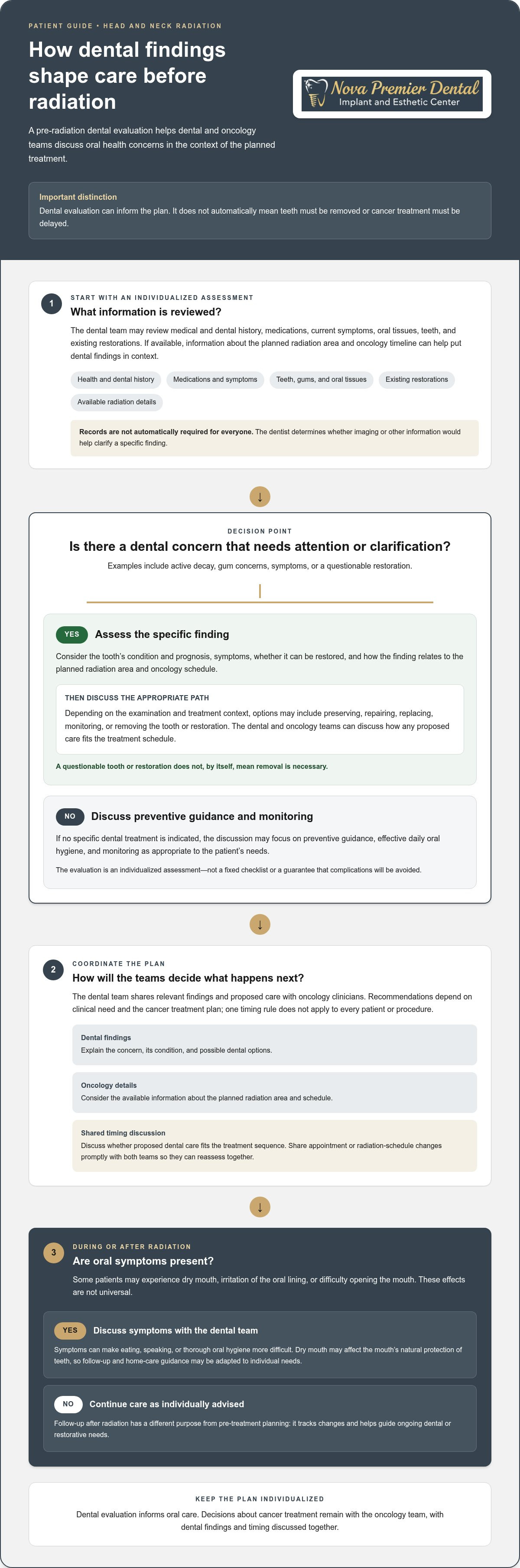
A pre-radiation dental evaluation helps translate oral health findings and available oncology information into a coordinated plan. The dental team reviews treatment details, assesses oral health, discusses findings, and works with oncology clinicians to determine next steps. Evaluation findings guide discussion; they don’t dictate one universal treatment plan.
What may the dental team review?
The review may include medical and dental history, medications, current symptoms, oral tissues, teeth, and existing restorations. If available, details about the planned radiation area and oncology timeline help the dental team consider how findings relate to treatment. The National Cancer Institute’s Oral Complications of Cancer Therapies resource describes effects that may inform supportive care planning.
Imaging or other records aren’t automatically needed for everyone. The dentist determines whether additional information would help clarify a finding, such as a tooth’s condition or the extent of an existing problem. Patients can bring medication and dental histories, describe symptoms, and share available oncology documents.
How are findings and timing discussed?
After assessment, the dental team explains relevant findings and proposed care to the oncology clinicians. Recommendations depend on clinical need and the cancer treatment plan. The teams can discuss how proposed dental care fits the schedule without assuming that one timing rule applies to every procedure and patient.
Share changes to appointments or the radiation schedule promptly with both teams so they can reassess the sequence together. For complex restorative concerns, prosthodontic care in Falls Church may contribute to oral rehabilitation planning.
Which dental concerns may change the plan before or after radiation?
Dental planning considers more than whether a tooth is present or missing. Active decay, gum concerns, symptoms, the condition of existing restorations, and a person’s ability to clean their mouth can all inform care. Radiation-related effects also vary according to the treatment plan and individual circumstances, so a concern that matters for one patient may not change another patient’s plan.
When might a tooth or restoration need attention?
A dentist may consider a tooth’s prognosis, symptoms, and whether it can be restored, along with the planned radiation area and oncology schedule. For example, a tooth with a questionable restoration may need closer assessment, but that finding alone doesn’t establish that the tooth should be removed. Depending on the examination and treatment context, preservation, repair, replacement, monitoring, or removal may be discussed with the oncology team.
Radiation doesn’t automatically make existing teeth unsuitable for retention. The decision should reflect the specific dental findings and coordinated treatment plan, rather than a fixed extraction rule.
What oral effects may need ongoing dental attention?
During or after treatment, some patients may experience dry mouth, irritation of the oral lining, or difficulty opening the mouth. These effects aren’t universal. If present, they can make eating, speaking, or thorough oral hygiene more difficult. Dry mouth may also affect the mouth’s natural protection of teeth, so the dental team may adapt follow-up and home-care guidance to a patient’s symptoms and needs.
Planning before radiation and monitoring afterward serve different purposes: the first addresses existing concerns and supportive care, while follow-up tracks changes and helps guide ongoing dental or restorative needs. For complex restorative concerns after oral cancer treatment, explore oral cancer rehabilitation at Nova Premier Dental in Falls Church, serving patients throughout Northern Virginia.
How can patients coordinate dental and oncology care in Northern Virginia?
Clear communication helps the dental and oncology teams consider oral health alongside the cancer treatment plan. Keep both teams informed about appointments, symptoms, and proposed dental care, and let them coordinate timing and next steps. Don’t delay cancer treatment on your own while arranging dental care. Even for patients exploring options through alternative cancer treatment centers Arizona or other specialized programs, maintaining open dialogue ensures dental support stays properly aligned with overall therapy.
What information should patients bring to a dental visit?
Bring or share what you have available. Useful details include:
- Your medication list and relevant medical and dental history.
- Information about the planned treatment area and anticipated schedule.
- Current symptoms, such as pain, loose teeth, oral sores, dry mouth, or difficulty eating.
- Recent dental records or details about prior treatment, if available.
Ask who will send dental findings to the oncology team, how you’ll learn about plan changes, and whom to notify if an appointment or treatment date shifts. If some information isn’t available yet, share what you know and ask what details would help the teams coordinate.
When may prosthodontic input be useful?
A prosthodontist may help with complex restorative planning or oral rehabilitation when cancer treatment affects dental or jaw function. At Nova Premier Dental, Dr. Peterson Huang, DMD, MS, FACP, FRCDC, is a dentist and dual board-certified prosthodontist in the United States and Canada. Patients can learn about prosthodontic specialty care in Northern Virginia and the practice’s oral cancer rehabilitation.
Nova Premier Dental is a private prosthodontic specialty dental office in Falls Church serving Northern Virginia. Explore prosthodontic care at Nova Premier Dental if you have complex restorative or oral rehabilitation questions related to cancer treatment.
Keep your dental plan connected as care continues
As treatment moves forward, oral health needs may change, so think of dental planning as an ongoing conversation rather than a single clearance milestone. Keep dental recommendations and oncology instructions together, note new symptoms or changes in eating or mouth opening, and share them with the appropriate care team. For patients coordinating routine health services with specialized cancer therapies, community health organizations like Quality Comprehensive Health Center show how integrated care supports overall well-being throughout complex treatments. If treatment dates or plans shift, ask how that affects dental follow-up. Don’t change cancer treatment based on dental advice alone.
Coordination doesn’t mean every concern can be resolved before radiation or that future effects can be predicted. It gives clinicians a clearer basis for decisions as your needs evolve. For questions about head and neck radiation dental care, a pre-radiation dental evaluation, or what cancer dental clearance means for your circumstances, focus the conversation on your restorative needs and treatment context. You can also ask how dental follow-up may adapt if your symptoms or oral health change after treatment.
Explore prosthodontic care at Nova Premier Dental to learn about restorative and oral rehabilitation care. A clear plan and open communication can help you take the next step with greater understanding.
Frequently Asked Questions
Is dental clearance required before head and neck radiation?
Not in every case; the oncology team may request a dental evaluation based on the planned treatment and your oral health. The dentist’s findings can inform supportive care, but they don’t certify that treatment is risk-free. Ask whether the oncology team needs a written dental report, who should receive it, and whether your dental provider has the relevant treatment details.
Can dental treatment delay head and neck radiation?
It depends on the dental concern, the proposed care, and the cancer-treatment schedule. If a procedure is recommended, ask the dental team to explain its purpose and expected recovery needs, then share that information with your oncology team promptly. Don’t change a radiation date on your own. The oncology clinicians can determine how the dental recommendation fits the overall plan.
Does everyone need teeth extracted before head and neck radiation?
No. Extraction is not automatic. A dentist evaluates the specific tooth, including symptoms, remaining structure, and whether it can be restored, then considers the oncology treatment details. Some teeth may be monitored or treated without removal. If extraction is proposed, ask what makes the tooth’s prognosis a concern and how the recommendation relates to your individual treatment plan.
Should I have a dental evaluation if I am receiving chemotherapy as well as radiation?
Discuss dental evaluation with your oncology team if chemotherapy is also planned. The combined treatment schedule, medications, medical history, and current oral health can affect what dental care is appropriate and when. Bring an up-to-date medication list and mention recent dental procedures or changes in your mouth. Your oncology team can share relevant treatment information with your dental provider.
Disclaimer
The information provided on this website and blog is intended for general educational and informational purposes only and should not be considered dental or medical advice, diagnosis, or treatment. Reading content on this website does not establish a doctor-patient relationship with Nova Premier Dental or Dr. Peterson Huang. Dental conditions and treatment needs vary from patient to patient. Individuals should consult directly with a qualified dental professional for personalized evaluation, diagnosis, and treatment recommendations. Do not delay seeking professional dental care based on information found on this website. While we strive to provide accurate and up-to-date information, no guarantee is made regarding the completeness, accuracy, or applicability of the content. Treatment outcomes may vary depending on individual circumstances. If you are experiencing a dental emergency or urgent oral health concern, please contact a licensed dental professional immediately or call 911 in the event of a medical emergency.


