
Article by
Peterson Huang DMD, MS, FACP, FRCDC
Dr. Peterson Huang is a dual board-certified prosthodontist serving Falls Church and Northern Virginia. He has been recognized as a Top Prosthodontist by Northern Virginia Magazine and Arlington Magazine and is affiliated with the Inova Fairfax Hospital Tumor Board. Dr. Huang focuses on dental implants, full mouth reconstruction, and complex restorative dentistry for patients who need advanced, comprehensive care.
Is your denture adhesive becoming a permanent staple in your morning routine, or is it simply masking a deeper structural failure? Most patients at Nova Premier Dental naturally hope a quick reline or a minor fix will suffice when a prosthetic begins to feel uncomfortable. However, understanding when to replace dentures instead of repair is essential to preventing accelerated bone loss and maintaining the structural integrity of your facial profile.
As a dual board-certified prosthodontist in Northern Virginia, I've seen how repeated minor repairs often lead to chronic gum irritation and long-term dysfunction. In this guide, Dr. Peterson Huang outlines the critical clinical signs that indicate your appliance has reached the end of its functional lifespan. You'll discover how a comprehensive replacement restores not just your ability to eat and speak clearly, but also provides a superior return on investment for your oral health. We prioritize your long-term wellness by offering in-house payment plans for qualifying patients; this allows you to comfortably manage the cost of elite care while you're already enjoying the benefits of a rejuvenated, functional smile.
Key Takeaways
- Learn why the five to seven year functional lifespan of acrylic prosthetics is a biological limit, as material fatigue leads to bacterial absorption and structural instability.
- Recognize the specific physiological markers of jawbone resorption that indicate when to replace dentures instead of repair to maintain your facial structure and long-term oral health.
- Understand how chronic irritation from ill-fitting dentures can lead to systemic issues, including nutritional deficiencies and the development of painful stomatitis.
- Discover how high-precision, custom-milled dentures and implant-supported solutions provide a stable foundation that temporary repairs simply cannot match.
- Explore how specialized in-house payment plans allow you to invest in a high-end, restorative solution while comfortably managing costs over several months.
Understanding the Lifespan of Modern Dental Prosthetics
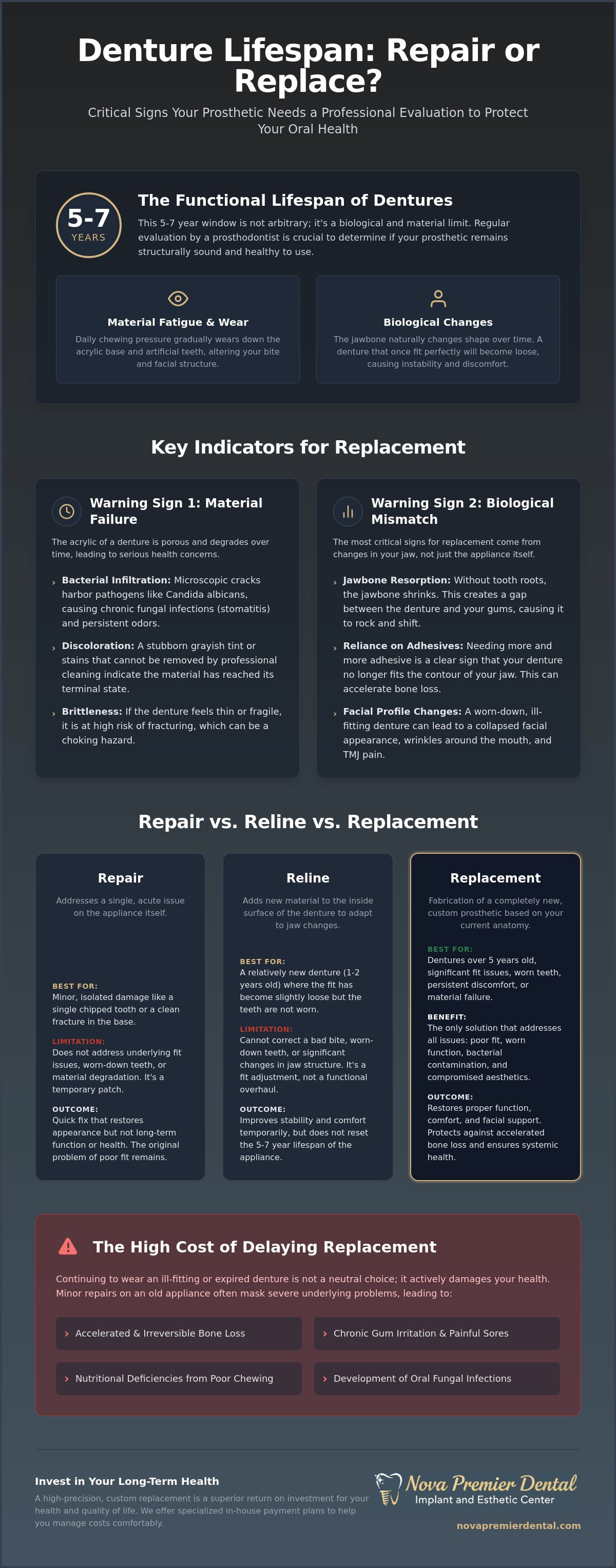
Many patients view their dental appliances as permanent fixtures. However, Complete Dentures are sophisticated medical devices with a finite functional lifespan. While high-quality acrylic is exceptionally durable, it's subjected to thousands of pounds of pressure during daily mastication. Most specialists, including Dr. Peterson Huang, recommend a full clinical evaluation every five years to determine if your prosthetic remains sound. Understanding when to replace dentures instead of repair is a critical decision that impacts your nutritional intake and soft tissue health.
The 5-7 Year Rule: Why Timing Matters
The five to seven year window isn't arbitrary; it's based on the rate of material degradation and biological change. Over time, daily chewing pressure gradually thins the denture base and wears down the artificial teeth. This loss of vertical dimension changes how your jaw closes, which can lead to TMJ strain or a collapsed facial appearance. In 2026, we utilize digital scanning and CAD/CAM fabrication to create replacements that far exceed the precision of older, hand-packed models. A minor chip in a tooth might be a candidate for emergency denture repair, but when the occlusal surfaces are flattened, a full replacement is the only way to restore chewing efficiency.
Acrylic Fatigue and Bacterial Infiltration
Acrylic is a porous polymer. Even with meticulous daily cleaning, the material undergoes microscopic changes over years of use. Tiny fissures develop deep within the base; these cracks become breeding grounds for pathogens like Candida albicans. This often results in chronic oral candidiasis, a fungal infection that causes persistent redness and soreness under the denture. If your appliance has developed a lingering odor or a grayish tint that won't go away, the material has likely reached its terminal state. Professional cleaning cannot reach into these deep pores. At this stage, a prosthodontist in Northern Virginia will typically advise a new prosthetic to protect your systemic health.
Dr. Huang's dual board certification ensures that every recommendation is grounded in advanced clinical science. We focus on the restorative aspect of your smile, ensuring your prosthetic supports your biological foundation. If your denture feels thin or brittle, it's likely time to consider a modern replacement that utilizes the latest 2026 material standards.
Biological Signs: Why Your Jawbone Dictates Replacement
While a cracked base or a chipped tooth might seem like a simple mechanical issue, the most critical indicators for a new prosthetic are biological rather than structural. The jawbone is a dynamic tissue that requires constant stimulation from tooth roots to maintain its volume. Once teeth are removed, the alveolar bone begins a lifelong process of resorption. This natural shrinking means that a prosthetic which fit perfectly three years ago will eventually lose its intimate contact with the underlying tissue. Understanding when to replace dentures instead of repair requires recognizing that a repair only addresses the appliance, whereas a replacement addresses the changing landscape of your mouth.
The Cycle of Bone Resorption and Fit
Alveolar bone resorption is a progressive condition. As the ridge of the jawbone diminishes, the denture begins to shift, creating friction and localized pressure points. This instability often prompts patients to rely on thick layers of adhesive. However, relying on adhesives to bridge a significant gap is a temporary measure that can actually accelerate bone loss. Ill-fitting appliances exert uneven force on the remaining ridge, signaling the body to resorb even more bone. According to clinical standards, the average lifespan of a denture is often limited by these anatomical changes. If the mismatch between the prosthetic base and your jaw is substantial, a laboratory repair cannot restore the necessary stability; a comprehensive replacement is required to protect your remaining bone structure.
Facial Aesthetics and Vertical Dimension
One of the most profound impacts of aged dentures is the loss of the Vertical Dimension of Occlusion (VDO). This term refers to the distance between the upper and lower jaws when the teeth are in contact. As the artificial teeth wear down and the jawbone resorbs, this distance decreases, leading to a "sunken" appearance. This facial collapse often results in increased wrinkling around the mouth and a protruding chin, which can prematurely age a patient's appearance. A dual board-certified specialist like Dr. Peterson Huang restores facial height and youthful contours by precisely calculating the ideal VDO for each unique patient. By choosing a new, custom-designed prosthetic, you're not just improving your bite; you're undergoing a non-surgical facial rejuvenation. If you've noticed changes in your profile, it's time to schedule a professional evaluation to discuss a restorative solution. Our practice provides in-house payment plans for qualifying patients, ensuring you can prioritize your biological health while managing the investment over several months.
Repair vs. Reline vs. Replacement: A Comparison Framework
Determining the appropriate course of action for a failing prosthetic requires a clear understanding of the differences between a reline, a repair, and a full replacement. A denture reline is a vital maintenance procedure where new acrylic is added to the tissue-side of the base to compensate for minor bone resorption and improve the fit. In contrast, a denture repair involves structural intervention, such as bonding a cracked base or replacing a single dislodged tooth. While these services are essential, understanding when to replace dentures instead of repair involves a pragmatic cost-benefit analysis. We typically utilize the "Rule of Three" as a clinical benchmark. If your appliance requires more than three repairs within a twelve month period, the acrylic has likely reached a state of systemic fatigue. Additionally, if the cumulative cost of relining and patching an aged prosthetic approaches 50% of the investment for a new, high-precision replacement, the clinical and financial return on investment shifts toward a fresh start.
When a Repair is the Right Choice
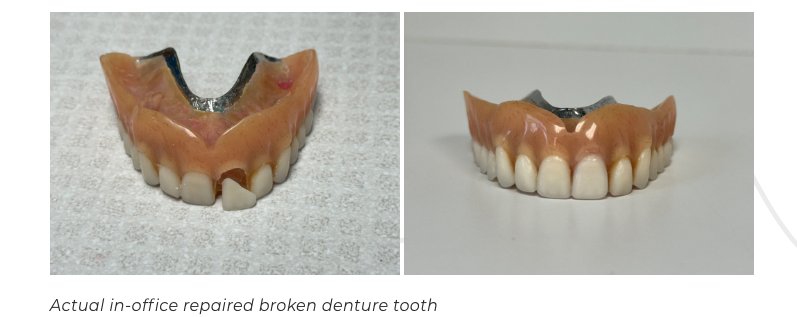
A repair is often the most logical solution for newer prosthetics, particularly those under three years old that have suffered isolated accidental damage. If you drop your appliance and it suffers a clean fracture, emergency denture repair in Falls Church can often restore the device to its original state without compromising its long-term integrity. These scenarios represent mechanical failures rather than biological mismatches. At Nova Premier Dental, we meticulously evaluate the fracture site to ensure a repair won't create a permanent weak point that leads to future instability. If the base remains vibrant and the teeth show minimal wear, a professional repair is a sound investment.
When Replacement is the Only Solution
There are specific clinical markers where a repair is merely a temporary bandage on a terminal problem. If your prosthetic teeth have become severely "flat" through years of use, your chewing efficiency drops significantly. This forces your jaw muscles to overwork, which often manifests as TMJ pain or chronic headaches. Multiple recurring fractures in the acrylic base also signal that the material has become too brittle to sustain daily masticatory forces. In these complex cases, Dr. Peterson Huang recommends a full replacement to restore proper occlusion and comfort. To make this transition seamless, our practice offers in-house payment plans for qualifying patients. This allows you to prioritize your restorative health while managing the cost over several months as you enjoy your new smile.
The Risks of Delaying Denture Replacement
Postponing a necessary replacement often leads to a cascade of physiological complications that far exceed simple oral discomfort. While a patient might attempt to tolerate a loose prosthetic, the long-term biological cost is significant. Understanding when to replace dentures instead of repair is paramount to avoiding chronic conditions such as denture stomatitis. This condition is characterized by painful inflammation and fungal overgrowth beneath an unstable base. These lesions represent a persistent inflammatory state that can compromise your systemic health if left unaddressed. Chronic irritation from ill-fitting acrylic can also lead to epulis fissuratum, which are redundant tissue folds that may eventually require surgical intervention before a new prosthetic can even be fitted.
Systemic Health and Digestion
Mastication serves as the critical first stage of the digestive process. When prosthetic teeth lose their sharp, anatomical contours, patients often unconsciously shift to a soft-food diet. This avoidance of fibrous, nutrient-dense foods like raw vegetables and lean proteins leads to nutritional deficiencies and gastrointestinal strain. Functional restoration is not a luxury; it's a requirement for longevity and metabolic health. If you find yourself cutting food into tiny pieces or avoiding certain textures entirely, your current appliance is failing your systemic needs.
This principle of expert restoration for minor issues is applicable across many fields; for example, specialized cosmetic services like Five Star Dent Removal focus on precision techniques to address minor damage before it affects the overall value and performance of an asset.
Jaw Joint Strain and Headaches
An unbalanced bite does more than make chewing difficult. It places immense stress on the temporomandibular joints. As dentures wear down, the jaw is forced into a hyper-closed position. This misalignment can trigger TMJ and jaw joint disorders, often manifesting as chronic tension headaches, neck pain, or clicking sounds when speaking. A dual board-certified specialist like Dr. Peterson Huang uses precise maxillofacial measurements to ensure your new prosthetic realigns your bite, alleviating these neuromuscular symptoms. We believe that financial considerations shouldn't prevent you from accessing essential medical care. Our practice offers in-house payment plans for qualifying patients, allowing you to manage the investment over several months while you're already benefiting from a stable, healthy smile.
Beyond the physical risks, the psychological burden of a failing prosthetic is profound. The constant fear of a denture slipping during a meal or conversation causes many to withdraw from social engagements. This loss of confidence often leads to social isolation, which negatively impacts overall quality of life. If you're experiencing chronic soreness or have limited your diet due to prosthetic instability, contact Nova Premier Dental today to explore our high-precision restorative options.
Specialized Denture Solutions at Nova Premier Dental
At Nova Premier Dental, we believe that every patient deserves a prosthetic that mirrors the precision of natural anatomy. While general dental labs often produce generic, one-size-fits-all appliances, our practice specializes in high-precision, custom-milled dentures designed by a dual board-certified expert. Deciding when to replace dentures instead of repair is a pivotal moment in your oral health journey. Choosing a specialist-designed replacement ensures your new smile is built on a foundation of clinical excellence. We utilize a 2026 digital workflow that includes intraoral scanning and CAD/CAM fabrication, resulting in a fit that traditional hand-packed acrylic simply cannot match. This advanced approach restores both your chewing function and your natural facial contours with surgical-level accuracy.
Permanent Dentures: The Ultimate Replacement
For many patients, the cycle of repairing traditional acrylic prosthetics becomes an exhausting and costly endeavor. In these cases, Dental implants and All-on-4 solutions represent the gold standard of modern restorative care. Unlike traditional dentures that rest on the gums and rely on suction, permanent dentures are anchored directly into the jawbone. This provides 100% chewing power and, most importantly, stops the progression of alveolar bone resorption by providing the necessary stimulation to the jaw. Many patients who believe they are merely candidates for another replacement are actually ideal candidates for an implant-supported solution. This transition eliminates the embarrassment of slipping and the constant need for adhesives, offering a permanent solution to a recurring problem.
Your Consultation in Falls Church
Your journey toward a functional, beautiful smile begins with a comprehensive evaluation at our Falls Church practice. As a prosthodontist in Northern Virginia, Dr. Peterson Huang conducts a meticulous assessment of your bone density, facial height, and occlusal needs. Our commitment to elite patient care has been recognized through numerous awards and recognition within the local medical community. We understand that investing in specialized restorative care is a significant decision for your future. To support our patients, we offer in-house payment plans for qualifying individuals. These plans allow you to distribute the cost of your care over several months, ensuring you can prioritize your long-term health while enjoying the immediate benefits of a rejuvenated, stable smile. Determining when to replace dentures instead of repair is a decision that impacts your quality of life for years to come. We're here to ensure that choice leads to a lifetime of confidence and comfort.
Restore Your Smile’s Foundation and Functional Beauty
Choosing a new prosthetic over a temporary fix is a vital investment in your systemic health and facial integrity. The decision regarding when to replace dentures instead of repair hinges on recognizing the biological limits of aged acrylic and the inevitable changes in your jawbone structure. Dr. Peterson Huang, a dual board-certified prosthodontist in Northern Virginia, specializes in complex oral reconstruction to ensure your replacement provides total functional stability. By moving beyond the cycle of frequent repairs, you protect your alveolar bone and reclaim your confidence in every social interaction.
At Nova Premier Dental, we make this transition seamless through in-house payment plans that allow you to manage the cost over several months while already enjoying the benefits of your new smile. Schedule your specialized denture evaluation with Dr. Huang today to discover the difference that elite, customized care makes for your long-term wellness. You don't have to settle for discomfort when a stable, beautiful smile is within reach.
Frequently Asked Questions
How long do dentures typically last before they need to be replaced?
Most dentures have a functional lifespan of five to seven years before the materials begin to degrade significantly. While high-quality acrylic is designed for durability, it eventually succumbs to material fatigue and bacterial absorption due to its porous nature. Regular clinical evaluations with a specialist ensure that your prosthetic remains structurally sound and biologically compatible with your naturally changing jawbone structure over time.
Can I use a DIY denture repair kit if my prosthetic cracks?
You should never use a DIY repair kit because these over-the-counter adhesives often contain chemicals that are toxic or damaging to the prosthetic material. Attempting a home fix can permanently ruin the alignment of your appliance, making a professional repair impossible and requiring an immediate full replacement. If you experience a fracture, it is essential to seek emergency denture repair from a qualified specialist to evaluate the damage.
What are the signs that my dentures no longer fit correctly?
The most common indicators of a poor fit include persistent gum sores, difficulty chewing fibrous foods, and the frequent need for adhesives to maintain stability. You might also notice a clicking sound when speaking or a sunken facial appearance as the vertical dimension of your bite collapses. These symptoms often signal that it is time for a professional assessment to determine when to replace dentures instead of repair.
Is it cheaper to repair or replace my dentures in the long run?
Replacement often provides a superior return on investment when compared to the cumulative costs of frequent repairs and relines on an aging appliance. While a single repair is less expensive upfront, an aged prosthetic with systemic weakness will continue to fail under daily chewing pressure. Investing in a high-precision replacement prevents the ongoing expense of patching an appliance that has reached its terminal functional state.
What happens if I continue to wear old, worn-out dentures?
Wearing worn-out dentures can lead to accelerated jawbone resorption and chronic inflammatory conditions like denture stomatitis or painful gum lesions. The lack of proper occlusion also contributes to TMJ disorders and nutritional deficiencies due to impaired chewing and forced dietary restrictions. Delaying replacement often results in more complex and expensive reconstructive procedures in the future to restore lost bone and tissue volume.
How does a prosthodontist differ from a general dentist when making new dentures?
A prosthodontist in Northern Virginia like Dr. Peterson Huang has completed three additional years of specialized residency training beyond dental school. This advanced education focuses specifically on complex oral reconstruction and the intricate physics of prosthetic design. A prosthodontist provides a level of precision and customization that ensures your appliance supports your unique biological foundation and aesthetic goals.
Are there permanent alternatives to traditional removable dentures?
Yes, permanent dentures anchored by dental implants offer a stable, non-removable alternative to traditional prosthetics. These modern solutions, such as All-on-4 dental implants, restore nearly 100% of your natural chewing power and prevent future bone loss. They eliminate the instability and social anxiety associated with removable appliances, providing a long-term restorative solution for patients seeking a more natural feel.
Does Nova Premier Dental offer payment plans for new dentures?
Nova Premier Dental offers in-house payment plans for qualifying patients to help manage the investment in high-quality restorative care. These plans allow you to distribute the cost over several months, making elite prosthetic services accessible. This ensures you can comfortably manage the cost of care while you are already enjoying the functional and aesthetic benefits of your new smile.
Disclaimer
The information provided on this website and blog is intended for general educational and informational purposes only and should not be considered dental or medical advice, diagnosis, or treatment. Reading content on this website does not establish a doctor-patient relationship with Nova Premier Dental or Dr. Peterson Huang. Dental conditions and treatment needs vary from patient to patient. Individuals should consult directly with a qualified dental professional for personalized evaluation, diagnosis, and treatment recommendations. Do not delay seeking professional dental care based on information found on this website. While we strive to provide accurate and up-to-date information, no guarantee is made regarding the completeness, accuracy, or applicability of the content. Treatment outcomes may vary depending on individual circumstances. If you are experiencing a dental emergency or urgent oral health concern, please contact a licensed dental professional immediately or call 911 in the event of a medical emergency.


