

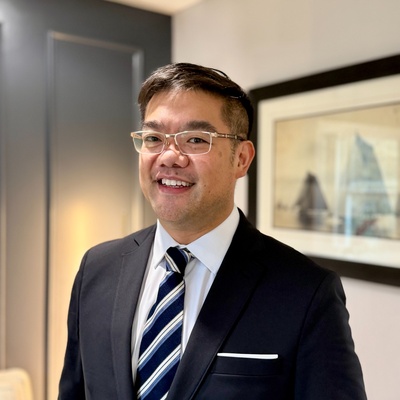
Article by
Peterson Huang DMD, MS, FACP, FRCDC
Dr. Peterson Huang is a dual board-certified prosthodontist serving Falls Church and Northern Virginia. He has been recognized as a Top Prosthodontist by Northern Virginia Magazine and Arlington Magazine and is affiliated with the Inova Fairfax Hospital Tumor Board. Dr. Huang focuses on dental implants, full mouth reconstruction, and complex restorative dentistry for patients who need advanced, comprehensive care.
Full-mouth dental implants may be considered when many or all teeth are missing, severely damaged, or have a poor prognosis. Treatment planning begins with a diagnosis of the teeth, gums, jawbone, bite, medical history, and personal goals. In Falls Church and across Northern Virginia, patients may also compare implant-supported restorations with conventional dentures, removable implant overdentures, bridges, or treatment to preserve selected natural teeth.
This guide explains how full-arch implant treatment is evaluated, what restorative options may be available, and the benefits, limitations, risks, maintenance requirements, and alternatives to discuss with a qualified clinician. Nova Premier Dental is a private prosthodontic specialty dental office in Falls Church serving Northern Virginia.
Key Takeaways
- Full-mouth implant treatment requires assessment of oral disease, bone volume, bite, medical factors, and the condition of any remaining teeth.
- Options may include fixed implant-supported teeth, removable implant overdentures, conventional dentures, bridges, or treatment that preserves natural teeth.
- Implants can improve retention and chewing compared with some removable appliances and may help preserve bone locally, but they do not prevent all bone changes or guarantee a particular result.
- The implant fixture and the visible prosthesis are different components and may require different maintenance or replacement over time.
- A prosthodontic consultation may be useful when tooth replacement involves extensive reconstruction, multiple specialties, significant bone loss, complex bite considerations, or difficult-to-maintain restorations.
What Are Full Mouth Dental Implants?
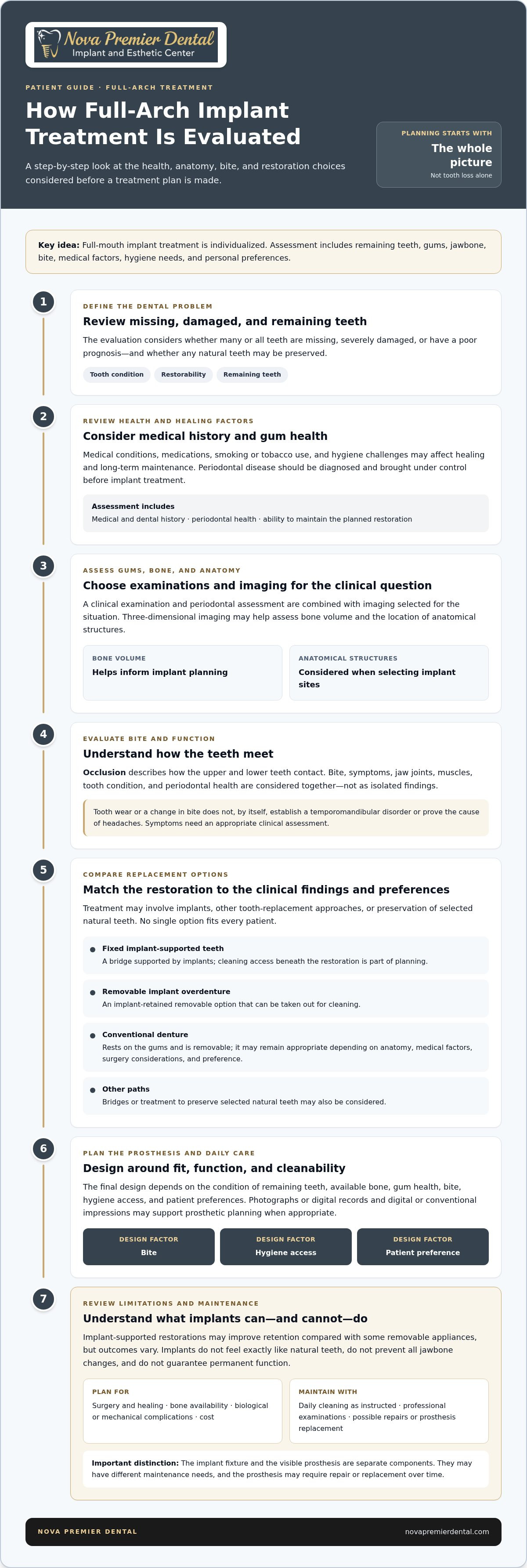
Full-mouth or full-arch implant treatment uses dental implants to support replacement teeth for one or both arches. An implant is placed in the jawbone and, after healing, may support an individual crown, a bridge, or an overdenture. The final design depends on the number and condition of remaining teeth, available bone, gum health, bite, hygiene access, and the patient's preferences. More information about dental implants can help patients understand the general stages of care.
Conventional dentures rest on the gums and can be removed for cleaning. Implant-supported bridges or overdentures may improve retention and chewing for some patients, but they require surgery, adequate bone or additional procedures, and ongoing professional care. Implants may help reduce the rate of local bone resorption in areas where they are placed; they do not prevent all changes to the jaw or guarantee permanent function. A conventional denture may remain an appropriate option when surgery, medical factors, anatomy, cost, or personal preference make implants unsuitable. Patients can review denture options as part of the comparison.
Who Is a Candidate for Full-Arch Implants?
Potential candidates require an individualized examination rather than a decision based only on tooth loss. Evaluation may be appropriate for patients with:
- Multiple missing, fractured, decayed, or severely worn teeth that cannot be predictably restored.
- Periodontal disease that has been diagnosed and brought under control before implant treatment.
- Loose or uncomfortable dentures, or difficulty chewing that persists despite appropriate denture adjustment.
- Medical conditions, medications, smoking or tobacco use, or hygiene challenges that may affect healing and long-term maintenance.
Functional Benefits Beyond the Smile
Implant-supported restorations may provide greater stability than a conventional denture and may support more efficient chewing for some patients. They can also reduce pressure on the gum tissue and help maintain bone locally around an implant. Benefits vary with the design, implant position, prosthetic materials, health of the supporting tissues, and daily care. Implants do not feel exactly like natural teeth, and a fixed restoration still requires cleaning, examinations, and possible repairs.
- Retention: A fixed bridge or implant overdenture may move less than a conventional removable denture.
- Function: Some patients find chewing and speech easier after adapting to a stable restoration, although food choices and function vary.
- Maintenance: The restoration cannot be treated as maintenance-free. Access beneath a bridge and around implants must be cleaned according to the clinician's instructions.
- Limitations: Surgery, healing, cost, bone availability, biological complications, mechanical complications, and eventual prosthesis repair or replacement must be considered.
Nova Premier Dental offers in-house payment plans for qualifying patients, allowing treatment costs to be paid over several months.
When Prosthodontic Care May Be Appropriate
Prosthodontists receive additional specialty training in the diagnosis, planning, and restoration of missing or damaged teeth, including complex cases involving multiple teeth, dentures, implants, and bite considerations. Many restorative procedures are appropriately performed by general dentists. A referral to a prosthodontist may be useful when treatment involves extensive reconstruction, difficult prosthetic design, substantial bone or soft-tissue changes, significant tooth wear, several treatment alternatives, or coordination with periodontal, surgical, orthodontic, or medical care.
Occlusion describes how the upper and lower teeth contact. It is one part of diagnosis, along with the jaw joints, muscles, tooth and restoration condition, periodontal health, and symptoms. Tooth wear, changes in bite, or a reduced vertical dimension may be associated with several conditions, but they do not establish that a patient has a temporomandibular disorder or that they cause headaches or migraines. A clinician should evaluate symptoms rather than assume a single cause. Patients with jaw pain, joint noises, limited opening, or persistent headaches may need an appropriate medical or dental assessment before restorative treatment.
Dr. Peterson Huang: A Leader in Oral Reconstruction
Clinician Credentials
Peterson Huang, DMD, MS, FACP, FRCDC; dentist and dual board-certified prosthodontist. The dual prosthodontic certification applies to the United States and Canada. It is not a claim of board certification in implant dentistry, periodontology, or oral surgery.
Prosthodontist vs. General Dentist: The Training Gap
General dentists provide many examinations, restorations, crowns, bridges, and tooth-replacement services. Prosthodontists receive additional specialty training for complex restorative cases, which may be helpful when a treatment plan involves extensive tooth loss, multiple prostheses, implant-supported restoration, or coordination among several disciplines. The appropriate provider depends on the diagnosis, treatment complexity, and the clinician's training and experience.
The Full Mouth Implant Process at Nova Premier Dental
Evaluation generally includes a medical and dental history, clinical examination, periodontal assessment, review of the remaining teeth, photographs or digital records when appropriate, and imaging selected for the clinical question. Three-dimensional imaging may help assess bone volume and the location of anatomical structures, while digital or conventional impressions may support prosthetic planning. The examination should also consider whether any teeth can be predictably treated rather than automatically replaced.
If implants are selected, treatment may involve tooth removal, bone or soft-tissue procedures, implant placement, a temporary restoration, healing, and delivery of the definitive prosthesis. Same-day temporary teeth are not appropriate for every patient. Risks can include pain, swelling, infection, bleeding, injury to nearby structures, inadequate healing, peri-implant disease, implant loss, prosthetic fracture or loosening, speech changes, and difficulty cleaning. The clinician should explain alternatives and individualized risks before consent. The Cleveland Clinic overview of dental implants provides general patient information, but it does not replace an examination.
Digital Planning and Precision Diagnostics
Digital planning can support communication about implant position, restorative space, and the proposed appearance. It does not eliminate biological or mechanical uncertainty, and a digital preview is not a guarantee of the final result. Bite and jaw-joint findings should be assessed as part of the broader diagnosis rather than assuming that a particular implant position will prevent jaw pain or other symptoms.
Permanent Solutions: All-on-4 and Beyond
All-on-4 is one approach to an implant-supported full-arch restoration; other designs may use a different number or distribution of implants, removable overdentures, or conventional dentures. Angled implant placement may be considered in selected anatomy, but it does not always eliminate the need for bone grafting or other procedures. The choice depends on bone volume, restorative space, hygiene access, medical factors, and the desired level of removability. Implant fixtures and the prosthesis they support have different maintenance needs and may not have the same service life.
Options, Costs, and Long-Term Maintenance
The cost of full-arch treatment varies with the number of arches treated, extractions, bone or soft-tissue procedures, implant number and position, temporary and definitive prostheses, materials, sedation, and required maintenance. A written consultation should identify what is included, which steps may be separate, and how complications or repairs would be handled. Patients should compare the proposed fixed restoration with removable implant overdentures, conventional dentures, bridges, or treatment that preserves natural teeth when feasible.
An implant fixture may remain functional for many years, but its outcome depends on bone and gum health, hygiene, smoking or tobacco exposure, medical conditions, bite forces, and regular professional care. The overlying crown, bridge, or denture is a separate prosthesis that may require adjustment, repair, or replacement sooner than the fixture. No treatment can guarantee a permanent result. Maintenance commonly includes daily brushing and cleaning around the restoration, periodic examinations and professional cleaning, and prompt evaluation of bleeding, swelling, pain, mobility, odor, or a change in the bite.
Frequently Asked Questions
How long does the full mouth dental implant process take from start to finish?
The timeline varies according to extractions, healing, bone or soft-tissue procedures, implant stability, medical factors, and the type of temporary and definitive restoration. Some patients may receive a temporary restoration during the healing period, while others need a removable provisional or staged treatment. The clinician should provide an individualized sequence rather than promise a fixed completion date.
Are full mouth dental implants painful during or after the procedure?
Discomfort and swelling are possible after implant surgery, and the amount varies with the procedure and the individual. Local anesthetic, sedation when appropriate, and prescribed or over-the-counter pain management may be discussed. Patients should follow the surgical instructions provided and contact the office or seek urgent care for uncontrolled bleeding, worsening swelling, fever, difficulty breathing or swallowing, or other concerning symptoms.
What is the success rate of full-arch dental implants?
There is no single success rate that applies to every full-arch case. Outcomes depend on implant location, bone and gum health, oral hygiene, smoking or tobacco use, medical conditions, bite forces, treatment design, and follow-up. A clinician should explain the evidence and the patient's individual risks without presenting a percentage as a guarantee.
Will my insurance cover full mouth dental implants in Northern Virginia?
Insurance benefits vary by policy and may distinguish between examinations, extractions, implant surgery, bone procedures, and the restorative prosthesis. Patients should review their plan and request a written estimate. Treatment decisions should be based on diagnosis and suitability, not insurance coverage alone.
What is the difference between a prosthodontist and a periodontist for implants?
A prosthodontist focuses on the diagnosis and design of replacement teeth and complex restorations. A periodontist focuses on the gums and supporting bone and may provide periodontal or implant-related surgical care. An oral and maxillofacial surgeon may be involved when surgical expertise is indicated. Depending on the case, treatment may be provided by one clinician or coordinated among several providers.
How do I clean and maintain my new full mouth implants?
Maintenance depends on the restoration design. Patients generally need to brush twice daily, clean beneath or around the prosthesis with tools recommended by the clinician, and attend periodic examinations and professional cleanings. A water flosser may be useful for some patients but should not replace other instructed cleaning. Follow-up allows the team to assess the gums, bone, implant stability, bite, screws or attachments, and prosthesis. The practice's examination and cleaning information provides general preventive guidance.
Can I get implants if I have been told I have low bone density?
Reduced bone volume does not automatically rule out implants, but it may limit implant position or require grafting, a different restorative design, or a removable alternative. Imaging helps assess the anatomy; it cannot guarantee that grafting will be unnecessary or that treatment will succeed. An individualized evaluation is needed before selecting an approach.
Disclaimer
The information provided on this website and blog is intended for general educational and informational purposes only and should not be considered dental or medical advice, diagnosis, or treatment. Reading content on this website does not establish a doctor-patient relationship with Nova Premier Dental or Dr. Peterson Huang. Dental conditions and treatment needs vary from patient to patient. Individuals should consult directly with a qualified dental professional for personalized evaluation, diagnosis, and treatment recommendations. Do not delay seeking professional dental care based on information found on this website. While we strive to provide accurate and up-to-date information, no guarantee is made regarding the completeness, accuracy, or applicability of the content. Treatment outcomes may vary depending on individual circumstances. If you are experiencing a dental emergency or urgent oral health concern, please contact a licensed dental professional immediately or call 911 in the event of a medical emergency.


