


Article by
Peterson Huang DMD, MS, FACP, FRCDC
Dr. Peterson Huang is a dual board-certified prosthodontist serving Falls Church and Northern Virginia. He has been recognized as a Top Prosthodontist by Northern Virginia Magazine and Arlington Magazine and is affiliated with the Inova Fairfax Hospital Tumor Board. Dr. Huang focuses on dental implants, full mouth reconstruction, and complex restorative dentistry for patients who need advanced, comprehensive care.
Immediate Steps: What to Do for a Chipped Tooth
A chipped tooth is one of the most frequent dental injuries, occurring from direct trauma, biting on hard objects, untreated decay that undermines the enamel, or persistent clenching and grinding (bruxism). If you have sustained a chipped tooth in Great Falls, VA or the surrounding Northern Virginia area, taking the correct initial measures can help protect the remaining tooth structure, prevent bacterial contamination, and improve the long-term prognosis of the tooth.
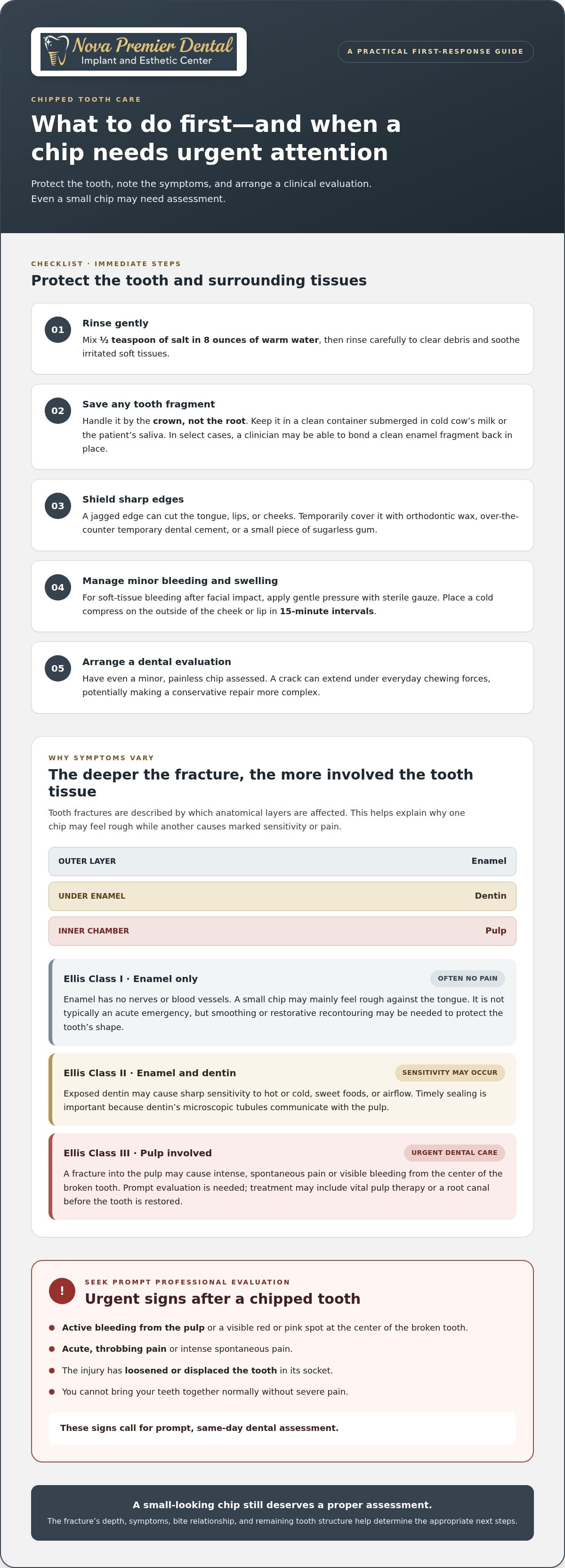
- Rinse gently with warm salt water: Mix half a teaspoon of salt in eight ounces of warm water and rinse your mouth carefully. This cleans debris from the area, soothes irritated soft tissues, and helps reduce oral bacteria around exposed enamel or dentin.
- Recover and store any tooth fragments: If you can find the piece of chipped tooth, handle it carefully by the crown, not the root. Store the fragment in a clean container submerged in cold cow's milk or the patient's saliva. In select instances of clean enamel fractures, an experienced restorative clinician may be able to bond the natural fragment back into place.
- Protect your tongue and oral soft tissues: Chipped enamel often leaves jagged, razor-sharp margins that can lacerate the lips, cheeks, or tongue. You can temporarily shield the sharp edges using orthodontic wax, temporary dental cement purchased over the counter, or a small piece of sugarless gum.
- Control swelling and minor bleeding: If the injury involved facial impact, apply gentle pressure with sterile gauze to manage any soft tissue bleeding. Place a cold compress on the outside of your cheek or lip in 15-minute intervals to limit inflammation and relieve discomfort.
- Schedule a comprehensive clinical evaluation: Even minor, asymptomatic chips require professional diagnostic assessment. A crack can propagate through the tooth under everyday chewing loads (occlusal forces), potentially turning a conservative repair into an extensive functional issue.
Assessing the Severity of the Chip
Dental fractures are clinically categorized according to the depth of the anatomical structures involved. Knowing the anatomical layers of a tooth helps explain why symptoms differ widely between injuries:
- Enamel-only infractions and chips (Ellis Class I): Enamel is the hard, mineralized outer surface of the tooth. It contains no nerves or blood vessels. Minor chips limited to the enamel layer typically cause no pain, though patients immediately notice the roughness against their tongue. While not an acute emergency, these fractures still require smoothing or restorative recontouring to prevent further structural degradation.
- Enamel and dentin fractures (Ellis Class II): Dentin lies beneath the enamel and consists of microscopic tubules that communicate directly with the dental pulp. When a fracture exposes dentin, patients commonly experience sharp sensitivity to thermal changes (cold and hot liquids), sweet foods, and airflow. Exposed dentin requires timely sealing to stop bacterial infiltration from traveling toward the pulp tissue.
- Fractures involving the pulp (Ellis Class III): The pulp is the innermost chamber containing living nerves, connective tissues, and blood vessels. A fracture extending into the pulp chamber typically causes intense, spontaneous pain and visible bleeding from the center of the broken tooth (appearing as a red or pink spot). This situation represents an urgent dental condition requiring prompt pulpal therapy (such as a root canal or vital pulp therapy) before restorative reconstruction.
When a Chip Becomes an Urgent Situation
While many enamel chips can be evaluated during regular clinical hours, certain clinical signs indicate an urgent need for same-day restorative intervention. If you observe active pulpal bleeding, acute throbbing pain, an injury that loosened or displaced the tooth within its alveolar bone socket (luxation injury), or an inability to close your teeth together normally without severe pain, seek prompt professional evaluation.
Timely diagnostic assessment at a qualified dental practice, such as Nova Premier Dental in nearby Falls Church, can prevent pulpal necrosis, limit deep microleakage, and preserve vital tooth structure before complex endodontic or surgical interventions become necessary.
Advanced Repair Options: From Bonding to Custom Porcelain Veneers
Restoring a fractured tooth involves balancing biomechanical longevity, structural preservation, and aesthetic harmony. The appropriate treatment depends on the volume of missing tooth structure, the location of the fracture line, the patient's occlusal relationship (how the upper and lower teeth meet), and functional habits such as nocturnal bruxism.
The primary restorative approaches for chipped front and back teeth include the following modalities:
- Direct composite resin bonding: A conservative, single-visit solution for small-to-moderate enamel and dentin defects.
- Custom porcelain veneers: Thin, laboratory-fabricated ceramic facings that restore significant structural loss, surface morphology, and long-term color stability.
- Ceramic crowns: Full-coverage restorations used when a fracture undermines more than half the clinical crown or involves substantial cuspal loss.
- Inlays and onlays: Indirect partial-coverage restorations designed for posterior teeth where a chip affects the chewing surfaces without necessitating a full crown.
Dental Bonding for Conservative Aesthetic Repairs
Direct composite bonding utilizes tooth-colored resin materials composed of dimethacrylate monomers and inorganic filler particles (such as silica or zirconia). The procedure is minimally invasive and can often be completed without local anesthesia if the chip is restricted to enamel.
The clinical protocol involves several precise steps:
- Surface preparation and beveling: The clinician prepares a micro-bevel along the fractured enamel margin. This bevel increases the available surface area for bonding and helps feather the resin so the transition between natural tooth and restorative material remains imperceptible.
- Total-etch or selective-etch bonding: Phosphoric acid is applied to clean and demineralize the enamel prisms, creating micro-porosities. An adhesive bonding agent is then applied and light-polymerized, forming a strong micromechanical interlocking layer.
- Polychromatic layering: Because natural teeth have distinct internal optical properties—higher opacity and chroma in the dentin, with higher translucency and opalescence at the incisal edge—the clinician layers various shades and opacities of composite resin sequentially.
- Finishing and polishing: Fine diamond burs, polishing discs, and silicone points contour the anatomy, establish primary, secondary, and tertiary surface textures, and bring the restoration to a high luster that mirrors surrounding teeth.
Longevity and Limitations: Peer-reviewed clinical studies indicate that anterior composite resin restorations have an average functional lifespan of 5 to 7 years. Over time, composite resin is susceptible to marginal staining, surface wear, and chipping under heavy shearing stresses. Bonding represents an excellent conservative choice, but it requires periodic maintenance, polishing, and occasional replacement.
Porcelain Veneers for Long-Term Durability and Aesthetics
When a fracture involves a significant portion of an anterior tooth or when previous composite repairs have failed repeatedly, porcelain veneers represent a durable, indirect restorative solution. Dental ceramics, such as lithium disilicate or feldspathic porcelain, replicate the optical translucency, refractive index, and surface luster of natural human enamel far more accurately than composite resins over extended periods.
Key clinical considerations for porcelain veneers include:
- Enamel preservation: Long-term ceramic adhesion depends heavily on bonding to natural enamel rather than dentin. Skilled preparation focuses on conservative reduction (typically 0.3 mm to 0.7 mm) to maintain the restoration entirely within the enamel shell whenever feasible.
- Stain resistance and surface stability: Glazed dental ceramics are non-porous and highly resistant to stains from coffee, tea, red wine, and dietary chromogens, retaining their shade stability over many years.
- Predictable longevity: According to dental literature, lithium disilicate and feldspathic veneers show survival rates exceeding 90% at 10 to 15 years when properly planned, fabricated, and bonded under strict isolation. For detailed clinical evidence on ceramic longevity, review our analysis on how long veneers last.
Full-Coverage Crowns and Partial Indirect Restorations
If a chip compromises structural integrity to the point where less than 50% of the natural clinical crown remains, or if the tooth has undergone endodontic therapy, a full-coverage crown may be required. Modern dental ceramics—such as monolithic zirconia or layered lithium disilicate—provide adequate compressive strength to withstand masticatory forces while protecting the remaining tooth root against vertical root fracture.
On posterior premolars and molars, chips frequently fracture individual cusps. Rather than placing a full crown, a prosthodontist may recommend an onlay. This conservative option preserves sound buccal and lingual tooth structure while covering the compromised cusp to restore full chewing mechanics.
The Specialist Advantage: Prosthodontic Considerations for Front Tooth Repair
Repairing an anterior tooth involves much more than filling a void with material. The front teeth guide mandibular movements during speech and chewing (anterior guidance), protect posterior teeth from destructive lateral forces, and define the facial aesthetic line. When addressing complex, extensive, or recurrent tooth fractures, consultation with a board-certified prosthodontist in Northern Virginia provides access to specialized restorative expertise.
Prosthodontist vs. General Dentist for Chipped Teeth
General dentists provide foundational oral care, diagnosis, preventive treatment, and routine restorations. Many general dental practitioners routinely repair chipped teeth with direct bonding or crowns with successful results. However, when a chip is accompanied by broader functional complexities—such as severe bite wear, lack of restorative clearance, or trauma affecting multiple adjacent teeth—a prosthodontist brings advanced training to the treatment plan.
Prosthodontists complete three additional years of intensive, accredited specialty residency training after graduating from dental school. This postgraduate education focuses comprehensively on:
- Occlusal principles and biomechanics: Understanding how masticatory forces travel through natural teeth, restorations, and the temporomandibular joints (TMJ).
- Dental materials science: Selecting exact ceramic and polymer formulations based on compressive, flexural, and shear strength properties.
- Complex rehabilitation: Re-establishing proper anterior guidance, vertical dimension of occlusion, and functional harmony across the entire dental arch.
At Nova Premier Dental, Dr. Peterson Huang, DMD, MS, FACP, FRCDC, completed his specialty training in prosthodontics and maintains dual board certification through the American Board of Prosthodontics and the Royal College of Dentists of Canada. This background allows for the systematic diagnosis and restoration of traumatic fractures, particularly where bite issues contributed to the initial tooth failure.
Diagnostic and Restorative Planning at Nova Premier Dental
Achieving a predictable, natural-looking restoration requires thorough diagnostic assessment before clinical treatment begins. A comprehensive evaluation for a chipped front tooth includes:
- High-resolution digital radiography: Periapical and bitewing radiographs verify root integrity, screen for subgingival root fractures, and assess periodontal ligament width and pulpal proximity.
- Vitality testing: Cold testing (using endodontic refrigerant spray) and electric pulp tests confirm whether the neurovascular bundle inside the pulp chamber remains healthy or has sustained concussive trauma.
- Occlusal analysis: Assessing centric relation, maximum intercuspation, and eccentric excursions ensures the new restoration will not receive excessive lateral force during chewing or nighttime clenching.
- Digital intraoral scanning and photography: High-definition digital impressions eliminate uncomfortable alginate trays, allowing exact computer-aided design (CAD) of restorations with precise margins and contours.
Planning Your Restoration: Costs, Longevity, and Payment Options
The cost of repairing a chipped tooth in Northern Virginia depends on several diagnostic and clinical factors:
- Severity and depth of the fracture: Minor enamel smoothing or single-surface bonding costs significantly less than a multi-surface complex composite, veneer, or full crown.
- Material selection: Direct composite resin is less costly initially than indirect restorations like laboratory-milled lithium disilicate or zirconia ceramics.
- Tooth location: Restoring central incisors within the aesthetic zone requires complex shade matching and stratification, demanding greater clinical time and technique.
- Adjunctive procedures: If the chip exposed the nerve or damaged soft tissues, preliminary periodontal contouring or endodontic treatment will be necessary before the definitive restoration can be placed.
| Treatment Type | Primary Indications | Average Clinical Lifespan | Clinical Advantages | Limitations to Consider |
|---|---|---|---|---|
| Direct Composite Bonding | Small to moderate enamel or dentin chips | 5 – 7 years (with routine care) | Completed in one visit; minimal tooth preparation; repairable | Susceptible to staining, wear, and marginal degradation over time |
| Porcelain Veneers | Moderate to large chips on front teeth; cosmetic integration | 10 – 15+ years | Exceptional translucency and shade stability; highly stain-resistant | Requires conservative enamel reduction; higher initial investment |
| Ceramic Dental Crowns | Extensive fractures compromising >50% of the tooth crown | 10 – 15+ years | Full structural protection against heavy occlusal forces | Requires circumferential tooth reduction; less conservative |
In-House Payment Options
Nova Premier Dental believes clinical quality and clear financial communication should go hand in hand. While many dental insurance policies provide partial coverage for restorative procedures that are medically necessary to repair broken teeth, coverage levels vary widely based on individual employer plans and benefit structures.
To assist patients in managing restorative costs comfortably, Nova Premier Dental offers in-house payment plans for qualifying patients, allowing treatment costs to be paid over several months while patients enjoy their new smile. Our administrative team works directly with patients to review insurance estimates and clarify all treatment costs prior to initiating care.
Comprehensive Restorative Care at Nova Premier Dental
Nova Premier Dental is a private prosthodontic specialty practice located in Falls Church, Virginia, serving patients from Great Falls, McLean, Arlington, Tysons, and across the Northern Virginia region. Patients facing complex dental trauma, cracked teeth, or failing previous restorations benefit from a clinical environment designed around thorough diagnostic protocols, meticulous restorative craftsmanship, and patient comfort.
Why Northern Virginia Patients Seek Specialized Prosthodontic Evaluation
When an anterior tooth is fractured, patients often express two primary concerns: Will the tooth look natural, and will the restoration break again? A prosthodontist evaluates both issues concurrently by examining not just the single tooth, but the broader functional system that surrounds it.
By assessing how your incisors disclude your molars during lateral jaw movements, verifying the absence of traumatic interference, and designing restorations that mimic natural dental anatomy, prosthodontic planning helps safeguard against premature restoration failure. Where nocturnal clenching or grinding is identified as an underlying contributor to tooth fracture, custom protective night guards (occlusal splints) are integrated into the post-restorative maintenance regimen to preserve the clinical results.
What to Expect During Your Restorative Consultation
Your initial consultation for a chipped tooth at our Falls Church practice includes:
- Comprehensive examination: Clinical inspection of the fractured site, evaluation of adjacent and opposing teeth, and assessment of your periodontal health.
- Diagnostic imaging: Low-radiation digital X-rays to assess the root structure, bone levels, and pulp chamber.
- Treatment discussion: An objective presentation of viable treatment options (such as bonding versus porcelain ceramic restorations), outlining the biological trade-offs, anticipated longevity, maintenance requirements, and associated costs for each approach.
- Personalized care plan: A clear, staged plan detailing the necessary visits, digital impression timelines, and any interim protective restorations required while custom laboratory ceramics are fabricated.
If you have questions about repairing a chipped or fractured tooth, our Falls Church prosthodontic practice provides specialized restorative consultations for patients throughout Great Falls and Northern Virginia.
Frequently Asked Questions
Is a chipped tooth repair considered a dental emergency?
It depends on the depth of the fracture and accompanying symptoms. A minor chip restricted to the enamel layer is not a medical emergency, though it should be evaluated within a few days to smooth sharp edges and prevent the crack from spreading. However, if the chip involves intense pain, visible bleeding from the center of the tooth (pulpal exposure), or a tooth that was knocked loose, you should seek same-day dental care.
How long does dental bonding last on a front tooth?
Direct composite resin bonding on an incisor generally lasts between 5 and 7 years. Its longevity depends significantly on the size of the restoration, your chewing habits, and oral hygiene. Patients who bite directly into hard foods (such as ice, raw carrots, or hard candies) or who grind their teeth without a night guard may experience chipping of the composite resin earlier.
Can a prosthodontist fix a chip that repeatedly breaks off?
Yes. When a repaired chip breaks repeatedly, the underlying issue is often biomechanical rather than adhesive. A prosthodontist performs a detailed occlusal evaluation to determine whether your bite is placing excessive shearing force on the restoration during chewing or jaw movement. Adjusting the opposing tooth, altering the restoration margin, or upgrading to a stronger ceramic material (such as a veneer or crown) often resolves recurrent failures.
Does chipped tooth repair hurt?
Most repairs for superficial or moderate enamel chips cause little to no discomfort and can often be completed without local anesthetic. If the fracture line extends into sensitive dentin near the nerve, a local anesthetic is administered to ensure you remain completely comfortable throughout the preparation and bonding process.
Will my dental insurance cover the cost of a chipped tooth repair?
Many dental insurance policies provide coverage for chipped tooth repair if the procedure is deemed restorative and structurally necessary to restore function. Direct bonding and crowns frequently qualify for partial coverage under major or basic dental services. Purely elective cosmetic adjustments may have limited coverage. Nova Premier Dental provides itemized pre-treatment estimates to help you understand your insurance benefits clearly.
What is the most durable way to fix a large chip on a front tooth?
For moderate to large chips on anterior teeth, custom porcelain veneers or full-coverage ceramic crowns offer the highest clinical durability and aesthetic stability. Dental porcelain resists staining and wear significantly better than composite resin, maintaining its polish, color match, and functional integrity for 10 to 15 years or more when properly maintained.
Can I get a same-day repair for my chipped tooth?
Yes, minor-to-moderate fractures can frequently be restored during a single visit using direct composite resin bonding. If the tooth requires an indirect restoration, such as a custom laboratory porcelain veneer or crown, a temporary resin restoration is fabricated and bonded to the tooth during your first visit to protect it and maintain natural appearance while the final ceramic piece is fabricated.
Disclaimer
The information provided on this website and blog is intended for general educational and informational purposes only and should not be considered dental or medical advice, diagnosis, or treatment. Reading content on this website does not establish a doctor-patient relationship with Nova Premier Dental or Dr. Peterson Huang. Dental conditions and treatment needs vary from patient to patient. Individuals should consult directly with a qualified dental professional for personalized evaluation, diagnosis, and treatment recommendations. Do not delay seeking professional dental care based on information found on this website. While we strive to provide accurate and up-to-date information, no guarantee is made regarding the completeness, accuracy, or applicability of the content. Treatment outcomes may vary depending on individual circumstances. If you are experiencing a dental emergency or urgent oral health concern, please contact a licensed dental professional immediately or call 911 in the event of a medical emergency.


