


Article by
Peterson Huang DMD, MS, FACP, FRCDC
Dr. Peterson Huang is a dual board-certified prosthodontist serving Falls Church and Northern Virginia. He has been recognized as a Top Prosthodontist by Northern Virginia Magazine and Arlington Magazine and is affiliated with the Inova Fairfax Hospital Tumor Board. Dr. Huang focuses on dental implants, full mouth reconstruction, and complex restorative dentistry for patients who need advanced, comprehensive care.
Full mouth reconstruction (also called full mouth rehabilitation) is a planned, staged restoration of the teeth, supporting tissues, and bite in both jaws. It is not the same as a cosmetic makeover, and most people with a few damaged teeth do not need it. This article describes the clinical signs you need a full mouth reconstruction, how those signs are evaluated, and when a referral to a prosthodontist may be useful. It was written with input from the prosthodontic team at Nova Premier Dental, a private prosthodontic specialty dental office in Falls Church serving Northern Virginia.
Key Takeaways
- Full mouth reconstruction is function-focused: it addresses worn, missing, or failing teeth and how the upper and lower teeth meet. A smile makeover is primarily aesthetic.
- Signs that may point toward comprehensive treatment include multiple missing teeth, widespread tooth wear, repeated failure of restorations, advanced gum disease with loose teeth, and difficulty chewing.
- Jaw pain, headaches, and tooth wear have many possible causes. They are diagnostic considerations, not proof that a reconstruction is needed.
- Many restorative procedures are routinely and appropriately performed by general dentists. A prosthodontist evaluation can be helpful when a case is complex or involves several overlapping problems.
What Is Full Mouth Reconstruction and How Does It Differ from a Makeover?
A full mouth reconstruction involves restoring or replacing teeth throughout both jaws, usually in planned phases. It is not a single procedure. Depending on the case, it may combine crowns, bridges, dental implants, dentures, and treatment of gum disease or decay. Our overview of full mouth rehabilitation and the page on full mouth rehabilitation at our practice describe the scope in more detail.
A smile makeover focuses on appearance, using treatments such as whitening, bonding, or veneers. Reconstruction focuses on health and function: the condition of the teeth and gums, the stability of the bite, and the ability to chew and speak comfortably. Appearance often improves as a result, but it is not the primary goal.
Occlusion: Why the Bite Matters
Occlusion is the way the upper and lower teeth contact one another. Restorations placed on a bite that is unstable or overloaded may chip, loosen, or fracture more readily. For this reason, reconstruction planning evaluates the bite, the jaw joints, and the muscles in addition to individual teeth. The aim is to distribute chewing forces in a way the teeth and implants can tolerate. Individual factors, including grinding habits, remaining tooth structure, and bone support, affect how well any restoration performs.
When a General Dentist Refers to a Specialist
General dentists provide important preventive and restorative care, and many crowns, bridges, and dentures are appropriately completed in general practice. Prosthodontists complete additional specialty training focused on restoring and replacing teeth and managing complex restorative cases. A referral may be considered when several problems overlap, such as extensive wear, missing teeth, failing restorations, and a bite that needs to be reorganized. Dr. Peterson Huang, DMD, MS, FACP, FRCDC, is a dentist and dual board-certified prosthodontist, meaning he holds prosthodontic board certification in the United States and Canada. You can read more about Dr. Huang's training and background and about prosthodontic care in Northern Virginia.
Structural Signs You Need a Full Mouth Reconstruction
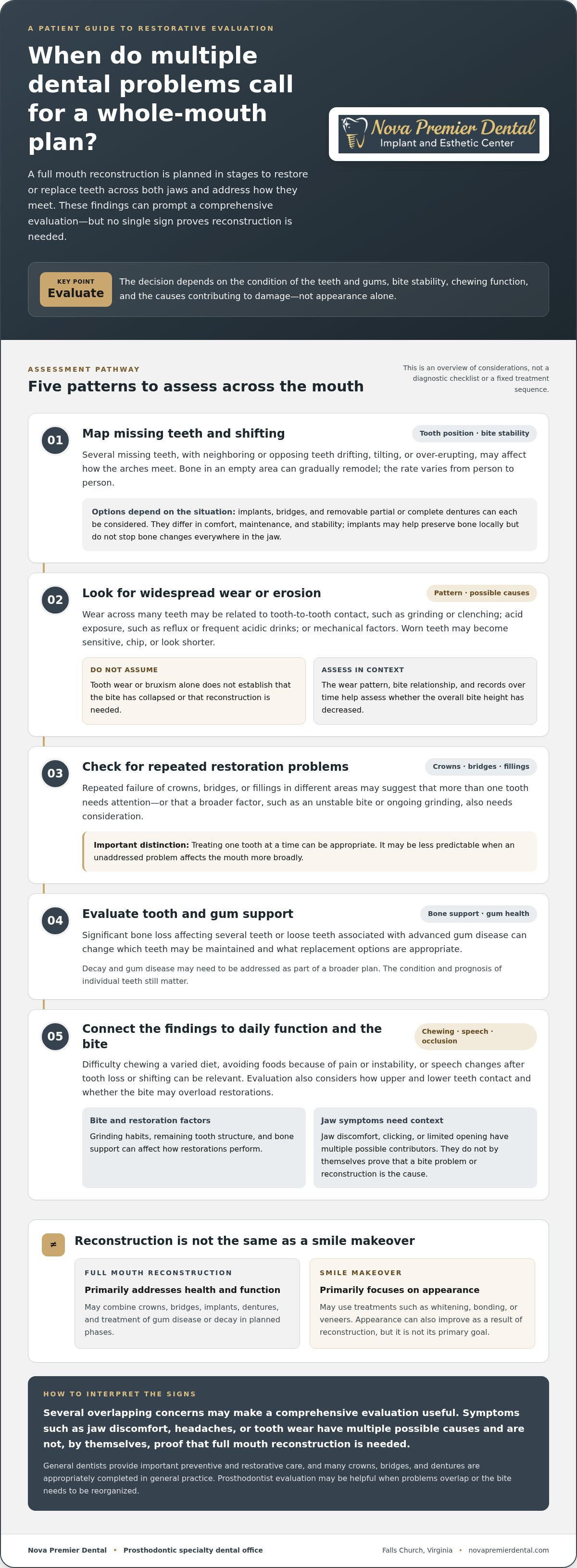
The following findings may suggest that treating teeth one at a time is no longer adequate. Whether they do depends on a clinical examination.
- Multiple missing teeth with shifting, tilting, or over-erupted neighboring teeth.
- Widespread tooth wear from acid erosion, grinding, or both.
- Repeated failure of crowns, bridges, or fillings in different areas of the mouth.
- Significant bone loss affecting the support of many teeth.
- Possible loss of vertical dimension, discussed below.
Missing Teeth and Arch Instability
When teeth are lost, neighboring and opposing teeth can drift, and the jawbone in the empty area gradually remodels and shrinks because it no longer receives stimulation from a tooth root. This does not happen at the same rate in every person. Bite forces may also shift onto the remaining teeth, which can contribute to wear or failure of existing restorations. Dental implants may help preserve bone locally and improve stability and function in appropriate candidates, but they do not stop bone changes everywhere in the jaw. Bridges and removable partial or complete dentures are also reasonable options in many situations, each with trade-offs in comfort, maintenance, and stability. A prosthodontist can review which option fits your anatomy and health.
Treating one tooth at a time is often entirely appropriate. It becomes less predictable when the underlying problem, such as an unstable bite or ongoing grinding, is spread across the whole mouth and has not been addressed.
Severe Tooth Wear and Erosion
Wear has several causes. Attrition comes from tooth-to-tooth contact, as with bruxism (grinding or clenching). Erosion is chemical loss of enamel from acid, such as from reflux, frequent acidic drinks, or vomiting. Abrasion comes from mechanical factors. Worn teeth may be sensitive, may chip, and may look shorter. For one example of acid exposure, see our page on whether sucking on lemon can dissolve teeth.
Tooth wear does not automatically mean the vertical dimension of occlusion (VDO), the overall height of the bite, has been lost. Teeth can wear while the body compensates by allowing the teeth and supporting bone to continue erupting. Likewise, bruxism does not automatically lead to a collapsed bite. Evaluation looks at the pattern of wear, the bite relationship, and records over time. Where VDO has genuinely decreased, restoring it is a planning decision made carefully and often tested first with removable or provisional restorations. Changes in facial appearance can be associated with tooth loss and wear, but they have other causes too, including aging and weight change.
Identifying and managing the cause matters as much as rebuilding the teeth. That may include treating reflux in coordination with a physician, addressing diet, or using a night guard. See our article on bruxism treatment for more information.
Biological and Functional Warning Signs
Some signs involve how the mouth functions rather than how it looks:
- Difficulty chewing a varied diet, or avoiding certain foods because of pain or instability.
- Loose teeth from advanced gum disease.
- Persistent jaw discomfort, clicking, or limited opening.
- Changes in speech after tooth loss or when teeth have shifted.
None of these signs alone establishes that a reconstruction is needed. They indicate that a comprehensive evaluation may be worthwhile.
Jaw Pain and TMJ Disorders
Temporomandibular disorders (TMDs) are multifactorial. Muscle tension, joint conditions, stress, sleep, injury, and bite factors may all contribute, and the evidence does not show that a bite discrepancy, a crown, or worn teeth inevitably causes jaw pain, headaches, or neck pain. Headaches in particular have many medical causes and should be evaluated by a physician when they are persistent. The National Institute of Dental and Craniofacial Research offers a patient overview of TMJ disorders.
Conservative care, such as self-care measures, physical therapy, and occlusal appliances, is generally the first approach. Changing the bite permanently is not routinely recommended as a treatment for TMD alone. If jaw symptoms occur together with extensive tooth damage, the evaluation can consider both. Our page on TMJ and jaw joint disorders explains how we approach assessment.
Advanced Periodontal Disease
Gum disease is treated before restorative work begins, because restorations depend on healthy supporting tissue. In advanced cases with severe attachment loss and mobility, a periodontal evaluation determines which teeth have a reasonable prognosis. Some teeth can be maintained with treatment; others may be better replaced. Replacement options include implant-supported fixed prostheses such as permanent dentures, bridges, or conventional removable dentures. Conventional dentures avoid surgery and cost less in some cases, but they can move during function, may need relining as the jaw changes, and generally provide less chewing stability than implant-supported options. Implant-supported prostheses require surgery, healing time, and lifelong cleaning, and their components and the prosthesis itself may need repair or replacement over time even when the implants remain stable.
How Is the Need for Reconstruction Evaluated?
A thorough evaluation typically includes:
- A medical and dental history, including reflux, medications, sleep, and grinding habits.
- An examination of teeth, gums, existing restorations, jaw joints, and muscles.
- Radiographs, and when needed 3D imaging such as cone-beam CT, to assess bone and tooth roots.
- Impressions or digital scans of the teeth and records of how they meet.
- A diagnostic wax-up or provisional restorations in some cases, to preview and test proposed changes before final restorations are made.
The result is a treatment sequence tailored to the individual, which may include periodontal care, extractions, implant placement, provisional restorations, and then definitive restorations. Timelines vary with healing and complexity. Our article on what full mouth reconstruction involves outlines the steps.
When to Consider a Prosthodontist Evaluation
Prosthodontics is a recognized dental specialty focused on restoring and replacing teeth. Prosthodontists complete additional residency training beyond dental school. This training can be valuable in complex situations, such as extensive wear, a need to change the bite, full-arch implant cases, or several failed restorations. It does not mean that treatment by another qualified dentist is inferior, and a second opinion can help any patient weigh options. Our comparison of prosthodontists and general dentists explains how the roles differ and overlap.
An evaluation may be helpful if:
- You have problems in several areas of the mouth rather than one tooth.
- Restorations have repeatedly broken or loosened.
- You have been told many teeth cannot be saved and are weighing fixed and removable options.
- You want another opinion before agreeing to extensive treatment.
Limitations, Maintenance, and Longevity
Reconstruction is a major undertaking with risks. Teeth prepared for crowns can develop decay or nerve problems, restorations can chip or fracture, and implants can develop peri-implant disease or lose integration. Implant survival and the longevity of crowns, bridges, and prostheses are different measures: an implant may remain in place while the porcelain, screws, or prosthesis needs repair or replacement. How long results last depends on oral hygiene, regular dental visits, grinding habits, materials, bone and gum health, and general health, so no specific duration can be promised. Many patients with grinding habits wear a custom night guard to help protect restorations.
You can see examples of completed cases in our before and after gallery, keeping in mind that each case reflects individual circumstances.
Frequently Asked Questions
Is full mouth reconstruction the same as All-on-4 dental implants?
No. All-on-4 replaces a full arch with an implant-supported prosthesis on four implants. A reconstruction may include that approach for one or both arches, but it may instead use crowns, fixed bridges, individual implants, or dentures, depending on the findings.
How long does a full mouth reconstruction take?
It varies widely. Time depends on the number of phases, whether extractions, bone grafting, or implants are needed, and healing. Some cases take several months; others take longer. A treatment plan after examination gives a more reliable estimate for your situation.
Will I be without teeth during treatment?
Provisional (temporary) restorations are generally used so that you can eat, speak, and function while final restorations are made. Their comfort and strength are more limited than final restorations, and your dentist will advise on any dietary precautions.
Does insurance cover full mouth reconstruction?
Dental plans often cover some components, such as crowns, extractions, or periodontal care, subject to annual maximums, waiting periods, and exclusions. Coverage varies by plan, so a benefits review before treatment is advisable. See our page on dental insurance and benefits. Nova Premier Dental offers in-house payment plans for qualifying patients, allowing treatment costs to be paid over several months.
Is the procedure painful?
Treatment is performed with local anesthesia, and sedation may be an option for some patients. Soreness after surgical or extensive restorative visits is common and is usually manageable with recommended medication, though experiences vary.
Can I have a reconstruction if I have bone loss?
Often, yes, but it affects the options. Depending on the amount and location of bone, treatment may involve bone grafting, implants placed in available bone, or non-implant alternatives such as removable prostheses. Imaging is needed to judge candidacy. See Am I a Candidate for Dental Implants? for more.
Why see a prosthodontist rather than a general dentist?
You do not always need to. General dentists appropriately perform many restorative procedures. A prosthodontist has additional specialty training in restoring and replacing teeth, which may be helpful for complex, multi-factor cases or when you want a second opinion.
If you have questions about a complex restorative concern, Nova Premier Dental in Falls Church provides prosthodontic specialty care for patients throughout Northern Virginia, and you can contact the office to arrange an evaluation.
Disclaimer
The information provided on this website and blog is intended for general educational and informational purposes only and should not be considered dental or medical advice, diagnosis, or treatment. Reading content on this website does not establish a doctor-patient relationship with Nova Premier Dental or Dr. Peterson Huang. Dental conditions and treatment needs vary from patient to patient. Individuals should consult directly with a qualified dental professional for personalized evaluation, diagnosis, and treatment recommendations. Do not delay seeking professional dental care based on information found on this website. While we strive to provide accurate and up-to-date information, no guarantee is made regarding the completeness, accuracy, or applicability of the content. Treatment outcomes may vary depending on individual circumstances. If you are experiencing a dental emergency or urgent oral health concern, please contact a licensed dental professional immediately or call 911 in the event of a medical emergency.


