
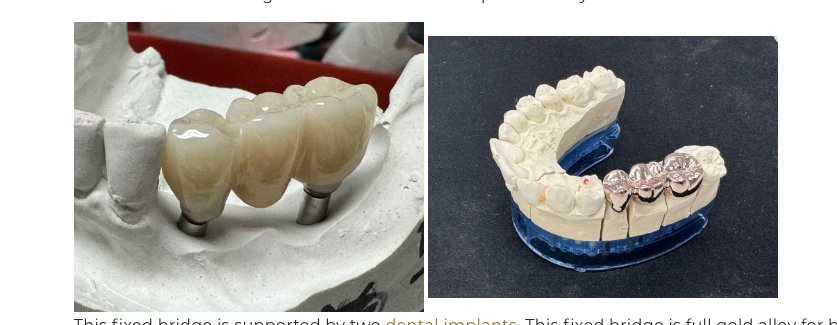

Article by
Peterson Huang DMD, MS, FACP, FRCDC
Dr. Peterson Huang is a dual board-certified prosthodontist serving Falls Church and Northern Virginia. He has been recognized as a Top Prosthodontist by Northern Virginia Magazine and Arlington Magazine and is affiliated with the Inova Fairfax Hospital Tumor Board. Dr. Huang focuses on dental implants, full mouth reconstruction, and complex restorative dentistry for patients who need advanced, comprehensive care.
The most conservative choice for tooth replacement might actually be the most invasive for your healthy teeth. While many patients gravitate toward a bridge to avoid surgery, this mechanical patch requires the permanent removal of enamel from adjacent teeth. When comparing a dental bridge vs implant, it is essential to understand that one option merely fills a space while the other restores biological function. At Nova Premier Dental, we prioritize the preservation of your natural oral structures. Dr. Huang utilizes his specialized expertise to ensure your restoration feels natural and protects your long-term health.
You may feel anxious about the clinical nature of surgery or confused by the varying costs of restorative care. This guide clarifies those differences, highlighting why dental implants maintain a 92% survival rate over twenty years according to 2026 research. You will learn how our prosthodontist in Northern Virginia uses AI-driven diagnostics and 3D printing to improve outcomes. We also explain how our in-house payment plans allow you to distribute the cost of excellence over several months, ensuring that elite reconstructive care remains within reach while you already enjoy the benefits of your new smile.
Key Takeaways
- Understand why a dental implant acts as a biological restoration that preserves bone, while a bridge serves as a mechanical patch for missing teeth.
- Learn how to protect the integrity of your adjacent healthy teeth by evaluating the structural requirements of a dental bridge vs implant.
- Discover the long-term maintenance protocols and replacement cycles that differentiate 15-year restorative solutions from lifetime dental restorations.
- Identify the specific clinical factors, such as bone density and systemic health, that determine your candidacy for advanced reconstructive procedures.
- See how a specialized prosthodontist in Falls Church optimizes functional harmony and aesthetic precision for complex cases.
The Impact of Missing Teeth and Your Restoration Options
Losing a natural tooth initiates a cascade of biological changes that extend far beyond the visible gap in your smile. Your teeth exist in a state of dynamic equilibrium, held in place by their neighbors and the opposing teeth in the opposite arch. When a tooth is removed, this balance is disrupted. Adjacent teeth often tilt or drift into the void, while the opposing tooth may begin to supra-erupt, moving out of its socket because it no longer has a surface to bite against. This movement can lead to a collapsed bite and increased difficulty in maintaining oral hygiene.
Choosing between a dental bridge vs implant requires an understanding of these two distinct restorative philosophies. A fixed bridge is a prosthetic that utilizes the healthy teeth on either side of a gap as anchors to support an artificial tooth. Conversely, a dental implant is a sophisticated titanium post that is surgically positioned into the jawbone. This post serves as a synthetic root, allowing for a stand-alone restoration that does not compromise the health of surrounding teeth. Both options aim to restore function, but their impact on your long-term oral health varies significantly.
The Consequences of Untreated Tooth Loss
Delaying treatment can lead to complex structural failures. As teeth shift, your bite alignment changes, which often places undue stress on the temporomandibular joint. This can result in chronic discomfort or TMJ disorders. Perhaps most critically, the jawbone requires the stimulation of a tooth root to maintain its volume. Research indicates that up to 50% of the ridge width of the jawbone can be lost within the first year after extraction if an implant is not placed to preserve the site. This bone resorption can eventually alter your facial structure, leading to a prematurely aged appearance.
The Role of the Prosthodontist in Modern Restoration
Managing these complex biological shifts requires the precision of a specialist. A prosthodontist undergoes years of additional clinical training beyond general dentistry to master the art of oral reconstruction. Dr. Peterson Huang is a dual board-certified specialist who focuses on achieving functional harmony through meticulous planning. By visiting a prosthodontist in Northern Virginia, you ensure that your restoration is designed with a deep understanding of occlusion, aesthetics, and long-term biological stability. Specialized training is the foundation of a restoration that lasts for decades rather than just a few years.
Dental Bridge vs Implant: A Mechanical and Biological Comparison
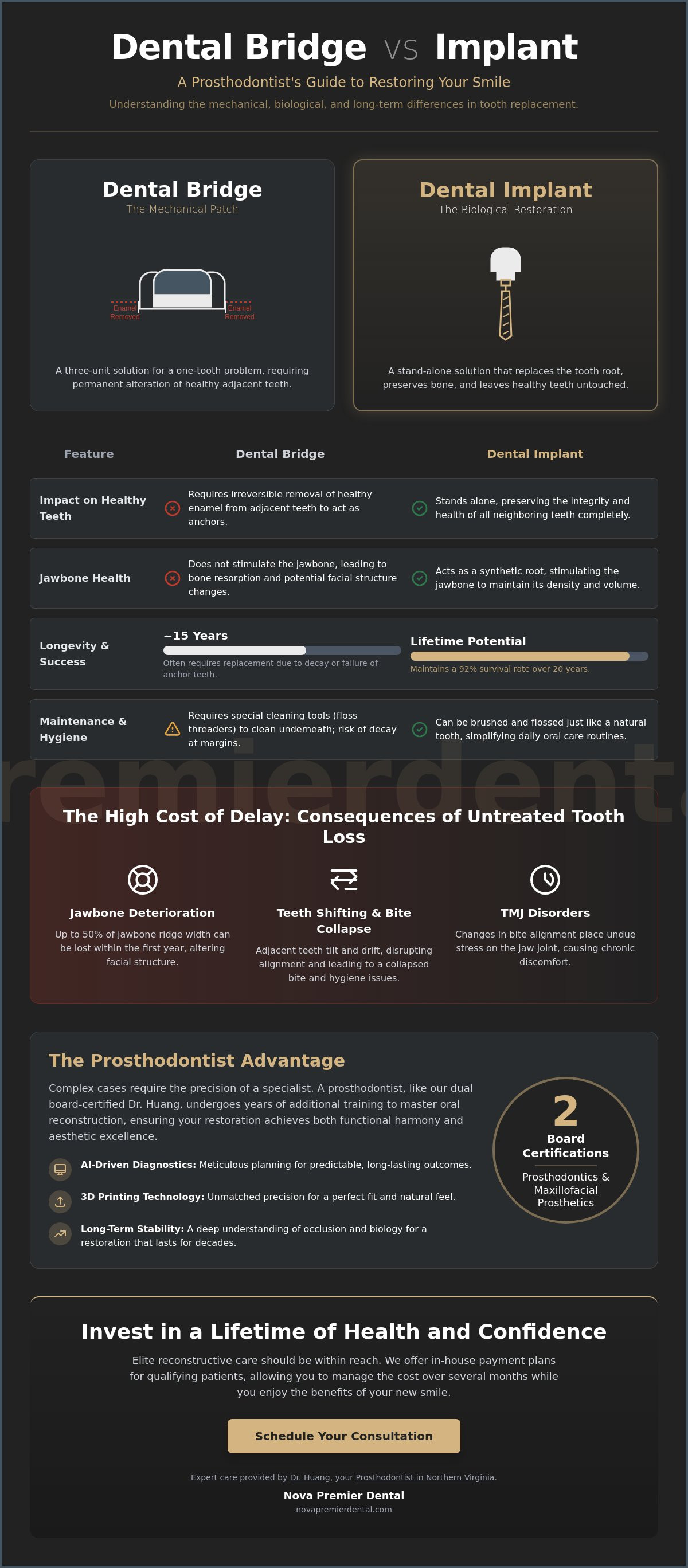
When analyzing the engineering of a dental bridge vs implant, we must consider how each prosthetic interacts with your existing anatomy. A traditional fixed bridge is essentially a three-unit solution to a one-tooth problem. It relies on the structural integrity of the teeth on either side of the gap to support the artificial replacement. In contrast, dental implants function as stand-alone restorations. They replace the entire tooth structure from root to crown, placing no mechanical burden on the remaining dentition. While a bridge can be completed in approximately two weeks, the osseointegration of an implant typically requires several months of biological healing to ensure long-term stability.
The Biological Cost: Impact on Adjacent Healthy Teeth
The most significant drawback of a bridge is the biological tax paid by neighboring teeth. To accommodate a bridge, a specialist must remove a substantial amount of healthy enamel from the adjacent abutment teeth to serve as anchors. This process is irreversible. Once the enamel is removed, these teeth are more susceptible to decay at the prosthetic margins and may eventually require root canal therapy due to the trauma of preparation. By choosing an implant, you protect the integrity of the entire arch. Because implants don't require the modification of other teeth, they represent a more conservative long-term approach to oral health. As noted in this clinical overview of the Dental Bridge vs. Implant, preserving natural tooth structure is a primary goal of modern restorative dentistry.
Functional Differences in Biting and Chewing
Functionality is where the biological design of an implant truly excels. Because an implant is fused to the jawbone, it provides a bite force nearly identical to that of a natural tooth. It also offers superior aesthetics by mimicking the emergence profile, which is the way a tooth naturally grows from the gum line. Bridges, while functional, sit on top of the gum tissue. This can sometimes lead to minor speech changes or a less natural feel during mastication. If you're concerned about how these differences might affect your daily life, Dr. Huang can provide a personalized assessment of your bite during a comprehensive exam.
Beyond the clinical outcomes, we understand that the initial investment in specialized care is a significant consideration. Our practice offers in-house payment plans for qualifying patients. This allows you to manage the cost over several months while you're already benefiting from a restoration that feels and functions like your own. This specialized care from a prosthodontist in Northern Virginia ensures that your functional beauty is restored without compromising your surrounding teeth.
Long-Term Longevity and the Real Cost of Maintenance
The financial and biological value of a dental bridge vs implant is best measured across decades rather than months. While the initial investment for a bridge may appear lower, its lifecycle is significantly shorter. Clinical data indicates that dental bridges typically last between 10 and 15 years, with 15-year survival rates ranging from 70% to 85%. In contrast, dental implants are engineered as a lifetime solution. A 2026 study in the Journal of Functional Biomaterials reported a clinical success rate of 97.83% for implants, even in complex cases. Over a 30-year period, a patient will likely replace a bridge twice, whereas an implant remains a stable, one-time restoration.
Beyond the prosthetic itself, we must address the irreversible process of bone resorption. When a tooth root is absent, the jawbone no longer receives the mechanical stimulation required to maintain its density. You can lose up to 50% of the ridge width within the first year after extraction. Because a bridge only sits on top of the tissue, it cannot stop this bone loss. Over time, this leads to a "sunken" facial appearance and a visible gap under the prosthetic. Implants are the only restoration that preserves the jawbone by mimicking the biological function of a natural root.
Durability and Failure Modes
The most common reason for bridge failure is recurrent decay at the margins of the anchor crowns. Because the abutment teeth are susceptible to bacteria, the entire structure can be compromised if a single anchor tooth develops a cavity. Implants are immune to dental decay, though they still require healthy gum support. Our practice utilizes advanced materials like high-translucency zirconia, which offers superior fracture resistance compared to traditional porcelain-fused-to-metal options. This meticulous material selection by a prosthodontist in Northern Virginia ensures your restoration withstands the daily forces of mastication.
Oral Hygiene Requirements
Maintaining a bridge requires specialized tools, such as floss threaders, to clean the area beneath the artificial tooth (the pontic). If plaque accumulates in these hard-to-reach spaces, it quickly leads to gum inflammation or decay of the supporting teeth. Implants allow for a more intuitive hygiene routine, as you can brush and floss them exactly like natural teeth. We provide comprehensive restorative dentistry guidance to help you protect your investment. To make this elite level of care accessible, Dr. Huang offers in-house payment plans. These plans allow qualifying patients to manage the cost over several months while they already enjoy the functional beauty of their new smile.
Decision Framework: Is a Bridge or an Implant Right for You?
Determining the optimal path between a dental bridge vs implant involves a meticulous clinical evaluation of your unique physiological profile. While the biological advantages of implants are clear, certain clinical realities may guide a patient toward a fixed bridge. This decision isn't merely about filling a gap. It's about ensuring the long-term stability of your entire masticatory system. For patients facing multiple missing teeth or complex bite issues, a comprehensive Full Mouth Reconstruction may be the most effective way to restore functional harmony.
Clinical Candidacy and Health Factors
Successful implant integration requires sufficient bone volume and healthy periodontal tissues. If you've experienced significant bone resorption, we may recommend a bone grafting procedure to create a stable foundation for the titanium post. Systemic health also plays a critical role in your candidacy. Conditions such as uncontrolled diabetes or certain autoimmune disorders can impede the body's ability to heal, potentially increasing the risk of implant failure. In these instances, or for patients who wish to avoid surgical intervention entirely, a bridge remains a sophisticated and reliable alternative.
A bridge might also be the more logical choice if the teeth adjacent to the gap already require crowns. If those neighbors have large existing fillings or structural compromises, "prepping" them for a bridge can solve two problems at once. Conversely, if the adjacent teeth are pristine and healthy, we strongly advocate for an implant to avoid unnecessary enamel removal.
Managing the Investment in Your Health
We understand that the upfront cost of specialized restorative care is a major consideration for our patients. While a bridge often requires a lower initial investment, it's vital to consider the total cost of ownership. Because bridges typically require replacement every seven to fifteen years, the cumulative expense often exceeds that of a single, lifelong implant. At Nova Premier Dental, we believe that financial constraints shouldn't prevent you from receiving elite medical care.
To help you prioritize your oral health, we offer in-house payment plans for qualifying patients. These plans allow you to distribute the cost of your treatment over several months. This approach ensures you can enjoy the benefits of a restored, natural-feeling smile immediately while managing the investment comfortably over time. This commitment to individualized care is why Dr. Huang is recognized as a leading specialist in restorative excellence.
If you're ready to discover which restoration best suits your biological needs, we invite you to schedule a consultation with our specialist team to receive a personalized treatment plan.
The Specialized Approach at Nova Premier Dental
Choosing between a dental bridge vs implant is a significant medical decision that requires more than a standard clinical perspective. While general dentists provide essential maintenance, a prosthodontist is a specialist dedicated specifically to the restoration and replacement of teeth. At Nova Premier Dental, our practice is built on the foundation of elite reconstructive expertise. Dr. Peterson Huang is a dual board-certified specialist who approaches every case with a meticulous eye for functional beauty. This advanced level of training ensures that your restoration isn't just a mechanical fix, but a biological integration that respects the harmony of your entire smile.
What to Expect During Your Consultation
Your journey toward a restored smile begins with a comprehensive diagnostic phase that utilizes the most advanced technology available in 2026. We use AI-driven diagnostics to analyze CBCT scans with extreme precision. This technology allows us to assess your bone density and plan the exact placement of an implant or the structural requirements of a bridge before any procedure begins. We also integrate 3D printing into our workflow, which improves the fit and speed of fabrication for custom restorations. You'll participate in a collaborative process where we discuss material choices, such as high-translucency zirconia, to ensure your prosthetic matches your natural teeth perfectly. We invite you to explore our Before and After gallery to see the transformative results we achieve for our patients.
A Legacy of Excellence in Northern Virginia
Our commitment to the Northern Virginia community is reflected in our history of clinical leadership and local awards. We don't believe in one-size-fits-all solutions. Instead, we provide personalized treatment plans that prioritize your long-term oral health and systemic well-being. Whether you require a single tooth replacement or a complex reconstruction, our goal is to deliver a result that feels natural and lasts for decades. We understand that specialized care is an investment. To ensure you can access the highest standard of treatment without delay, we offer in-house payment plans for qualifying patients. These plans allow you to distribute the cost over several months, so you can enjoy the functional benefits of your new smile while managing the payments comfortably. For a specialized second opinion on your restorative options, contact our prosthodontist in Falls Church to schedule your expert evaluation.
Restoring Your Functional Beauty with Expert Guidance
Deciding between a dental bridge vs implant is a commitment to your long-term oral health and systemic well-being. Throughout this comparison, we've explored how an implant serves as a biological replacement for a missing root, while a bridge acts as a mechanical prosthetic. Each patient’s anatomy is unique. Selecting the right path requires the meticulous diagnostic precision that only a specialist can provide. At Nova Premier Dental, we focus on preserving your healthy tooth structure while achieving functional harmony that lasts for decades.
Dr. Peterson Huang is a dual board-certified specialist dedicated to providing elite restorative care to the Northern Virginia community. We don't want financial concerns to stand in the way of your health. Our practice offers in-house payment plans for qualifying patients. These plans allow you to manage the investment over several months while you're already enjoying the benefits of your restoration. If you're ready for a natural-feeling smile, Schedule Your Specialized Consultation with Dr. Huang Today at our prosthodontist office in Falls Church. We're here to help you make an informed choice with confidence.
Frequently Asked Questions
How long does a dental bridge last compared to an implant?
A dental implant is designed to be a lifetime restoration, while a fixed bridge typically requires replacement every 10 to 15 years. Research from 2026 confirms that dental implants maintain a 20-year survival rate of approximately 92%. In contrast, the 15-year survival rate for dental bridges ranges between 70% and 85% because the anchor teeth are more susceptible to recurrent decay and structural strain over time.
Is the dental implant surgery painful?
Most patients find that the discomfort during and after implant placement is minimal and well-managed with local anesthesia. The procedure is often described as less invasive than a standard tooth extraction. We prioritize your comfort by using precise surgical techniques and offering sedation options. Any post-operative sensitivity typically resolves within a few days and is easily managed with standard over-the-counter pain relief.
Can I switch from a bridge to an implant later?
It's possible to transition from a bridge to an implant, though the process often requires bone grafting to be successful. Because a bridge doesn't stimulate the jawbone, you can lose up to 50% of the ridge width within the first year after a tooth is lost. If you've had a bridge for several years, Dr. Huang will evaluate your bone density to determine if a graft is necessary to support a new implant post.
Does insurance usually cover bridges or implants?
As of 2026, many PPO dental insurance plans cover 40% to 50% of major restorative work once your deductible is met. Most plans have an annual maximum benefit between $1,500 and $2,500. To ensure elite care is accessible, we offer in-house payment plans. These allow you to manage the remaining cost of your dental bridge vs implant over several months while you're already enjoying the benefits of your new smile.
What happens if I don’t have enough bone for an implant?
If your jawbone lacks the volume to support an implant, we can often restore the site through bone grafting or a sinus lift. We utilize AI-driven diagnostics to analyze CBCT scans, which helps us assess bone density and plan the reconstruction with high precision. These advanced techniques allow us to create a stable foundation for a successful, long-term restoration even in cases of significant bone resorption.
How do I clean a dental bridge vs. a dental implant?
Cleaning a dental bridge requires the use of floss threaders or interproximal brushes to remove plaque from beneath the artificial tooth. If bacteria accumulate in this gap, the anchor teeth can develop decay or gum disease. Dental implants are much simpler to maintain because they are cleaned exactly like natural teeth. You can brush and floss around an implant without specialized tools, making it easier to maintain your oral health.
Are there any age limits for getting dental implants?
There is no upper age limit for dental implants, provided you are in good health and have sufficient bone density to support the prosthetic. The only age restriction is that the jaw must be fully developed, which usually occurs around age 18. For many older adults in Northern Virginia, implants are the ideal solution for maintaining a high quality of life and preventing the facial collapse associated with long-term bone loss.
Why should I see a prosthodontist for my tooth replacement?
A prosthodontist in Northern Virginia has completed three years of advanced specialty training beyond dental school. This education focuses specifically on the restoration of complex oral structures and the achievement of functional harmony. By choosing Nova Premier Dental, you're entrusting your care to a specialist who uses meticulous smile design and advanced technology to ensure your restoration feels natural and lasts for decades.
Disclaimer
The information provided on this website and blog is intended for general educational and informational purposes only and should not be considered dental or medical advice, diagnosis, or treatment. Reading content on this website does not establish a doctor-patient relationship with Nova Premier Dental or Dr. Peterson Huang. Dental conditions and treatment needs vary from patient to patient. Individuals should consult directly with a qualified dental professional for personalized evaluation, diagnosis, and treatment recommendations. Do not delay seeking professional dental care based on information found on this website. While we strive to provide accurate and up-to-date information, no guarantee is made regarding the completeness, accuracy, or applicability of the content. Treatment outcomes may vary depending on individual circumstances. If you are experiencing a dental emergency or urgent oral health concern, please contact a licensed dental professional immediately or call 911 in the event of a medical emergency.


